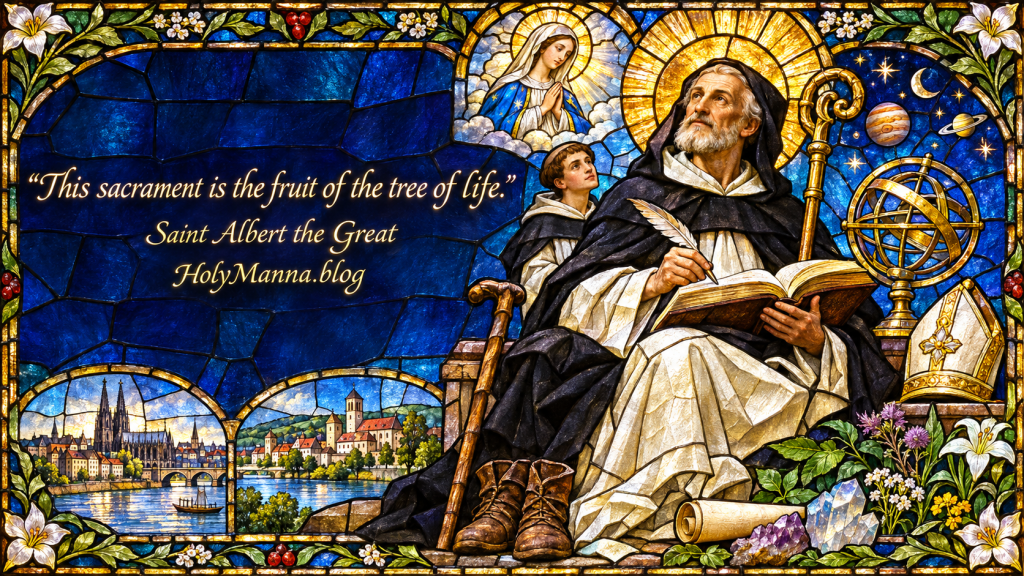
The Friar Who Read Two Books
Most saints receive their titles from later generations. Saint Albert the Great received his while he was still alive. In the thirteenth century, when Europe’s universities were young and Aristotle was arriving in Latin for the first time, a German Dominican friar read everything, questioned everything, and wrote about nearly everything, from the structure of a plant to the nature of the Trinity. His contemporaries began calling him Albertus Magnus, Albert the Great, and the name stuck for eight centuries. The Church honors him as a Doctor of the Church and as the Doctor Universalis, the Universal Teacher, because there was almost no branch of knowledge he left untouched. Pope Pius XII formally named him the heavenly patron of all who cultivate the natural sciences in 1941, and he is commonly invoked today by scientists, philosophers, medical technicians, and students.
Yet his greatness was never only intellectual. Albert was a preacher, a reluctant bishop, a peacemaker in a divided city, a defender of the mendicant orders, and the teacher who alone recognized the genius of a quiet student named Thomas Aquinas. He walked across Germany on foot well into old age, wept openly at the death of his student, and lost his brilliant memory in his final years with peace. The Catechism teaches that by canonizing some of the faithful, the Church proposes them to believers as models and intercessors, recognizing the power of the Spirit of holiness within her (CCC 828). Albert is such a model, especially for anyone who has ever wondered whether a serious love of science and a serious love of God can live together in one heart.
A Ladder Against the Wall
Albert was born in Lauingen, a town on the Danube in Swabia, in what is now Bavaria. He signed his own name as Albert of Lauingen, so the place is well established, but the date is not. The Catholic Encyclopedia places his birth around 1205 or 1206 while noting that others say 1193, and the New Catholic Encyclopedia settles on about 1200. The earliest date rests on two later sources claiming he was about eighty-seven when he died, a figure historians cannot confirm. The safest statement is that he was born around the year 1200, and that he lived to a remarkable old age for his century.
His family belonged to the knightly nobility. Older biographies call him the eldest son of the Count of Bollstädt, while modern German scholarship considers that title mistaken and places his father, Markward of Lauingen, among the lesser imperial service nobility. Either way, Albert grew up with the expectation of a lord’s life, and his early education went unrecorded. As a young man he went to Padua in northern Italy, a university town where the liberal arts flourished, and there he first encountered the writings of Aristotle that would occupy him for the rest of his life.
Padua also brought him face to face with Blessed Jordan of Saxony, the second Master General of the Order of Preachers and a famously persuasive recruiter. Pope Benedict XVI, in his catechesis of March 24th, 2010, observed that hagiographic sources describe Albert’s decision as gradual, a slow overcoming of doubts and family resistance through his relationship with God, the example of the friars, and Jordan’s preaching. Catholic sources generally date his entry into the Order to 1223, though some scholars argue for 1229. He received the habit from Jordan himself.
A story has long been told about this period of his life. The young friar Albert, discouraged that his mind seemed slower than those of his gifted classmates, resolved to abandon his vocation. He secretly set a ladder against the wall of the priory to escape, but before climbing he knelt to pray one last Hail Mary. The Blessed Virgin appeared to him, gently reproached him for never having asked her for the knowledge he longed for, and promised that he would receive learning no one would surpass. She added a warning: because these gifts came from God and not from himself, they would be taken from him before his death as a sign that his end was near. This story was cherished by Dominican writers for centuries and inspired paintings of the Virgin appearing to the young Albert. It cannot be verified by any contemporary record, and it should be received as a pious tradition rather than established history. What is beyond dispute is that Albert’s devotion to Mary was lifelong and intense; he wrote extensively in her praise, and his biographers called him the secretary and panegyrist of the Blessed Virgin.
The Teacher Who Heard an Ox Bellow
After his formation, Albert was sent to teach, and the list of his posts reads like a map of the German-speaking Church: Hildesheim, Freiburg, Regensburg, Strasbourg, and Cologne. While lecturing at Cologne on Peter Lombard’s Sentences and composing his Summa de bono, he was ordered to Paris, the greatest university in Christendom. In 1245 he became a Master of Theology there under Guerric of Saint-Quentin, the first German Dominican ever to hold that chair. In his lecture hall sat a large, silent young Italian friar named Thomas Aquinas.
Thomas’s classmates, mistaking his humility for dullness, called him the dumb ox. According to the early biographers of Saint Thomas, especially William of Tocco writing around 1320, Albert tested the young man with a difficult question, heard him answer with clarity and originality no one expected, and turned to the class with a prophecy. Albert told them that they called him a dumb ox, but that his bellowing in doctrine will one day resound throughout the world. The saying comes down through Thomas’s biographers rather than Albert’s own writings, and the exact wording varies by translation, but it is among the best attested anecdotes of medieval Dominican history, and history has thoroughly vindicated it.
In 1248 the Order sent Albert back to Cologne to found a new house of advanced studies, a studium generale, which is regarded as the seed of the University of Cologne, Germany’s oldest. He brought Thomas with him as his assistant and master of students. Benedict XVI described their bond as one of mutual esteem and friendship, and the Pope remarked that the sole merit of having been Thomas’s teacher would be enough to earn Albert profound admiration. Yet Albert was great in his own right. He set himself the staggering task of making the entire body of Aristotle’s philosophy intelligible to the Latin West. He paraphrased and commented on virtually every Aristotelian work, added the learning of the Arabic commentators, corrected the ancient philosopher where observation proved him wrong, and even created whole new sciences where Aristotle had left gaps, including the first systematic study of minerals.
What made Albert revolutionary was his insistence on looking at the world itself. In his treatise on plants he wrote that Experimentum solum certificat in talibus, which means that experiment alone gives certainty in such matters. In his work on minerals he insisted that the task of natural science is to inquire into the causes of natural things rather than simply to accept what one is told. He observed, catalogued, and compared, writing on the embryo in the egg, the habits of animals, the properties of stones, astronomy, and geography. Much of his science has naturally been superseded, but his method, patient attention to creation as a book written by God, was centuries ahead of his time.
This is why the Church sees in him more than a scholar. The Catechism teaches that the order and harmony of the created world, which man discovers progressively as the laws of nature, call forth the admiration of scholars (CCC 341). It also teaches that starting from the world’s order and beauty, one can come to a knowledge of God as the origin and end of the universe (CCC 32). Albert lived that teaching. For him, as Benedict XVI put it, there is friendship between science and faith, and the scientist who studies nature with humility walks a real path of holiness. The Catechism states the principle plainly: since the same God who reveals mysteries also gave the light of reason to the human mind, truth cannot contradict truth, and methodical research in every branch of knowledge, carried out in a truly scientific manner and without overriding moral law, can never conflict with the faith (CCC 159).
His own generation grasped how rare he was. Ulrich of Strasbourg, his student, called him the wonder and the miracle of our time. Even Roger Bacon, the English Franciscan who grumbled that Albert was being cited as an authority while still alive, conceded that he was most studious and had seen countless things. Dante placed Albert of Cologne beside Thomas among the wise in the heaven of the Sun in the Paradiso. Albert was, uniquely among the scholars of the High Middle Ages, called the Great before he died.
A Reluctant Bishop in Worn Boots
Albert’s holiness showed itself most clearly in how he handled the duties he did not want. In 1254 he was elected Provincial of Teutonia, a Dominican province stretching across Germany, Austria, and the Low Countries. Tradition says he visited its many priories entirely on foot and without money, as the Order’s rule required, earning him the affectionate nickname Boots the Bishop in later years. In 1256 he traveled to the papal court, which most sources place at Anagni though the Catholic Encyclopedia says Rome, to defend the very existence of the mendicant orders against William of Saint-Amour, who had attacked the friars’ way of life. Pope Alexander IV condemned William’s book, and Albert stayed on for a time as Master of the Sacred Palace, the Pope’s own theologian. He resigned the provincialate in 1257 to return to his books.
The books did not keep him long. In 1252 and again in 1258, the citizens of Cologne and their powerful Archbishop, Konrad von Hochstaden, were locked in a bitter struggle over who truly governed the city. Both sides trusted Albert to arbitrate. His 1258 settlement, remembered in German history as the Great Arbitration, ended the conflict and is still studied by legal historians. The Catechism describes peace as the tranquillity of order, the work of justice and the effect of charity (CCC 2304). Albert, the man of the library, became the man the city called when it needed peace.
Then in 1260 Pope Alexander IV named him Bishop of Regensburg, a diocese in disorder. Albert did not want the office. The Dominican Master General, Blessed Humbert of Romans, pleaded with the Pope not to take Albert from his studies, and Albert himself resisted. He obeyed. For two years he governed the troubled diocese, restoring peace and discipline, reorganizing parishes and religious houses, and renewing its works of charity, as Benedict XVI summarized. He refused to ride, walking his large diocese in the worn boots of a friar. In 1262 he received permission to resign, though a few sources give 1263, and he returned to the cloister with relief. Pope Urban IV promptly gave him another task: to preach the Crusade throughout Germany and Bohemia in 1263 and 1264. Albert did it, and then went home to Cologne to teach.
Albert was never martyred, but his later years held sorrows that tested him deeply. In 1270 he sent a treatise to Paris to help Thomas fight the Averroists who denied the individual immortal soul. In 1274 Pope Gregory X summoned the aging friar to the Second Council of Lyons, called to heal the schism between the Latin and Greek Churches. On the road Albert learned that Thomas had died at Fossanova on his way to the same council. Tradition records that he cried out that the light of the Church had been extinguished, and that for the rest of his life he could not hear Thomas’s name without tears. The sorrow was not finished. In 1277 the Bishop of Paris, Stephen Tempier, issued condemnations that struck at some of Thomas’s positions. Albert, now well past seventy, made the long journey to Paris to defend the teaching and the memory of his student. The old master stood up for the dead disciple, and in time the Church vindicated them both.
The last trial was the hardest. In 1278 Albert drew up his will, and in that same year his memory began to fail. The Catholic Encyclopedia records plainly that his mind gradually clouded and his body, worn by fasting, vigils, and labor, gave way to age. Dominican tradition connects this decline to the promise of Our Lady told in the story of his youth, and some accounts place the first failure in the middle of a public lecture, which Albert recognized as the sign of his approaching death. These details cannot be verified, and the claim in a few retellings that the lecture took place in Paris conflicts with the fact that he was living in Cologne in 1278. What is certain is that the most learned man in Europe spent his final two years in simplicity, prayer, and dependence on his brothers. The Catechism observes that illness and suffering can make a person more mature, helping him discern what is not essential so that he can turn toward that which is (CCC 1501). Albert, who had desired everything for the glory of God, was now stripped of everything but God. He died peacefully in the Dominican priory of Holy Cross in Cologne on November 15th, 1280. A tradition says he died seated in his chair, clothed in his habit, while the friars gathered around him and sang the Salve Regina. That scene cannot be verified, but it is how his brothers chose to remember him.
A Tomb in Cologne and a Crown Six Centuries Late
Veneration of Albert began almost immediately at his tomb in the Dominican church of Holy Cross in Cologne. Several encyclopedias note that the tomb soon acquired a reputation for miracles, and the steady flow of the faithful to it led Pope Innocent VIII in 1484 to permit the Dominican priories of Cologne and Regensburg to celebrate his Mass and Office. A story is reported that when his grave was first opened, about three years after his death, his body was found incorrupt, and that when it was opened again in 1483, in the presence of the Master General of the Order, only his bones remained and were placed in a more worthy tomb. This account appears in several Catholic compilations, but no contemporary documentation of it has been found, and it cannot be verified.
Specific, documented accounts of individual healings through Albert’s intercession are scarce in the reliable sources, and honesty requires saying so. When Pope Pius XI canonized Albert on December 16th, 1931, he did so by papal decree, through the document In Thesauris Sapientiae, in what the Church calls an equipollent or equivalent canonization. Because of the antiquity and constancy of Albert’s cult and the overwhelming witness of his writings and virtues, the Pope dispensed with the ordinary process and its formally investigated miracles, declaring him a saint of the universal Church and, in the same act, a Doctor of the Church. Pius XI called him exactly the saint whose example should inspire this modern age, an age that longed for peace and placed its hope in scientific discovery. Germany had petitioned for this since 1872, and the Cologne celebrations the following year drew some thirty thousand people to the cathedral. Ten years later, on December 16th, 1941, in the darkest days of a world war, Pope Pius XII issued the decree Ad Deum naming Albert the heavenly patron of all who devote themselves to the natural sciences. The Catechism reminds the faithful that the saints in heaven do not cease to intercede with the Father for us (CCC 956), and scientists across the world have taken Albert as their intercessor ever since.
His relics tell a story of their own. When the French Revolution’s armies secularized the Rhineland and the church of Holy Cross was suppressed and later demolished, Albert’s remains were carried to the nearby Romanesque church of Saint Andreas, one of the twelve great Romanesque churches of Cologne. When his tomb was opened for that transfer, his bones were found wrapped in a set of medieval Mass vestments, a blue silk chasuble with gold embroidery and a stole and maniple bearing images of Christ and the saints, which some scholars believe may date from Albert’s own lifetime. They are preserved in the sacristy of Saint Andreas today. Since November 15th, 1954, his relics have rested in a third-century Roman sarcophagus in the crypt of that church, which the Dominicans have served since 1947. Smaller relics are honored at Cologne Cathedral and in Regensburg.
The shrine has drawn popes. On November 15th, 1980, the seven hundredth anniversary of Albert’s death, Pope Saint John Paul II began his first pastoral visit to Germany in Cologne. He prayed at the sarcophagus in Saint Andreas, celebrated a solemn liturgy in Albert’s honor, and addressed the scientists and university students of Germany in Cologne Cathedral, telling them that remembering Albert must not be just an act of due piety but a summons to recover his synthesis of faith and reason for the questions of the present day. Thirty years later Benedict XVI devoted an entire general audience to him. Albert’s own words supply the key to all of it. Benedict quoted what he called Albert’s formula of holiness: to desire all that I desire for the glory of God, just as God desires for his glory all that he desires.
Albert’s cultural footprint is enormous. Lauingen keeps his statue in its square and celebrates him each November. The University of Cologne honors him with a monument. The Albertus-Magnus-Institut in Bonn, founded in the year of his canonization, has labored for nearly a century on the critical edition of his works, a project so vast that the 1890s Paris edition alone filled thirty-eight volumes. Parishes, schools, Newman centers, and Dominican provinces across the world bear his name, and an asteroid, 20006 Albertus Magnus, circles the sun in his honor. His fame as a student of nature also spawned later stories, far from Catholic in origin, that he had been an alchemist or magician who built a talking brass head that Thomas destroyed in fright. These tales cannot be verified, and the Catholic Encyclopedia notes that Albert himself rejected enchantment and the magical arts, in keeping with the Church’s constant teaching that all practices of magic or sorcery are gravely contrary to the virtue of religion (CCC 2117).
What Albert Teaches a Restless Generation
Albert the Great speaks with surprising directness to anyone who has been told to choose between being thoughtful and being faithful. He refused that choice. He read the book of Scripture and the book of creation with the same reverence, because he knew both came from the same Author. The Catechism echoes him when it teaches that science and technology are precious resources when placed at the service of man and that they must be ordered to the true good of the person (CCC 2293). Where have you been told that your intelligence and your faith cannot share the same room? Albert’s answer was to study harder and pray harder, and to let each strengthen the other.
He also teaches the humility of a great mind. The man his century called a miracle walked everywhere on foot, obeyed superiors who sent him to jobs he did not want, and never stopped saying that his gifts were not his own. The Catechism teaches that humility is the foundation of prayer (CCC 2559). The tradition of Our Lady’s promise, whether or not it happened exactly as told, captures a truth Albert certainly lived: he held his brilliance with open hands, and when God took it back at the end, he did not grasp. What gifts do you hold as though they belonged to you alone, and what would it look like to hold them with open hands this week?
Albert teaches teachers. He saw in a silent, overweight, mocked young man the greatest theologian the Church would ever produce, and he spent his old age defending that student’s memory when it would have been easier to stay quiet in Cologne. Every mentor, parent, coach, and manager can ask: Who in your life is being underestimated right now, and what would it cost you to believe in them out loud?
He teaches peacemaking. The scholar who would rather have been reading was the one both sides of a bitter dispute trusted to be fair. Fairness is a habit of looking honestly at every side of a question, which Albert had practiced for decades in the lecture hall before he practiced it in a city. Is there a conflict in your family, parish, or workplace where you could be the one person everyone trusts to tell the truth?
Finally, he teaches how to grow old and how to lose. His last two years were a slow surrender of the very faculty that had made him famous. He did not rage; he prayed. The Catechism teaches that the way of perfection passes by way of the Cross, and that there is no holiness without renunciation (CCC 2015). For a generation terrified of decline and obsessed with productivity, Albert’s quiet final chapter is almost scandalous in its peace. When you imagine losing the thing you are best at, can you imagine God being enough?
A few practical steps follow naturally. Spend ten minutes this week outdoors paying real attention to one created thing and end by thanking God for it. Read one chapter of Scripture slowly and ask what it says about the One who made what you just observed. Pray for a scientist, doctor, or student you know, and ask Saint Albert to intercede for them. Encourage one person who is being overlooked. And when you fail at something, offer it to God as Albert offered his failing memory.
Engage With Us!
Saint Albert the Great reminds believers that the laboratory and the chapel are not rivals, that the greatest minds are the humblest, and that every gift a person holds is on loan for the glory of God. HolyManna would love to hear how his story speaks to you. Please share your thoughts and reflections in the comments below, and consider the following questions:
- Albert believed that truth cannot contradict truth. Where have you experienced tension between your faith and what you have learned, and how did you work through it?
- Albert recognized genius in a student everyone else mocked. Who first believed in you before you believed in yourself, and have you ever thanked them?
- Albert obeyed when he was sent to be a bishop he did not want to be. When has obedience to a duty you did not choose turned out to be a path of grace?
- The tradition of Our Lady’s promise says Albert’s gifts would be taken away before his death. How would you want to respond if God asked you to surrender your greatest talent?
- Albert walked everywhere on foot even as a bishop. What small, concrete practice of humility could you adopt this month?
Whatever your work, whether in a lab, a classroom, an office, a kitchen, or a hospital, do it as Albert did, with your eyes open to the wonder of creation and your heart fixed on its Creator. Learn generously, teach patiently, make peace where you can, and hold every gift with open hands. Live your faith boldly and do everything with the love and mercy that Jesus taught us.
Saint Albert the Great, pray for us!
Follow us on YouTube, TikTok, Instagram and Facebook for more insights and reflections on living a faith-filled life.


Leave a Reply