Thirty-third Sunday in Ordinary Time – Lectionary: 157
Two Kinds of Fear and One Returning Master
Somewhere in nearly every life there is a gift sitting in a drawer, still in the box, because using it felt too risky.
The readings for the Thirty-third Sunday in Ordinary Time, November 15th, 2026, put two kinds of fear side by side and ask which one is running the house. Proverbs 31 praises the woman who fears the LORD, and her fear looks like busy hands, a spindle, and arms stretched toward the poor. Psalm 128 blesses those who fear the Lord, and the blessing looks like a table full of children and the fruit of one’s own work. Then the Gospel introduces a servant who says “out of fear I went off and buried your talent in the ground.” Same word, opposite result. One fear rolls up its sleeves. The other digs a hole.
The Church places these readings on the second to last Sunday of the liturgical year on purpose. November belongs to the Last Things, and Year A spends these final weeks inside the great discourse of Matthew 24 and 25, the teaching Jesus gave on the Mount of Olives only days before His Passion. Last Sunday brought the ten virgins and the call to be ready. Today brings the talents and the call to be fruitful. Next Sunday, the Solemnity of Christ the King, brings the sheep and the goats and the call to mercy. Readiness, fruitfulness, and mercy form one movement.
Saint Paul’s letter, probably the oldest writing in the New Testament, supplies the posture for all of it: “let us stay alert and sober.” The Master has gone on a journey. He has left real treasure in ordinary hands. He is coming back. Everything in these readings turns on what happens in between.
First Reading — Proverbs 31:10-13, 19-20, 30-31
When Wisdom Puts On Work Clothes
The Book of Proverbs opens with Lady Wisdom calling out in the streets and the city gates, begging anyone who will listen to come learn from her. It closes with wisdom in a house, running a household, buying wool and flax, feeding the poor. The abstract has become a person, and the person has become a wife and mother with calloused hands. In Hebrew the poem is an acrostic of 22 lines, one for each letter of the alphabet, as if this woman were the complete alphabet of a wise life. The Hebrew calls her eshet chayil, a woman of valor, using a word normally reserved for soldiers, and the Vulgate followed with mulier fortis, the valiant woman. A tradition still alive in Jewish homes has the husband sing this poem to his wife at the Sabbath table on Friday evening.
The Church has long read her on two levels. Literally she is the ideal wife, which is why the lectionary pairs her with Psalm 128. Spiritually, commentators such as Saint Bede the Venerable in On the Valiant Woman and Saint Albert the Great saw in her the Church, the Bride of Christ, trading faithfully with everything her Bridegroom entrusted to her while He is away. That is exactly why she belongs next to the parable of the talents. She is the servant who did not bury anything.
Proverbs 31:10-13, 19-20, 30-31
When one finds a worthy wife,
her value is far beyond pearls.
Her husband, entrusting his heart to her,
has an unfailing prize.
She brings him good, and not evil,
all the days of her life.
She obtains wool and flax
and works with loving hands.
She puts her hands to the distaff,
and her fingers ply the spindle.
She reaches out her hands to the poor,
and extends her arms to the needy.
Charm is deceptive and beauty fleeting;
the woman who fears the LORD is to be praised.
Give her a reward for her labors,
and let her works praise her at the city gates.
Detailed Exegesis
Verse 10: “When one finds a worthy wife, her value is far beyond pearls.”
The Hebrew opens with a question, “Who can find?”, and the answer is that such a woman is a discovery, not a purchase. The same book has already said that wisdom is “more precious than corals” in Proverbs 3:15, so the reader is meant to hear the echo. To find this woman is to find wisdom living under one’s own roof.
Verse 11: “Her husband, entrusting his heart to her, has an unfailing prize.”
The verb for entrusting, batach, is the word the Psalms use for trusting in God, and Scripture almost never applies it to a human being. The “prize” is literally spoil, what a warrior brings home from battle. Her campaigns are fought at the loom and the market, and her husband never comes home to an empty house. The Gospel will open with a master who likewise “entrusted his possessions” to his servants.
Verse 12: “She brings him good, and not evil, all the days of her life.”
Her goodness is not a mood or a season. “All the days of her life” is covenant language, the same steadiness the Gospel praises when the master returns “after a long time” and finds his servants still at work.
Verse 13: “She obtains wool and flax and works with loving hands.”
The Hebrew says she works “with the delight of her hands.” She is not grinding through drudgery. She has found joy inside the work itself, which is what the Church means when it says labor can be a participation in God’s own creative act.
Verse 19: “She puts her hands to the distaff, and her fingers ply the spindle.”
A distaff holds the raw fiber; a spindle twists it into thread. These are the humblest tools in the house, and nobody applauds the thread. This is the poem’s quiet insistence that holiness is mostly hidden and repetitive, a comfort to anyone whose vocation involves a lot of laundry.
Verse 20: “She reaches out her hands to the poor, and extends her arms to the needy.”
Notice the hands again. The same hands that spun the thread now open toward the poor. The poem moves directly from productivity to generosity because, in biblical wisdom, the whole point of making is giving. Work that never becomes charity has stopped halfway.
Verse 30: “Charm is deceptive and beauty fleeting; the woman who fears the LORD is to be praised.”
Here the poem names its engine. Everything she has done flows from fear of the LORD, not dread of punishment but the reverence that keeps God at the center. The book began with the thesis that “Fear of the LORD is the beginning of knowledge” in Proverbs 1:7, and it ends by showing that fear in a human life. Charm and beauty are simply ranked, not condemned.
Verse 31: “Give her a reward for her labors, and let her works praise her at the city gates.”
The city gates were courthouse, marketplace, and town square at once, where the elders sat in judgment. Her defense is her deeds. The Gospel’s master will say almost the same thing in different words: “Well done, my good and faithful servant.”
Teachings
The Church counts fear of the Lord among the seven gifts of the Holy Spirit, which means it is something God pours in, not something a person manufactures. CCC 1831 teaches: “The seven gifts of the Holy Spirit are wisdom, understanding, counsel, fortitude, knowledge, piety, and fear of the Lord. They belong in their fullness to Christ, Son of David. They complete and perfect the virtues of those who receive them. They make the faithful docile in readily obeying divine inspirations.” The valiant woman is docile in exactly this sense.
Her joyful labor also illustrates the Church’s theology of work. CCC 2427 states: “Human work proceeds directly from persons created in the image of God and called to prolong the work of creation by subduing the earth, both with and for one another. Hence work is a duty: ‘If any one will not work, let him not eat.’ Work honors the Creator’s gifts and the talents received from him. It can also be redemptive.” The phrase “the talents received from him” is the Catechism’s own bridge to today’s Gospel.
CCC 1605 explains why the husband can entrust his heart: “Holy Scripture affirms that man and woman were created for one another: ‘It is not good that the man should be alone.’ The woman, ‘flesh of his flesh,’ his equal, his nearest in all things, is given to him by God as a ‘helpmate’; she thus represents God from whom comes our help.” When Saint Bede and Saint Albert read the valiant woman as the Church, they were extending this same logic: the Bride is the one through whom Christ’s help reaches the world.
Reflection
The valiant woman is not a standard to be intimidated by. She is a picture of what happens when reverence for God shapes ordinary Tuesday afternoons. Her holiness has no stage, only a spindle.
Start small this week. Pick one repetitive task you normally resent and do it deliberately for God, with what the Hebrew calls the delight of the hands. Then let the work become giving: set aside a portion of whatever you produce, whether money, time, or a cooked meal, for someone who has less.
Where in your life has charm or image been doing the work that only the fear of the Lord can do? Who has entrusted their heart to you, and do they come home to an unfailing prize? What hidden, repetitive work in your week could become an act of worship if you let it?
Responsorial Psalm — Psalm 128:1-5
The Blessing That Sits Down to Dinner
Psalm 128 belongs to the Songs of Ascents, the fifteen pilgrim psalms from Psalm 120 through Psalm 134 sung by families walking up to Jerusalem for the great feasts. It is short enough to memorize on the road and homely enough to sing at a kitchen table. Like Proverbs 31, it is a wisdom text, and it opens with the Bible’s favorite word for a life that has gone right: blessed. The Church still sings it at weddings, which is fitting, because it describes a household where fear of the Lord has produced fruit you can see.
The psalm answers a question left hanging by the first reading. Proverbs described the woman who fears the LORD. The psalm describes what her home looks like from the husband’s chair. It also anticipates the Gospel, because the blessing of eating the fruit of one’s own handiwork is precisely what the faithful servants receive when the master returns. The psalm’s promises also reach well beyond one household: Saint Augustine heard in every line the voice of Christ and His Bride, the Church.
Psalm 128:1-5
R. (cf. 1a) Blessed are those who fear the Lord.
Blessed are you who fear the LORD,
who walk in his ways!
For you shall eat the fruit of your handiwork;
blessed shall you be, and favored.
R. Blessed are those who fear the Lord.
Your wife shall be like a fruitful vine
in the recesses of your home;
Your children like olive plants
around your table.
R. Blessed are those who fear the Lord.
Behold, thus is the man blessed
who fears the LORD.
The LORD bless you from Zion:
may you see the prosperity of Jerusalem
all the days of your life.
R. Blessed are those who fear the Lord.
Detailed Exegesis
Verse 1: “Blessed are you who fear the LORD, who walk in his ways!”
Fear and walking belong together. Fear is the interior disposition; walking is the exterior conduct. The psalm refuses to separate reverence from behavior, which is the same refusal Saint Paul will make when he says children of the day must not sleep.
Verse 2: “For you shall eat the fruit of your handiwork; blessed shall you be, and favored.”
In the ancient world this was not a given. The curses of Deuteronomy 28 describe planting a vineyard and watching someone else drink the wine. To eat what one has grown is to live under blessing rather than curse. The Gospel’s good servants know this joy; the servant who buried his talent produced nothing to eat.
Verse 3: “Your wife shall be like a fruitful vine in the recesses of your home; your children like olive plants around your table.”
The vine and the olive were the two defining crops of Israel, and both are slow. A vine takes years to bear; an olive tree takes decades. The image is one of patient fruitfulness, not quick results. Olive shoots sprout from the roots of the parent tree, so the children literally grow out of the parents’ own life. The “recesses of the home” are the inner rooms, the private heart of the house where the real fruit is borne.
Verse 4: “Behold, thus is the man blessed who fears the LORD.”
The word “thus” gathers everything that came before. Blessing is not a feeling. It is a table with people around it. Saint Augustine noticed that the psalm speaks of one man and heard in it the one Christ in whom the many are blessed.
Verse 5: “The LORD bless you from Zion: may you see the prosperity of Jerusalem all the days of your life.”
The blessing widens from the household to the holy city. No family flourishes in isolation; the home is blessed from Zion and for Zion. The phrase “all the days of your life” closes the circle with Proverbs, where the valiant woman does good all the days of her life.
Teachings
Saint Augustine preached on this psalm on the feast of Saint Felix the Martyr and spent most of the sermon on the words “Your wife.” He wrote: “it is said to Christ. His wife, therefore, is the Church: His Church, His wife, we ourselves are.” For Augustine the fruitful vine is the Church, the children around the table are the faithful gathered at the altar, and the fear that begins the psalm must be a particular kind of fear: “let us fear the Lord with a chaste fear, with a fear that abides forever.” Chaste fear is the fear of losing the Beloved, not the fear of being punished. It is the fear of the valiant woman, not the fear of the third servant.
Augustine also saw that eating the fruit of one’s handiwork is partly a promise for later: “But there is a difference between hope and attainment. If hope be so sweet, how much sweeter will reality be?” And on the final verse he wrote: “If your life be for ever, you will see the good things of Jerusalem for evermore.”
The Catechism keeps the literal sense in view as well. CCC 2373 teaches: “Sacred Scripture and the Church’s traditional practice see in large families a sign of God’s blessing and the parents’ generosity.” And CCC 1657 describes the home the psalm pictures: “Thus the home is the first school of Christian life and ‘a school for human enrichment.’” It is in that school, the Catechism continues, that a person learns endurance, the joy of work, fraternal love, repeated forgiveness, and above all the worship of God.
Reflection
This psalm is an invitation to look at your own table. The people around it, however few or many, are the olive shoots God has planted in your life, and olive trees grow slowly.
Pray this psalm aloud at dinner this week. Thank God for the fruit of your own handiwork before you eat it. If you are single, pray it for the household you came from and the one you hope to build, or for your parish, which is also a table with children around it.
Do you experience your daily work as something you get to eat the fruit of, or as something that always feeds someone else? Where is God asking you for the patience of an olive tree?
Second Reading — 1 Thessalonians 5:1-6
Awake in the Dark and Dressed for the Day
Thessalonica was the capital of Roman Macedonia, a port city on the Via Egnatia, the great highway linking Rome to the East. Saint Paul arrived around the year 49 or 50, preached for only a few weeks, and was driven out by a riot, as Acts 17 records. He wrote this letter from Corinth not long afterward, around AD 50 or 51, which makes it very likely the oldest document in the entire New Testament. The community was young, persecuted, and anxious. Some members had already died, and the survivors wondered whether their dead would miss the Lord’s return. Paul answered that question in chapter 4. Chapter 5 answers the next one: when?
Paul’s answer is that the when is not the point. The how is the point. The day of the Lord, a phrase the prophets Amos, Joel, and Zephaniah used for God’s decisive intervention in history, will arrive without an appointment. What matters is whether the people it finds are asleep or awake. This is the hinge of the whole Sunday. The valiant woman’s hands, the psalm’s fruitful table, and the Gospel’s trading servants all describe what being awake looks like.
1 Thessalonians 5:1-6
Concerning times and seasons, brothers and sisters,
you have no need for anything to be written to you.
For you yourselves know very well that the day of the Lord will come
like a thief at night.
When people are saying, “Peace and security, “
then sudden disaster comes upon them,
like labor pains upon a pregnant woman,
and they will not escape.But you, brothers and sisters, are not in darkness,
for that day to overtake you like a thief.
For all of you are children of the light
and children of the day.
We are not of the night or of darkness.
Therefore, let us not sleep as the rest do,
but let us stay alert and sober.
Detailed Exegesis
Verse 1: “Concerning times and seasons, brothers and sisters, you have no need for anything to be written to you.”
Paul gently refuses to produce a calendar. The Thessalonians already know what they need to know, because Jesus Himself taught that no one knows the day or the hour. Curiosity about dates is a distraction from readiness.
Verse 2: “For you yourselves know very well that the day of the Lord will come like a thief at night.”
The image comes straight from Jesus in Matthew 24:43. A thief does not send a notice. Saint John Chrysostom asked why God would leave the day hidden and answered: “On this account He so comes as a thief in the night; that we may not abandon ourselves to wickedness, nor to sloth; that He may not take from us our reward.” The hiddenness is a mercy. It keeps the servants working.
Verse 3: “When people are saying, ‘Peace and security,’ then sudden disaster comes upon them, like labor pains upon a pregnant woman, and they will not escape.”
Many commentators hear in “peace and security” an echo of the slogans of the Roman Empire, which promised exactly those two things to anyone who stayed in line. Paul is saying that no empire can deliver what only God can. The labor pains image is deliberately double. The pain is sudden and unavoidable, but it also means something is being born.
Verse 4: “But you, brothers and sisters, are not in darkness, for that day to overtake you like a thief.”
The thief only surprises people in the dark. For those who are awake and lit, the same arrival is not a break-in but a homecoming. The day of the Lord is only a threat to those who have made themselves strangers to the Lord.
Verse 5: “For all of you are children of the light and children of the day. We are not of the night or of darkness.”
Baptism has already made the Thessalonians children of light. Paul is not telling them to become something; he is telling them to live as what they already are. Chrysostom put it simply: children of the day are “those who do the works of light.”
Verse 6: “Therefore, let us not sleep as the rest do, but let us stay alert and sober.”
Chrysostom drew the practical conclusion: “Here he shows, that to be in the day depends on ourselves.” Being spiritually awake is a choice, renewed daily. He added a line that lands squarely on the third servant of today’s Gospel: “it is possible to sleep while awake, by doing nothing good.”
Teachings
The Church has never stopped expecting the day of the Lord. CCC 673 teaches: “Since the Ascension Christ’s coming in glory has been imminent, even though ‘it is not for you to know times or seasons which the Father has fixed by his own authority.’ This eschatological coming could be accomplished at any moment, even if both it and the final trial that will precede it are ‘delayed.’”
The Catechism ties this expectation directly to prayer. CCC 2612 states: “In Jesus ‘the Kingdom of God is at hand.’ He calls his hearers to conversion and faith, but also to watchfulness. In prayer the disciple keeps watch, attentive to Him Who Is and Him Who Is Coming, in memory of his first coming in the lowliness of the flesh, and in the hope of his second coming in glory.”
And in its commentary on the last petition of the Our Father, the Catechism quotes the very image Paul uses. CCC 2849 teaches: “Vigilance is ‘custody of the heart,’ and Jesus prayed for us to the Father: ‘Keep them in your name.’ The Holy Spirit constantly seeks to awaken us to keep watch. Finally, this petition takes on all its dramatic meaning in relation to the last temptation of our earthly battle; it asks for final perseverance. ‘Lo, I am coming like a thief! Blessed is he who is awake.’” Chrysostom’s observation about sleeping while awake explains why this vigilance is not about anxiety but about activity. The person who is doing good is, by definition, awake.
Reflection
Spiritual sleep rarely feels like sleep. It feels like being busy, distracted, comfortable, and vaguely sure there will be time later. Paul’s word for the cure is sober, which means seeing things as they actually are.
This week, choose one concrete way to stay awake. Make a good examination of conscience before bed. Get to Confession if it has been a while. Put the phone down for the last hour of the day and pray instead. These are not dramatic measures; they are what children of the day do.
If the Lord came tonight, what would He find you in the middle of? Where have you been saying “peace and security” to yourself about something that needs attention? What would it look like to be alert without being anxious?
Holy Gospel — Matthew 25:14-30
The Master’s Joy Is the Whole Point
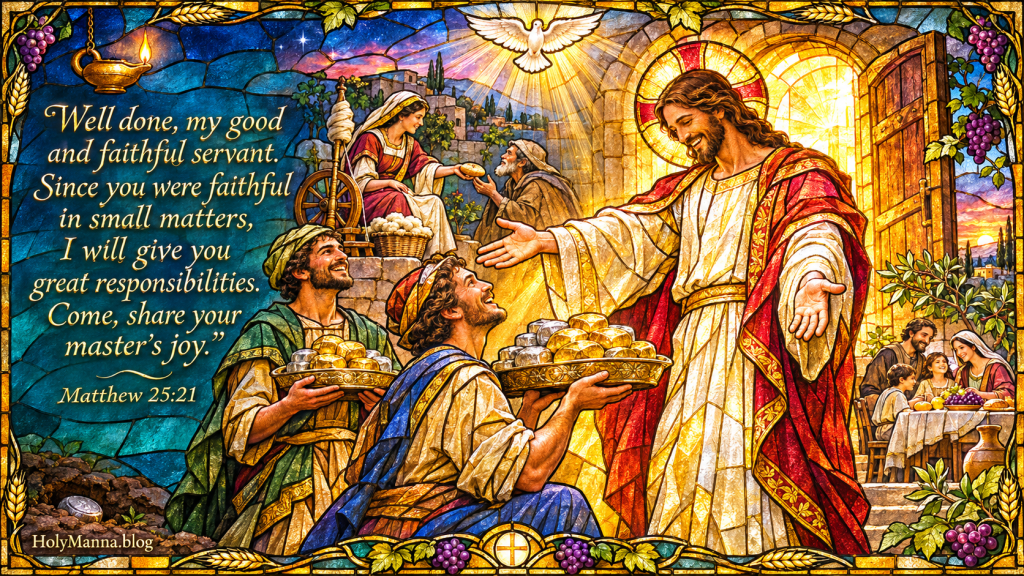
Jesus told this parable on the Mount of Olives, within days of His arrest, between the ten virgins, judged on readiness, and the sheep and the goats, judged on mercy. The talents are the hinge: being ready means being busy with what the Master left behind. A talent was roughly 75 pounds of silver, nearly 20 years of a laborer’s wages, so even the servant who received the least was handed a fortune. The English word “talent” comes from this parable, but Jesus meant more than aptitude. Benedict XVI put it plainly: “The man in the parable represents Christ himself, the servants are the disciples and the talents are the gifts that Jesus entrusts to them.”
Matthew 25:14-30
Jesus told his disciples this parable:
“A man going on a journey
called in his servants and entrusted his possessions to them.
To one he gave five talents; to another, two; to a third, one–
to each according to his ability.
Then he went away.
Immediately the one who received five talents went and traded with them,
and made another five.
Likewise, the one who received two made another two.
But the man who received one went off and dug a hole in the ground
and buried his master’s money.“After a long time
the master of those servants came back
and settled accounts with them.
The one who had received five talents came forward
bringing the additional five.
He said, ‘Master, you gave me five talents.
See, I have made five more.’
His master said to him, ‘Well done, my good and faithful servant.
Since you were faithful in small matters,
I will give you great responsibilities.
Come, share your master’s joy.’
Then the one who had received two talents also came forward and said,
‘Master, you gave me two talents.
See, I have made two more.’
His master said to him, ‘Well done, my good and faithful servant.
Since you were faithful in small matters,
I will give you great responsibilities.
Come, share your master’s joy.’
Then the one who had received the one talent came forward and said,
‘Master, I knew you were a demanding person,
harvesting where you did not plant
and gathering where you did not scatter;
so out of fear I went off and buried your talent in the ground.
Here it is back.’
His master said to him in reply, ‘You wicked, lazy servant!
So you knew that I harvest where I did not plant
and gather where I did not scatter?
Should you not then have put my money in the bank
so that I could have got it back with interest on my return?
Now then! Take the talent from him and give it to the one with ten.
For to everyone who has,
more will be given and he will grow rich;
but from the one who has not,
even what he has will be taken away.
And throw this useless servant into the darkness outside,
where there will be wailing and grinding of teeth.’”
Detailed Exegesis
Verse 14: “A man going on a journey called in his servants and entrusted his possessions to them.”
The master trusts servants, as the husband trusted his wife in Proverbs. The Ascension is a gift of responsibility, not an abandonment.
Verse 15: “To one he gave five talents; to another, two; to a third, one, to each according to his ability. Then he went away.”
The distribution is unequal and deliberate. Saint John Chrysostom explained that “the talents here are each person’s ability, whether in the way of protection, or in money, or in teaching.” No one receives more than he can handle, and no one receives nothing.
Verse 16: “Immediately the one who received five talents went and traded with them, and made another five.”
“Immediately” is the mark of the valiant woman and the child of the day. He does not wait for better conditions.
Verse 17: “Likewise, the one who received two made another two.”
He doubles his smaller share, and the parable treats him exactly like the first.
Verse 18: “But the man who received one went off and dug a hole in the ground and buried his master’s money.”
Burying money was a recognized way of keeping it safe, so the servant does nothing illegal. He simply does nothing.
Verse 19: “After a long time the master of those servants came back and settled accounts with them.”
The delay is real, and so is the return. Chrysostom saw in it a lesson “that you might learn His long-suffering.”
Verse 20: “The one who had received five talents came forward bringing the additional five. He said, ‘Master, you gave me five talents. See, I have made five more.’”
Chrysostom noticed that the good servants “are very thankful, and reckon all to Him.”
Verse 21: “His master said to him, ‘Well done, my good and faithful servant. Since you were faithful in small matters, I will give you great responsibilities. Come, share your master’s joy.’”
Five talents were a fortune, and the master calls them small; everything on earth is small next to what is coming. The reward is more responsibility, and it is called joy.
Verse 22: “Then the one who had received two talents also came forward and said, ‘Master, you gave me two talents. See, I have made two more.’”
He makes no apology for having less.
Verse 23: “His master said to him, ‘Well done, my good and faithful servant. Since you were faithful in small matters, I will give you great responsibilities. Come, share your master’s joy.’”
The praise is identical, word for word; comparison has no place in the Kingdom.
Verse 24: “Then the one who had received the one talent came forward and said, ‘Master, I knew you were a demanding person, harvesting where you did not plant and gathering where you did not scatter.’”
The failure began with a false picture of the master, what Benedict XVI called “a false image of God that paralyzes faith and good works.”
Verse 25: “So out of fear I went off and buried your talent in the ground. Here it is back.”
The whole Sunday has been building toward this sentence: the valiant woman feared the LORD and worked, while this servant feared the master and froze. Pope Francis named the fork in the road: “Either you are afraid before God, or you trust in the Lord.”
Verse 26: “His master said to him in reply, ‘You wicked, lazy servant! So you knew that I harvest where I did not plant and gather where I did not scatter?’”
The master turns the servant’s own words back on him; even on those terms, inaction made no sense.
Verse 27: “Should you not then have put my money in the bank so that I could have got it back with interest on my return?”
The servant did not fail a hard test; he declined to take it.
Verse 28: “Now then! Take the talent from him and give it to the one with ten.”
Unused gifts pass to those who will use them.
Verse 29: “For to everyone who has, more will be given and he will grow rich; but from the one who has not, even what he has will be taken away.”
Saint Gregory the Great understood the “having” as charity: whoever has it receives more, and whoever lacks it loses even what he seemed to have. Chrysostom added: “He that has a gift of word and teaching to profit thereby, and uses it not, will lose the gift also.”
Verse 30: “And throw this useless servant into the darkness outside, where there will be wailing and grinding of teeth.’”
The parable ends in the dark Paul warned about; the servant is condemned for uselessness, not for a crime.
Teachings
The Catechism cites this parable in CCC 1936 to explain why God made people different, and CCC 1937 draws the lesson: “These differences belong to God’s plan, who wills that each receive what he needs from others, and that those endowed with particular ‘talents’ share the benefits with those who need them.”
Chrysostom agreed: “For nothing is so pleasing to God, as to live for the common advantage.” Saint Gregory the Great, in Homily 9 on the Gospels, preached on December 31st, 590, insisted that “there is no poor man who must not hold what he has received, however little, for a talent.”
Benedict XVI summed up the logic: “Yes, what Christ has given us is multiplied in its giving!” Pope Francis supplied the antidote to the third servant’s paralysis: “never be afraid of God! Awe, yes; fear, no.”
Both endings are real. CCC 1821 speaks of “the joy of heaven, as God’s eternal reward for the good works accomplished with the grace of Christ,” and CCC 1033 calls hell a “state of definitive self-exclusion from communion with God.” The third servant excluded himself.
Reflection
The most dangerous sentence in this parable is “Here it is back.” It sounds responsible, but it is a refusal to love, and God wants His gifts spent.
This week, name one talent you have been protecting instead of investing, and take one concrete risk with it for someone else’s good.
What false image of God has been keeping you from taking risks for Him? When you imagine standing before Christ, do you picture a demanding auditor or a Father who wants to share His joy?
Spend It All Before He Gets Home
Picture the house at the end of the day. The valiant woman has put away the spindle, and the poor have eaten. The family in the psalm has cleared the table, and the olive shoots are asleep in the inner rooms. Somewhere in Thessalonica a small, frightened church is keeping its lamps lit and reading a letter that tells them they are children of the day. And in the parable, two servants are sitting inside their master’s joy while a third stands outside in the dark, holding the one thing he thought he had protected.
The whole Sunday comes down to a single choice about fear. Reverent fear of the Lord, the kind the Holy Spirit gives, produces working hands, fruitful tables, and bold investments of grace. Servile fear, the kind built on a false picture of God, produces holes in the ground. The returning Master does not ask how much anyone was given. He asks what was done with it, and He says exactly the same words to the one who doubled five and the one who doubled two.
Everything a Christian has is on loan: the Word, Baptism, the Our Father, forgiveness, the Eucharist, and every natural gift besides. None of it was meant to be kept safe. It was meant to be multiplied in the giving. The Master has been away a long time, and the day of His return will come like a thief to those asleep and like a homecoming to those awake. Spend what He left, and trade with it boldly. Reach out to the poor, and keep the lamp lit. And when He walks through the door, let the only words on His lips be “Come, share your master’s joy.”
Engage With Us!
Please share your reflections in the comments below. Which of these readings spoke most directly to your week, and what is one talent you intend to put to work before next Sunday?
- Proverbs 31:10-13, 19-20, 30-31 portrays a woman whose fear of the LORD shows up in her hands. What ordinary, hidden work in your life could become an act of worship, and how would it change if you did it with “the delight of your hands”?
- Psalm 128:1-5 promises that those who fear the Lord will eat the fruit of their handiwork and see their table full. Where is God asking you for the slow patience of a vine or an olive tree rather than quick results?
- 1 Thessalonians 5:1-6 calls believers children of the light who stay alert and sober. In what area of your life have you been saying “peace and security” while quietly falling asleep?
- Matthew 25:14-30 contrasts two servants who traded with trust and one who buried his gift out of fear. What false image of God has kept you from taking a risk for His Kingdom, and what would trust look like this week?
- Taken together, the readings set reverent fear that works against servile fear that hides. Which fear has been running your house, and what is one concrete step toward the Master’s joy?
Living a life of faith does not require five talents. It requires getting to work with whatever is in your hands, today, for the good of someone else. Do that with the love and mercy Jesus taught, and the Master will find you awake when He comes.
Sacred Heart of Jesus, we trust in You!
Immaculate Heart of Mary, pray for us!
Saint Michael the Archangel, defend us in battle!
Follow us on YouTube, TikTok, Instagram and Facebook for more insights and reflections on living a faith-filled life.


Leave a Reply