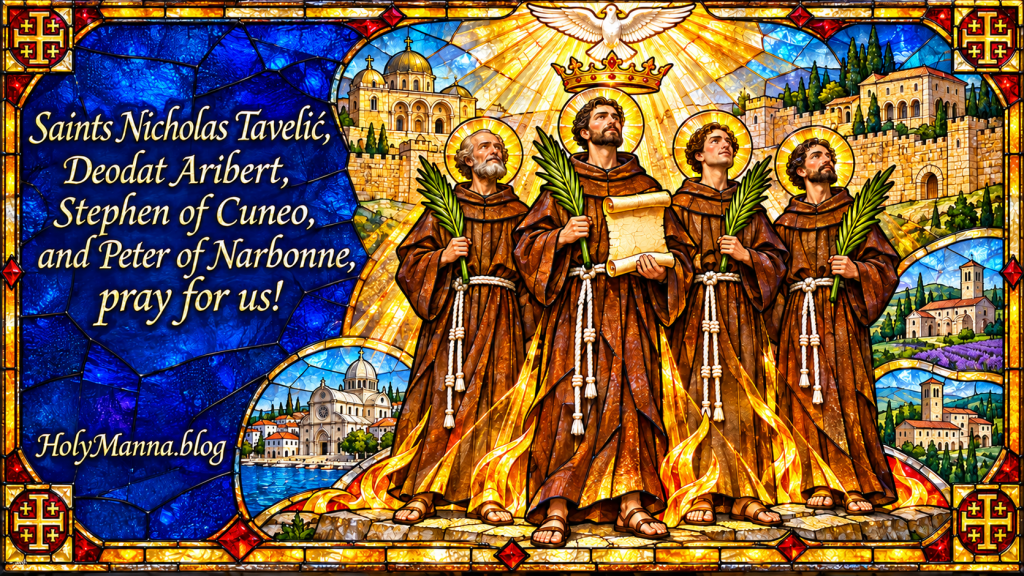
Four Friars, One Fire
Every November 14th the Church remembers 4 Franciscan priests who walked out of a friary on Mount Zion in Jerusalem, carried a written profession of faith into the most dangerous square in the city, and never walked back. Nicholas Tavelić was Croatian. Deodat Aribert and Peter of Narbonne were French. Stephen of Cuneo was Italian. They had spent years guarding the holy places where Jesus lived, died, and rose again, and in 1391 they decided that guarding was no longer enough. They proclaimed Christ openly before the chief Muslim judge of Jerusalem, refused to take back a single word, and on November 14th, 1391 they were put to death and burned so thoroughly that no relic of them survives.
The Church calls them the first martyrs of the Custody of the Holy Land, the Franciscan mission that has kept the shrines of Christianity for 8 centuries. Of roughly 158 friars who have died violently in that service since 1335, these 4 are the only ones formally canonized. The Roman Martyrology records them this way: “In Jerusalem, Saints Nicholas Tavelić, Deodat Aribert, Stephen of Cuneo and Peter of Narbonne, priests of the Order of Minors and martyrs, who were burned in fire for having courageously preached the Christian religion in the public square before the Saracens, firmly professing Christ the Son of God.”
Their story forces an uncomfortable question. Pope Saint Paul VI, who canonized them on June 21st, 1970, admitted openly that the Church had hesitated for 5 centuries over whether men who provoked their own deaths could be true martyrs. His answer, and the Church’s answer, is yes. The Catechism teaches that “Martyrdom is the supreme witness given to the truth of the faith: it means bearing witness even unto death” (CCC 2473). These 4 men gave that witness where speaking the name of Jesus to a Muslim was a capital crime, knowing the cost. Nicholas Tavelić is also the first canonized saint of the Croatian people, and his feast, known in Croatian as Tavelićevo, is still kept with great devotion in Šibenik and far beyond.
Four Roads to Mount Zion
The 4 friars came from 4 very different corners of Catholic Europe, and their paths only converged in Jerusalem in the early 1380s.
Nicholas Tavelić was born around 1340, most sources say in Šibenik on the Dalmatian coast of what was then the Kingdom of Croatia and Dalmatia, though a minority tradition places his birth at Velim near Stankovci. He came from a noble family of the region. Later accounts say he was well educated and that his family opposed his decision to leave a promising secular future for the Friars Minor; this is a tradition handed down in Franciscan biographies and cannot be verified. What is documented is that in 1365 he entered the Franciscan friary of Saint Mary at Bribir, the stronghold of the powerful Šubić family, and was ordained a priest.
Not long after, Nicholas answered one of the great missionary calls of the medieval Church. Pope Nicholas IV, himself a Franciscan, had issued the bull Prae cunctis in 1291 urging friars to work in Bosnia, where the Bogomil heresy had drawn much of the population away from Catholic faith. Nicholas was one of about 60 friars who took up that work. He spent roughly 12 years preaching in Bosnia, knowing both the joy of conversions and the grief of rejection. The Franciscan Book of Saints records that there he “gained innumerable souls for Christ by his extreme kindness and charity,” and that while some revered him, others persecuted him with relentless hatred.
It was in Bosnia that Nicholas met the man who would become his closest friend. Deodat Aribert, known in Latin as Deodat de Ruticinio, belonged to the Franciscan Province of Aquitaine in southwestern France. His date of birth is unknown, probably around 1340. Paul VI’s canonization homily names him Deodat of Rodez, and most Catholic sources follow that identification, while a few connect Ruticinio with Roussillon instead. Deodat was sent to Bosnia in 1372, labored alongside Nicholas against the Bogomils, and formed with him a friendship that would carry them together to Jerusalem and finally to death.
Stephen of Cuneo came from the Franciscan Province of Genoa. The Diocese of Cuneo in Piedmont honors him as its first canonized native son, gives his family name as Tornelli, and places his birth around 1340 in Cuneo itself, where he entered the local friary of Saint Francis. A separate tradition reported by Italian hagiographers claims he was born at Fiumorbo in Corsica to a family named Prunelli. The 2 claims cannot be reconciled with certainty, and for 600 years he has simply been known as Stephen of Cuneo. What is better attested is that he spent about 8 years in the Franciscan vicariate of Corsica before being sent to Jerusalem in 1383.
Peter of Narbonne belonged to the Franciscan Province of Provence in southern France. Nothing is known of his birth. Franciscan sources record that he was drawn to Italy by the early Observant reform that Blessed Paoluccio Trinci had begun at Brogliano in Umbria in 1368, a return to the strict poverty and prayer of Saint Francis. A tradition holds that Peter lived about 15 years as a hermit at Brogliano; this cannot be verified. He left for the Holy Land in 1381 and was received into the friary on Mount Zion.
By 1383 or 1384 (the sources differ by a year) all 4 were living together in that friary beside the Cenacle, where Jesus had celebrated the Last Supper. They had come by 4 roads to the same upper room.
Keeping Watch at the Cenacle
To understand what the friars did in 1391, it helps to understand where they were standing. Jerusalem was ruled by the Mamluk sultans of Egypt. The crusading age was over, and the Franciscans had only returned to the Holy City around 1335, when King Robert of Naples and Queen Sancia negotiated with the sultan for friars to live at the Cenacle and the Holy Sepulchre. Pope Clement VI confirmed the arrangement in 1342, and the Custody of the Holy Land was born. The friars were tolerated as caretakers of shrines and hosts to pilgrims. They were not tolerated as preachers. Any public attempt to convert a Muslim was punishable by death.
For about 7 years the 4 friars lived within those limits. They kept the holy places, celebrated the sacraments, cared for pilgrims, and studied Arabic. The Custos of the Holy Land, Father Francesco Patton, has described their witness as one of “full adherence to one’s vocation,” and that quiet fidelity is the first thing a reader should notice. These men did not arrive in Jerusalem looking for a dramatic death. They arrived to serve, and they served faithfully for the better part of a decade in a hostile city, far from home.
Their patience was itself obedience to Saint Francis. In the Earlier Rule of 1221, Francis set out 2 ways for friars living among Muslims: “One way is not to engage in arguments or disputes but to be subject to every human creature for God’s sake and to acknowledge that they are Christians. The other way is to announce the Word of God, when they see it pleases the Lord.” The first way is silent witness. The second is open proclamation. Francis himself modeled the second when he crossed the battle lines at Damietta in 1219 to preach before the Sultan of Egypt. The 4 friars lived the first way for years before they discerned that the Lord was asking the second of them.
No miracles are documented from their years in Jerusalem, and the Church has never claimed any. Older Franciscan sources speak in general terms of God glorifying Nicholas through miracles, but they name none, and the canonization did not rest on any. What the sources do record is something quieter and in some ways harder: 4 priests from 3 nations, bound by the same Rule, living in brotherhood on the very ground where Jesus washed His disciples’ feet. The Catechism teaches that “It is from God’s love for all men that the Church in every age receives both the obligation and the vigor of her missionary dynamism” (CCC 851). That love had been growing in them for 7 years before it finally spoke aloud.
Why should you remember and emulate them? Because most Christians will never be asked to die for the faith, but every Christian is asked to live it where it is unwelcome: an office, a classroom, a family table. The friars show that courage is not a sudden feeling but a long habit. They did not improvise their martyrdom. They prayed over it and made it the fruit of years of ordinary fidelity.
Three Days Before the Qadi
The most reliable account comes from Father Gerard Chalvet, the Guardian of the Mount Zion friary and an eyewitness, who wrote a detailed report about 2 months after the events. That report was sent to Europe and became the foundation of everything later written about the martyrs. The Franciscan Order still reads from it in the Office of Readings for their feast.
According to that account, the 4 friars had discussed for a long time how they might win souls for God in Jerusalem. They sought the advice of theologians and experienced brothers, whose names are not recorded, and together they composed a written statement setting out Christian doctrine and responding to the claims of Islam. Each friar carried a copy written in both Italian and Arabic. They prayed. Then, on the feast of Saint Martin, November 11th, 1391, at about the third hour of the morning, they set aside their fears and acted.
They went to the Temple area, which medieval Christians often called the Mosque of Omar, and asked to be brought before the Qadi, the chief Muslim judge of Jerusalem. His name has not come down to history. Before him and a crowd of Muslims they read their statement aloud. They declared that they had come to preach the Gospel so that all souls might be saved, including the Qadi himself and the nobles of the city, and that no one could be saved except through faith in Jesus Christ.
The crowd listened at first, then grew enraged. The Qadi asked whether the friars were speaking wisely or as fools. They answered seriously and gently that they meant every word. He ordered them to retract their words and to embrace Islam. They refused. The contemporary account preserves their answer: “We are ready to suffer every form of torture for the Catholic Faith.”
They were beaten on the spot and thrown into a dark dungeon, where the eyewitness report describes them bound in wooden stocks. Later Franciscan tradition adds that they were given no food or water; that detail cannot be verified. During those 3 days they had every opportunity to save their lives by renouncing Christ. They did not take it.
On November 14th, 1391, they were led out before a large crowd, most likely near what is now the Jaffa Gate, though the exact spot is uncertain because the present walls of Jerusalem date from the 16th century. Once more they were commanded to abjure. Once more they refused and renewed their profession of faith in the risen Christ. Then they were hacked with swords and their bodies thrown into a fire and burned. The crowd scattered the ashes and hid whatever bones remained so that Christians could never gather relics. One modern source says they were beheaded, but the eyewitness report and the Roman Martyrology describe the sword followed by fire. The other friars of the Custody were not harmed.
This is the moment that troubled the Church’s theologians for 5 centuries. Pope Benedict XIV, the great 18th century authority on canonization, had taught that a death deliberately provoked is not true martyrdom. Were these 4 friars martyrs or reckless men? Paul VI faced the question head on in his canonization homily. He pointed to Saint Ignatius of Antioch begging the Romans not to interfere with his death, to Saint Apollonia, and to the Rule of Saint Francis itself, and he recalled that Jesus said of His own life, “No one takes it from me, but I lay it down on my own” (John 10:18). The friars did not seek death for its own sake. They sought to proclaim Christ and accepted death as its known price.
Paul VI put it in one sentence that has become the heart of their story: “Martyrdom, as is known, means testimony.” And he insisted on something modern readers need to hear clearly. Of the 4 friars he said, “they did not hate the Muslim world; rather, in their own way, they loved it.” Their statement before the Qadi was an act of love, however startling its form, because they believed the people before them needed Christ and were willing to die to tell them so.
The Catechism confirms the logic of their choice. “The disciple of Christ must not only keep the faith and live on it, but also profess it, confidently bear witness to it, and spread it” (CCC 1816). It quotes the Lord’s own warning: “Everyone who acknowledges me before others I will acknowledge before my heavenly Father. But whoever denies me before others, I will deny before my heavenly Father” (Matthew 10:32-33). The Church also teaches that fortitude “enables one to conquer fear, even fear of death, and to face trials and persecutions” (CCC 1808). Three days in a dungeon with a door that would open at a single word of denial is as pure a test of fortitude as any in the history of the Church.
Ashes Scattered, Memory Kept
The men who burned the friars wanted them forgotten. They failed completely.
Within weeks Father Chalvet’s report was traveling across Europe. Franciscans everywhere began to honor the 4 as martyrs, and nowhere more fervently than in Šibenik, Nicholas’s hometown, where his memory was kept alive by his fellow citizens generation after generation. Portraits of him were painted around the year 1500. In the Franciscan church of Saint Francis in Šibenik a side altar rose in his honor. His feast day came to be called Tavelićevo, and it is still celebrated there every year with Mass, procession, and prayer.
Because the bodies were destroyed, there are no first class relics of these saints and no tomb to visit, and Catholic sources record no specific miraculous cures attributed to their intercession. Croatian and Italian writers speak instead of a different kind of wonder: that the memory of 4 men whose very ashes were scattered should have survived 600 years and spread to 3 continents. They attribute that survival to Divine Providence. This is a judgment of faith rather than a documented miracle, and it is offered here as such.
Formal recognition came slowly. In the 1880s Bishop Antun Josip Fosco of Šibenik convened a commission to examine the ancient cult, and on its findings Pope Leo XIII confirmed the immemorial veneration of Nicholas Tavelić in 1889, giving him the title of Blessed. The other 3 waited longer. Pope Paul VI confirmed their cult in 1966, at first assigning a separate feast on November 17th while the Franciscan calendar kept November 14th, the day they died together. The tireless work of Father Ante Crnica, a Croatian Franciscan canon lawyer and vice postulator who died in 1969, brought the cause to completion. On June 21st, 1970, in Saint Peter’s Basilica, before some 20,000 Croatian pilgrims, Paul VI canonized all 4 together and fixed their common feast on November 14th. The canonization was a solemn confirmation of their ancient cult rather than a modern miracle process. The Catechism explains that “By canonizing some of the faithful, i.e., by solemnly proclaiming that they practiced heroic virtue and lived in fidelity to God’s grace, the Church recognizes the power of the Spirit of holiness within her and sustains the hope of believers by proposing the saints to them as models and intercessors” (CCC 828).
For Croatia the canonization was a national event. Nicholas became the first canonized saint of the Croatian people, and in 1970 the Franciscan church in Šibenik was declared the Croatian National Shrine of Saint Nikola Tavelić. Pilgrims there can also see the Šibenik Prayer, a devotional text from 1375 that is one of the oldest monuments of the Croatian language. Decades earlier, in 1939, the Franciscans of Bosnia had begun a great votive shrine to the then Blessed Nicholas in the Kovačići district of Sarajevo, the land where he had preached for 12 years. Churches bearing his name stand in Zagreb, Sombor, Vinjani, and Montreal, where the Croatian Catholic community gathers each week in a parish dedicated to him. Croatian Post issued a stamp for the 50th anniversary of the canonization in 2020.
Jerusalem has not forgotten them either. The Custody of the Holy Land celebrates their memorial every November 14th with Mass at the Cenacle friary, the successor of the house where they lived. For the 50th anniversary of the canonization, Croats from the homeland and the diaspora commissioned a bronze statue of Nicholas for the Franciscan friary on Mount Zion, as close as possible to the Upper Room. The pandemic delayed its unveiling, but it was blessed in 2021 by Father Sandro Tomašević, a Croatian friar of the Custody, who said that Croatia gave the saint birth for earth and Zion gave him birth for heaven.
Stephen of Cuneo is honored by the Diocese of Cuneo as its first canonized native. But the 4 are nearly always venerated together, as they died. The Custos of the Holy Land has pointed out that this is itself part of their message: a Croatian, 2 Frenchmen, and an Italian, bound by one Rule and one faith, gave one witness. The Catechism teaches that the Church is “the sacrament of the unity of the human race” (CCC 775), and Scripture shows that unity fulfilled in heaven by a multitude “from every nation, race, people, and tongue” (Revelation 7:9). Mount Zion in 1391 was a small picture of that unity, and the Custody of the Holy Land still is today.
Learning Courage From Four Quiet Years
It would be easy to read this story as a tale of 4 bold men and 3 dramatic days. The deeper lesson is in the 7 years that came before. The friars did not stumble into heroism. They prepared the ground with prayer, study, fraternity, and humble service, and when the moment came the courage was already there.
Paul VI drew the lesson out plainly. He contrasted the friars’ conviction with the relativism, conformism, and comfortable indifference of the modern age, and he told the Church that “one must have the courage of truth! Christian courage!” That courage looks different in an office or a university dorm than it did in a Jerusalem courtyard, but it is the same virtue. The Catechism teaches that every Christian’s witness “is a transmission of the faith in words and deeds” (CCC 2472). Words and deeds. Not one or the other.
When was the last time you acknowledged Christ before others at a real cost to yourself? The friars remind every believer that faith kept entirely private slowly stops being faith at all. Saint Peter’s instruction remains the rule: “Always be ready to give an explanation to anyone who asks you for a reason for your hope, but do it with gentleness and reverence” (1 Peter 3:15). Notice both halves. The friars were ready. They were also, by every account, free of hatred for the people they addressed. Paul VI pointed to that love as what made them saints rather than fanatics, and the Church insists that “Nobody may be forced to act against his convictions” in religious matters (CCC 2106). Witness is an invitation, never a weapon.
Where in your life has the Lord asked you to move from silent example to spoken word? Saint Francis’s 2 ways are not a ladder. Most Franciscans in the Holy Land today live the first way, serving Christians and Muslims alike through schools, hospitals, and hospitality. The friars of 1391 were called to the second. The question for every disciple is not which way is better but which way God is asking right now, and whether they are listening closely enough to know.
There is also a lesson about friendship. Nicholas and Deodat met in Bosnia, served together for a decade, traveled to Jerusalem together, and died together. Peter and Stephen joined that brotherhood and shared its end. None of them went to the Qadi alone. Who are the companions who make you braver in your faith, and are you being that companion to anyone? The Christian life was never meant to be lived solo, and saints are rarely made that way.
Finally, there is the matter of what remains. Everything the friars had was destroyed: their bodies, their bones, even their ashes. What survived was their testimony, carried in a letter, kept in the hearts of a coastal town, and vindicated by the Church 6 centuries later. Jesus said, “Unless a grain of wheat falls to the ground and dies, it remains just a grain of wheat; but if it dies, it produces much fruit” (John 12:24). What are you holding onto that God may be asking you to let fall to the ground?
Practically, a reader might honor these saints this week by praying for the Christians of the Holy Land, who still live under pressure; by praying by name for one Muslim neighbor or coworker with the same love Paul VI saw in the friars; and by finding one small place where faith has been kept silent and letting it speak, gently and clearly.
Engage With Us!
The story of these 4 Franciscan martyrs raises hard and beautiful questions about what it means to belong to Christ in public. Share your thoughts and reflections in the comments below.
- The friars lived 7 quiet years in Jerusalem before they spoke openly. What season of hidden preparation might God be asking of you right now, and how are you using it?
- Paul VI said the friars “did not hate the Muslim world; rather, in their own way, they loved it.” How can you share your faith with people of other beliefs in a way that is unmistakably rooted in love?
- The friars spent 3 days in prison with freedom available at the price of a single denial. What small silences and compromises tempt you in daily life because they would make things easier?
- Nicholas and Deodat were friends for nearly 20 years before they died together. Who strengthens your faith, and how can you deepen that friendship this month?
- No relic of these saints survives, yet their memory has endured for 600 years. What legacy of faith are you building that would outlast everything material about your life?
The 4 friars of Mount Zion were not superhuman. They were priests who prayed, studied, argued over the best way forward, and finally chose to trust God with the outcome. The same grace that carried them through a Jerusalem dungeon is offered at every Mass and in every quiet moment of prayer. Take it. Live your faith where you are, speak it with gentleness and courage, love the people God has placed around you without exception, and do everything with the love and mercy that Jesus taught us.
Saints Nicholas, Deodat, Stephen, and Peter, pray for us!
Follow us on YouTube, TikTok, Instagram and Facebook for more insights and reflections on living a faith-filled life.


Leave a Reply