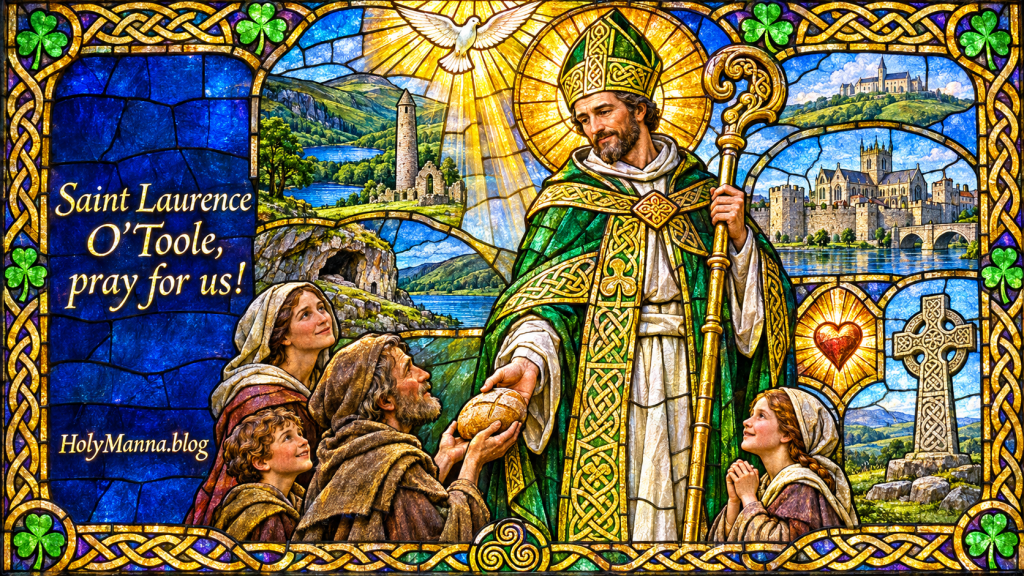
The Hostage Who Became the Heart of Dublin
Every November 14th the Church remembers a man whose life reads like the script of a historical drama: a chieftain’s son handed over as a child hostage, a monk who became an abbot at 25, a reluctant archbishop who stood in the breach when his city was stormed, a diplomat clubbed over the head at the altar of Canterbury, and an exile who died in a Norman abbey still pleading for his people. Saint Laurence O’Toole, known in Irish as Lorcán Ua Tuathail and in France as Saint Laurent d’Eu, was the first native Irishman to serve as Archbishop of Dublin, and he is honored today as the principal patron of the Archdiocese of Dublin.
He lived through the Anglo-Norman invasion of Ireland and spent his last decade crossing the Irish Sea trying to make peace between kings who did not particularly want it, all while feeding the hungry, sheltering abandoned children, and reforming the Irish Church as Papal Legate. By canonizing a saint the Church proclaims “that they practiced heroic virtue and lived in fidelity to God’s grace” and proposes them “as models and intercessors” (CCC 828). Laurence was canonized only 45 years after his death.
From a Herdsman’s Hut to the Valley of the Two Lakes
Laurence was born around 1128 near Castledermot in what is now County Kildare, though Butler’s Lives of the Saints says about 1125 and some Irish sources say 1132. His father was Muirchertach, or Maurice, Ua Tuathail, chieftain of Uí Muiredaig, often rendered Hy Murray, in southern Kildare, and his mother came from the rival chieftain family of the O’Byrnes. Laurence was the youngest of 4 sons, and his sister Mór would later marry Dermot MacMurrough, King of Leinster, which placed the future saint in the middle of the dynastic politics that would soon tear Ireland apart.
The defining trauma of his childhood came when he was about 10. Dermot suspected Maurice of disloyalty and demanded a hostage, and Maurice handed over his youngest son. According to the Life written at Eu shortly after the saint’s death, Dermot sent the boy in chains to a remote and stony place where he was kept in a herdsman’s hut, poorly clothed and barely fed. For roughly 2 years the son of a king learned hunger and powerlessness from the inside. Decades later, as an archbishop seated at table with dozens of beggars, he was not performing charity for an audience; he was feeding the boy he had once been.
Around 1140 he was released into the keeping of the Bishop of Glendalough, the great monastic city founded by Saint Kevin in the valley of the two lakes, until his father could collect him. By the time Maurice arrived, the boy who had known a hut in the wilderness had discovered a different solitude, one filled with psalms and bells and men who had given everything to God. Butler records that Maurice announced he would dedicate one of his 4 sons to the Church and proposed to cast lots to decide which. Laurence objected: “There is no need of casting lots.” He had already chosen, and his father left him at Glendalough under the patronage of Saint Kevin.
This was the conversion of Laurence, not from unbelief to belief but from a princely future to a monastic one. The Catechism teaches that “conversion is first of all a work of the grace of God who makes our hearts return to him” (CCC 1432), and that grace reached Laurence through suffering first and sanctuary second. He spent some 13 years at Glendalough as student and monk, and when the abbot died in 1153 or 1154 the community unanimously elected him abbot. He was about 25.
The Abbot Who Sold the Treasury and the Archbishop Who Fed Sixty
His abbacy began in crisis. A famine struck during his first 4 months in office, and he sold the treasures of the monastery to feed the hungry. The Archdiocese of Dublin calls him the greatest abbot of Glendalough since Saint Kevin. He drew the Canons Regular of Saint Augustine into the reform of the abbey, becoming an Augustinian canon himself. The early Life also credits him with protecting the community from brigands through prayer, fasting, and miraculous cures, though no details of those cures are preserved and they rest on the testimony of the early biographer alone.
Around 1160 he declined the bishopric of Glendalough, pointing out that canon law required a bishop to be 30. The refusal did not hold for long. Archbishop Gregory of Dublin died on October 8th, 1161, and the electors of Dublin, a Norse Irish trading city whose bishops had until then been consecrated at Canterbury, turned unanimously to the Abbot of Glendalough. In early 1162 he was consecrated in the cathedral of the Holy Trinity, today’s Christ Church, by Gelasius, Archbishop of Armagh. He was the first Irishman to hold the see.
In 1163 he persuaded the canons of his cathedral to adopt the Rule of Arrouaise, a strict form of the Augustinian life, and then he joined them. He ate in their refectory, kept their silence, and rose for the night Office. Beneath his vestments he wore the white habit of a canon, and beneath that a rough hair shirt which, the Life says, he never changed. He abstained from meat and fasted on bread and water every Friday. After the night Office he knelt in long prayer before a venerated crucifix, and at dawn he walked the churchyard reciting the Office of the Dead. The Catechism teaches that “the way of perfection passes by way of the Cross” and that “there is no holiness without renunciation and spiritual battle” (CCC 2015). Laurence lived that sentence 8 centuries before it was written.
His charity was as concrete as his penance. The Life states that the poor were fed daily in his presence, never fewer than 30 and often 60, and that he supported many more in private houses. He took homeless and abandoned children into his own residence. The Catechism describes the grace of a bishop as the grace “to guide and defend his Church with strength and prudence as a father and pastor, with gratuitous love for all and a preferential love for the poor, the sick, and the needy” (CCC 1586), and it defines the works of mercy as “charitable actions by which we come to the aid of our neighbor in his spiritual and bodily necessities” (CCC 2447). The household of Laurence was a working definition of both. He never let go of Glendalough either. Each Lent he withdrew to Saint Kevin’s Bed, a tiny cave on a cliff above the Upper Lake reachable only by boat, so that his retreats, his fasts, and his open table gathered the Church’s 3 classic forms of penance, “fasting, prayer, and almsgiving” (CCC 1434), into one life.
The most dramatic miracle attributed to him during his lifetime took place in England. On one of his missions to Henry II in the 1170s, Laurence stayed at Canterbury and spent the night in prayer at the tomb of Saint Thomas Becket, murdered there in December 1170. The next morning, as he approached the altar for Mass, a deranged man who apparently hoped to make him “another Saint Thomas” struck him a violent blow on the head with a staff. He fell, and all present believed he was dying. Then he came to himself, asked for water, blessed it with the sign of the cross, and had the wound washed. The bleeding stopped at once and he celebrated Mass. The author of the Life claims to have been present and adds that the fracture was still visible in the saint’s skull after his death. Henry ordered the attacker hanged; Laurence pleaded for the man and won his pardon, living out the teaching that “Christian prayer extends to the forgiveness of enemies, transfiguring the disciple by configuring him to his Master” (CCC 2844). Sources differ on the year, Butler placing it around 1171 and others in 1175, but the episode rests on an eyewitness account. The Archdiocese of Dublin also records that his ship was more than once caught in violent storms and that its safe arrival was attributed to his prayer, a belief of his contemporaries rather than an examined miracle.
Standing Between the Sword and the City
Laurence was not a martyr; he died of fever in a monastery bed. But the hardships of his last 14 years were a slow martyrdom of another kind.
The catastrophe began in his own family. In 1166 his brother-in-law Dermot MacMurrough was driven out of Leinster, fled to England, swore fealty to Henry II, and recruited Norman adventurers, among them Richard de Clare, known as Strongbow. In August 1170 Strongbow arrived with about 1,200 men, took Waterford, married Dermot’s daughter Eva, and marched on Dublin. The terrified citizens besieged the house of Laurence, begging him to save them. He went out to the Norman camp to negotiate a surrender that would spare the city, and while the leaders were still talking, the lieutenants of Strongbow stormed the walls and began killing and looting. Laurence rushed back into the city. He saved lives, the Archdiocese of Dublin says, by the sheer force of his presence; he ministered to the dying; and he carried the bodies of the dead in his own arms to see them buried. In 1171 he helped organize a vast Irish coalition to retake Dublin, but the siege collapsed when the Normans sallied out and routed the Irish camp. That autumn Henry II himself landed in Ireland, and Laurence, reading the situation clearly, deferred to the king. From then on he devoted himself to the one thing still possible, which was peace.
The Catechism teaches that “peace is the work of justice and the effect of charity” (CCC 2304), and that those who renounce violence and use “those means of defense available to the weakest, bear witness to evangelical charity” (CCC 2306). Laurence became that witness. In 1175 he negotiated the Treaty of Windsor between Henry II and Rory O’Connor. In 1179 he led the Irish bishops to the Third Lateran Council, where he laid the state of the Irish Church before Pope Alexander III, who named him Papal Legate for all Ireland. He came home, convened a council at Clonfert that removed unworthy clerics, and during a famine of 3 years, Butler records, fed 50 strangers and 300 poor every day and cared for as many as 300 abandoned infants at once.
His reforming zeal and his use of papal authority against Norman barons seizing Church property infuriated Henry II. In the spring of 1180 Laurence left Dublin for the last time, sent by Rory O’Connor to deliver the son of the High King as a hostage and to settle the tribute owed under the treaty. Henry refused to see him, detained him for 3 weeks at Abingdon Abbey, and crossed to Normandy. Laurence, sick and exhausted, followed. Whether the two men ever met is disputed: the Catholic Encyclopedia and Butler say Henry relented and that Laurence learned of it before he died, while the Archdiocese of Dublin says he died without meeting the king.
The Life records that as he climbed the hill overlooking the town of Eu and saw the abbey church below, he recited the psalm: “This is my resting place forever; here I will dwell, for I desire it” (Psalm 132:14). A chapel on that hillside has marked the spot ever since. He knocked at the gate of the Abbey of Saint Mary, a house of Victorine Canons Regular, and was received by Abbot Osbert. A fever had already seized him. He made his confession, received Viaticum and the anointing of the sick, and took to his bed.
Two sayings from those final days survive in the Life, and with the Canterbury episode and his boyhood refusal to cast lots they are the only verified words of Laurence O’Toole. Reminded that he ought to make his will, he smiled and answered: “Of what do you speak? I thank God I have not a penny left in the world to dispose of.” Other translations render it, “God knows, I have not a penny under the sun to leave anyone.” Then, as death approached, his attendants heard him cry out in Irish, his thoughts on the people he had left in Dublin: “Alas, you poor, foolish people, what will you do now? Who will take care of you in your trouble? Who will help you?” O’Hanlon adds that as long as he could speak he repeated the words of the psalmist, “Have mercy on me, O my God, have mercy on me, since my soul hath trusted in thee” (Psalm 57:2). He died in the night of Friday, November 14th, 1180, at about 52. Jesus said, “I am the good shepherd. A good shepherd lays down his life for the sheep” (John 10:11). Laurence did not die by the sword, but he died worn out by 14 years of standing between the sword and his flock, with his people on his lips.
One quotation should be flagged. A line sometimes circulated online as a saying of Saint Laurence, “My God is the rock where I take refuge; my shield, my mighty help, my stronghold,” is Scripture in the Grail translation (Psalm 18:3), not a recorded saying of the saint.
The Heart That Came Home
The Life reports that on the night of his death many in Eu saw a brilliant light around the abbey, and that in Dublin a citizen named Innocent saw the high altar collapse in a vision and announced the death of the archbishop before any messenger could have arrived. Neither sign can be verified.
His tomb at Eu became a place of pilgrimage almost at once. The Life describes the sick arriving from distant villages and lists the favors granted in the language of the Gospels: the blind saw, the deaf heard, the mute spoke, lepers were cleansed, paralytics walked, the possessed were freed, and some who had died were restored to life. The biographer gives categories rather than named cases. On April 17th, 1186, because the old church was being demolished, the body was exhumed and, according to a manuscript preserved in Marsh’s Library in Dublin, found incorrupt after 5 years and 5 months, with flesh and hair preserved and the joints still flexible. This is the testimony of the medieval record and cannot be verified by modern means.
After 6 formal attempts and petitions to two earlier popes, Abbot Guido of Eu traveled to Rome and came home with the bulls. Pope Honorius III canonized Laurence at Rieti in December 1225, and Butler records that the bull itself states that 7 dead persons had been raised through his intercession. Some older authorities give 1226, the year the bulls reached Eu and were celebrated there, but the bull is dated 1225. Laurence was only the second Irish person canonized by formal papal process, after Saint Malachy. On May 10th, 1226, in the presence of the Archbishop of Rouen and the Bishop of Amiens, the relics were translated to a place of honor in the main church, and the canons of Eu went on recording miracles for centuries, about 256 in all. The Catechism explains the crowds: those in heaven “do not cease to intercede with the Father for us” (CCC 956), and the Church has always honored “the veneration of relics, visits to sanctuaries, pilgrimages, processions” as authentic expressions of the religious sense of the Christian people (CCC 1674).
Later traditions multiplied. One story tells of a chalice associated with the saint from which the sick drank in hope of healing, stolen in 1408 and recovered, then carried off by the Huguenots of Dieppe in 1562. Another tells that in May 1940, during the octave of the saint, some 300 pilgrims processing up to the hillside chapel were unharmed when the town below was bombed. Neither story can be verified. The tomb was defaced in the French Revolution and the medieval reliquaries lost, but the relics survived, and the collegiate church of Notre-Dame-et-Saint-Laurent at Eu remains a pilgrimage site today.
But the most beloved relic of Saint Laurence is not in France. His heart was sent to Dublin, where it has been kept in Christ Church Cathedral since the thirteenth century in a heart-shaped wooden box inside a small iron cage in the Chapel of Saint Laud. Then, on March 3rd, 2012, a thief who had apparently hidden overnight in the building cut through the bars, ignored the gold and silver, and walked out with the heart. For 6 years it was gone. In April 2018, acting on a tip, the Irish police recovered it undamaged in Phoenix Park, and on April 26th, 2018 it was carried back into Christ Church during Choral Evensong. The Dean acknowledged openly that there is no scientific way to prove the heart belongs to Laurence, only centuries of unbroken tradition. Irish newspapers reported, without police confirmation, that the thieves returned it because they believed it was cursed; that claim cannot be verified.
Saint Laurence is the principal patron of the Archdiocese of Dublin. His feast on November 14th is an optional memorial in Ireland, a feast in Dublin, and a commemoration in the Roman Martyrology for the universal Church. In 2025 Catholics and Anglicans of Dublin made a joint pilgrimage to Eu for the 800th anniversary of his canonization, and on the feast itself Archbishop Dermot Farrell announced that Pope Leo XIV had designated Saint Mary’s Pro-Cathedral as the cathedral of the archdiocese, the first official Catholic cathedral in Dublin since the Reformation. More than 8 centuries after a tired Irish bishop climbed a hill in Normandy and chose his resting place, his city is still arranging its calendar around him.
What a 12th Century Peacemaker Teaches a 21st Century Heart
It would be easy to admire Laurence O’Toole as a figure in stained glass, but his life presses on the places where modern Catholics actually live.
Start with the hostage years. His compassion for the poor was forged in a herdsman’s hut where a 10 year old prince went hungry, and he let his wounds become his ministry. What suffering in your own past has God been inviting you to turn outward, into mercy for someone who is suffering it now? The Catechism teaches that “God blesses those who come to the aid of the poor and rebukes those who turn away from them” (CCC 2443). Someone near you is living through something you survived, and your survival is a credential you can spend on them.
Consider his hidden life. The Archbishop of Dublin rose at midnight to sing psalms, knelt for hours before a crucifix, walked a graveyard at dawn praying for the dead, and then went out and ran a diocese and negotiated with kings. The contemplative and the active were not in competition in him; the first fueled the second. Where in your week is the cave above the lake, the place where you let God restore you before you go back out to the city? It can be 20 minutes before a tabernacle or a rosary in the car with the radio off. The Catechism calls prayer “the raising of one’s mind and heart to God” (CCC 2559), and the life of Laurence proves that the people most useful to God in public are the ones most faithful to Him in private.
Then there is peacemaking. Laurence spent 14 years trying to reconcile men who had every reason to hate each other, and he mostly failed. By the measure of the world his diplomacy was a long defeat, and yet the Church calls him a saint precisely for the attempt, because Jesus said, “Blessed are the peacemakers, for they will be called children of God” (Matthew 5:9), and He did not make that blessing conditional on success. Is there a relationship in your life where you have stopped trying to make peace because you decided it was hopeless? Laurence would ask you to try again and leave the outcome to God.
Finally, consider the hair shirt and the empty purse. Laurence commanded the revenues of the richest see in Ireland and died without a penny because he had given it all away. What small, hidden renunciation could you take on this month, not to be seen, but to make room in your heart for God and for the poor? Perhaps it is fasting on Fridays all year, as Laurence did on bread and water, or inviting someone lonely to your table the way he invited 60 beggars to his. Laurence died crying out for his people, and he would want you to hear that cry as a question addressed to you. Who will take care of them, and who will help them? The answer he gave with his whole life was that God cares for His people through anyone willing to love them as Christ does, and today that includes you.
Engage With Us!
Saint Laurence O’Toole lived at a hinge of history and chose, over and over, the harder road of mercy, penance, and peace. The HolyManna community would love to hear how his story speaks to you. Please share your thoughts and reflections in the comments below.
Here are some questions to get the conversation started:
- The two years Laurence spent as a child hostage shaped his lifelong tenderness toward the poor. What hardship in your own life has God used, or could God use, to make you more compassionate?
- The Archbishop of Dublin joined his canons in the refectory, kept their silence, and sang the night Office with them. What would a more disciplined rhythm of prayer look like in the middle of your busy life?
- Laurence forgave and pleaded for the man who nearly killed him at the altar of Canterbury. Is there someone you need to forgive, and what is holding you back?
- His peacemaking between Irish and Norman largely failed in worldly terms. How do you measure success in your own efforts at reconciliation, and does the Gospel ask you to measure it differently?
- On his deathbed Laurence could say he had not a penny left in the world to dispose of. What possession, habit, or comfort is God asking you to loosen your grip on?
- Every Lent Laurence withdrew to the cave of Saint Kevin above the lake. Where is your place of retreat with God, and when did you last go there?
Saint Laurence O’Toole was a prince who chose poverty, a contemplative who chose the public square, and a peacemaker who kept working for peace long after it looked impossible. He did it all for love of the Good Shepherd and of the flock the Shepherd had given him. You are called to the same love. Whatever is in front of you this week, a difficult conversation, a hungry neighbor, a sin you keep confessing, a cave above the lake you keep postponing, do it with the love and mercy that Jesus taught us. Jesus promised, “Amen, I say to you, whatever you did for one of these least brothers of mine, you did for me” (Matthew 25:40).
Saint Laurence O’Toole, pray for us!
Follow us on YouTube, TikTok, Instagram and Facebook for more insights and reflections on living a faith-filled life.


Leave a Reply