Saturday of the Thirty-second Week in Ordinary Time – Lectionary: 496
The Ones Who Keep Coming Back
Some people simply refuse to go away, and heaven loves them for it.
The readings for November 14th are built around a single quality that the world often mistakes for stubbornness and that Scripture calls faith. In The Third Letter of John, a layman named Gaius keeps opening his door to traveling missionaries he has never met, so faithfully that strangers report his love back to the whole Church. In Psalm 112, the person who fears the Lord keeps lending, keeps giving, and keeps conducting business with justice, until his generosity becomes something that endures forever. And in The Gospel of Luke, a widow with no money, no husband, and no leverage keeps walking back into a corrupt courtroom until even a judge who fears nobody gives in.
The central theme is faith that keeps showing up. Persevering prayer and persevering generosity are two hands of the same living faith, and they are precisely what Jesus wonders whether He will find when He returns: “But when the Son of Man comes, will he find faith on earth?”
The Third Letter of John is the shortest book in the New Testament, a note from an aging apostle about something as ordinary as who gets a guest room. Psalm 112 is a Hebrew acrostic, the twin of Psalm 111, so that the one who fears the Lord mirrors the Lord’s own works. And Jesus tells His parable right after speaking about the delayed coming of the Son of Man, to disciples who would soon learn how long waiting can feel. The widow, the psalmist, and Gaius all answer the same question in advance. Yes, Lord, there will be faith on earth, because some people never stop coming back.
First Reading — 3 John 5-8
The Layman Whose Guest Room Built the Church
Picture an elderly apostle, probably in Ephesus near the close of the first century, dictating a note short enough for a single sheet of papyrus. He calls himself “the Elder,” and the Church has always recognized him as Saint John. He writes to Gaius, a layman of whom nothing else is known except that traveling missionaries praised his hospitality when they got home.
The situation is tense. Itinerant preachers moved from town to town carrying the Gospel, dependent on local believers for a bed and a meal. A few verses after today’s reading, John names a man called Diotrephes who “loves to dominate” and who was refusing these missionaries and expelling anyone who welcomed them. Gaius, then, is not merely being polite. He is choosing a side in a quiet struggle over whether the Church will be an open house or a closed club.
This fits the day’s theme perfectly, because Gaius is the hospitable counterpart to the Gospel’s persistent widow. She keeps asking; he keeps giving. Both refuse to grow weary, and both are described in the language of faithfulness.
3 John 5-8
Beloved, you are faithful in all you do for the brothers and sisters,
especially for strangers;
they have testified to your love before the Church.
Please help them in a way worthy of God to continue their journey.
For they have set out for the sake of the Name
and are accepting nothing from the pagans.
Therefore, we ought to support such persons,
so that we may be co-workers in the truth.
Detailed Exegesis
Verse 5
“Beloved, you are faithful in all you do for the brothers and sisters, especially for strangers;”
The Greek word translated “faithful” is the same root as “faith.” John does not praise Gaius for being generous or kind, though he was both. He praises him for being faithful, as though welcoming strangers were itself an act of belief. In a sense it is. To feed a stranger who can never repay is to wager that God sees and God repays. Anyone can host friends. Gaius housed people he had never met, on the strength of nothing but a shared baptism.
Verse 6
“they have testified to your love before the Church. Please help them in a way worthy of God to continue their journey.”
The missionaries went home and told the whole assembly about Gaius. His kindness became public testimony. Then John asks for more. “To help them continue their journey” was a technical phrase in the early Church for outfitting travelers with food, money, and companions for the road. The standard John sets is breathtaking: “in a way worthy of God.”
Verse 7
“For they have set out for the sake of the Name and are accepting nothing from the pagans.”
“The Name” with no further explanation means Jesus. The early Church spoke this way constantly; the apostles left the Sanhedrin “rejoicing that they had been found worthy to suffer dishonor for the sake of the name” in Acts 5:41. These missionaries took no money from the unbelievers they preached to, following the example of Saint Paul, who refused payment from the Corinthians so no one could accuse him of selling the Gospel. The Didache, a Christian manual from the same era, confirms how seriously this was guarded: “Let every apostle who comes to you be received as the Lord… If he asks for money, he is a false prophet.” Saint Hilary of Arles comments plainly on this verse: “This means that the servants of God have accepted no assistance from those who are not believers.” If the preachers took nothing from pagans, believers had to provide everything.
Verse 8
“Therefore, we ought to support such persons, so that we may be co-workers in the truth.”
Here is the astonishing conclusion. The person who provides the bed and the bread is not a spectator to the mission. He is a co-worker with the truth itself. Gaius never preached a sermon on record, yet John places him alongside the missionaries as a partner in the same work. This is the Catholic understanding of the lay vocation centuries before the term existed.
Teachings
The Church teaches that the apostolic mission belongs to every baptized person. CCC 863 states: “The whole Church is apostolic, in that she remains, through the successors of St. Peter and the other apostles, in communion of faith and life with her origin: and in that she is ‘sent out’ into the whole world. All members of the Church share in this mission, though in various ways.” Gaius is the living illustration. His guest room was an apostolate.
The Catechism also joins hospitality to prayer in a way that anticipates today’s Gospel. CCC 1971, summarizing Romans 12, quotes Saint Paul: “Rejoice in your hope, be patient in tribulation, be constant in prayer. Contribute to the needs of the saints, practice hospitality.” Constant prayer and practical hospitality sit side by side in one breath.
Saint Augustine, preaching on today’s psalm, explains why such giving matters eternally: “The Apostle witnesses, that the works of mercy are the seed of the future harvest.” The Lord Himself promised in Matthew 10:42 that whoever gives even a cup of cold water to a disciple will not lose his reward, and Hebrews 13:2 adds a holy warning: “Do not neglect hospitality, for through it some have unknowingly entertained angels.”
Reflection
Gaius teaches that you do not have to be in the pulpit to be a co-worker in the truth. Most Christians will never travel for the sake of the Name, but nearly everyone can support someone who does.
Consider one concrete step this week. Identify a priest, religious sister, seminarian, missionary, or Catholic apostolate whose work you believe in, and support them in a way worthy of God, whether through a recurring donation, a meal, a handwritten note, or a commitment to pray for them by name. Then look closer to home, to the new family in the pew, the college student far from home, or the widow who eats alone, and ask whether your table could become a mission post.
Who are the “strangers” God has placed within reach of your hospitality right now? If the missionaries of your diocese went home and described your welcome, what would they say?
Responsorial Psalm — Psalm 112:1-6
A Portrait of the Man Who Mirrors God
Psalm 112 is one half of a matched pair. Psalm 111 and Psalm 112 are both acrostics, each line beginning with the next letter of the Hebrew alphabet, and both are exactly the same length. Psalm 111 praises the works of the Lord: gracious, merciful, just, generous, faithful forever. Psalm 112 then describes the man who fears that Lord, and the very words used of God are now used of the human being. He is gracious. He is merciful. He is just. His generosity endures forever. The person who fears the Lord has become a living reflection of Him.
This is why the psalm belongs so naturally between today’s other readings. Gaius in the First Reading is the man of Psalm 112, gracious and lending. The judge in the Gospel is his photographic negative, a man who “neither feared God nor respected any human being.” The psalm quietly asks which of these two the reader intends to become.
Psalm 112:1-6
R. Blessed the man who fears the Lord.
or:
R. Alleluia.
Blessed the man who fears the LORD,
who greatly delights in his commands.
His posterity shall be mighty upon the earth;
the upright generation shall be blessed.
R. Blessed the man who fears the Lord.
or:
R. Alleluia.
Wealth and riches shall be in his house;
his generosity shall endure forever.
Light shines through the darkness for the upright;
he is gracious and merciful and just.
R. Blessed the man who fears the Lord.
or:
R. Alleluia.
Well for the man who is gracious and lends,
who conducts his affairs with justice;
He shall never be moved;
the just one shall be in everlasting remembrance.
R. Blessed the man who fears the Lord.
or:
R. Alleluia.
Detailed Exegesis
Verse 1
“Blessed the man who fears the LORD, who greatly delights in his commands.”
The psalm opens like the Sermon on the Mount, with a beatitude. Fear of the Lord in Scripture is not terror but reverent awe, the posture of someone who knows who God is and who he himself is not. This fear produces delight, not dread. The one who fears the Lord does not merely tolerate the commandments; he greatly delights in them. Saint Augustine observes that such a person lives before the One “who alone judges both truthfully and mercifully.”
Verse 2
“His posterity shall be mighty upon the earth; the upright generation shall be blessed.”
Blessing in the Old Testament is never merely private. The faithful man’s influence flows downstream to children and grandchildren, and the Church Fathers also saw here the spiritual fruit of good works, which Augustine calls the seed of the harvest to come.
Verse 3
“Wealth and riches shall be in his house; his generosity shall endure forever.”
A careless reading turns this into a prosperity gospel, but the psalm forbids that by immediately defining the “riches” as generosity. Saint Augustine insists, “For his house is his heart; where, with the praise of God, he lives in greater riches with the hope of eternal life.” The wealth of the just man is a heart full of God and hands that keep opening.
Verse 4
“Light shines through the darkness for the upright; he is gracious and merciful and just.”
The second line borrows the exact language God uses to describe Himself to Moses in Exodus 34:6: “a God gracious and merciful.” The just man has taken on the family resemblance. Saint Augustine applies the first line to the baptized, who “remember that they were some time in darkness, but are now light in the Lord.” The darkness is not gone, but it is no longer in charge.
Verse 5
“Well for the man who is gracious and lends, who conducts his affairs with justice;”
Lending to the poor without interest was commanded in the Law, and the just man does it gladly. Augustine’s commentary on this verse is unforgettable: “Whilst you forgive that you may be forgiven, you are merciful; while you give that it may be given unto you, you lend.” Every act of mercy is a loan to God, and God pays back.
Verse 6
“He shall never be moved; the just one shall be in everlasting remembrance.”
Saint Paul quotes this very psalm in 2 Corinthians 9:9 to encourage cheerful giving: “He scatters abroad, he gives to the poor; his righteousness endures forever.” Augustine hears in “he shall never be moved” the final judgment itself: he is the one “who, called to the right hand, shall hear these words, Come, you blessed of My Father, inherit the kingdom prepared for you from the foundation of the world.” Everlasting remembrance is a place at the right hand of the King.
Teachings
CCC 1831 counts fear of the Lord among the gifts of the Holy Spirit: “The seven gifts of the Holy Spirit are wisdom, understanding, counsel, fortitude, knowledge, piety, and fear of the Lord. They belong in their fullness to Christ, Son of David. They complete and perfect the virtues of those who receive them. They make the faithful docile in readily obeying divine inspirations.” The blessed man of Psalm 112 is docile in exactly this way, and it bears fruit in generosity.
On that generosity, CCC 2446 quotes Saint John Chrysostom: “Not to enable the poor to share in our goods is to steal from them and deprive them of life. The goods we possess are not ours, but theirs.” And CCC 2447 concludes that “giving alms to the poor is one of the chief witnesses to fraternal charity: it is also a work of justice pleasing to God.” The psalm said the same thing long before: the man who lends is the man who conducts his affairs with justice.
Reflection
Psalm 112 invites an honest audit. The world measures a person by what he accumulates. The psalm measures him by what he releases.
Try this concretely. Look at your last month of spending and ask where generosity actually appears. If it is thin, choose one recurring act of giving and build it into your budget like any other obligation, because Scripture treats it as one. Then consider whether someone in your life is drowning in a small debt you could quietly relieve, with no expectation of repayment.
Do you fear the Lord in the way the psalm describes, with awe that produces delight rather than anxiety? If your house is your heart, what is actually stored there?
Holy Gospel — Luke 18:1-8
The Widow Who Wore Down a Judge
Jesus has just told His disciples something sobering. In Luke 17:22 He warned that “the days will come when you will long to see one of the days of the Son of Man, but you will not see it.” A long season of waiting is coming, and waiting is where faith goes to die if it is not fed. So Jesus tells a story about a woman who refused to stop waiting out loud.
In first-century Judea a widow had almost no legal standing and was easy prey for anyone who wanted what little she had, which is why the Law of Moses defends her so fiercely. Exodus 22:21-22 warns: “You shall not wrong any widow or orphan. If ever you wrong them and they cry out to me, I will surely listen to their cry.” Pope Benedict XVI summarized the point in his homily of October 17th, 2010: “In the Bible, the widow and the orphan are the most needy categories because they are defenseless and without means.”
Into this world Jesus places a judge who fears neither God nor man, the exact opposite of the blessed man of Psalm 112, and a widow who simply will not leave. Here the day’s theme comes to its sharpest point: faith that keeps showing up, even in front of a closed door.
Luke 18:1-8
Jesus told his disciples a parable
about the necessity for them to pray always without becoming weary.
He said, “There was a judge in a certain town
who neither feared God nor respected any human being.
And a widow in that town used to come to him and say,
‘Render a just decision for me against my adversary.’
For a long time the judge was unwilling, but eventually he thought,
‘While it is true that I neither fear God nor respect any human being,
because this widow keeps bothering me
I shall deliver a just decision for her
lest she finally come and strike me.’”
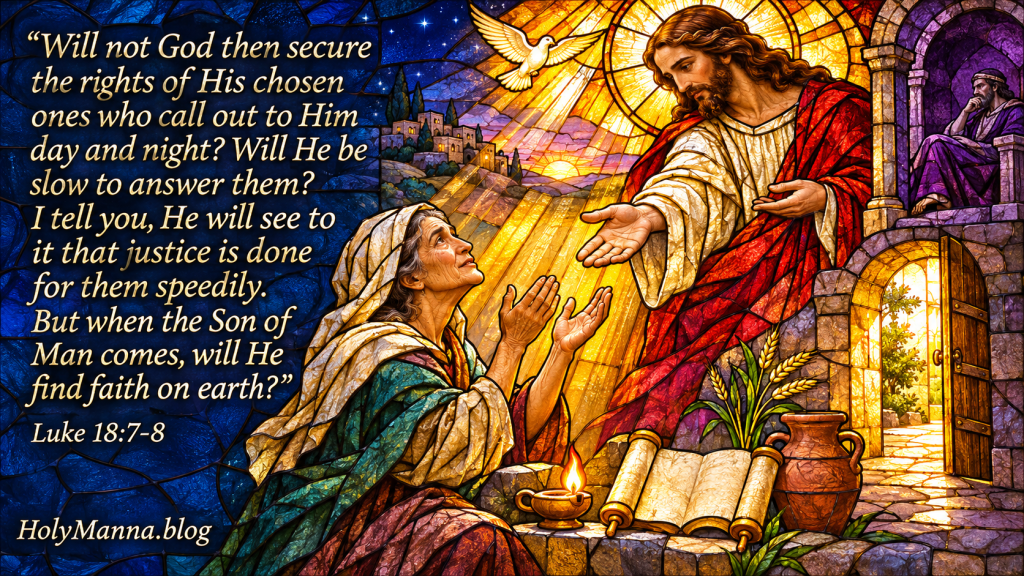
The Lord said, “Pay attention to what the dishonest judge says.
Will not God then secure the rights of his chosen ones
who call out to him day and night?
Will he be slow to answer them?
I tell you, he will see to it that justice is done for them speedily.
But when the Son of Man comes, will he find faith on earth?”
Detailed Exegesis
Verse 1
“Jesus told his disciples a parable about the necessity for them to pray always without becoming weary.”
Saint Luke gives the meaning before the parable. This is about prayer, and specifically about not quitting. The word for “becoming weary” describes losing heart, going slack from inner exhaustion. Jesus is naming a spiritual danger, not a bad habit.
Verse 2
“He said, ‘There was a judge in a certain town who neither feared God nor respected any human being.’”
Two things normally restrain a powerful person: conscience before God and concern for reputation. This judge has neither, and Saint Cyril of Alexandria does not soften the portrait of a man who “did not fear God or have any shame.”
Verse 3
“And a widow in that town used to come to him and say, ‘Render a just decision for me against my adversary.’”
The Greek tense indicates repeated, habitual action. She “used to come,” again and again, asking not for revenge but for justice. She has no bribe and no advocate. All she has is her presence and her voice, and she spends both relentlessly.
Verse 4
“For a long time the judge was unwilling, but eventually he thought, ‘While it is true that I neither fear God nor respect any human being,’”
The judge admits to himself exactly what the narrator said about him. He is not converting, only calculating, and Jesus lets the audience hear his reasoning so that the contrast with God will be unmistakable.
Verse 5
“‘because this widow keeps bothering me I shall deliver a just decision for her lest she finally come and strike me.’”
The verb translated “strike” literally means to hit under the eye, to give someone a black eye. The image is comic and fierce: a powerful judge afraid that a penniless widow will eventually punch him. Cyril of Alexandria sums it up: “The constant coming of the oppressed widow conquered the unjust judge… Even against his will, he granted her request.”
Verse 6
“The Lord said, ‘Pay attention to what the dishonest judge says.’”
Jesus wants the disciples to notice the judge’s own words, because the argument that follows is one of “how much more.” Saint Augustine states the principle: “These examples now are proposed so that important things may be suggested from things of less importance.” The parable works by contrast, not comparison.
Verse 7
“‘Will not God then secure the rights of his chosen ones who call out to him day and night? Will he be slow to answer them?’”
If a wicked judge yields to a stranger he despises, how much more will a loving Father answer His own chosen ones. Cyril of Alexandria asks in the same spirit: “How will not he who loves mercy and hates iniquity, and who always gives his helping hand to those that love him, accept those who draw near to him day and night and avenge them as his elect?”
Verse 8
“‘I tell you, he will see to it that justice is done for them speedily. But when the Son of Man comes, will he find faith on earth?’”
The promise and the question arrive together. God will act, and from heaven’s vantage point He acts speedily, even when years pass on earth. Then Jesus turns the lens around. The question was never whether God would be faithful, but whether His people will still be praying when He comes. Saint Augustine draws the connection tightly: “faith is the fountain of prayer.” When the fountain dries up, the stream stops.
Teachings
CCC 2613 places this parable at the heart of the Church’s teaching on prayer: “The second, ‘the importunate widow,’ is centered on one of the qualities of prayer: it is necessary to pray always without ceasing and with the patience of faith. ‘And yet, when the Son of Man comes, will he find faith on earth?’”
The Church has always understood prayer as a struggle. CCC 2573, reflecting on Jacob wrestling the angel, says that “the spiritual tradition of the Church has retained the symbol of prayer as a battle of faith and as the triumph of perseverance.” CCC 2742 teaches that “This tireless fervor can come only from love. Against our dullness and laziness, the battle of prayer is that of humble, trusting, and persevering love.”
Pope Francis, in his Angelus of October 20th, 2013, warned against making persistence a technique: “Pray always, but not in order to convince the Lord by dint of words!” God does not need to be worn down: “he is always listening and he knows everything about us lovingly.” He praised the widow’s maternal tenacity: “She knew how to battle for her children!” Saint Monica showed the same tenacity, praying for her wayward son Augustine for years until a bishop assured her that the son of such tears could not perish.
Reflection
The widow had nothing but persistence, and it was enough. You have far more than she did, yet it is easy to abandon a prayer after a week of silence.
Choose one intention you have quietly given up on, a conversion, a healing, a reconciliation, a vocation, and bring it before God every day for the next month, at a fixed time and place. Then pair prayer with action, as CCC 2745 urges, since the one who prays without ceasing unites prayer to works. Pray for the estranged friend and send the text. Pray for the poor and give.
What prayer have you stopped praying because the answer seemed too slow? Do you approach God like the widow, confident He will hear because He has promised to, or like someone who expects to be ignored? When the Son of Man comes, will He find you still knocking?
Still Knocking When He Comes
Put the three readings side by side and a single face emerges. It is the face of someone who does not stop.
Gaius does not stop opening his door, and strangers carry news of his love back to the Church. The man of Psalm 112 does not stop lending and giving, and his generosity becomes the one thing about him that endures forever. The widow does not stop walking into that courtroom, and a judge who fears no one finally does the right thing just to make her go away. None of them is spectacular. All of them are faithful, and faithful, Scripture insists, is what blessed looks like.
The Gospel ends with a question Jesus leaves hanging in the air: “when the Son of Man comes, will he find faith on earth?” It is a real question addressed to real disciples facing a long wait, and to every Christian living in the long Ordinary Time between Pentecost and the Second Coming. The answer is not written in advance. It is written in kitchens where a stranger is fed, in budgets where generosity is a line item, and in bedrooms where someone kneels for the thousandth time to pray for the same person by name.
So here is the invitation for November 14th. Pick one door to keep opening, one gift to keep giving, and one prayer to keep praying, and do not stop. Do not stop when it is inconvenient, when the silence stretches on, or when results seem nowhere in sight. The judge gave in because the widow kept coming. The Father, who is nothing like that judge, has already promised to hear. He asks only that His people still be there, hands open and voices raised, when He comes.
Engage With Us!
Today’s readings paint a portrait of faith that refuses to quit, in prayer, hospitality, and generosity. Share your reflections in the comments below. How have these readings spoken to your own walk with Christ, and where are you still waiting on God?
- In 3 John 5-8, Gaius is called a “co-worker in the truth” simply for supporting those who went out for the sake of the Name. Who in the Church’s mission could you support this week in a way worthy of God?
- Psalm 112:1-6 describes the man who fears the Lord as gracious, merciful, and just, mirroring God’s own attributes. Which of these is hardest for you to live out in your daily and financial affairs?
- In Luke 18:1-8, the widow keeps returning to a judge who will not listen. What prayer have you been tempted to abandon, and what would it mean to bring it back before God with her kind of persistence?
- Taken together, these readings suggest that persevering prayer and persevering generosity are two expressions of one living faith. When the Son of Man comes, what evidence of faith would He find in the ordinary patterns of your week?
A life of faith rarely looks dramatic. It looks like showing up again, opening the door again, and praying the same prayer again, trusting that the God who heard the widow also hears you. Keep coming back, do everything with the love and mercy Jesus taught, and let your faith be the kind He hopes to find when He returns.
Sacred Heart of Jesus, we trust in You!
Immaculate Heart of Mary, pray for us!
Saint Michael the Archangel, defend us in battle!
Follow us on YouTube, TikTok, Instagram and Facebook for more insights and reflections on living a faith-filled life.


Leave a Reply