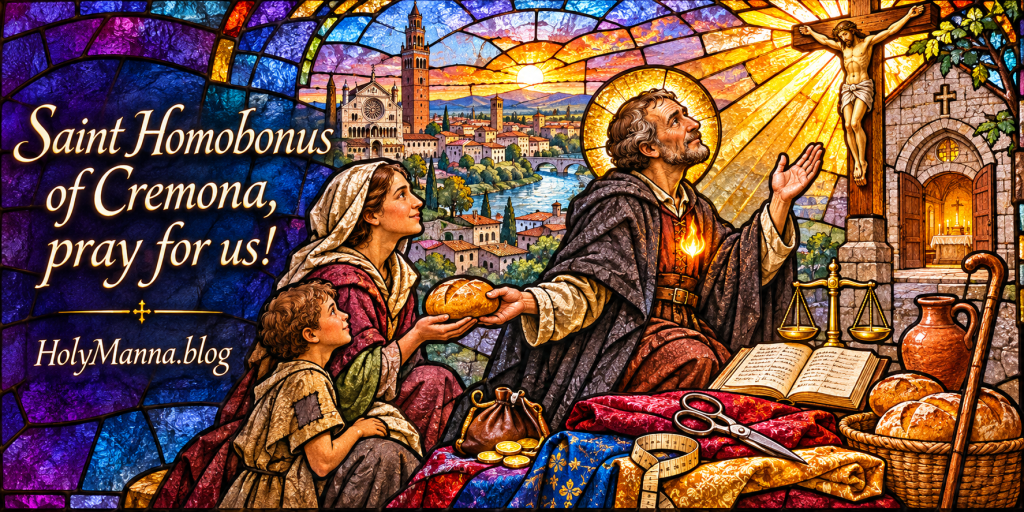
A Good Man in Name and in Deed
Most of the saints the Church puts before the faithful were priests, monks, nuns, bishops, kings, or martyrs. Saint Homobonus of Cremona was none of those things. He was a cloth merchant with a shop, a wife, children, a ledger, and a reputation in the marketplace. He never took vows, never wore a religious habit, and never wrote a line of theology. He simply bought and sold fabric with such honesty, gave away so much of what he earned, and prayed with such persistence that when he died on November 13th, 1197, the whole city of Cremona wanted him declared a saint. Pope Innocent III agreed, and in a bull issued only fourteen months after his death he described Homobonus as “a man good in name and deed.” The historian André Vauchez, whose work the Holy See itself cites, points out that Homobonus is the only layman from outside the nobility who was canonized by a pope during the entire Middle Ages. The Church holds him up as patron of the city and diocese of Cremona, of tailors and cloth workers, and of merchants and business people, and he is commonly invoked by shoemakers as well. His name in Latin, Homobonus, and in Italian, Omobono, means exactly what it sounds like: good man. The old Roman Martyrology keeps his memory on November 13th with the simple line, “At Cremona, the holy Confessor Homobonus, who was famous for miracles, and whose name Innocent III enrolled among those of the Saints.” For anyone who has ever wondered whether holiness is possible with a job, a mortgage, and a family, Homobonus is the answer the Church gives.
A Tailor’s Son in the New Quarter of Cremona
Homobonus was born in Cremona, a prosperous river city in Lombardy on the banks of the Po, sometime in the first half of the 12th century. One early life, Quoniam historiae, says he lived about eighty years, fifty of them in his trade and fifteen in a life of penance, which would place his birth around 1117, though other Catholic sources estimate closer to 1135. His family, the Tucenghi, were merchants, and a later life says his father was a tailor and cloth dealer who trained his son in the business from boyhood. Butler’s Lives of the Saints records that his father chose the name Homobonus at baptism on purpose and then set about teaching the boy to live up to it, forming him by word and example to prize honesty, integrity, and religion above profit.
The family lived in the Cittanova, the new city of Cremona, the quarter of the rising merchant class, and their home sat in the parish of Sant’Egidio, the church of Saint Giles. They also owned fields outside the city walls. The early sources disagree slightly about his exact trade. Quoniam historiae says he was a tailor first and later a merchant; Labentibus annis says he was both at once; the liturgical life Cum orbita solis stresses that he was a substantial cloth merchant who traded by land and sea. What every source agrees on is that he was successful and that he was scrupulously honest.
Butler puts it memorably: from childhood Homobonus hated even the shadow of untruth or injustice, and he would sooner suffer a great loss than commit a sin to avoid it. He looked on his trade as work entrusted to him by God, kept his accounts in order, and treated difficult customers with patience. On his parents’ advice he married a virtuous woman who ran the household well. The sources name a son, Monaco, and a later vernacular life speaks of two children, while one modern summary suggests the couple had none, so the record is honestly uncertain on that point. Pope John Paul II simply called him “an exemplary spouse and father.”
The decisive turn in his life came late. Around the age of sixty-five, roughly in the year 1182, Homobonus left his trade and embraced what the Church of his day called the life of penance. He did not enter a monastery or join a religious order. He made what the sources call a professio in signis, a public profession by outward signs, putting on the plain dark cloak and hair shirt of a penitent and giving up banquets, public entertainments, and the ordinary social life of a wealthy citizen. The sources offer different glimpses of what moved him. Cum orbita solis speaks of a painful trial that he endured, saying he was tested like gold in a furnace. Labentibus annis says he meditated on the brevity of life and on the Lord’s words in The Gospel of Matthew about storing up treasure in heaven. The Catechism teaches that “Jesus’ call to conversion and penance, like that of the prophets before him, does not aim first at outward works, ‘sackcloth and ashes,’ fasting and mortification, but at the conversion of the heart, interior conversion” (CCC 1430). Homobonus’s outward signs flowed from an inner change, and his penance took the three forms that The Catechism names explicitly: “fasting, prayer, and almsgiving” (CCC 1434).
The Shop, the Church, and the Poor
What did the penitential life of a retired merchant actually look like? The early life Quoniam historiae preserves his fasting rule in surprising detail. Throughout Lent he ate a single daily meal without meat, dairy, or eggs, except on Sundays. On Good Friday he took only bread and water. He fasted on the Ember days, throughout Advent, every Friday and Saturday of the year, and on the vigils of the great feasts, and for four days a week during the rest of the year he ate no meat. This was a layman, in his own house, with no superior to enforce any of it.
His prayer was just as disciplined. He attended Mass every day and kept the full round of the Hours from Matins through Vespers. When he could not be in church, he prayed at the hours the bells announced. Butler describes his habit of walking to the church of Saint Giles a little before midnight each night to assist at Matins, then remaining, often lying prostrate before the crucifix, until the morning Mass had ended. The crucifix tied to his memory is still kept in the church where he prayed. In this he was living what The Catechism calls the heart of Christian life: “The Eucharist is ‘the source and summit of the Christian life’” (CCC 1324).
Prayer and fasting overflowed into charity, and charity is what Cremona remembered. Every one of the early lives calls him pater pauperum, father of the poor. He gave alms generously, opened his home to the poor and to pilgrims, fed and housed them, and personally saw to the burial of the abandoned dead. The bull of canonization notes that he was always early to church unless he was out seeking alms on behalf of the poor, which means this wealthy man was willing to go begging for others. His last years, from 1186 to 1197, coincided with a prolonged famine across the region, so his generosity met a real and desperate need. Butler records that he set aside a tenth of his income for the needy and sought out the poor in their own homes. Butler also reports that when his wife complained that his almsgiving would ruin the family, Homobonus answered that giving to the poor was like lending at high interest with Christ himself as the guarantor. That line is Butler’s paraphrase rather than a verbatim saying, but it captures a conviction the sources agree he held.
Here the Church’s teaching illuminates the saint. The Catechism names the exact works Homobonus practiced: “The works of mercy are charitable actions by which we come to the aid of our neighbor in his spiritual and bodily necessities. Instructing, advising, consoling, comforting are spiritual works of mercy, as are forgiving and bearing wrongs patiently. The corporal works of mercy consist especially in feeding the hungry, sheltering the homeless, clothing the naked, visiting the sick and imprisoned, and burying the dead” (CCC 2447). Burying the dead, the work almost nobody wants, was the one he is specifically remembered for.
Homobonus also matters because of how he treated money while he was still making it. The Church has never taught that wealth is evil, but it has always taught that it is owed to others. The Catechism explains that “in his use of things man should regard the external goods he legitimately owns not merely as exclusive to himself but common to others also, in the sense that they can benefit others as well as himself” (CCC 2404). Homobonus seems to have understood his shop in exactly this way. He also refused to cheat. The Catechism lists among the sins against the seventh commandment “business fraud; paying unjust wages; forcing up prices by taking advantage of the ignorance or hardship of another” (CCC 2409). In a city where such things were ordinary, a merchant who would not do them stood out enough to be canonized.
Beyond the shop and the poor, Homobonus was a peacemaker. Cremona in his lifetime was torn between the old aristocratic families and the merchant class of the new city, and it was troubled by Cathar heresy. The bull of canonization calls him vir pacificus, a man of peace, and haereticorum aspernator, one who rejected heretics. John Paul II summarized the tradition this way: he “did his utmost to settle the controversies which broke out between factions and families in the city” while he “safeguarded the integrity of the Catholic faith faced with heretical infiltrations.” The diocesan historian Don Daniele Piazzi is careful to say that the details of this peacemaking are a hypothesis rather than a documented fact, since the sources are thin, but the title given by the pope himself, “man of peace and peacemaker,” is secure. The Catechism teaches that “peace is not merely the absence of war, and it is not limited to maintaining a balance of powers between adversaries” (CCC 2304).
Several stories are told about wonders worked through him during his life. One tradition holds that he was in the habit of going to Sant’Egidio before dawn and having the priest Oberto unlock the doors for him, and that one morning the doors, which had been firmly locked the night before, opened of their own accord as he approached. This cannot be verified. Another tradition, still retold in Cremona, says that while he was carrying jars of wine to the laborers in his vineyard outside the walls he met some thirsty poor people and gave them all of it; afraid to arrive with empty jars, he filled them at a spring and made the sign of the cross over them, and the workers declared they had never tasted better wine. The same tradition speaks of bread multiplying in his hands for the poor. These stories cannot be verified, and they do not appear in the early critical sources. The early life Quoniam historiae does tell of demons beating him in his vineyard, and the miracle list Omnipotens Deus says that his hands turned black from handling money until his confessor told him to give it to the poor. The diocese itself treats both as pious tales, and neither can be verified. Butler, writing with more restraint, says only that God often rewarded the charity of Homobonus with miracles on behalf of those he helped and by multiplying his stores.
The Cost of an Honest Life
Homobonus was never persecuted for the faith, and he was not martyred. His hardships were the ordinary and exhausting kind, which makes them easier to recognize. Pope John Paul II identified three fronts on which he had to struggle. The first was his own home, because his wife did not share his choices. A wife watching her husband give away the family’s wealth and pour his nights into a church could hardly have found it easy, and one later account says he led relief efforts during the plagues of 1147 and 1192 against her wishes. The second front was his parish, which looked on his austerity with suspicion. A layman who fasted like a monk and lay prostrate on the church floor every night was bound to attract raised eyebrows from the very people he worshipped beside. The third front was his trade, where, in the pope’s words, he faced “the competition and bad faith of some who tried to cheat the honest merchant.” An honest man in a dishonest market pays for his honesty every day.
He bore all of this quietly. He did not retreat from the city, abandon his family, or lower his standards. He kept the fasts, kept the Hours, kept the poor, and kept the peace. The Catechism describes this kind of perseverance when it teaches that “the way of perfection passes by way of the Cross. There is no holiness without renunciation and spiritual battle” (CCC 2015). It also explains why a layman, and not only a priest or religious, can be called to this: “All Christians in any state or walk of life are called to the fullness of Christian life and to the perfection of charity” (CCC 2013). Homobonus lived that sentence eight centuries before the Second Vatican Council wrote it down.
His death was the perfect summary of his life. Before dawn on November 13th, 1197, he went as usual to Sant’Egidio for Matins and then knelt before the crucifix waiting for Mass. As the Gloria was intoned, he stretched out his arms in the form of a cross and sank forward onto the floor. Those around him assumed he was lost in devotion. When the Gospel was read and he did not rise, they went to him and found that he had died. Every early source agrees on the day and the manner of his death. John Paul II wrote that he “ended his earthly life contemplating the Crucifix, while attending Mass in his city parish of St Giles, as was his daily custom.” For a man whose whole spirituality was built on the crucifix and the Eucharist, it is hard to imagine a more fitting end.
The Tomb That Became a City’s Heart
Almost immediately, reports of miracles at his tomb began to spread and pilgrims began to come. Bishop Sicard of Cremona, who recorded him in his own chronicle as a simple man of great faith and devotion, examined his virtues and the reported miracles and then went to Rome as a pilgrim, accompanied by the parish priest Osbert and a group of citizens, to ask the new pope, Innocent III, to canonize him. The pope, in John Paul II’s words, acted “after having evaluated the numerous testimonies, some written, of the miracles attributed to the intercession of Homobonus.” In January 1199, barely a year into his own pontificate and only fourteen months after the merchant’s death, Innocent III issued the bull Quia pietas and enrolled Homobonus among the saints. The Holy See gives the date as January 12th, while the Bollandist scholarly edition of the sources gives January 11th, and Butler’s older account gives the year as 1198; the discrepancy is a matter of dating conventions rather than a real dispute. In that bull the pope called him “father of the poor,” “consoler of the afflicted,” “assiduous in constant prayer,” “man of peace and peacemaker,” and “a man good in name and deed.” John Paul II added that the saint “is still like a tree planted by streams of water that yields its fruit in our time,” borrowing the image of Psalm 1.
The miracles that moved Innocent III were collected in the dossier that became the early lives, and while those documents affirm many healings and favors at his tomb, the specific accounts that survive are sparse, and none can be individually verified today. A later tradition holds that in 1698 the city of Modena proclaimed him its co-patron after a pestilence stopped on his feast day; this rests on a single secondary account and cannot be verified. What can be verified is the relentless devotion of Cremona. A 14th-century chronicle says Bishop Sicard moved the saint’s body to the cathedral in 1202, though the diocese also records that his body rested in a marble ark in Sant’Egidio until 1614, when it was carried in solemn procession with the relics of the city’s other protectors to the crypt of the cathedral, where it remains. The two accounts are not easily reconciled, and the honest answer is that the early history of the relics is uncertain. His head is said to be preserved in the church where he died, which was retitled in his honor in 1363 and is now the church of Sant’Omobono.
In 1592 the cathedral of Cremona was dedicated jointly to him and to the Assumption of the Blessed Virgin. In 1643, after Pope Urban VIII asked every city to choose a single principal patron whose feast would be a day of obligation, the city council of Cremona considered four candidates and, after months of deliberation, voted thirty-seven to two to five for Homobonus. John Paul II noted the “immense joy” and “tears of devotion” of the people at that choice. To this day, on every November 13th, the civic authorities of Cremona descend into the cathedral crypt for the traditional offering of candles at his tomb, and the city’s artisans present the bishop with lengths of cloth at the offertory of the pontifical Mass. The Diocese kept a Year of Saint Homobonus from November 13th, 1997, to January 12th, 1999.
His cult spread well beyond Lombardy. In Rome a church was given to the tailors’ guild in 1575 and rededicated to him as Sant’Omobono, a town near Bergamo bears his name, and a hospital in Freetown, Sierra Leone, is named for him. In Cremona people still say of someone who asks for too much money, “non ho mica la borsa di Sant’Omobono,” meaning that the speaker does not have the purse of Saint Homobonus, since his purse, always open to the poor, is his emblem in art along with the merchant’s cloak and the beggar at his side. In recent decades he has been rediscovered in the United States as the patron of business people, and small statues of him are sold as desk ornaments to executives who may not know the half of his story.
Holiness With a Ledger
The temptation, when reading about a saint who fasted on bread and water and prayed through the night, is to file him under impossible and move on. But Homobonus refuses to be filed there. He had a job, a spouse who did not always understand him, neighbors who gossiped, competitors who cheated, bills, inventory, and customers. The Church canonized him not in spite of those things but through them. The Catechism teaches that the laity have a vocation “to seek the kingdom of God by engaging in temporal affairs and directing them according to God’s will” (CCC 898), and that their work itself can be an offering, since “all their works, prayers, and apostolic undertakings, family and married life, daily work, relaxation of mind and body, if they are accomplished in the Spirit . . . become spiritual sacrifices acceptable to God through Jesus Christ” (CCC 901).
Start where he started: with honesty. What would change in your work this week if you resolved, as he did, to suffer a loss rather than tell a lie or cut a corner? Most people are never asked to commit a great fraud; they are asked, a hundred times a year, to shade a number, oversell a product, or stay quiet about a mistake. Homobonus treated each of those small moments as a question about his soul. The Catechism reminds the faithful that “economic activity . . . is to be exercised within the limits of the moral order” (CCC 2426).
Then look at what he did with what he earned. The tithe he set aside as a young man became, in old age, a complete reorientation of his wealth toward the poor. Do you know the names of any poor people, or are the poor only a category to you? Homobonus went to their homes. He buried the ones no one else would bury. The Catechism is blunt about the stakes: Our Lord “makes charity to the poor a condition of entering his kingdom” (CCC 2443, citing Matthew 25:31 to 46). A practical step is simple. Pick one corporal work of mercy and do it this month, in person, not only with a donation.
Then consider his prayer. Not everyone can rise at midnight for Matins, and most should not try. But Homobonus prayed at the bells when he could not be in church, which means he let the hours of the day call him back to God. What would it look like for you to let three fixed moments of your day, morning, midday, and evening, become appointments with the Lord? Daily Mass, even once or twice a week beyond Sunday, was the engine of his whole life, and The Catechism teaches that “the Church warmly recommends that the faithful receive Holy Communion each time they participate in the celebration of the Eucharist” (CCC 1417).
Finally, remember that he was a man of peace in a city of factions. Is there a conflict in your family, parish, or workplace where you could be the one who refuses to pick a side for the sake of winning and chooses instead to make peace? Saint Homobonus never founded an order, never preached a sermon, never left the city where he was born. He sold cloth honestly, gave his money away, prayed every day, made peace, and died before the crucifix at Mass. The Church looked at that life and saw a saint. If the Church looked at your ordinary week, what would it see?
Engage With Us!
Saint Homobonus has a way of unsettling the excuse that holiness is for other people. Share your thoughts and reflections in the comments below, especially if his story touched something in your own work, family, or prayer life. Here are a few questions to get the conversation going:
- Homobonus believed that his business was work entrusted to him by God. Do you see your own job that way, and what would change if you did?
- He would rather take a financial loss than commit even a small dishonesty. Where in your work or finances are you most tempted to cut corners, and what would it cost you to stop?
- His wife did not always share his choices, and his parish looked on him with suspicion. How do you respond when the people closest to you do not understand your faith?
- He was called father of the poor because he went to them in person. Who are the poor in your own life, and how could you go to them this month?
- He died with his arms outstretched before the crucifix during the Gloria at Mass. What would it mean for you to let the Mass become the center of your week rather than one item on your schedule?
Saint Homobonus shows that a counter, a ledger, and a family dinner table can be the road to heaven when they are walked in honesty, generosity, and prayer. Take his example to work tomorrow. Be honest when it costs you, open your hand to someone who cannot repay you, and find a few minutes before a crucifix to let the Lord look at you. Live every ordinary day with the love and mercy that Jesus taught us, and trust that God sees it all.
Saint Homobonus of Cremona, father of the poor, pray for us!
Follow us on YouTube, TikTok, Instagram and Facebook for more insights and reflections on living a faith-filled life.


Leave a Reply