The Shepherd Who Would Not Bend
Only 4 popes in the entire history of the Church carry the title “the Great” in the Annuario Pontificio, the Vatican’s official yearbook: Saint Leo I, Saint Gregory I, John Paul II and Saint Nicholas I. Nicholas, the least famous of the four, did something quieter and in some ways harder. He held the line on marriage, on the authority of Peter’s successor, and on the dignity of the human person at a moment when the whole Western world seemed to be sliding into chaos. He simply refused to let powerful men rewrite the Gospel for their own convenience, and he did it while quietly feeding the blind and the crippled of Rome from a list he kept himself.
The Church remembers him on November 13th, the anniversary of his death in 867. The 2004 Roman Martyrology honors him at Saint Peter’s in Rome as the pope who undertook with apostolic vigour to strengthen the authority of the Roman Pontiff in the whole Church of God. The Catechism explains why that matters. The pope, as Bishop of Rome and Peter’s successor, is the perpetual and visible source and foundation of the unity both of the bishops and of the whole company of the faithful (CCC 882). When bishops take bribes, when kings discard their wives, when a patriarch is installed by an emperor’s whim, somebody has to be the rock. For 9 years and 7 months, Nicholas was that rock.
A Roman Boy in the Shadow of the Lateran
Nicholas was born in Rome, and that is about the only thing the sources agree on. The Catholic Encyclopedia states plainly that his birth date is unknown. Vatican News places it around the year 800, while other Catholic references propose 820 or 825. Whatever the year, he came from a distinguished Roman family. His father, Theodore, held the office of Defensor, a legal and administrative post in the service of the Roman Church, which means Nicholas grew up inside the machinery of the papacy. He was educated at the Lateran, the pope’s own residence, and from his youth he was known for piety, intelligence, and eloquence.
There is no dramatic conversion story in his life. His was the slower, steadier path of a young man who was given the faith early and never let go of it. Pope Sergius II made him a subdeacon between 844 and 847. Pope Saint Leo IV ordained him a deacon. Under Pope Benedict III he became the chief adviser to the Holy See. Benedict died in April of 858, and Emperor Louis II, the Carolingian ruler of Italy, came into Rome to influence the election. On April 24th, 858, Nicholas was elected, consecrated, and enthroned in Saint Peter’s, all on the same day and in the emperor’s presence. There is a story, told by the Renaissance papal historian Platina, that when Nicholas heard of his election he fled and hid in the Vatican, and that the electors had to find him and carry him to the Lateran, where they placed him on the papal chair against his will. It is a lovely picture of a man who did not want power for its own sake, but no contemporary source confirms it, and it cannot be verified.
Three days after his consecration, Nicholas gave a farewell banquet for the emperor. Afterward he rode out to the imperial camp, and there the most powerful man in Western Europe dismounted, took the pope’s horse by the bridle, and led him on foot for some distance. The emperor had helped make this pope. The pope was about to show him that the Church did not belong to emperors.
Governing Like a Father, Not a Prince
To understand why Nicholas matters, picture his world. Charlemagne’s empire was splitting into feuding kingdoms, and Vikings were raiding up the rivers of France. The Catholic Encyclopedia describes a Western Europe in which Christian morality was openly despised and many bishops were worldly men unworthy of their office. Into that mess stepped a pope who, in the words of the same source, lived a life of earnest Christian asceticism and profound piety.
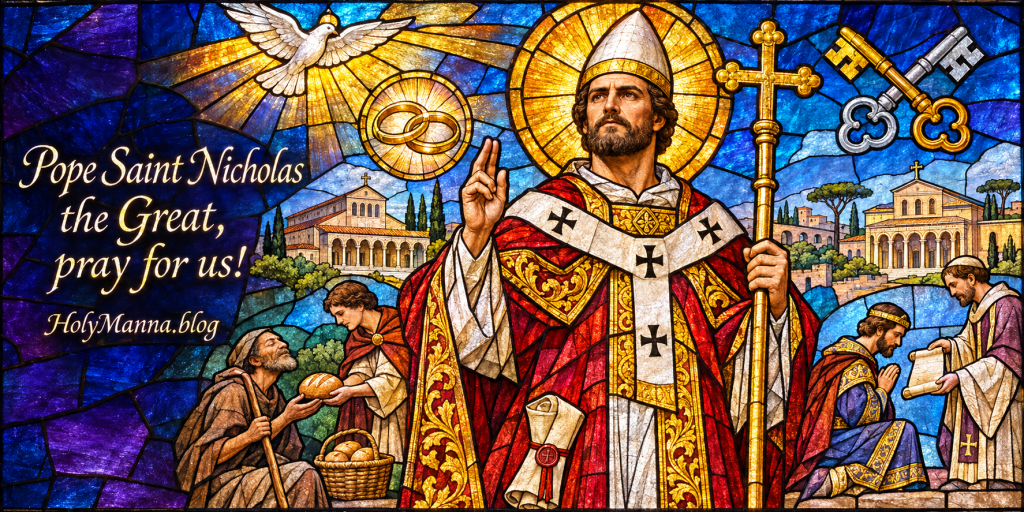
His holiness showed first in how he treated the poor. The Liber Pontificalis, the ancient book of the lives of the popes, preserves details that are easy to skip and impossible to forget. Like Saint Gregory the Great before him, Nicholas kept a list of every blind and disabled person in Rome and had food sent to each of them every single day. The poor who could walk came to the Lateran for provisions on an assigned day of the week, and so that no one would forget which day was theirs, each received a token bearing the pope’s name, with a number of knots formed from nuts to mark the day. He visited the sick regularly, and whatever alms they entrusted to him he distributed to the poor in secret, by night as well as by day. He poured money into the deaconries and hospitals that fed the hungry, and he rebuilt and endowed churches not only in Rome but in Albano, Palestrina, Porto, Ostia, Velletri, Orvieto, and as far away as Ravenna. This is the man the chronicles call a terror to tyrants. He was also the man who knew which day the beggar at the Lateran gate was supposed to show up. The Catechism teaches that the works of mercy are charitable actions by which we come to the help of our neighbor in his spiritual and bodily necessities (CCC 2447). Nicholas did not delegate them.
His holiness showed second in how he handled bishops who had forgotten they were shepherds. Archbishop John of Ravenna was oppressing the people of the papal territory, imprisoning priests, forging documents against Rome, and abusing papal legates. Nicholas summoned him 3 times, and when he ignored every summons, excommunicated him, traveled to Ravenna in person, and set the diocese in order. John submitted at a Roman synod in November 861, relapsed, and was forced to submit again. The formidable Archbishop Hincmar of Reims tried to block Bishop Rothad of Soissons from appealing his deposition to Rome. Nicholas insisted, and Hincmar was finally compelled to acknowledge that the pope had the right to judge the major cases of the Church. The Catechism expresses the principle Nicholas defended when it says that the Roman Pontiff has full, supreme, and universal power over the whole Church, a power which he can always exercise unhindered (CCC 882).
His holiness showed third in the way he treated people he had every political reason to crush. When Prince Boris of Bulgaria, newly baptized, sent an embassy to Rome in the summer of 866 with 106 questions about how a Christian nation should live, Nicholas wrote the Responsa ad consulta Bulgarorum, a long, patient, pastoral letter that is one of the most humane documents of the Middle Ages. He answered it on November 13th, 866, exactly one year to the day before he died. Boris asked whether pagans who refused the faith could be forced to accept it. Nicholas said no. Such people should be won by warnings, exhortation, and reason, never by force, because, as he wrote, everything which is not voluntary, cannot be good. The Catechism teaches the same thing 11 centuries later: nobody is to be forced to embrace the faith against his will. The act of faith is of its very nature a free act (CCC 160). Boris asked whether a suspected thief could be tortured until he confessed. Nicholas answered that a confession must be spontaneous and voluntary, never dragged out of a man by violence, and the Catechism echoes him: torture which uses physical or moral violence to extract confessions, punish the guilty, frighten opponents, or satisfy hatred is contrary to respect for the person and for human dignity (CCC 2297). Boris asked about executions. Nicholas told the prince that just as Christ had rescued him from eternal death, so he should labor to free from the punishment of death not only each of the innocent, but all the guilty as well. Pope Francis quoted those exact words in the encyclical Fratelli Tutti in 2020, and the Catechism now teaches that the death penalty is inadmissible because it is an attack on the inviolability and dignity of the person (CCC 2267).
Honesty requires one plain statement here. No Catholic source records any miracle worked by Nicholas during his lifetime. His greatness was of a different kind. It was the daily, grinding fidelity of a man who did the right thing when the wrong thing would have been so much easier.
The King, the Mistress, and the Pope Who Said No
The fight that defines Nicholas began in a royal bedroom. King Lothair II ruled Lotharingia, roughly the lands between France and Germany. He had married Theutberga for political reasons, but his heart belonged to Waldrada, who had been his mistress since before the wedding. Theutberga had borne him no children. Lothair wanted her gone and Waldrada crowned, and the bishops of his kingdom, who owed him everything, gave him what he wanted. Theutberga was accused of unspeakable crimes, coerced into a confession, and at the Synod of Aachen on April 28th, 862, the bishops of Lorraine declared the marriage over and approved the union with Waldrada.
Theutberga appealed to Rome. Nicholas ordered a new synod at Metz in June 863 and sent 2 legates to investigate. Lothair bribed them. The legates assented to the Aachen decision and condemned Theutberga, who had not even been invited to attend. Two archbishops, Günther of Cologne and Theutgaud of Trier, both rumored to be relatives of Waldrada, carried the synod’s document to Rome, expecting the pope to ratify it.
Nicholas read it, rejected it, and did something no pope had ever done. At the Lateran Synod in October 863 he annulled the Synod of Metz as a heretical assembly, deposed Günther and Theutgaud from their sees, and for good measure deposed John of Ravenna and Hagano of Bergamo as well. It was exactly what the Gospel demanded. Jesus had said, What God has joined together, no human being must separate (Matthew 19:6). The Catechism teaches that the matrimonial union of man and woman is indissoluble: God himself has determined it (CCC 1614), and that a consummated marriage between the baptized can never be dissolved (CCC 1640).
The response was swift and violent. The deposed archbishops ran to Emperor Louis II, Lothair’s brother, and in February 864 the emperor marched on Rome with an army. The Frankish annals of the time record what happened next. The pope had ordered a fast and a penitential procession to Saint Peter’s. The emperor’s soldiers attacked the procession, and the great processional cross was broken and thrown into the mud. Nicholas took refuge in Saint Peter’s Basilica and remained there for 2 days without food. Then the emperor fell ill with a fever. The annals add that the man who had broken the cross died soon afterward, and the people of Rome took the emperor’s sickness as a judgment from heaven. The fever and the reconciliation are documented history; whether the soldier’s death was a divine judgment is a story of the time and cannot be verified. What is certain is that Empress Engelberga brokered peace, the emperor withdrew, and he ordered the deposed archbishops to go home. Nicholas had not moved an inch.
In August 865 a papal legate forced him to take Theutberga back publicly. In 866 Lothair pressured Theutberga herself into writing to the pope, asking for a divorce on the grounds that she was sterile and begging permission to enter a convent. Nicholas saw through it. He replied that sterility was no ground for divorce and, with a flash of the sharpness that made him feared, added that her childlessness was the fruit not of her body but of Lothair’s wickedness. When rumors spread that the king might simply have his wife murdered, Nicholas declared that even if Theutberga died, Lothair could never marry Waldrada, because he had committed adultery with her. The Catechism names the sin exactly: Divorce is a grave offense against the natural law. It claims to break the contract, to which the spouses freely consented, to live with each other till death (CCC 2384). Lothair died in 869 without a legitimate heir, and his kingdom was carved up by his uncles. The pope who had been besieged in his own basilica had won.
Nicholas was no enemy of marriage itself, only of its abuse. When Judith, daughter of Charles the Bald, eloped with Count Baldwin of Flanders without her father’s consent and the Frankish bishops excommunicated her, Nicholas urged leniency in order to protect the freedom of marriage. The rule was the same for kings and countesses. A promise made before God binds everyone.
A Storm From the East
The second great struggle of his pontificate reached him from Constantinople. In 858 the Byzantine emperor Michael III deposed the saintly Patriarch Ignatius for political reasons and installed Photius, a brilliant layman who was rushed through the clerical orders in a matter of days. Both sides appealed to Rome. Nicholas sent 2 legates to a council at Constantinople in 861 with strict instructions to examine the case. The legates were pressured and bribed into approving Photius. When they returned, Nicholas repudiated their actions, wrote to the Eastern patriarchs on May 8th, 862, calling on them to refuse recognition to Photius, and at a Roman synod in April 863 he excommunicated Photius and declared Ignatius the lawful patriarch.
In 865 he wrote Michael III a letter that became famous. The emperor had demanded that the pope submit. Nicholas answered by quoting Pope Gelasius from 4 centuries earlier, reminding the emperor that Christ himself had distinguished the duties and dignities of the 2 powers, so that Christian emperors would need the bishops for eternal life and the bishops would need the emperors for the ordering of earthly affairs. The Catechism expresses the same principle when it teaches that the Church is not to be confused in any way with the political community and is both the sign and the safeguard of the transcendent character of the human person (CCC 2245).
Photius struck back. In 867 he convened a synod at Constantinople that purported to excommunicate the pope, condemned Rome’s primacy and her missionary work in Bulgaria, and attacked the Western use of the word Filioque in the Creed. It was the opening wound of the Photian Schism and the first clear expression of the grievances that would one day divide East and West. Nicholas never learned of it. The news reached Rome only after his death. But Providence moved quickly. In late September 867 a palace revolution brought Basil I to the Byzantine throne, Photius was deposed, and on November 23rd, 10 days after Nicholas died, Ignatius was restored to his see. The Fourth Council of Constantinople in 869 and 870, which the Catholic Church counts as the eighth ecumenical council, confirmed everything Nicholas had decided.
He had carried all of this while sick; one account says he had been ill for several years. In his final year he summoned 2 Greek brothers who were evangelizing the Slavs in Moravia to come to Rome and defend their work. Their names were Cyril and Methodius. They arrived carrying the relics of Pope Saint Clement, but too late to meet the pope who had called them; it was his successor, Adrian II, who received them and approved their Slavonic liturgy. Nicholas died in Rome on November 13th, 867, and was buried in Saint Peter’s, according to Platina in the porch of the basilica, in the place he himself had chosen. The Catechism describes the virtue that carried him: fortitude is the moral virtue that ensures firmness in difficulties and constancy in the pursuit of the good (CCC 1808).
After the Tomb
Here HolyManna must be honest with you, because Nicholas would have demanded it. There are no recorded healings at his tomb, no apparitions, no incorrupt body, no miraculous rescues attributed to his intercession in the Catholic sources. The old Saint Peter’s where he was buried was torn down and rebuilt in the sixteenth and seventeenth centuries, and no separate shrine or pilgrimage ever grew up around his name. His portrait survives among the medallions of the popes that ring the Basilica of Saint Paul Outside the Walls in Rome, in the long line of Peter’s successors.
The miracle of Nicholas is his reputation. The Catholic Encyclopedia reports that he was regarded as a saint immediately after his death, by the Romans who had watched him feed their poor and by his contemporaries across Europe. His feast was kept on December 6th until 1883, when it was moved to November 13th, the day of his death. The most moving testimony comes from Regino, abbot of Prüm, writing only a generation later. In his chronicle for the year 868 he declared that since the days of Gregory the Great no pope seated on the throne of Peter could be compared with Nicholas. In the English rendering of his Latin, He tamed kings and tyrants, and ruled the world like a sovereign: to holy bishops and clergy he was mild and gentle, to the wicked and unconverted a terror; so that we might truly say a new Elias arose in him. A new Elijah. That is the judgment of history on a man who never performed a sign.
His influence after death ran in three directions. In the West, his insistence that the pope could hear appeals from any Christian and judge any bishop became the settled law of the Church, and his defense of Theutberga became the model for every later pope who refused a king’s divorce. In the East, the wound of the Photian affair never fully healed, and the tragedy of 1054 cast its first shadow in 867. In Bulgaria, Boris eventually chose Constantinople in 870, but the Responsa remained, and Bulgarian historians still treat it as the foundational document of their nation’s Christian law and customs.
Backbone and Tenderness in the Same Heart
What should a Catholic in the 2020s take from a pope of the 860s? Start with this. Nicholas never confused kindness with weakness, and he never confused firmness with cruelty. The same man who told a king that sterility was no excuse for divorce was the man who kept a list of Rome’s blind so that none of them would go hungry. The same man who deposed 2 archbishops told a Bulgarian prince that nobody should ever be forced into the faith. His backbone and his tenderness came from the same source, which was love of God and love of the people God had entrusted to him. The Catechism describes that union when it says the fruits of charity are joy, peace, and mercy and that charity demands beneficence and fraternal correction (CCC 1829).
Where in your own life have you been tempted to let a hard truth slide because speaking it would cost you something? Lothair had bishops, armies, and an emperor for a brother. Nicholas had a fast, a procession, and a cross that got thrown in the mud. He still said no. Saint Paul told Timothy to proclaim the word; be persistent whether it is convenient or inconvenient; convince, reprimand, encourage through all patience and teaching (2 Timothy 4:2).
Who are the blind and the disabled on your list? You probably do not keep a literal register of the poor in your city, but you could keep one in your heart. The elderly neighbor nobody visits. The coworker going through a divorce. The relative who has drifted from the Church and is too proud to say how lonely he is. Nicholas sent food every day to people who could not come and get it. Pick one person this week who cannot come to you, and go to them.
Do you believe that faith must be free? It is easy to nod at CCC 160 and then nag a spouse or a child toward Mass with guilt and pressure rather than with warmth and witness. Nicholas told Boris that nothing which is not voluntary can be good. The same applies to the people at your kitchen table. Invite, model, pray, and trust God with the rest.
Finally, consider how Nicholas handled defeat. He never saw Lothair repent. He never saw Boris come back to Rome. He never learned that Photius had fallen and Ignatius had been restored. He died with every one of his great battles apparently unresolved, and every one of them was vindicated after his death. Are you willing to be faithful without seeing the results? That is what sanctity usually looks like. The fruit comes later, and often it comes for someone else.
Engage With Us!
The story of Pope Saint Nicholas I is a story about standing firm with a soft heart, and HolyManna would love to hear what it stirred in you. Share your thoughts and reflections in the comments below.
- Nicholas refused to approve a royal divorce even when an army surrounded him. Where is God asking you to hold a line in your marriage, your family, or your friendships, and what is it costing you?
- He kept a personal list of the blind and disabled of Rome and fed them daily. Who are the people in your life who cannot come to you, and how could you go to them this week?
- Nicholas told a newly converted prince that no one should be forced to believe, because nothing that is not voluntary can be good. Does the way you share your faith with the people closest to you look more like force or more like invitation?
- He died without seeing a single one of his great struggles resolved. Where are you being asked to stay faithful without any visible results, and how can his example help you persevere?
- Regino called him mild to the good and a terror to the wicked. Which of those two comes more naturally to you, and how might you grow in the other?
Pope Saint Nicholas the Great never saw a vision or worked a wonder. He simply got up every day, fed the poor, told the truth to the powerful, and trusted God with the outcome. That is a holiness within reach of every one of you. So go and live your faith with courage this week, and do it all, the hard conversations and the hidden kindnesses alike, with the love and mercy that Jesus taught us.
Pope Saint Nicholas the Great, pray for us!
Follow us on YouTube, TikTok, Instagram and Facebook for more insights and reflections on living a faith-filled life.


Leave a Reply