Memorial of Saint Frances Xavier Cabrini, Virgin (In the USA) – Lectionary: 495
Keep Walking, Don’t Look Back
Some people spend their whole lives looking over their shoulder, and others spend them sprinting past every signpost. The readings for Friday, November 13th, the Memorial of Saint Frances Xavier Cabrini in the United States, speak to both. The central theme is fidelity in motion. The Christian life is a road, and the only way to stay on it is to keep walking in the truth that was handed down, neither racing ahead of it nor turning back.
In the First Reading, the Elder who wrote The Second Letter of John warns a beloved community about teachers so “progressive” that they have walked right out of the teaching of Christ. The Responsorial Psalm answers with the steady confidence of Psalm 119, where blessedness belongs to those who walk in the law of the Lord and who beg him not to let them stray. The Gospel from The Gospel of Luke shows the opposite ditch on the same road, the one Lot’s wife fell into when she looked back at the city she had been told to leave.
These readings arrive in the final weeks of the liturgical year, when the Church turns the eyes of her children toward the end of all things. Saint Frances Xavier Cabrini fits the day beautifully. She had dreamed of China since girlhood, and when Pope Leo XIII told her, “Not to the East, but to the West,” she sailed for New York in 1889 and gave the rest of her life to immigrants who had nothing. Canonized by Pope Pius XII in 1946 as the first United States citizen raised to the altars, and named Patroness of Immigrants in 1950, she never looked back and never ran ahead of the Church that sent her. That is exactly the road these readings describe.
First Reading — 2 John 4-9
A Short Letter with a Long Reach
The Second Letter of John is the shortest book in the entire Bible, only thirteen verses. Its author calls himself simply “the Presbyter,” the Elder, and the Church has traditionally identified him with Saint John the Apostle writing from the region of Ephesus near the end of the first century. He addresses a “chosen Lady” and “her children.” Most Catholic commentators understand the Lady as a local church and her children as its members, since the letter slides between singular and plural and closes with greetings from the children of her “chosen sister,” another congregation.
The community was being visited by traveling teachers who denied that Jesus Christ had come in the flesh, an early form of the error later called Docetism, from the Greek word dokeō, “to seem,” because it held that Christ only seemed to have a body. The Elder does not answer with a treatise. He answers like a pastor: love one another, walk in the commandments, and stay inside the teaching you received. The reading names the first way a believer leaves the road, which is by running ahead of it.
2 John 4-9
[Chosen Lady:]
I rejoiced greatly to find some of your children walking in the truth
just as we were commanded by the Father.
But now, Lady, I ask you,
not as though I were writing a new commandment
but the one we have had from the beginning:
let us love one another.
For this is love, that we walk according to his commandments;
this is the commandment, as you heard from the beginning,
in which you should walk.Many deceivers have gone out into the world,
those who do not acknowledge Jesus Christ as coming in the flesh;
such is the deceitful one and the antichrist.
Look to yourselves that you do not lose what we worked for
but may receive a full recompense.
Anyone who is so “progressive”
as not to remain in the teaching of the Christ does not have God;
whoever remains in the teaching has the Father and the Son.
Detailed Exegesis
Verse 4: “I rejoiced greatly to find some of your children walking in the truth just as we were commanded by the Father.”
The Elder opens with joy, not alarm. Truth here is something walked, not merely believed. The word “some” is honest, since not everyone has stayed on the path. Walking in the truth is tied to a command from the Father, so fidelity is obedience to a Person, not loyalty to an idea.
Verse 5: “But now, Lady, I ask you, not as though I were writing a new commandment but the one we have had from the beginning: let us love one another.”
This echoes the Last Supper, where Jesus gave his disciples the new commandment to love one another. The Elder insists it is not new. The community is not being asked to adopt something fresh but to return to what it already has. Fidelity often looks like remembering rather than discovering.
Verse 6: “For this is love, that we walk according to his commandments; this is the commandment, as you heard from the beginning, in which you should walk.”
The definition is deliberately circular. Love is walking in the commandments, and the commandment is to walk in love. Love in the Johannine writings is never a mood; it has a shape, and the shape is obedience. Anyone who claims to love God while discarding what God commands has redefined the word.
Verse 7: “Many deceivers have gone out into the world, those who do not acknowledge Jesus Christ as coming in the flesh; such is the deceitful one and the antichrist.”
Here the Elder names the danger. The Greek participle for “coming” is present tense, stressing that the Incarnation is a permanent reality, not a past costume. A Christ who only seemed to have a body could only seem to die and only seem to rise. The Elder calls this spirit “antichrist,” the same language found in 1 John 2:18 and 1 John 4:3, and The Catechism of the Catholic Church cites this very verse in its teaching on the Church’s final trial in CCC 675.
Verse 8: “Look to yourselves that you do not lose what we worked for but may receive a full recompense.”
Perseverance is the point. Salvation can be begun and not finished. The Elder speaks of a full recompense that depends on remaining faithful to the end, and he includes the labor of the apostles themselves in what is at stake.
Verse 9: “Anyone who is so ‘progressive’ as not to remain in the teaching of the Christ does not have God; whoever remains in the teaching has the Father and the Son.”
The Greek word rendered “progressive” is proagōn, “one who goes ahead.” The false teachers likely presented themselves as advanced Christians who had moved beyond the apostolic preaching. The Elder’s reply is devastating in its simplicity. To go beyond the teaching of Christ is to leave Christ, and to remain in it is to possess both the Father and the Son. The verb “remain” is the same one Jesus uses in John 15 for the branches abiding in the vine.
Teachings
The Catechism grounds the Elder’s insistence on love with obedience. CCC 1823 teaches: “Jesus makes charity the new commandment. By loving his own ‘to the end,’ he makes manifest the Father’s love which he receives.” It continues in CCC 1824: “Fruit of the Spirit and fullness of the Law, charity keeps the commandments of God and his Christ: ‘Abide in my love. If you keep my commandments, you will abide in my love.’”
On the error the Elder confronts, CCC 465 states: “The first heresies denied not so much Christ’s divinity as his true humanity (Gnostic Docetism). From apostolic times the Christian faith has insisted on the true incarnation of God’s Son ‘come in the flesh.’” Saint Ignatius of Antioch, on his way to martyrdom around the year 107, answered the same error with his own chains in his Letter to the Trallians: “But if, as some that are without God, that is, the unbelieving, say, that He only seemed to suffer (they themselves only seeming to exist), then why am I in bonds?” Saint Irenaeus of Lyons quoted today’s verses in Against Heresies against teachers who divided Jesus from the Christ, calling them men who “are to outward appearance sheep” but “inwardly they are wolves.”
The word “progressive” deserves one more witness. Saint Vincent of Lérins, writing in 434, asked whether there could be any progress in the Church and answered yes, “Yet on condition that it be real progress, not alteration of the faith.” Doctrine grows the way a child grows into an adult, never by becoming something else.
Saint Augustine, preaching on The First Letter of John, gave the summary that holds it all together: “Love, and do what you will: whether you hold your peace, through love hold your peace; whether you cry out, through love cry out; whether you correct, through love correct; whether you spare, through love do you spare: let the root of love be within, of this root can nothing spring but what is good.”
Reflection
The Elder’s test is still the best one available. When a new teaching arrives, ask whether it confesses Jesus Christ come in the flesh, and whether it keeps the commandment of love with its full shape intact. Those two questions expose most errors.
A simple practice this week is to pray the Creed slowly and notice how much of it concerns the flesh of Christ: conceived, born, suffered, crucified, died, buried, rose. Then look honestly at one relationship where love has been reduced to sentiment and ask what obedience would look like there.
Where are you tempted to go “beyond” what the Church teaches because it feels more sophisticated? What would it mean to remain, and to be glad to remain?
Responsorial Psalm — Psalm 119:1-2, 10-11, 17-18
The Longest Psalm, Taken One Letter at a Time
Psalm 119 is the longest chapter in the Bible, 176 verses arranged as an alphabetic acrostic. There are twenty-two stanzas, one for each letter of the Hebrew alphabet, and all eight verses of each stanza begin with that letter. The verses sung today come from the first three stanzas, Aleph, Beth, and Gimel. The psalmist uses eight different words for God’s revelation, among them law, decrees, commands, and promise, rotating them with the patience of someone in love.
Saint Augustine admitted that he put off commenting on this psalm, partly because of its length and partly, in his words, “on account of its depth being fathomable by few.” It belongs to Israel’s wisdom tradition, where the law is not a burden but a path of light. Between the Elder’s warning about running ahead and the Gospel’s warning about turning back, this psalm is the road itself.
Psalm 119:1-2, 10-11, 17-18
R. (1b) Blessed are they who follow the law of the Lord!
Blessed are they whose way is blameless,
who walk in the law of the LORD.
R. Blessed are they who follow the law of the Lord!
Blessed are they who observe his decrees,
who seek him with all their heart.
R. Blessed are they who follow the law of the Lord!
With all my heart I seek you;
let me not stray from your commands.
R. Blessed are they who follow the law of the Lord!
Within my heart I treasure your promise,
that I may not sin against you.
R. Blessed are they who follow the law of the Lord!
Be good to your servant, that I may live
and keep your words.
R. Blessed are they who follow the law of the Lord!
Open my eyes, that I may consider
the wonders of your law.
R. Blessed are they who follow the law of the Lord!
Detailed Exegesis
Verse 1: “Blessed are they whose way is blameless, who walk in the law of the LORD.”
The psalm opens with a beatitude, the same word that opens the Psalter and that Jesus uses on the mountain. Happiness and obedience are not opposites. The “way” is a life taken as a whole, and the law of the Lord is where that way becomes blameless.
Verse 2: “Blessed are they who observe his decrees, who seek him with all their heart.”
Observing decrees and seeking God are placed side by side as one movement. The law is not an alternative to a personal relationship with God. It is how the relationship is sought with the whole heart.
Verse 10: “With all my heart I seek you; let me not stray from your commands.”
The psalmist knows that seeking and straying can happen in the same person. This verse is a prayer against the two dangers of today’s readings. Straying can mean wandering ahead or drifting back; either way, the remedy is to ask God to hold the walker on the road.
Verse 11: “Within my heart I treasure your promise, that I may not sin against you.”
The word of God is stored in the heart like a treasure, not kept on a shelf like a reference book. Memorized Scripture becomes a defense at the moment of temptation, which is why the saints learned the psalms by heart.
Verse 17: “Be good to your servant, that I may live and keep your words.”
Life and obedience are linked, and both are received as gifts. The psalmist does not promise to keep God’s words by his own strength. He asks for the goodness that makes keeping them possible.
Verse 18: “Open my eyes, that I may consider the wonders of your law.”
The psalm ends today with a prayer for sight. The law has wonders in it, but they are hidden from eyes that are closed. Reading Scripture is not enough; God must open the eyes of the reader.
Teachings
Saint Augustine, commenting on the first verse, heard the psalm speaking to every human longing: “I know what you wish, you are seeking bliss: if then you would be blessed, be undefiled.” On the second verse he added that to examine the testimonies of the Lord and seek him with all the heart “is to be undefiled in the way, this is to walk in the law of the Lord.”
The Catechism affirms the same link between law and happiness in CCC 1718: “The Beatitudes respond to the natural desire for happiness. This desire is of divine origin: God has placed it in the human heart in order to draw man to the One who alone can fulfill it.” The law is a path, not a cage, and CCC 1972 adds that the New Law makes the believer act out of love rather than fear.
On verse 18 and the prayer for open eyes, CCC 2654 passes on the counsel of the spiritual writers: “Seek in reading and you will find in meditating; knock in mental prayer and it will be opened to you by contemplation.”
Reflection
Today’s psalm offers a method, not just a mood. Choose one of these six verses and carry it all day. Verse 10 works well on a commute: “With all my heart I seek you; let me not stray from your commands.” Say it before opening a phone, before a hard conversation, before bed.
A second step is to pray verse 18 before every reading of Scripture this week. The difference between reading the Bible and being read by it often comes down to that one prayer.
Which of God’s commands have you been treating as advice rather than as a treasure? What would it look like to seek him with all your heart in the most ordinary hour of tomorrow?
Holy Gospel — Luke 17:26-37
Ordinary Days and the Sudden Day
This passage is the second half of the first discourse on the end times in The Gospel of Luke, found in Luke 17:20-37. The Pharisees had asked when the kingdom of God would come, and Jesus turned to his disciples to speak of the day of the Son of Man. Much of the material has a parallel in Matthew 24, but Luke alone adds Lot, Sodom, and the command to remember Lot’s wife, all drawn from Genesis 19.
The Lectionary moves from verse 35 to verse 37 because verse 36 is absent from the oldest manuscripts and from the NABRE, having most likely been copied in from Matthew 24:40. The Greek word rendered “vultures” can also mean eagles, and the Fathers made much of both meanings. The reading shows the second way a believer leaves the road, by turning back.
Luke 17:26-37
Jesus said to his disciples:
“As it was in the days of Noah,
so it will be in the days of the Son of Man;
they were eating and drinking,
marrying and giving in marriage up to the day
that Noah entered the ark,
and the flood came and destroyed them all.
Similarly, as it was in the days of Lot:
they were eating, drinking, buying,
selling, planting, building;
on the day when Lot left Sodom,
fire and brimstone rained from the sky to destroy them all.
So it will be on the day the Son of Man is revealed.
On that day, someone who is on the housetop
and whose belongings are in the house
must not go down to get them,
and likewise one in the field
must not return to what was left behind.
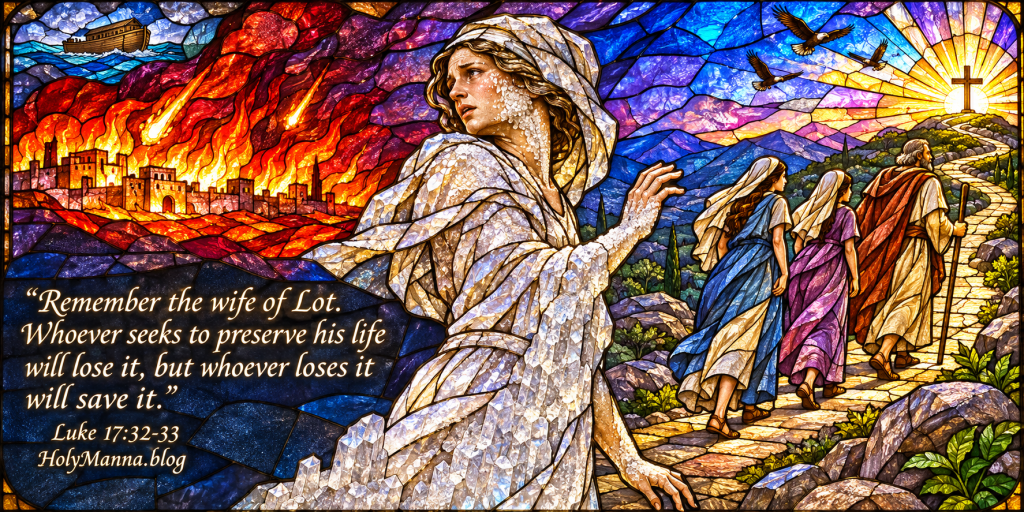
Remember the wife of Lot.
Whoever seeks to preserve his life will lose it,
but whoever loses it will save it.
I tell you, on that night there will be two people in one bed;
one will be taken, the other left.
And there will be two women grinding meal together;
one will be taken, the other left.”
They said to him in reply, “Where, Lord?”
He said to them, “Where the body is,
there also the vultures will gather.”
Detailed Exegesis
Verse 26: “As it was in the days of Noah, so it will be in the days of the Son of Man;”
Jesus reaches for the Flood, the first great judgment in Scripture. Noah’s generation was not unusually monstrous but unusually unaware, and the coming of the Son of Man will find the world the same way.
Verse 27: “they were eating and drinking, marrying and giving in marriage up to the day that Noah entered the ark, and the flood came and destroyed them all.”
Every activity listed is good, since eating, drinking, and marrying are gifts of God. The sin was not in the activities but in the absorption, in living as though the ordinary would last forever, right up to the day it did not.
Verse 28: “Similarly, as it was in the days of Lot: they were eating, drinking, buying, selling, planting, building;”
Luke doubles the warning with a second city. Sodom’s notorious sins are not even mentioned; what Jesus names is commerce and construction, the business of a city confident in its own future.
Verse 29: “on the day when Lot left Sodom, fire and brimstone rained from the sky to destroy them all.”
The judgment arrived on the very day of Lot’s departure, so the delay was a mercy for the one righteous household. The pattern repeats throughout Scripture: God waits, and then God acts.
Verse 30: “So it will be on the day the Son of Man is revealed.”
The Son of Man is already present, hidden in the world, and the last day will not create him but unveil him, along with the true state of every heart.
Verse 31: “On that day, someone who is on the housetop and whose belongings are in the house must not go down to get them, and likewise one in the field must not return to what was left behind.”
Flat-roofed houses in Palestine had outdoor stairs, so a person could flee without reentering the home. The image is urgency without possessions. When Christ appears, nothing accumulated will matter.
Verse 32: “Remember the wife of Lot.”
Three words in Greek, and they land like a hammer. Lot’s wife had already been rescued. She was outside the city, on the road, with the angels’ command fresh in her ears. She looked back anyway, and Genesis 19:26 says she became a pillar of salt. Her body left Sodom; her heart never did.
Verse 33: “Whoever seeks to preserve his life will lose it, but whoever loses it will save it.”
Grasping is losing, and surrendering is saving. Lot’s wife is the proof, since she tried to keep one last piece of the old life and lost all of the new one.
Verse 34: “I tell you, on that night there will be two people in one bed; one will be taken, the other left.”
The judgment divides people who share everything external by what no one could see. Proximity to the faithful is not the same as faith.
Verse 35: “And there will be two women grinding meal together; one will be taken, the other left.”
Grinding grain was women’s morning work, done in pairs at a hand mill. Again the division runs through the most ordinary task; there is no safety in shared circumstance, only in the heart.
Verse 37: “They said to him in reply, ‘Where, Lord?’ He said to them, ‘Where the body is, there also the vultures will gather.’”
The disciples want a location, and Jesus refuses to give one. The day will be as unmistakable as birds circling over a carcass. Saint Ambrose read it more deeply: the body is Christ, and the eagles are the faithful gathered wherever he is.
Teachings
CCC 1040 describes the day Jesus is speaking of: “The Last Judgment will come when Christ returns in glory. Only the Father knows the day and the hour; only he determines the moment of its coming.” CCC 2612 draws the practical conclusion: “In prayer the disciple keeps watch, attentive to Him Who Is and Him Who Comes, in memory of his first coming in the lowliness of the flesh, and in the hope of his second coming in glory.”
Saint Cyril of Alexandria preached on these verses in his Commentary on Luke. Of the days of Noah and Lot he said the Lord “requires us to be always watchful and ready to make our defense before the tribunal of God.” Of Lot’s wife he said bluntly that “she became foolish and stonelike.”
Saint Ambrose, as recorded in the Catena Aurea of Saint Thomas Aquinas, taught that “Lot’s wife represents those who in time of trouble look back and turn aside from the hope of the divine promise, and hence she was made a pillar of salt as a warning to men not to do likewise, and to season as it were their hearts, lest they become corrupt.” On the final verse, the same saint connected the Gospel to today’s First Reading. In his Exposition of the Gospel of Luke he wrote that around the body of Christ, “eagles believe that Jesus has come in the flesh,” and added: “Where faith is, there is the sacrament and the dwelling place of holiness.”
Pope Benedict XVI kept all of this from sliding into dread. In Spe Salvi he wrote: “The image of the Last Judgement is not primarily an image of terror, but an image of hope,” while insisting that “Grace does not cancel out justice.”
Reflection
The people of Noah’s day were not punished for eating dinner. They were lost because dinner was all there was. The question is whether anything in an ordinary week points beyond the week. Daily prayer, Sunday Mass, regular Confession, and a nightly examination of conscience are the housetop stairs that let a person leave quickly when the Lord calls.
Then comes the harder work of naming the Sodom that still has a grip, whether a resentment, a habit, or a version of oneself that felt safer. Lot’s wife shows that leaving physically is not enough. Ask the Lord for the grace to stop turning around.
What are you still looking back at? If Christ were revealed tonight, what would you want to have already let go of?
The Road Runs Forward
Taken together, today’s readings sound like three voices on one road. The Elder stands at the front, warning the eager that going beyond the teaching of Christ is not progress but exit. The psalmist walks in the middle, treasuring God’s word and asking not to stray. And Jesus stands behind, pointing at a pillar of salt and saying, remember her.
The temptations are opposite, but the cure is the same word: remain in the teaching, remain in love with its full shape of obedience, and remain in motion toward the One who is coming. Saint Ambrose saw the whole picture in a single image. The eagles gather around the body because they believe Jesus has come in the flesh, and wherever that faith is, there is the sacrament and the dwelling place of holiness. The road leads to an altar.
Saint Frances Xavier Cabrini walked it without a map. She wanted China and received New York, and she built hospitals, orphanages, and schools for people who had crossed an ocean and found nothing waiting. She did not run ahead of the Church, and she did not look back at the dream she gave up. She kept walking in the truth she had been handed, and the Church now calls her a saint.
The day of the Son of Man will come in the middle of an ordinary afternoon, during lunch, during errands, during the thousand small things that fill a life. That is not a threat but an invitation to let every ordinary thing be done by someone who is ready. Go to Mass this weekend with that in mind. Make a good Confession before Advent arrives. Treasure one verse of Psalm 119, and let it steady every step forward.
Engage With Us!
Readers are warmly invited to share their reflections in the comments below. The road is easier to walk in company, and one honest comment often becomes the encouragement another reader needed.
- In 2 John 4-9, the Elder warns against being so “progressive” as to leave the teaching of Christ. Where in your own life have you mistaken moving past the Church’s teaching for growing in faith, and what would remaining look like?
- In Psalm 119:1-2, 10-11, 17-18, the psalmist treasures God’s promise in his heart and prays not to stray. Which single verse of Scripture could you memorize this week so that it is already there when temptation comes?
- In Luke 17:26-37, Jesus says, “Remember the wife of Lot.” What is the Sodom you have physically left but keep looking back toward, and what would it take to stop turning around?
- Across all three readings, the call is to remain in the truth without running ahead or turning back. What is one concrete habit of readiness you could strengthen before the liturgical year ends?
Keep walking. The commandments are not a fence but a road, and the One who gave them waits at the end of it with open arms. Live this week with the love and mercy Jesus taught, do everything as though he might be revealed before supper, and trust that whoever loses his life for him will find it kept safe forever.
Sacred Heart of Jesus, we trust in You!
Immaculate Heart of Mary, pray for us!
Saint Michael the Archangel, defend us in battle!
Follow us on YouTube, TikTok, Instagram and Facebook for more insights and reflections on living a faith-filled life.


Leave a Reply