The Spark That Became a Fire
Every November 12th the Church remembers a man who asked God for something most people spend their lives avoiding. He asked to die. Not out of despair, but because he had looked at the wound in the side of Christ and decided that the only fitting answer was to let his own blood run for the same cause. Saint Josaphat Kuntsevych, Basilian monk, Archbishop of Polotsk, and martyr, is honored by the universal Church as the great witness to the unity of Christ’s Church under the successor of Saint Peter. He lived and died in the borderlands of what is now Ukraine, Belarus, and Lithuania, and yet his body rests today beneath an altar a few steps from the tomb of Peter himself.
Josaphat belongs to the Eastern tradition of the Church. He prayed the Byzantine liturgy, wore the monastic habit of Saint Basil the Great, and served as a bishop of the Ruthenian Church that had reunited with Rome at the Union of Brest in 1596. He showed that communion with the Pope does not require a man to stop being who God made him to be. The Catechism teaches that “Christ always gives his Church the gift of unity, but the Church must always pray and work to maintain, reinforce, and perfect the unity that Christ wills for her” (CCC 820). Josaphat prayed for that unity, worked for it, and finally paid for it with his life. His feast is a Memorial on the General Roman Calendar, celebrated in red, the color of the martyrs.
A Merchant’s Son in Volodymyr
Josaphat was born around the year 1580 in the town of Volodymyr in Volhynia, in the Polish-Lithuanian Commonwealth, in territory that is today part of western Ukraine. Some older writers say 1584. At his baptism he received the name John, in Ukrainian Ivan. His parents, Gabriel and Maryna Kuntsevych, came from the lesser Ruthenian nobility, though his father had turned to commerce and served as a town councillor. They were Christians of the Byzantine rite, and at the time of John’s birth their Church was separated from Rome.
That last fact is the hinge of the whole story. The Ruthenian Church of Kyiv had drifted out of communion with the Pope in the centuries after the great schism between East and West. In 1596, at the Union of Brest, its bishops formally reentered communion with Rome while keeping their Byzantine liturgy, their married parish clergy, and their own traditions. The Union healed one wound and opened another. Some Ruthenians embraced the Union; others rejected it and called those who accepted it traitors. John Kuntsevych was a teenager when the Union was signed, and he would spend the rest of his life inside the fracture it exposed.
There is a story from his childhood that the saint himself apparently told his confessor, and that was later recorded in the testimony gathered for his beatification. When he was a small boy, his mother took him to the church of Saint Paraskeva in Volodymyr and explained to him the icon of Christ crucified. As she spoke, John felt something like a spark of fire leave the wounded side of Jesus and enter his own heart. Pope Pius XI alludes to this when he writes of the love “which he had learned in his childhood by constant meditation on Jesus Crucified” (Ecclesiam Dei, 9). The exact words of the story vary from source to source, and it rests on testimony given decades after the fact, so it cannot be independently verified. What can be verified is that the boy became unusually devout. At school he memorized nearly the whole of the Chasoslov, the Byzantine book of hours, which he read every day.
His family was not wealthy, so as a young man John was sent to Vilnius, the capital of the Grand Duchy of Lithuania, to apprentice under a merchant named Popovych. He spent every free hour in prayer and study, and he gravitated toward the Church of the Holy Trinity, one of the few churches in Vilnius that had accepted the Union. Popovych disapproved at first, but over time he came to esteem the young man so highly that he offered him his entire fortune and the hand of his daughter in marriage. John declined both.
In Vilnius he also met Joseph Benjamin Rutsky, a learned Ruthenian nobleman who had returned to the Catholic Church and chosen to live his faith within the Byzantine rite of his ancestors. Rutsky guided John in study and virtue, and he deepened the conviction that the Union was not a betrayal of the East but its healing.
The Soul-Snatcher of Vilnius
In 1604, at about twenty-four years of age, John entered the Basilian Monastery of the Holy Trinity in Vilnius and took the monastic name Josaphat. The lessons of the old Roman Breviary record that he went barefoot even in the harsh Lithuanian winters, abstained from meat, drank wine only when obedience required it, and wore a rough hair shirt against his skin until the day he died. He prayed with the constant prostrations of the Eastern monks, repeating the Jesus Prayer, “Jesus Christ, Son of God, have mercy on me, a poor sinner.” Rutsky, who later joined the same order and became its leader, testified that Josaphat “in a short time made such progress in the monastic life that he could have become the master of the other monks” (Ecclesiam Dei, 10). The Catechism explains why such severity is not strange for a saint: “The way of perfection passes by way of the Cross. There is no holiness without renunciation and spiritual battle” (CCC 2015). Josaphat’s austerity was never a performance. It was the fire from the crucifix doing its work.
Under Josaphat and Rutsky a revival of Basilian monastic life began, and the Holy Trinity monastery became the seed of a reformed Basilian Order that still bears Josaphat’s name today. He was ordained a priest in 1609 after private study under the Jesuit Valentine Fabricius, and he was soon made superior, first at the monastery of Byten and then as archimandrite of Holy Trinity itself. As a priest he preached, heard confessions, and went looking for souls that others had given up on. From the liturgical books of his own tradition he drew proof after proof that the East had always confessed the primacy of Peter, and he set these down in works such as On the Baptism of Saint Volodymyr, On the Falsification of the Slavic Books by the Enemies of the Metropolitan, and On Monks and Their Vows. His opponents gave him a nickname. In the Slavic languages it was dushekhvat, the soul-snatcher, and Pius XI records that his adversaries themselves called him the “winner of souls” (Ecclesiam Dei, 11).
On November 12th, 1617, very much against his own wishes, Josaphat was consecrated Bishop of Vitebsk with the right of succession to Polotsk, and in 1618 he became Archbishop of Polotsk. The date of his consecration is worth remembering. Six years later, to the day, he would be killed.
What he found in Polotsk was close to ruin. Church buildings were crumbling, Church lands had been seized by laymen, and the clergy were poorly formed and in many cases living scandalously. Josaphat restored the churches, recovered seized properties, and published a catechism for his clergy that, in the Pope’s words, “followed the methods of St. Peter Canisius” (Ecclesiam Dei, 12). He wrote rules for priestly life, held synods, and urged “both the secular and regular clergy to a higher appreciation of their holy office” (Ecclesiam Dei, 12).
His love for the poor was the kind that costs something. The Breviary lessons and the encyclical both record that he once pawned his own omophorion, the great embroidered stole that is the very sign of a Byzantine bishop’s office, in order to relieve a poor widow. Pius XI puts it plainly: he “even went to the length of pawning his own omophorion in order to care for their needs” (Ecclesiam Dei, 11). The Catechism teaches that “the works of mercy are charitable actions by which we come to the aid of our neighbor in his spiritual and bodily necessities” (CCC 2447).
No miracles are documented from Josaphat’s lifetime. The marvel of his years as a bishop was quieter. Entire parishes that had rejected the Union came back, won over by a man who fasted more than they did, gave away more than he had, and celebrated their own liturgy more beautifully than they had ever seen it celebrated. Josaphat never asked the Ruthenians to become Latins. He asked them to be fully Eastern and fully Catholic at the same time, which is precisely what the Church still asks today. The Catechism recognizes that the Orthodox Churches stand in a communion with the Catholic Church so profound “that it lacks little to attain the fullness that would permit a common celebration of the Lord’s Eucharist” (CCC 838). Josaphat spent his whole episcopate trying to close that little gap, one soul at a time.
Here I Am
The ground shifted in 1620. A rival hierarchy was reestablished for those Ruthenians who rejected the Union, and a brilliant, bitter scholar named Meletius Smotrytsky was installed as the dissident Archbishop of Polotsk, the very see that Josaphat held. Smotrytsky’s pamphlets spread the claim that Josaphat had “gone Latin” and intended to force his whole flock to do the same. Hostility in Vitebsk and other towns grew into open rebellion. Churches were closed against him, and his clergy were threatened.
Even his friends turned on him. In 1622 the Grand Chancellor of Lithuania, Leo Sapieha, a Catholic, wrote Josaphat a harsh letter blaming him for the unrest and urging concessions to the dissidents for the sake of civil peace. The Catholic Encyclopedia records that Josaphat “firmly opposed” that pressure, and Pius XI adds that through it all the saint “always remained strictly within the confines of religious work, never mixing in politics” (Ecclesiam Dei, 12). He wanted the unity Christ had prayed for on the night before He died: “that they may all be one, as you, Father, are in me and I in you” (John 17:21).
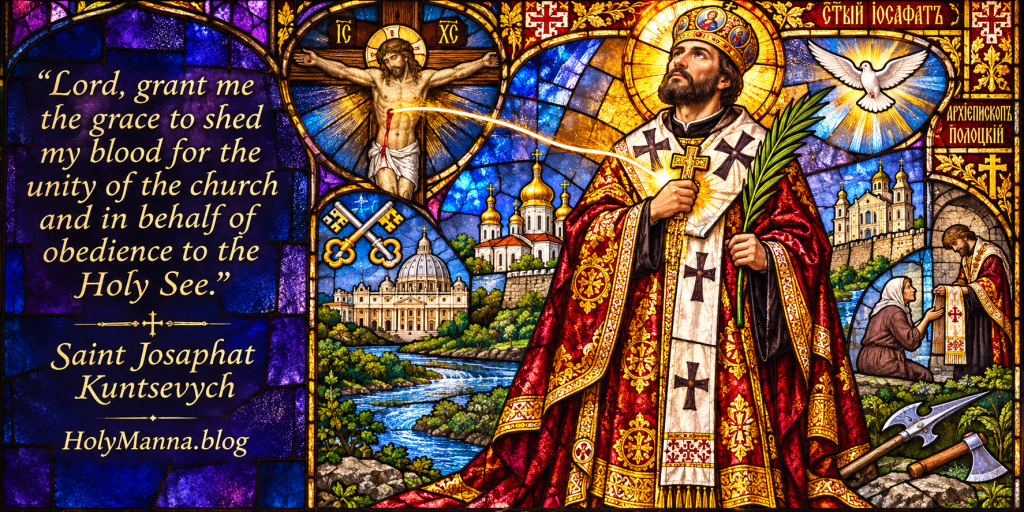
He knew what was coming. The encyclical states that “he was convinced that he would be martyred, and often spoke of the possibility of such an event occurring” (Ecclesiam Dei, 13). More than that, he asked for it. His prayer survives in his own words: “Lord, grant me the grace to shed my blood for the unity of the church and in behalf of obedience to the Holy See” (Ecclesiam Dei, 13). Friends warned him not to go to Vitebsk, the center of the revolt. He went anyway.
On the morning of Sunday, November 12th, 1623, a priest of the anti-Union party named Elias stood in the courtyard of the archbishop’s residence, hurled insults at him, and tried to force his way inside. Josaphat’s servants detained the man. That was the signal the conspirators had been waiting for. The bell of the town hall rang, and a mob poured into the streets armed with stones, staves, and halberds. Josaphat released the priest at once, but it was too late. The crowd broke into the residence and began beating the servants and clergy they found there.
He did not hide, and he did not flee. He came out to meet them, and the Breviary lessons preserve what he said: “My little children, why do you strike my servants? If you have any complaint against me, here I am.” Pius XI records that he asked the attackers “not to harm the members of his household, and then gave himself into their hands” (Ecclesiam Dei, 13). A blow from a halberd split his head. He was beaten with staves. Someone shot him. Finally an axe ended his life. The Pope writes that “despite his wounds he did not cease till his dying breath to implore God’s pardon for his murderers” (Ecclesiam Dei, 13). He was about forty-three years old, and it was the sixth anniversary of the day he had become a bishop.
The mob stripped the body and dragged it through the streets. According to accounts drawn from the later investigations, when they found the hair shirt beneath his garments, some of them hesitated, thinking they had killed the wrong man, because no one expected a Latinizing prelate to be wearing the penitential garment of a monk. That detail rests on the testimony of the time and cannot be independently verified. What is certain is that they threw his body into the Dvina River.
The Catechism defines what happened that morning: “Martyrdom is the supreme witness given to the truth of the faith: it means bearing witness even unto death. The martyr bears witness to Christ who died and rose, to whom he is united by charity” (CCC 2473). Josaphat forgave the men who were killing him, because he had learned from the Cross that “Christian prayer extends to the forgiveness of enemies” (CCC 2844). Jesus Himself had said it first: “Father, forgive them, they know not what they do” (Luke 23:34).
The Light on the Dvina
The body was recovered from the river several days later. The liturgical tradition preserved in the old Breviary says that when it was found, it was “surrounded with a miraculous light.” It is told here as the tradition it is, and it cannot be independently verified.
What followed can be verified. The King’s commission came down hard on Vitebsk, and the ringleaders were condemned to death. Then the first miracle of Josaphat’s death took place, not in a body but in souls. The Breviary states that the condemned men nearly all abjured the schism and repented of their crime. Pius XI confirms that in the years after the martyrdom “a great number of people, among whom were the very murderers of the Saint” returned to the Catholic Church (Ecclesiam Dei, 14). Even Meletius Smotrytsky, whose pamphlets had lit the fire, returned to communion with Rome four years later and defended the Union until his death in 1633. The Ruthenian bishops wrote to Rome: “We too are ready, as one of our number has already done, to offer our life’s blood for the Catholic religion” (Ecclesiam Dei, 14).
The miracles of healing began almost at once. In 1628 Pope Urban VIII appointed a commission that examined one hundred and sixteen witnesses under oath. Five years after his death, the archbishop’s body was found to be incorrupt, though the clothing had rotted away. Sources from the Ukrainian Greek Catholic Church record that witnesses testified to sight restored to the blind, to cures of heart disease and paralysis, and to deliverance from various dangers through his intercession, and a Basilian book printed in Vilnius in 1667 tells of a three-year-old Orthodox child healed while the relics were displayed for veneration. These individual cases rest on the testimony of the time and cannot be separately verified today, but the evidence was strong enough that a second commission was convened in 1637, and on May 16th, 1643, just twenty years after his death, Urban VIII beatified him. Blessed Pope Pius IX canonized him on June 29th, 1867, and Catholic sources frequently describe him as the first saint of the Eastern Church to be formally canonized through the Roman process. Pope Leo XIII later extended his Mass and Office to the universal Church.
The saints in heaven “do not cease to intercede with the Father for us” (CCC 956), and “their intercession is their most exalted service to God’s plan” (CCC 2683). The veneration of relics is likewise a form of piety the Catechism explicitly approves (CCC 1674).
The story of Josaphat’s relics is almost a second life. At his beatification the body was enshrined in a silver casket at the behest of Prince Leo Casimir Sapieha, and it rested in the cathedral of Saint Sophia in Polotsk. Around 1705, during the Great Northern War, the relics were moved for safety to the Radziwiłł residence at Biała, now Biała Podlaska in eastern Poland, where they remained for roughly two centuries. In 1873, when the Russian Empire was crushing the Greek Catholic Church, the relics were hidden in a wall of the crypt and forgotten. Then, in 1916, an old man who had watched the immuring as a boy revealed the spot to a Basilian priest, Father Demchuk, who carried the body to Saint Barbara’s Ukrainian church in Vienna. At the end of the Second World War they were moved again, to Rome. On November 22nd, 1963, in the middle of the Second Vatican Council and at the express wish of Pope John XXIII, Pope Paul VI had the body of Saint Josaphat placed beneath the altar of Saint Basil the Great in Saint Peter’s Basilica. Pilgrims can see him there today.
Fifty years after that translation, in 2013, Pope Francis welcomed Ukrainian Greek Catholic pilgrims to the basilica and told them, “the best way to celebrate St Josaphat is to love one another, and to love and serve the unity of the Church.” Each year on his feast the Byzantine Divine Liturgy is celebrated at his altar in Saint Peter’s.
In Volodymyr-Volynskyi, his birthplace, a pilgrimage center bearing his name was begun in 2013 beside the ancient crucifix before which, by tradition, the boy John once prayed. Cathedrals and parishes dedicated to him anchor the Ukrainian Greek Catholic diaspora in Edmonton, Toronto, Parma, and beyond, and the Basilian Order of Saint Josaphat bears his name on every continent. In Milwaukee, Polish immigrants raised the Basilica of Saint Josaphat between 1896 and 1901, modeled on Saint Peter’s and built from the salvaged stone of the old Chicago Post Office; Pius XI named it the third minor basilica in the United States in 1929.
What a Spark Can Do
Start with the spark. Whether or not the childhood story can be proven, the pattern it describes is real: a single moment of grace, received in the presence of the Cross, that a person then spends the rest of his life answering. Josaphat got a glimpse of the love of Christ crucified, and that was enough to make him pray every day, turn down a fortune and a bride, and walk barefoot through Lithuanian winters. When was the last time you let the Cross actually look back at you? Give the crucifix on your wall five unhurried minutes each day and see what it asks of you.
Then consider how he handled division. Josaphat lived in a Church torn in two, surrounded by people who sincerely believed he was a traitor. He did not win them with arguments alone. He won them by being more faithful to their shared tradition than they were, more generous to their poor than they were, and more willing to suffer than any of them. The Catechism teaches that the bonds of unity in the Church are “above all, charity” (CCC 815). Who in your life has become an opponent, and what would it look like to out-love them rather than out-argue them?
Consider the omophorion. A bishop pawning the sign of his own authority to feed a widow is a strange and beautiful picture of the Church’s preferential love for the poor. What is the one possession or status symbol you would find hardest to give up, and who nearby could it feed? You do not need an omophorion to live this. You need a budget line for the poor that actually hurts a little.
Consider the forgiveness. Josaphat prayed for the men who were splitting his skull. That was not spontaneous heroism. It was the fruit of decades of prostrations, fasts, and confessions, a heart trained so long in mercy that mercy was what came out under the blade. The Catechism is honest that “it is not in our power not to feel or to forget an offense,” and yet it teaches that the heart that offers itself to the Holy Spirit “turns injury into compassion and purifies the memory” (CCC 2843). Whose name do you need to put into your prayers tonight, not as an enemy but as a soul Christ died for?
Finally, consider the unity he died for. The Catechism teaches that “the desire to recover the unity of all Christians is a gift of Christ and a call of the Holy Spirit” (CCC 820). Ordinary Catholics can learn about the Christian East, pray for persecuted Eastern Catholics and their Orthodox neighbors, and refuse to let the Church’s divisions become an excuse for cynicism. Do you pray for the unity of Christians, and do you know anything about the Eastern Catholic Churches whose members may sit in the same pews on Sunday?
The Collect for November 12th asks God to “stir up in your Church, we pray, O Lord, the Spirit that filled Saint Josaphat as he laid down his life for the sheep.” He was a good shepherd because he followed the Good Shepherd, who said, “I am the good shepherd. A good shepherd lays down his life for the sheep” (John 10:11). Few are asked to lay down their life in a single morning. Everyone is asked to lay it down one small renunciation at a time. That is where the spark becomes a fire.
Engage With Us!
The story of Saint Josaphat Kuntsevych belongs to the whole Church, East and West, and HolyManna.blog would love to hear how it speaks to you. Share your thoughts and reflections in the comments below, and consider praying with these questions this week.
- Josaphat traced his whole vocation to a childhood moment before the crucifix. Can you name a moment when the love of Christ first became real to you, and how have you answered it since?
- Josaphat won over hostile towns by living his tradition more fully than his critics did. Where could deeper fidelity, rather than louder argument, change a relationship in your life?
- He pawned his own omophorion for a widow. What would it cost you to give in a way that actually changes your lifestyle, and who would benefit?
- He died asking God to pardon his killers. Is there someone you have refused to forgive, and what single step toward mercy could you take today?
- He gave his life for the unity of the Church under Peter. How might you learn about, pray for, and support the Eastern Catholic Churches and the cause of Christian unity this month?
Saint Josaphat did not become a saint on the day he died. He became one in the thousands of hidden mornings before it, in the prostrations and the fasts and the hours in the confessional, in the quiet decision to love the people who hated him. God is offering the same path to you, right where you stand. Take the spark He has already placed in your heart and let it grow. Live your faith openly, forgive quickly, give generously, and do everything you do with the love and mercy that Jesus taught us.
Saint Josaphat Kuntsevych, martyr for the unity of the Church, pray for us!
Follow us on YouTube, TikTok, Instagram and Facebook for more insights and reflections on living a faith-filled life.


Leave a Reply