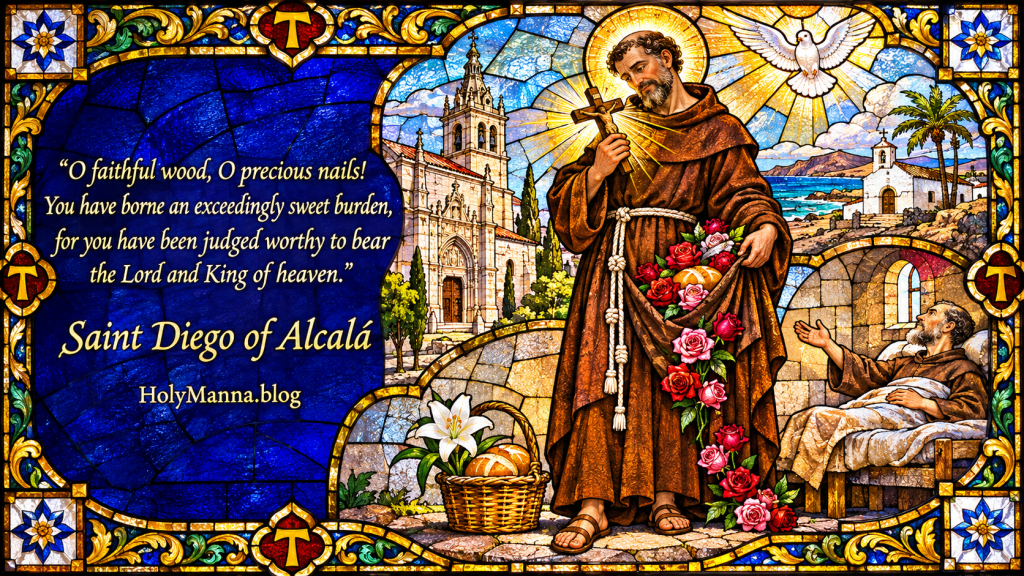
The Friar Who Hid Bread in His Habit
Most of the saints the Church lifts up from the 15th century were preachers, reformers, founders, or theologians. Saint Didacus of Alcalá, known more commonly as San Diego, was none of those things. He never became a priest. He never wrote a book. He spent his life as a Franciscan lay brother, the kind of friar who worked the garden, answered the door, cooked the soup, and nursed the sick while the ordained friars preached and heard confessions. And yet when Pope Sixtus V canonized him on July 10th, 1588, it was the first canonization the Church had celebrated in 65 years and the first ever of a Franciscan lay brother. A king of Spain had petitioned for it. A dying prince had been healed through him. A city on the far side of the world would eventually bear his name.
The Church proposes saints like Diego for a reason. The Catechism teaches that “by canonizing some of the faithful, i.e., by solemnly proclaiming that they practiced heroic virtue and lived in fidelity to God’s grace, the Church recognizes the power of the Spirit of holiness within her and sustains the hope of believers by proposing the saints to them as models and intercessors” (CCC 828). Diego is a model precisely because his holiness was so ordinary in its materials: bread, bandages, a garden hoe, a crucifix, and a heart that could not say no to a poor man.
He is the patron of Franciscan lay brothers, a title he held in the Order for centuries as the first non-ordained Friar Minor to be canonized, and he is the patron of the Diocese of San Diego in California, which takes its name from the mission Saint Junípero Serra dedicated to him in 1769. The Roman Martyrology commemorates him on November 12th, the anniversary of his death, though his liturgical memorial has moved more than once, as the story will explain.
A Hermit’s Garden Near Seville
Diego was born around the year 1400 in San Nicolás del Puerto, a small village in the hills north of Seville in Andalusia. Some Spanish sources give an exact birth date of November 14th, 1400, but the Catholic Encyclopedia states plainly that his date of birth is uncertain. His parents were poor and devout, and they named him Diego, a Spanish form of James, after the patron of Spain. Almost nothing else is known about his family, which is itself a clue to the kind of saint he became. Diego did not come from a house that kept records.
What the early accounts do agree on is that he felt the pull toward solitude very young. Butler’s Lives of the Saints records that as a youth he placed himself under the direction of a holy priest who lived as a hermit near the village, and that the two of them supported themselves by tending a small garden and carving wooden spoons and trenchers. The Franciscan tradition adds that during these years Diego joined the Third Order of Saint Francis, the branch for lay people who wanted to live the Franciscan spirit in the world. So before he ever wore the habit, he was already living a rule: prayer, manual work, and whatever was left over going to the poor.
After some years he returned home to his parents, but the desire for a more complete gift of himself did not fade. Around the age of 30, he applied to the Observant Franciscans at the friary of San Francisco de la Arrizafa, near Córdoba, and was received as a lay brother. The Observants were the reform wing of the Order, the friars who wanted to live the Rule of Saint Francis in its original poverty and simplicity, and it tells you something that Diego chose them. He was not looking for a comfortable religious life.
Early biographers noted that even as a lay brother with no formal theological training, Diego spoke about God with such clarity that learned theologians were astonished. Butler puts it this way: Diego “seemed so much absorbed in God as scarce to be able to speak but to him, or of him.” It is hard not to hear in that description the words of Jesus himself: “I give praise to you, Father, Lord of heaven and earth, for although you have hidden these things from the wise and the learned you have revealed them to the childlike” (Matthew 11:25).
Roses in the Habit and Healings in Rome
The Church teaches that “all Christians in any state or walk of life are called to the fullness of Christian life and to the perfection of charity” (CCC 2013). Diego took that seriously in the least glamorous way possible. He was a porter, a gardener, a cook, and an infirmarian, and he treated each of those jobs as a place where Christ could be met.
The story that has defined his image in art for four centuries comes from his years as a porter and almoner. The Franciscan tradition holds that Diego gave to the poor so freely that some of his brother friars grew uneasy about how much food was leaving the friary. According to the story, he was stopped one day on his way out with his habit folded over something he was carrying, and when he was asked what he had, he answered that it was flowers. When the habit was opened, the bread he had been carrying for the poor had become roses. This is why Zurbarán, Murillo, and so many others painted him with a crucifix in one hand and a lap full of roses in the other. It is a beautiful story, but the same miracle is also told of Saint Elizabeth of Hungary and others, and it should be received as a tradition that captures something true about the man rather than as established fact. This story cannot be verified.
What is documented is the pattern of charity behind the story. Franciscan Media notes that Diego gave so generously to the poor that some of his fellow friars were uneasy about it. He was living out what The Catechism calls the works of mercy, which are “charitable actions by which we come to the aid of our neighbor in his spiritual and bodily necessities” (CCC 2447). He was also living out a preference the Church has never abandoned, since “those who are oppressed by poverty are the object of a preferential love on the part of the Church” (CCC 2449).
Around 1441 or 1442, since the sources differ by a year, his superiors sent Diego to the Canary Islands, which Castile had only recently conquered and where the native population was still largely unevangelized. The Franciscan Book of Saints records that he went eagerly hoping for martyrdom, and that although he never received it, he bore the hardships of the mission with patience and helped convert many by word and example. Then something unusual happened. In 1445 he was appointed guardian, which is the Franciscan term for the superior, of the friary of San Buenaventura on the island of Fuerteventura. The Catholic Encyclopedia points out that making a lay brother the superior of a community was an exception to the normal rules of the Order. The ordained friars under him obeyed a man who could not celebrate Mass, because they recognized that he was the holiest among them. He held the post until 1449, when he was recalled to Spain. A local tradition in the Canaries also credits Diego and his companion Fray Juan de Santorcaz with discovering the image of the Virgen de la Peña, the patroness of Fuerteventura. That tradition cannot be verified.
In 1450, at the direction of the Observant vicar general Saint John of Capistrano, Diego traveled to Rome with Father Alonso de Castro for the Jubilee Year proclaimed by Pope Nicholas V and for the canonization of Saint Bernardine of Siena. Thousands of friars poured into the city for the ceremonies, and an epidemic broke out among them. Diego was assigned as infirmarian at the friary of Santa Maria in Aracoeli on the Capitoline Hill. Butler records that he first nursed his own companion, Father Alonso, through a dangerous illness, and then spent 13 weeks caring for the other sick friars.
This is where the earliest reports of healings during his lifetime cluster. The Franciscan Book of Saints records that although food and medicine were scarce in the crowded city, Diego always seemed to have enough for his patients, and that many of them were restored to health simply by his making the Sign of the Cross over them. The Catholic Encyclopedia confirms that his biographers credit him with miraculous cures through his intercession during these months. The Church has always understood that gift this way: “‘Heal the sick!’ The Church has received this charge from the Lord and strives to carry it out by taking care of the sick as well as by accompanying them with her prayer of intercession” (CCC 1509). Diego did both at once, with a basin in one hand and a prayer in the other.
Fevers, Islands, and an Abscess That Smelled of Flowers
Diego was never martyred, though he wanted to be. His hardships were quieter and longer. There was the physical toll of the Canary mission, the epidemic in Rome where he spent three months among the dying, the ordinary humiliations of being a lay brother in an Order full of brilliant preachers, and the lifelong war he waged on himself.
Butler records that Diego practiced severe bodily mortification and continual prayer, that no one ever saw him troubled or heard him speak in anger, and that he was remarkable for his humility. He meditated constantly on the Passion with a crucifix in his hands, and his devotion to the Eucharist and to Our Lady was intense. Several accounts, including Butler’s, report that during contemplation his body was sometimes seen lifted from the ground. Those reports come from the canonization era and cannot be verified, so they are best received as the testimony of those who knew him rather than as settled fact.
The Church does not pretend this kind of life is easy. The Catechism says it directly: “The way of perfection passes by way of the Cross. There is no holiness without renunciation and spiritual battle” (CCC 2015). Diego chose the battle every day for more than 30 years.
After Rome he returned to Spain and lived in a series of friaries, including La Salceda in Guadalajara, the same house where Cardinal Cisneros would later enter the Order. In 1456 he was sent to the friary of Santa María de Jesús in Alcalá de Henares, northeast of Madrid, and there he spent the last seven years of his life as gardener, porter, and infirmarian, caring for students and feeding the poor. The Catholic Encyclopedia describes these years as given to penance, solitude, and the delights of contemplation.
In the autumn of 1463 he fell ill with an abscess in his arm. The friars could do nothing for it. As death approached, The Franciscan Book of Saints records that he asked for an old, worn out habit so that he could die in it as a true son of Saint Francis. Butler adds that he put a friar’s cord around his neck as a sign of penance, took a wooden cross in his hands, and asked pardon of all the brothers gathered around his bed. Then, with his eyes fixed on the crucifix, he began to recite the words of the ancient Good Friday hymn Crux Fidelis. His last words, as the Franciscan tradition preserves them, were a line from that hymn: “O faithful wood, O precious nails! You have borne an exceedingly sweet burden, for you have been judged worthy to bear the Lord and King of heaven.” With that on his lips, he died on November 12th, 1463.
Here one small conflict in the record deserves honesty. The Catholic Encyclopedia, Butler, the Roman Martyrology, and the Vatican’s own saint of the day entry all give November 12th as the date of his death. Some Spanish sources give November 13th, which is the date Alcalá still celebrates. The older sources carry more weight, and November 12th is the better attested date.
Then came the first sign. The abscess that killed him should have filled the cell with the smell of corruption. Instead, the early accounts record that a sweet fragrance came from his body, and that it did not decay. Crowds arrived to venerate him in such numbers that his burial was delayed for months. When he was finally laid to rest in the Franciscan church at Alcalá, the miracles at his tomb began.
A King’s Son, a Clockwork Friar, and a City Named for Him
The Church teaches that the saints in heaven “do not cease to intercede with the Father for us, as they proffer the merits which they acquired on earth through the one mediator between God and men, Christ Jesus” and that “by their fraternal concern is our weakness greatly helped” (CCC 956). In the case of Diego , that help began almost immediately and reached, within a century, the throne of Spain.
The first royal visitor was King Henry IV of Castile. The tradition holds that the king injured his arm in a fall from his horse while hunting, that his physicians could not relieve the pain, and that he went to Alcalá to pray at the friar’s body. According to the story, the body was placed beside the king, the pain vanished, and his arm recovered its strength. Henry IV’s devotion to Diego is historically attested, and the kings of Castile honored the incorrupt body from his reign onward, but the details of the cure itself cannot be verified.
The second and far more consequential visitor was King Philip II, whose son and heir, Don Carlos, Prince of Asturias, was studying at the University of Alcalá in 1562 when he fell down a staircase and struck his head. Butler records that the surgeons judged the wound mortal. Historical accounts describe fever, swelling, blindness, and the prince lapsing toward death after the physicians, including the famous anatomist Andreas Vesalius, had tried everything they knew. At the urging of the king’s confessor, the Franciscans of Alcalá were summoned, and they carried the century old body of Fray Diego into the sickroom with great devotion and ceremony. One account says the body was laid on the prince’s bed; another says a friar placed one of the prince’s hands on the friar’s chest, and the prince fell into a deep sleep in which he saw the saint and was told he would not die. Six hours later, the story goes, he awoke. However the details are told, the outcome is a matter of record: Don Carlos recovered, and both the king and the prince petitioned Rome for the canonization. The dream and the precise sequence of that night cannot be verified, but the illness, the visit of the relics, and the recovery are documented history.
Philip’s gratitude took an unusual form. He commissioned Juanelo Turriano, the clockmaker who had served his father the Emperor Charles V, to build a small automaton of a walking, praying friar. A 16th century clockwork monk now in the Smithsonian Institution in Washington, which walks, raises a cross to its lips, and beats its chest, is widely believed to be that figure. Its connection to Diego , while strongly supported, cannot be verified with certainty.
Three popes had let the cause sit. Then in 1585 Sixtus V was elected, a Franciscan himself and the candidate Philip II had favored. The investigation was reopened, and on July 10th, 1588, in Saint Peter’s Basilica, Sixtus V proclaimed Fray Diego de San Nicolás a saint under the Latin name Didacus. Butler records that Pope Innocent XI later added his office to the Roman Breviary and moved his feast to November 13th, because November 12th was already occupied, first by Pope Saint Martin I and later by Saint Josaphat. The Franciscans now generally keep November 13th, while in the United States the Franciscan memorial falls on November 7th to make room for Saint Frances Xavier Cabrini.
His body still rests in Alcalá, in the Catedral Magistral de los Santos Niños Justo y Pastor, where it is kept in a 17th century silver urn in a chapel bearing his name and is exposed for veneration every November 13th, when the cathedral becomes a place of pilgrimage and a procession winds through the city. The Conceptionist nuns of the Convent of Santa Úrsula in Alcalá preserve his original tombstone and a hand. In his birthplace of San Nicolás del Puerto, the Ermita de San Diego was built between 1485 and 1514 to enshrine part of his remains. The Church encourages exactly this kind of devotion, listing among the legitimate expressions of popular piety “the veneration of relics, visits to sanctuaries, pilgrimages, processions” (CCC 1674).
Then there is the New World. In 1602 the Spanish explorer Sebastián Vizcaíno entered a bay on the California coast around the feast of San Diego and named it for the saint. In 1769 Saint Junípero Serra founded the first of the California missions there and called it Mission San Diego de Alcalá. The mission became a pueblo, the pueblo became a city, and today the city, county, bay, river, and university all carry the name of a Spanish lay brother who never left Europe. In Mexico, San Diego is the patron of towns from Puebla to Yucatán, where the town of Tekax has honored him with an annual procession for more than 380 years. In the Philippines, the pro-cathedral of Silay City is dedicated to him and holds a first class relic, and José Rizal gave the name San Diego to the fictional town at the center of his novel Noli Me Tángere.
His place in art is just as wide. Murillo painted him feeding the poor and in ecstasy before the cross, Zurbarán painted him with the roses, Annibale Carracci frescoed his life in the Spanish national church in Rome, and Lope de Vega wrote both a sonnet in his honor and a full drama titled San Diego de Alcalá. For a man whose entire ambition was to be unnoticed, Diego has been noticed for a very long time.
Carrying Bread for Someone
So what does a 15th century Spanish porter have to say to someone in their twenties or thirties trying to live the faith today? Quite a lot, as it turns out, because the pressures Diego resisted are the same ones you face.
The first is the lie that holiness requires a platform. Diego had none. He could not preach, write, or celebrate the sacraments. The things he could do were cook, dig, bandage, and open the door, and he did them so entirely for God that ordained priests placed themselves under his authority and a pope put him on the altars. Saint Paul explained the pattern long before Diego was born: “God chose the foolish of the world to shame the wise, and God chose the weak of the world to shame the strong” (1 Corinthians 1:27). What is the ordinary, unglamorous work in your life right now, and what would change if you did it as if Christ himself were the one being served?
The second is the temptation to manage your generosity. Diego’s brothers were not wrong to worry about the pantry; they were simply wrong about what mattered more. He gave until it made people uncomfortable, because he had taken Jesus at his word: “Amen, I say to you, whatever you did for one of these least brothers of mine, you did for me” (Matthew 25:40). Most people are not in danger of giving too much. Is there a place in your life where you have carefully calculated the limits of your charity, and what would it look like to stop calculating?
The third is the habit of treating prayer as something you fit in. Diego treated it as the thing everything else fit around. He prayed in the garden, prayed in the infirmary, prayed with a crucifix in his hand until the Passion was more real to him than the room he was standing in. The Catechism says that “humility is the foundation of prayer” (CCC 2559), and that is exactly the order in which Diego built his life. He was humble first, and prayer grew out of it. When was the last time you simply sat with a crucifix and looked at it, without asking for anything?
There are practical ways to let this saint into your week. You can pick one task you normally resent and offer it, quietly and completely, as Diego offered his. You can visit or sit with someone who is sick, because the infirmary was where his holiness was most visible. You can carry something for the poor, a bag of groceries or a hot meal, and let no one see you do it. You can keep a crucifix where you will see it first thing in the morning and say the line he died with. And you can ask him, as Philip II did, to intercede for someone you love who is in trouble, because the Church is clear that for the saints in heaven, their “intercession is their most exalted service to God’s plan” (CCC 2683).
Saint James wrote, “Humble yourselves before the Lord and he will exalt you” (James 4:10). Diego of Alcalá is what that verse looks like when a man believes it for 60 years.
Engage With Us!
Saint Diego spent his whole life trying to disappear into the service of others, and the Church has refused to let him. Share your thoughts and reflections in the comments below, and consider these questions as you do.
- Diego was a lay brother with no formal education, yet learned theologians marveled at how he spoke about God. Who in your life has taught you about God through their way of living rather than their words?
- The story of the roses grew from a real pattern of giving that made his brothers uneasy. Has your generosity ever made someone uncomfortable, and how did you respond?
- Diego spent 13 weeks nursing sick friars in Rome during an epidemic. What is one concrete act of care for the sick or the lonely you could commit to this month?
- He died reciting a hymn about the cross with a crucifix in his hands. What would you want on your lips at the end of your life, and are you living in a way that makes that likely?
- The ordained friars of Fuerteventura obeyed a lay brother because they recognized his holiness. Where in your life might God be asking you to recognize holiness in someone the world overlooks?
- A king of Spain was moved to petition Rome by a miracle for his son. Is there someone you love in trouble right now for whom you could ask Saint Diego to intercede?
Whatever your work is this week, whether it is answering a door, changing a bandage, or something that feels far more important, do it the way Diego did: entirely for God and entirely for the person in front of you. Carry bread for someone. Keep the crucifix close. Let your charity be larger than your calculations. And trust that the Lord who exalted a Spanish porter to the altars of the universal Church sees every hidden thing you do with the love and mercy that Jesus taught us.
Saint Diego of Alcalá, pray for us!


Leave a Reply