Memorial of Saint Josaphat, Bishop and Martyr – Lectionary: 494
A Kingdom Nobody Saw Coming
Everybody is looking up at the sky, and the Kingdom walks in through the side door.
That is the quiet surprise running through the readings for Thursday, November 12th, 2026, the Memorial of Saint Josaphat, Bishop and Martyr. The Pharisees want a date for the Kingdom of God, and Jesus tells them that its coming “cannot be observed,” because “the Kingdom of God is among you.” Meanwhile Paul, an old man in chains, writes a short personal letter asking a friend to welcome back a runaway slave as “a brother.” Between those two scenes the psalmist sings of a God who “sets captives free” and “raises up those who were bowed down.” The central theme is simple and demanding at the same time: the Kingdom of God arrives without fanfare, through persons rather than spectacles, and its road runs through the cross before it flashes like lightning.
The day’s saint fits the pattern perfectly. Josaphat Kuntsevych, born around 1580 in Volodymyr in present-day Ukraine, became a Basilian monk and then Archbishop of Polotsk, and he gave his life in 1623 at Vitebsk for the unity of the Church under the successor of Peter. Pope Pius XI, writing three centuries later in Ecclesiam Dei, preserved the saint’s prayer: “Lord, grant me the grace to shed my blood for the unity of the church and in behalf of obedience to the Holy See.” Beatified in 1643 and canonized on June 29th, 1867, Josaphat was the first Eastern-rite saint canonized by Rome. Unity, brotherhood, and a Kingdom that comes by way of suffering: the readings and the saint tell one story.
First Reading — Philemon 7-20
A Runaway, a Prisoner, and the Shortest Revolution in the Bible
The Letter to Philemon is the shortest of Paul’s letters. Paul writes from prison, traditionally in Rome in the early 60s, to Philemon, a Christian of Colossae whose home hosts the local church. Philemon owns a slave named Onesimus, a name that means “useful.” Onesimus had run away and, as verse 18 hints and Saint John Chrysostom states outright, took something with him. In the Roman world a fugitive slave could be branded, beaten, or killed, and harboring one was itself an offense.
Somehow Onesimus found Paul, who led him to Christ and now sends him home with this letter. The remarkable thing is that Paul never once commands; he persuades, pleads, puns, and finally signs a promissory note in his own hand. This is the Kingdom arriving without fanfare, in one household, through one welcome.
Philemon 7-20
Beloved:
I have experienced much joy and encouragement from your love,
because the hearts of the holy ones
have been refreshed by you, brother.
Therefore, although I have the full right in Christ
to order you to do what is proper,
I rather urge you out of love,
being as I am, Paul, an old man,
and now also a prisoner for Christ Jesus.
I urge you on behalf of my child Onesimus,
whose father I have become in my imprisonment,
who was once useless to you but is now useful to both you and me.
I am sending him, that is, my own heart, back to you.
I should have liked to retain him for myself,
so that he might serve me on your behalf
in my imprisonment for the Gospel,
but I did not want to do anything without your consent,
so that the good you do might not be forced but voluntary.
Perhaps this is why he was away from you for a while,
that you might have him back forever,
no longer as a slave but more than a slave, a brother,
beloved especially to me, but even more so to you,
as a man and in the Lord.
So if you regard me as a partner, welcome him as you would me.
And if he has done you any injustice
or owes you anything, charge it to me.
I, Paul, write this in my own hand: I will pay.
May I not tell you that you owe me your very self.
Yes, brother, may I profit from you in the Lord.
Refresh my heart in Christ.
Detailed Exegesis
Verse 7 reads: “I have experienced much joy and encouragement from your love, because the hearts of the holy ones have been refreshed by you, brother.”
Paul opens with sincere gratitude, leaning on the very quality he is about to ask for. The word behind “hearts” is literally “bowels,” the ancient seat of deep affection, and it returns twice more.
Verse 8 reads: “Therefore, although I have the full right in Christ to order you to do what is proper,”
Paul names his authority only to set it down, which is exactly how God deals with free creatures.
Verse 9 reads: “I rather urge you out of love, being as I am, Paul, an old man, and now also a prisoner for Christ Jesus.”
Instead of a command comes an appeal from an elderly prisoner, and Chrysostom notes that Paul mentions his chains before the name of Onesimus so that Philemon’s heart is already softened.
Verse 10 reads: “I urge you on behalf of my child Onesimus, whose father I have become in my imprisonment,”
Only now does the name appear, wrapped in fatherhood, because Paul has begotten Onesimus in Christ through the Gospel.
Verse 11 reads: “who was once useless to you but is now useful to both you and me.”
Here is Paul’s pun, since Onesimus means “useful.” Chrysostom admires the candor about the man’s past: “I know, he says, that he was unprofitable.” Grace does not pretend the past never happened; it transforms it.
Verse 12 reads: “I am sending him, that is, my own heart, back to you.”
The word for “bowels” returns; Paul is sending a piece of himself, and Chrysostom reads this as a call to receive Onesimus with honor, not mere pardon.
Verse 13 reads: “I should have liked to retain him for myself, so that he might serve me on your behalf in my imprisonment for the Gospel,”
Paul admits the temptation to keep a man who had become a real helper in the Gospel.
Verse 14 reads: “but I did not want to do anything without your consent, so that the good you do might not be forced but voluntary.”
This is the moral center of the letter: coerced goodness is not yet charity, so Paul refuses to force a good deed.
Verse 15 reads: “Perhaps this is why he was away from you for a while, that you might have him back forever,”
Paul reads providence into the mess: the flight was wrong, yet God used it so that a slave who left for a season could return as a brother forever.
Verse 16 reads: “no longer as a slave but more than a slave, a brother, beloved especially to me, but even more so to you, as a man and in the Lord.”
The Church has never stopped quoting this line, and CCC 2414 cites it word for word. Brotherhood “as a man and in the Lord” is real in daily life and eternal in grace.
Verse 17 reads: “So if you regard me as a partner, welcome him as you would me.”
Paul asks that the runaway receive the Apostle’s own welcome. Chrysostom paraphrases it simply: “if you consider me a friend, receive him as myself.”
Verse 18 reads: “And if he has done you any injustice or owes you anything, charge it to me.”
Paul takes on another man’s debt. Anyone who has knelt in a confessional recognizes the move, because Christ made it first.
Verse 19 reads: “I, Paul, write this in my own hand: I will pay. May I not tell you that you owe me your very self.”
A signed pledge comes next, followed by the lightest reminder that Philemon owes Paul his own soul. Chrysostom observes that the handwritten note would “both shame Philemon into compliance, and bring Onesimus out of trouble.”
Verse 20 reads: “Yes, brother, may I profit from you in the Lord. Refresh my heart in Christ.”
One last wordplay: the verb “profit” echoes the name Onesimus. The passage ends where it began, with a refreshed heart, except that now the refreshment is mercy shown to a brother.
Teachings
The Church reads this letter as a seed that eventually cracked slavery itself. CCC 2414 teaches: “The seventh commandment forbids acts or enterprises that for any reason – selfish or ideological, commercial, or totalitarian – lead to the enslavement of human beings, to their being bought, sold and exchanged like merchandise, in disregard for their personal dignity. It is a sin against the dignity of persons and their fundamental rights to reduce them by violence to their productive value or to a source of profit. St. Paul directed a Christian master to treat his Christian slave ‘no longer as a slave but more than a slave, as a beloved brother, . . . both in the flesh and in the Lord.’”
Pope Benedict XVI explained in Spe Salvi why it mattered that master and slave now belonged to one Church: “By virtue of their Baptism they had been reborn, they had been given to drink of the same Spirit and they received the Body of the Lord together, alongside one another. Even if external structures remained unaltered, this changed society from within.” Pope Francis said the same in his 2015 World Day of Peace message: “Onesimus became Philemon’s brother when he became a Christian.”
CCC 1931 names the only force that finally changes hearts: “Such behavior will cease only through the charity that finds in every man a ‘neighbor,’ a brother.”
Reflection
Paul had every right to give an order, and he chose to ask. Think of the person who owes you something and consider whether you are demanding it or inviting it. Then think about the person you have written off as useless. Onesimus proves that God specializes in exactly those people.
This week, write the note, make the call, or extend the welcome you have been withholding, without conditions. If a debt stands between you and someone, ask whether you could absorb it the way Paul did. Who in your life needs the welcome Philemon was asked to give Onesimus? And what would change if you treated the people who serve you, at work or in your parish, as brothers and sisters first?
Responsorial Psalm — Psalm 146:5a, 7-10
The King Who Gets His Hands Dirty
Psalm 146 opens the final five psalms of the Psalter, the great closing Hallel, each one framed by the word “Hallelujah.” The Septuagint attaches the names of Haggai and Zechariah to it, the prophets of the rebuilding after exile, which fits its mood: a people who have learned the hard way not to trust princes and who now trust the God of Jacob instead. Verse 3, just before the selection, warns against trusting rulers who cannot save, and verses 7 through 10 explain why God is different: he feeds, frees, heals, lifts, protects, and sustains.
Placed between Philemon and Luke, the psalm names what the Kingdom actually looks like when it arrives without fanfare. A captive set free sounds like Onesimus. A God who raises the bowed down sounds like the Kingdom Jesus says is already here. And the closing line, “The LORD shall reign forever,” is the quiet answer to the Pharisees’ question about when the Kingdom will come.
Psalm 146:5a, 7-10
R. (5a) Blessed is he whose help is the God of Jacob.
or:
R. Alleluia.
The LORD secures justice for the oppressed,
gives food to the hungry.
The LORD sets captives free.
R. Blessed is he whose help is the God of Jacob.
or:
R. Alleluia.
The LORD gives sight to the blind.
The LORD raises up those who were bowed down;
the LORD loves the just.
The LORD protects strangers.
R. Blessed is he whose help is the God of Jacob.
or:
R. Alleluia.
The fatherless and the widow he sustains,
but the way of the wicked he thwarts.
The LORD shall reign forever;
your God, O Zion, through all generations. Alleluia.
R. Blessed is he whose help is the God of Jacob.
or:
R. Alleluia.
Detailed Exegesis
Verse 5a reads: “Blessed is he whose help is the God of Jacob.”
The refrain is a beatitude. Blessedness is not located in strength or status but in whose help a person relies on. “God of Jacob” recalls a patriarch who was a schemer and a limping wrestler, which is to say, someone who needed help.
Verse 7 reads: “The LORD secures justice for the oppressed, gives food to the hungry. The LORD sets captives free.”
Three verbs reach three groups: the wronged, the hungry, and the imprisoned. Saint Augustine insists these words reach deeper than politics, since the deepest fetters are sin and mortality, and he adds a line worth memorizing: “We ought to be God’s hungry ones.”
Verse 8 reads: “The LORD gives sight to the blind. The LORD raises up those who were bowed down; the LORD loves the just.”
Nowhere else in the Old Testament does God personally open blind eyes; Isaiah 35:5 promises it as a messianic sign, and Jesus points to it when John’s disciples ask whether he is the one to come (Luke 7:22). Augustine reads blindness, fetters, and falling together as one condition healed by one grace: “There is another kind of fall, there are other kinds of fetters, just as there is other darkness and other light.”
Verse 9 reads: “The LORD protects strangers. The fatherless and the widow he sustains, but the way of the wicked he thwarts.”
The stranger, the orphan, and the widow are the classic triad of the vulnerable in the Law of Moses. God’s preference for them is not sentiment; it is justice, and the same justice bends the road of the wicked back on itself.
Verse 10 reads: “The LORD shall reign forever; your God, O Zion, through all generations. Alleluia.”
The psalm ends with a kingdom that never changes hands. Augustine turns the verse into a promise for the one singing it: “surely your God will not reign without you.”
Teachings
The Catechism teaches that this psalm’s list is not a description of a distant God but a portrait of Jesus. CCC 544 says: “The kingdom belongs to the poor and lowly, which means those who have accepted it with humble hearts. Jesus is sent to ‘preach good news to the poor’; he declares them blessed, for ‘theirs is the kingdom of heaven.’” The same paragraph adds that Jesus “identifies himself with the poor of every kind and makes active love toward them the condition for entering his kingdom.”
That is why the Church reads the psalm as a job description for her members. CCC 2443 states: “God blesses those who come to the aid of the poor and rebukes those who turn away from them.” CCC 2447 defines the works of mercy as “charitable actions by which we come to the aid of our neighbor in his spiritual and bodily necessities,” and lists among the corporal works “feeding the hungry, sheltering the homeless, clothing the naked, visiting the sick and imprisoned, and burying the dead.” Saint John Chrysostom, quoted in CCC 2446, puts it as sharply as anyone ever has: “Not to enable the poor to share in our goods is to steal from them and deprive them of life. The goods we possess are not ours, but theirs.”
Reflection
Every verb in this psalm is something God does, and every one of them is something you can do in his name. Pick one of them and make it yours. Feed someone this week, visit someone who is stuck, or stand up for someone who is being treated unjustly. Augustine’s reminder that the deepest hunger and the heaviest chains are spiritual also opens a second list: the friend who needs the truth, the family member who needs forgiveness, the coworker who is bowed down by discouragement.
Which of these verbs describes what God has already done for you? And which one is he asking you to become for someone else before this week is over? Blessedness, the psalm says, belongs to those whose help is the God of Jacob. The surest way to find that help is to pass it along.
Holy Gospel — Luke 17:20-25
The Answer Standing Right in Front of Them
The Pharisees ask Jesus a fair question. Every devout Jew of the first century longed for the Kingdom of God, the day when the Lord would reign openly, overthrow the oppressor, and restore Israel. Many expected signs in the heavens or a warrior Messiah, and several would-be deliverers of that era gathered crowds and came to nothing, as Acts 5:36-37 recalls. So the question is when, and Jesus answers with where and who.
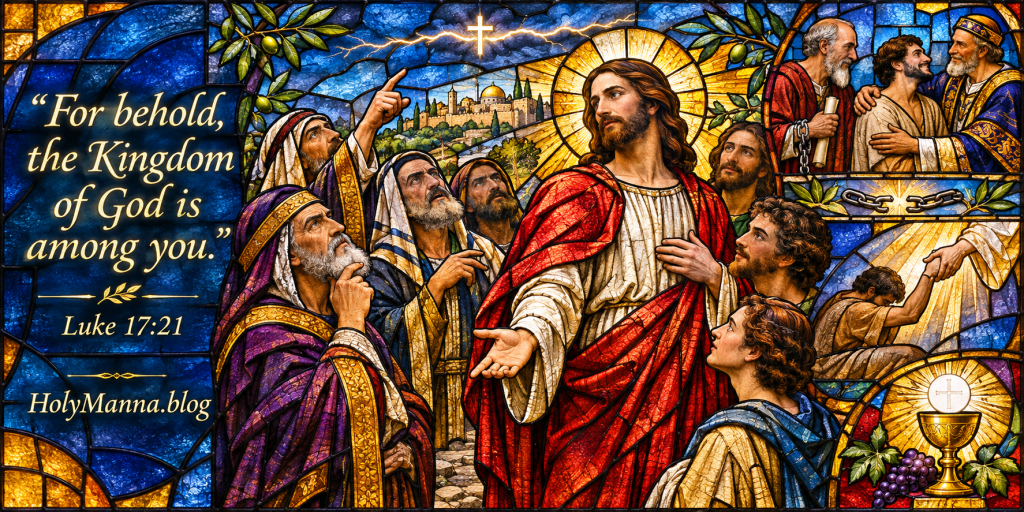
Luke’s Greek is precise. The Kingdom does not come “with observation,” a word used for watching the sky or monitoring symptoms. Then comes the famous phrase, “the Kingdom of God is among you,” which can also be translated “within you.” The Fathers favored the inward reading, modern translations favor the outward one, and the Church holds both. The Kingdom is Christ himself, standing in front of the people asking when he will arrive, and it is received inwardly by grace in every heart that says yes. After answering the Pharisees, Jesus turns to his disciples and tells them the rest: no chasing after rumors, a return as sudden as lightning, and first the cross.
Luke 17:20-25
Asked by the Pharisees when the Kingdom of God would come,
Jesus said in reply,
“The coming of the Kingdom of God cannot be observed,
and no one will announce, ‘Look, here it is,’ or, ‘There it is.’
For behold, the Kingdom of God is among you.”Then he said to his disciples,
“The days will come when you will long to see
one of the days of the Son of Man, but you will not see it.
There will be those who will say to you,
‘Look, there he is,’ or ‘Look, here he is.’
Do not go off, do not run in pursuit.
For just as lightning flashes
and lights up the sky from one side to the other,
so will the Son of Man be in his day.
But first he must suffer greatly and be rejected by this generation.”
Detailed Exegesis
Verse 20 reads: “Asked by the Pharisees when the Kingdom of God would come, Jesus said in reply, ‘The coming of the Kingdom of God cannot be observed,’”
Saint Cyril of Alexandria hears mockery in the question, as if death would catch Jesus before any kingdom appeared. Jesus refuses the premise, since the Kingdom is not a calendar event to be tracked.
Verse 21 reads: “and no one will announce, ‘Look, here it is,’ or, ‘There it is.’ For behold, the Kingdom of God is among you.”
Cyril draws out the inward sense in his Commentary on Luke: “It is within you. That is, it depends on your own wills and is in your own power, whether or not you receive it. Everyone that has attained to justification by means of faith in Christ and decorated by every virtue is counted worthy of the kingdom of heaven.” At the same time, the King is physically present. The miracles, the forgiveness, the healed lepers a few verses earlier are the Kingdom already breaking in.
Verse 22 reads: “Then he said to his disciples, ‘The days will come when you will long to see one of the days of the Son of Man, but you will not see it.’”
The audience shifts from the Pharisees to the disciples. To them Jesus speaks of a coming absence. “Son of Man” recalls the glorious figure of Daniel 7:13, and the disciples will one day ache for even a single day of his visible presence. Every Christian who has prayed through dryness knows this longing.
Verse 23 reads: “There will be those who will say to you, ‘Look, there he is,’ or ‘Look, here he is.’ Do not go off, do not run in pursuit.”
The same “here” and “there” that Jesus rejected for the Kingdom he now rejects for his return. Discipleship includes the discipline of not chasing every rumor.
Verse 24 reads: “For just as lightning flashes and lights up the sky from one side to the other, so will the Son of Man be in his day.”
When Christ returns, nobody will need to announce it. Lightning is sudden, unmistakable, and visible to everyone at once.
Verse 25 reads: “But first he must suffer greatly and be rejected by this generation.”
Before the lightning comes the cross. Jesus binds his own glory to his Passion with the word “must,” the same divine necessity he explains on the road to Emmaus in Luke 24:26. The generation asking for signs is the generation that will reject him, and the rejection is itself the road to the Kingdom.
Teachings
The Catechism holds all of this together. The Kingdom is already present: CCC 541 teaches that God the Father gathers people around his Son, and “This gathering is the Church, ‘on earth the seed and beginning of that kingdom.’” CCC 567 adds: “The kingdom of heaven was inaugurated on earth by Christ. ‘This kingdom shone out before men in the word, in the works and in the presence of Christ.’” And it is received inwardly, as Cyril said, because CCC 543 says that to enter it “one must first accept Jesus’ word.”
The Kingdom is also still to come, which is why the Church keeps praying for it. CCC 2816 says: “The Kingdom of God has been coming since the Last Supper and, in the Eucharist, it is in our midst. The kingdom will come in glory when Christ hands it over to his Father.” CCC 2818 explains that the petition “thy kingdom come” “refers primarily to the final coming of the reign of God through Christ’s return,” and that this hope “commits her to it all the more strongly” rather than distracting the Church from her mission in the world.
Finally, the cross comes first, for the Church as for her Lord. CCC 673 teaches that Christ’s return “could be accomplished at any moment,” and CCC 677 says: “The Church will enter the glory of the kingdom only through this final Passover, when she will follow her Lord in his death and Resurrection.” Saint Josaphat lived that sentence before it was written. Rejected by his own generation and killed by a mob, he entered the Kingdom the only way it can be entered.
Reflection
Most people have a version of the Pharisees’ question. When will things finally get better? When will God show up? Jesus answers that he already has, and that the Kingdom is sitting across the table from you, kneeling in the next pew, and waiting inside your own heart for a yes. Stop scanning the horizon for a sign and look at the person beside you.
Try this for one week. Refuse to chase the “here he is, there he is” of spiritual novelty, the next app, the next viral prophecy, and instead return to the Eucharist, where the Catechism says the Kingdom “is in our midst.” Then do one small act of hidden charity. Where have you been looking for the Kingdom, and where has it already been waiting for you? And what suffering in your life right now might be the road rather than the roadblock?
Look Beside You, Not Up
The Pharisees wanted a date. Paul wanted a welcome. The psalmist wanted everyone to see that the Lord already reigns, feeding the hungry and freeing the captive. And Jesus, standing in the middle of it all, said the thing nobody expected: “the Kingdom of God is among you.”
That is the whole story of November 12th. The Kingdom does not come with fanfare. It comes when an old prisoner refuses to command and chooses to plead, when a runaway thief is received as a beloved brother, when a God who could rule from a throne instead stoops to lift the bowed down. It comes in the Eucharist, hidden under bread. It comes through the cross first, and only then like lightning. Saint Josaphat understood this well enough to pray for the grace to shed his blood for the unity of the Church, and the Church was never more visibly one than in the moment he died for her.
So here is the invitation. Stop waiting for the Kingdom to be announced somewhere else, and start welcoming it where it already is. Forgive the debt that has been held too long. Make the call that keeps getting postponed. Feed the hungry person whose name is already known. Go to Mass this week and receive the King who is already in the midst of his people. The Pharisees looked for signs in the sky and missed the Messiah standing in front of them. The lesson is to look beside, not up. The God of Jacob is already there, and as Augustine promised, “surely your God will not reign without you.”
Engage With Us!
Share your reflections in the comments below. These readings ask big questions about where the Kingdom of God is and how it arrives, and this community grows stronger every time someone shares how the Word is landing in real life.
- In Philemon 7-20, Paul refuses to command Philemon and instead pleads, so that the good he does “might not be forced but voluntary.” Where in your relationships are you demanding what you should be inviting, and who in your life needs to be welcomed as “more than a slave, a brother”?
- In Psalm 146:5a, 7-10, the psalmist lists what the Lord does for the oppressed, the hungry, the captive, the blind, and the bowed down. Which of these has God done for you, and which one is he asking you to become for someone else this week?
- In Luke 17:20-25, Jesus tells the Pharisees that the Kingdom “cannot be observed” because it “is among you,” and then tells his disciples that “first he must suffer greatly.” Where have you been looking for the Kingdom in the wrong place, and what cross in your life might be its road?
- Taken together, the readings reveal a Kingdom that arrives without fanfare, through persons rather than spectacles. What is one hidden, unobserved act of charity you can do before Sunday that would make the Kingdom of God visible to one other person?
Living a life of faith does not require seeing lightning. It requires saying yes to the King who is already in your midst, and then doing everything, the forgiving and the feeding and the welcoming, with the love and mercy Jesus taught. May Saint Josaphat, martyr for the unity of the Church, intercede for everyone who reads these words.
Sacred Heart of Jesus, we trust in You!
Immaculate Heart of Mary, pray for us!
Saint Michael the Archangel, defend us in battle!
Follow us on YouTube, TikTok, Instagram and Facebook for more insights and reflections on living a faith-filled life.


Leave a Reply