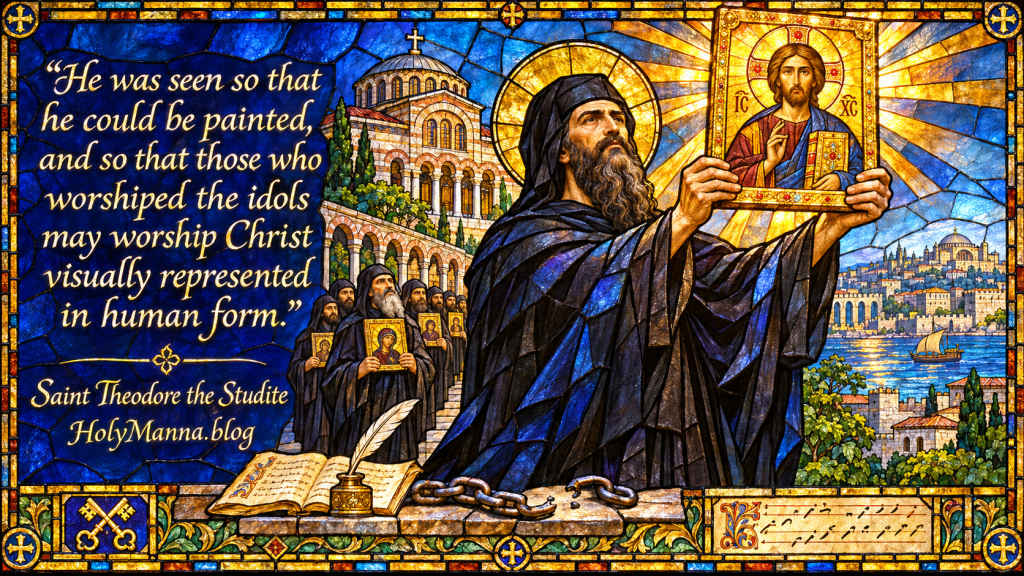
The Monk Who Would Not Bend
Every so often the Church produces a man who simply cannot be moved. Emperors threaten him, patriarchs grow weary of him, soldiers flog him, and jailers starve him, and he keeps saying the same thing until the whole world finally comes around to his position. Saint Theodore the Studite was that kind of man. Born in Constantinople in 759 and dying in exile on November 11th, 826, he spent most of his adult life either running the most influential monastery in the Christian East or being punished for refusing to let an emperor rewrite the faith.
The 2004 Roman Martyrology sums him up on November 11th with these words: “At Constantinople, Saint Theodore the Studite, abbot, who made his monastery a school of scholars, saints and martyrs who were victims of the persecutions of the iconoclasts; sent three times into exile, he held the traditions of the Fathers of the Church in high regard and wrote well-known works explaining Catholic doctrine.” That sentence carries the three great themes of his life: monastic reform, the defense of sacred images, and stubborn fidelity to what the Church had always taught.
Theodore matters to Catholics today for reasons that go well beyond the ninth century. He is the theologian who explained, more clearly than almost anyone before him, why a Christian can paint the face of Jesus and kneel before the painting without committing idolatry. He is the abbot whose Rule shaped Mount Athos and all of Russian monasticism. He is the Eastern monk who wrote to the Pope of Rome about the primacy of Peter in language still quoted in conversations between East and West. And he is a confessor of the faith, a man who suffered for Christ right up to the edge of martyrdom and never crossed over into compromise. Pope Benedict XVI devoted an entire General Audience to him on May 27th, 2009.
A Family That Gave Everything to God
Theodore was born into privilege and into holiness at the same time. His father, Photinus, served in the financial administration of the Byzantine Empire. His mother, Theoctista, is herself venerated as a saint. His maternal uncle, Plato, had walked away from a promising government career to become a monk, and would eventually become abbot of the monastery of Sakkoudion in Bithynia and a saint in his own right. Theodore was the eldest of three brothers; his brother Joseph would later become Archbishop of Thessalonica and is also honored as a saint. Few families in Church history have seen the mother, the uncle, and two of the sons all raised to the altars.
Theodore was a child during the first great wave of iconoclasm, the imperial campaign to strip churches of sacred images and punish those who venerated them. The ninth-century Life of Theodore records that Photinus gave up his government post rather than go along with the iconoclast policies of Emperor Constantine V. According to the same tradition, Theodore’s parents eventually distributed their wealth to the poor and, by mutual consent, each embraced monastic life. This detail comes from later hagiography rather than contemporary records, so it is told here as a tradition and cannot be verified.
What is well documented is that Theodore received an outstanding education in rhetoric, philosophy, and theology. In 780 the iconoclast Emperor Leo IV died, and his widow Irene began to steer the Empire back toward the veneration of images. In that new climate, Plato came to Constantinople and persuaded the whole family to follow him into the religious life. In 781, at the age of 22, Theodore entered Sakkoudion under his uncle’s direction. The Catechism describes this path as “one way of experiencing a ‘more intimate’ consecration, rooted in Baptism and dedicated totally to God” (CCC 916). For Theodore the monastic habit was never a retreat from the Church’s battles. It was the training ground for them.
The tradition records that he confessed his thoughts to his uncle daily, took the lowliest manual labor in the community, and fed his soul on Scripture and the writings of Saint Basil the Great. In 787 the Second Council of Nicaea, which Plato attended, solemnly vindicated the veneration of icons. Around 787 or 788, Patriarch Tarasius of Constantinople ordained Theodore a priest. In 794 Plato withdrew into silence and the community chose Theodore, still in his mid thirties, as abbot of Sakkoudion. He accepted reluctantly, and then governed with a firmness that would define the rest of his life.
The Rebirth of Studios
The moment that turned Theodore from a respected young abbot into a national figure came almost immediately, and it came over marriage. In 795 Emperor Constantine VI set aside his lawful wife, Maria, and married Theodote, a lady of the court who happened to be Theodore’s own cousin. The priest Joseph, steward of the great church of Constantinople, performed the wedding. Patriarch Tarasius, under heavy pressure from the throne, did not punish the priest or publicly rebuke the emperor.
Theodore refused to accept any of it. He broke communion with the priest Joseph and, for a time, with the Patriarch himself, because the Church cannot bless what Christ forbade: “What therefore God has joined together, let not man put asunder” (Matthew 19:6). The Catechism teaches that “a marriage concluded and consummated between baptized persons can never be dissolved” (CCC 1640), and that contracting a new union after divorce places the remarried spouse “in a situation of public and permanent adultery” (CCC 2384). Theodore said the same thing in 795, to an emperor’s face, when the emperor was his own cousin’s new husband. In 796 he was flogged and banished with ten of his monks to Thessalonica, while Plato was imprisoned in the capital.
The exile was short. In 797 Irene deposed her son and recalled the exiles with honor. Sakkoudion, however, was now exposed to Arab raids, so around 798 Irene offered Theodore the ancient monastery of Studios in Constantinople itself. Founded in the fifth century by a Roman consul named Studius and dedicated to Saint John the Baptist, it had dwindled to a handful of monks. Within a few years it was the beating heart of Eastern monasticism.
What Theodore built at Studios is the reason Benedict XVI called this period the beginning of the “Studite Reform.” He insisted on a conscious return to the Fathers, especially Saint Basil and Saint Dorotheus of Gaza. He restored strict common life after years of scattered, improvised monasticism. He wrote detailed regulations on enclosure, poverty, fasting, study, the liturgical hours, and manual labor to supplement the broader rules of Saint Basil. Monasteries of the era typically housed thirty or forty monks. Theodore himself mentions about three hundred at Studios, and the Life of Theodore speaks of more than a thousand Studite monks in all.
Benedict XVI singled out three pillars of Theodore’s teaching. The first was obedience, which Theodore, speaking of the daily surrender of one’s own will, called the “martyrdom of submission.” The second was the vision of the monastery as a true family, a living “Body of Christ.” The third was philergia, love of work, which Theodore was unafraid to describe as the monk’s “sacrifice” and his “liturgy.” No monk at Studios could hide from labor under the pretext of contemplation, and the proceeds of common work were to go to the poor. The Catechism echoes this conviction when it teaches that “work honors the Creator’s gifts and the talents received from him” (CCC 2427). The Studites worked as calligraphers, painters, poets, teachers, and librarians, and the monastery became a nursery of Byzantine hymnography. Together with his brother Joseph, Theodore composed much of the Lenten Triodion, hymns that Eastern Catholics and Orthodox Christians still sing every Great Lent.
Through all of it, he remained a spiritual father to his monks, and his Great Catechesis and Little Catechesis, collections of short daily talks to the brethren, survive to this day. The Byzantine synaxarion records that a holy contemporary, Saint Theoctistus, called him “a fiery teacher of the Church.”
The sources record one healing attributed to Theodore during his lifetime, from the years of his third exile. According to the Byzantine synaxarion, while held at Smyrna he healed a military commander, a relative of the emperor, of a grave illness, and urged him to repent of iconoclasm. The story adds that the man later relapsed into the heresy and died a miserable death. This account comes from later devotional tradition rather than contemporary documents, and it cannot be verified.
Three Exiles and a Procession of Icons
Theodore’s second exile grew out of the same marriage controversy. In 806 Emperor Nicephorus I had a layman, also named Nicephorus, elevated directly to the patriarchal throne, and shortly afterward the priest Joseph who had blessed the imperial wedding was quietly reinstated. Theodore and Plato protested that the Church cannot unsay what it had said about marriage because an emperor finds it convenient. In 809 a synod condemned the Studite position, and Theodore, Plato, and Joseph of Thessalonica were exiled to the Princes’ Islands. Theodore was recalled in 811 by the new Emperor Michael I.
It was during this second exile that Theodore did something remarkable for a monk of Constantinople. He wrote to the Pope. In Letter 33, addressed to Pope Leo III around 809, he explained why he was appealing over the heads of his own patriarch and emperor: “Since to the great Peter Christ our God gave, after the keys of the kingdom of heaven, also the dignity of chief shepherd of the flock, it is necessary that to Peter, that is, to his successor, whatever is newly innovated in the catholic Church by those who wander from the truth be referred.” This is the voice of the East describing the Bishop of Rome exactly as The Catechism does today: “the perpetual and visible source and foundation of the unity both of the bishops and of the whole company of the faithful” (CCC 882).
The third and longest exile was the one that made him a confessor. In 813 Leo V the Armenian seized the throne and set out to restore iconoclasm. Theodore became the head of the resistance. On Palm Sunday of 815, with imperial edicts against images already in force, he led his monks in a solemn procession around the gardens of Studios, each carrying an icon aloft, in full view of the city. The police reacted, exactly as he knew they would. Theodore was banished to Metopa in Bithynia, then around 819 to the fortress of Bonita in Anatolia, and finally to Smyrna. His monastery was filled with iconoclast monks.
The years between 815 and 821 were brutal. Theodore was scourged, imprisoned, and repeatedly moved. The Life records that at Bonita he and his disciple Nicholas were nearly starved by their guards, covered with sores, and barely kept alive, and that they endured it with prayer and thanksgiving. Through all of it he kept writing. Hundreds of letters poured out of his cell to monks, nuns, bishops, laypeople, and the Pope, until the whole resistance was being coordinated from a prison.
In 817 Theodore and four other abbots wrote to Pope Paschal I begging him to summon a synod against the heresy. The opening of Letter 271 is one of the clearest statements of papal primacy ever penned by an Eastern saint: “Hear, O apostolic head, shepherd appointed by God over the sheep of Christ, key-bearer of the kingdom of heaven, rock of the faith upon which the catholic Church has been built. For you are Peter, adorning and governing the throne of Peter.” When Paschal answered by condemning the iconoclasts, Theodore wrote to his disciple Naukratios that the heretics “have torn themselves away from the body of Christ, from the chief throne,” and added, “Let the most blessed and apostolic Paschal rejoice, then, because he has fulfilled the work of Peter.”
Theodore’s defense of the icons was a defense of the Incarnation. In his three Refutations, available in English as On the Holy Icons, he argued that if God the Son truly took flesh, then He truly had a human face, and a human face can be painted. “If Christ could not be portrayed, then He was not truly man, and humanity was not truly united with God in Him.” He pointed to the bronze serpent that Moses lifted up in the desert: “If God formerly condescended to be symbolized by a serpent in order to heal those who were bitten, how could it not be pleasing to Him and appropriate to set up the image of the bodily form which has been His since He became man?” And he insisted that the Incarnation itself was ordered toward being seen: “He was seen so that he could be painted, and so that those who worshiped the idols may worship Christ visually represented in human form.”
This is precisely the teaching the Church holds today. The Catechism says: “Since the Word became flesh in assuming a true humanity, Christ’s body was finite. Therefore the human face of Jesus can be portrayed” (CCC 476). It adds that Christ “has made the features of his human body his own, to the point that they can be venerated when portrayed in a holy image” (CCC 477). And it is careful, as Theodore was careful, to distinguish veneration from worship: “The honor paid to sacred images is a ‘respectful veneration,’ not the adoration due to God alone” (CCC 2132). Benedict XVI summarized Theodore’s insight this way: to abolish the veneration of the icon of Christ would be to repudiate His redeeming work.
Theodore was never martyred, but the Church honors him as a confessor, one who suffered for the faith without dying for it. The Catechism describes the virtue that carried him: “The virtue of fortitude enables one to conquer fear, even fear of death, and to face trials and persecutions” (CCC 1808). It also names the principle that put him in chains: “The citizen is obliged in conscience not to follow the directives of civil authorities when they are contrary to the demands of the moral order” (CCC 2242).
In 821 Leo V was assassinated and Michael II released the exiles. Michael did not restore the icons; he merely tolerated their defenders outside the capital. Theodore could return to Constantinople but not to Studios. When his efforts to persuade Michael to call a synod failed, he withdrew with his monks to Bithynia, settling near the church of the holy martyr Tryphon on the promontory of Akritas. He was in failing health, yet the sources say he celebrated the Divine Liturgy daily and kept instructing the brethren to hold fast to the faith, to venerate the holy icons, and to keep the Rule.
On Sunday, November 11th, 826, he died. The Life records that he asked the monks to chant the Canon for the Departure of the Soul, and that he breathed his last as they reached the verse of Psalm 119: “I will never forget thy precepts; for by them thou hast given me life” (Psalm 119:93). The sources differ on the exact place of his death; the Catholic Encyclopedia places it near Akritas, while Benedict XVI notes that he is believed to have died at Prinkipo, where his body was later kept. All agree that he died an exile, never having returned to the monastery he made famous, and never having seen the victory he fought for.
The Homecoming of an Incorrupt Confessor
The first story attached to his death belongs to Saint Hilarion, abbot of the Dalmatos monastery and himself a confessor under the iconoclasts. According to tradition, at the very hour Theodore died, Hilarion saw a heavenly light and heard a voice declaring that this was the soul of Theodore, who had suffered even unto blood for the holy icons, now departing to the Lord. This is told here as a tradition from the Byzantine synaxarion; it cannot be verified.
The victory Theodore never saw arrived seventeen years after his death. In 842 the last iconoclast emperor died, and on the first Sunday of Lent in 843 the Empress Theodora and Patriarch Methodius solemnly restored the holy images in a celebration the Eastern Church still keeps as the Triumph of Orthodoxy. Theodore’s disciple and successor, Naukratios, regained control of Studios and, with the permission of the Patriarch and the Empress, arranged for the bodies of Theodore and his brother Joseph to be brought home.
On January 26th, 844, the relics were carried from the island of Prinkipo to Studios. An anonymous Studite monk, writing within a few years of the event, describes a great crowd of monks, clergy, and laypeople cheering with joy as the relics entered the city. Patriarch Methodius came in person to Studios and with his own hands laid Theodore to rest in the same tomb as his uncle and spiritual father, Saint Plato, with Joseph beside him. The Empress could not attend but sent gifts. The same early account reports that when the coffin was opened, Theodore’s body was found whole and incorrupt, and that even his skin showed no change after eighteen years. This report comes from a near-contemporary monastic writer, and it cannot be independently verified. Some sources date the translation to 845, though 844 is better supported. Eastern Catholics and Orthodox still commemorate the translation on January 26th.
The Byzantine synaxarion adds a general testimony: that both during his life and after his death Theodore worked many miracles, and that those who invoked his name were delivered from fires, from wild beasts, and from illness. No individual cases are recorded in the sources available, and these claims cannot be verified. The Church’s confidence in such intercession rests on something firmer than any single story: the saints “do not cease to intercede with the Father for us” (CCC 956), and the veneration of relics is a form of piety the Church explicitly honors (CCC 1674).
Theodore’s real afterlife was institutional. His Rule, the Hypotyposis, was codified shortly after his death. In 962, when Saint Athanasius founded the Great Lavra on Mount Athos, he adopted it with a few modifications; portions of Theodore’s Testament are quoted word for word in early Athonite foundation documents still in use. Early in the eleventh century Saint Theodosius introduced the same Rule at the Monastery of the Caves in Kiev, and from there it shaped the whole of Russian monasticism.
The ruins of the Studios basilica still stand in Istanbul. And every year, on November 11th, the Roman Church names him in the Martyrology, while Eastern Catholic and Orthodox churches sing his troparion and chant the Lenten hymns he wrote. The monk who was never allowed home has been home for nearly twelve centuries.
Loving the Visible God
What does a ninth-century Byzantine abbot have to say to a Catholic in the twenty-first century? More than it might first appear.
Start with the icons. Theodore’s whole argument rested on a single conviction: God has a face. “The Word became flesh and dwelt among us” (John 1:14). Christ is “the image of the invisible God” (Colossians 1:15). It is easy to let the crucifix on the wall or the image of Our Lady on the dresser fade into decoration. Theodore suffered six years of prison for the right to kneel before that crucifix. The Catechism says that Christian iconography “expresses in images the same Gospel message that Scripture communicates by words” (CCC 1160). When was the last time you really looked at the sacred images in your home or your parish, and let them preach to you?
Then there is marriage. Theodore’s first exile came because he would not pretend that an emperor’s second marriage was a marriage. That took the courage to be the one person in the room who will not go along, when going along would be so easy and so well rewarded. Is there a truth of the faith you have grown quiet about because it is unpopular with people you love?
Then there is obedience, which Theodore called the martyrdom of submission. Benedict XVI drew the lesson out for everyone, not just monks: a society cannot function if everyone thinks only of himself, and the surrender of one’s own will to the common good is what heals both a community and the ego from the pride of being the center of the world. Obedience to the Church, to a spouse’s legitimate needs, to a boss, to a rule of life freely chosen, is the daily, undramatic form that martyrdom takes for most Christians. Where is God asking you to lay down your own will, and have you called that surrender what it really is, a share in the Cross?
Then there is work. Theodore refused to let his monks treat prayer as an excuse to avoid labor, and he called their work a liturgy. The Catechism says that work “can also be redemptive” and that by enduring its hardship in union with Jesus, a Christian “collaborates in a certain fashion with the Son of God in his redemptive work” (CCC 2427). What would change tomorrow morning if you treated your work as an offering placed on the altar?
Finally, there is the long view. Theodore died in exile, defeated by every visible measure, seventeen years before the icons came home. He was simply asked to be faithful. Saint Paul describes that posture: “I have fought the good fight, I have finished the race, I have kept the faith” (2 Timothy 4:7). Can you keep doing the right thing without needing to see it win?
Some practical ways to carry Theodore into daily life: place a sacred image where it will be seen first thing in the morning, and greet Christ there before greeting a phone. Choose one small, hidden act of obedience each day and offer it silently. Begin the workday with the sign of the cross. Pray for the unity of East and West. And when the pressure comes to soften a hard truth, remember the monk who led a procession of icons straight past the imperial police on Palm Sunday, because he loved the face of Jesus more than he feared the face of the emperor.
Engage With Us!
Readers are invited to share their thoughts and reflections in the comments below. Saint Theodore’s story raises questions worth sitting with.
- Theodore taught that denying the icon of Christ means denying the Incarnation. How do sacred images help you encounter the humanity of Jesus?
- His first exile came from defending the indissolubility of marriage against an emperor. Where is the Church’s teaching on marriage most challenging for you to hold or to explain?
- He called obedience the martyrdom of submission. What is one area where surrendering your own will would draw you closer to Christ?
- He died in exile without seeing the icons restored. How do you stay faithful when you cannot see the fruit of your faithfulness?
- His letters to the Pope show an Eastern monk looking to Peter’s successor as a rock of unity. How can you pray and work for the unity of Christians today?
Saint Theodore never saw the victory he fought for, and he never stopped fighting for it. He loved the face of Christ enough to be flogged for it, loved the Church enough to be exiled for her, and loved his monks enough to keep teaching them from a prison cell. May his intercession give every reader the courage to hold the faith whole, to venerate the God who became visible, and to do everything with the love and mercy that Jesus taught us.
Saint Theodore the Studite, pray for us!
Follow us on YouTube, TikTok, Instagram and Facebook for more insights and reflections on living a faith-filled life.


Leave a Reply