The Soldier Who Cut His Cloak in Two
Every November 11th the Church remembers a man whose single act of kindness at a city gate has been painted and retold more often than almost any story outside the Gospels. Saint Martin of Tours, born about 316 and dead by 397, was a Roman cavalryman, then a hermit, then a monk, then the reluctant Bishop of Tours, and finally the first non-martyr in the Western Church to be publicly honored as a saint. His friend and biographer Sulpicius Severus called his life a bloodless martyrdom. Pope Benedict XVI, at the Angelus on November 11th, 2007, called him one of the most celebrated and venerated saints of Europe and prayed “that all Christians may be like St Martin, generous witnesses of the Gospel of love and tireless builders of jointly responsible sharing.”
Martin is the patron saint of France, of soldiers, of the poor and of beggars, of tailors, of winegrowers, and of innkeepers, and the half of a cloak he gave away is the reason the English language has the words chapel and chaplain. The Roman Martyrology for November 11th records at Tours the heavenly birthday of “blessed Martin, bishop and confessor, whose life was so renowned for miracles that he received the power to raise three persons from the dead.”
A Pagan Officer’s Son Who Wanted the Desert
Martin was born at Sabaria in the Roman province of Pannonia, the city known today as Szombathely in western Hungary. His parents were pagans. His father was a military tribune who had risen through the ranks, and while Martin was still a boy the family was transferred to Ticinum, the modern Pavia in northern Italy, where he grew up.
The traditional birth date of 316 or 317 comes from Gregory of Tours; some modern historians argue for about 336, which would make Martin 61 rather than 81 at his death, and the question remains open.
What is not disputed is the early pull toward Christ. Sulpicius records that at about 10 years old, against his parents’ wishes, Martin walked into a church and asked to be enrolled as a catechumen. At 12 he wanted to go off to the desert as a hermit. The Catechism teaches that “the desire for God is written in the human heart, because man is created by God and for God” (CCC 27). In Martin that desire showed itself before he could shave.
At 15, under the Roman law that bound the sons of veterans to serve, Martin was conscripted into the cavalry. He was still an unbaptized catechumen when his unit was stationed at Amiens in northern Gaul. Even in uniform, Sulpicius says, he lived more like a monk than a soldier, treating his one servant as an equal and giving most of his pay to the poor.
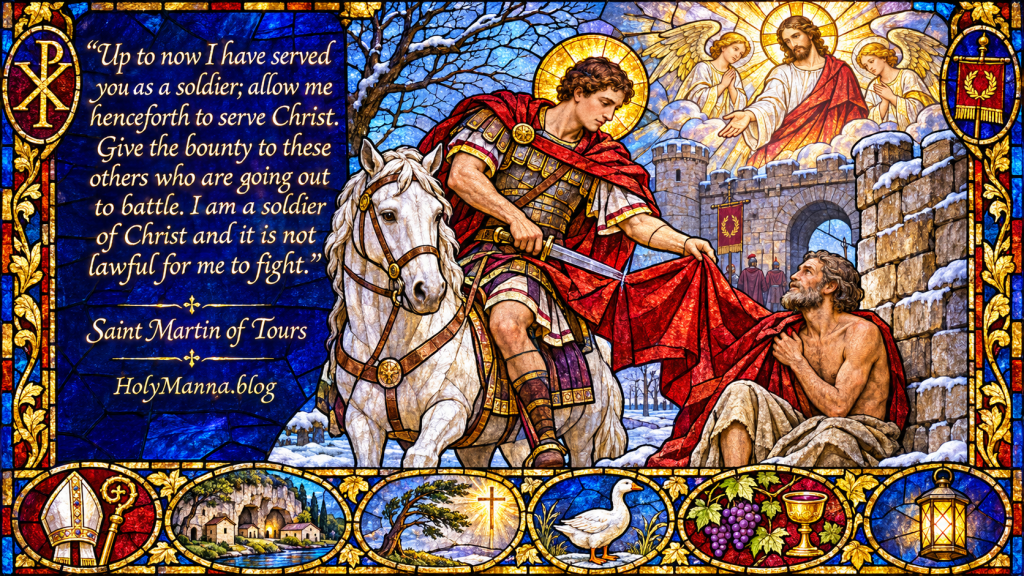
The scene for which he is known came on a bitter winter day at the gate of Amiens. A beggar, nearly naked, was pleading with everyone who passed, and everyone passed. Martin had already given away the rest of his clothing and had nothing left but the heavy military cloak on his back. So he drew his sword, cut the cloak in two, and wrapped one half around the shivering man.
That night Martin dreamed. He saw Christ Himself, surrounded by angels, wearing the half-cloak that had gone to the beggar, and he heard the Lord say to the angels, “Martin, who is still but a catechumen, clothed me with this robe.” Sulpicius writes that Martin recognized the words of the Gospel, “Amen, I say to you, whatever you did for one of these least brothers of mine, you did for me” (Matthew 25:40), and that he “flew to be baptized.” He was about 18.
The Church reads the scene exactly as Martin did. The Catechism lists clothing the naked among the corporal works of mercy and teaches that “the works of mercy are charitable actions by which we come to the help of our neighbor in his spiritual and bodily necessities” (CCC 2447). Martin did not yet know the Catechism, but he already knew Matthew 25.
Soldier of Christ, Hermit, Monk, and Bishop
Martin stayed in the army about two more years after his Baptism, a soldier in name only. The break came before a battle with Germanic invaders near Worms on the Rhine. When the Caesar Julian, later known as Julian the Apostate, was handing out a cash bonus to the troops, Martin refused his share: “Up to now I have served you as a soldier; allow me henceforth to serve Christ. Give the bounty to these others who are going out to battle. I am a soldier of Christ and it is not lawful for me to fight.”
Julian accused him of cowardice. Martin answered that he would stand in the front line the next morning without weapons: “In the name of the Lord Jesus, and protected not by a helmet and buckler but by the sign of the cross, I will thrust myself into the thickest squadrons of the enemy without fear.” He was held in custody to make good on the promise, but the next day the enemy sent envoys asking for peace, and the battle never came. The usual date given is about 356.
This episode does not mean the Church condemns military service. The Catechism teaches that “those who are sworn to serve their country in the armed forces are servants of the security and freedom of nations” (CCC 2310), while also protecting conscientious objectors (CCC 2311). Martin’s departure was a personal vocation, which is exactly why soldiers have always claimed him as their own.
Free at last, Martin went to Poitiers to sit at the feet of Saint Hilary, the great defender of the divinity of Christ against the Arian heresy. Hilary wanted to ordain him a deacon; Martin, insisting he was unworthy, accepted only the minor order of exorcist. Then, prompted by a dream, he crossed the Alps to see his parents, was seized by robbers on the way, and so calmly told one of them that the mercy of God is closest in times of trial that the man released him and became a Christian. At home Martin converted his mother, though his father would not be moved. He preached against the Arians in Illyricum, was publicly scourged, and was driven out; the Arian bishop of Milan expelled him again; and learning that Hilary had been exiled, Martin withdrew to a tiny island called Gallinaria in the Gulf of Genoa and lived there as a hermit.
When Hilary was allowed home about 360, Martin rejoined him and was given land at Ligugé, a few miles from Poitiers. The hermitage that grew up there is regarded as the oldest known monastic foundation in Europe. For roughly 10 years Martin lived there, preaching in the surrounding villages and working the miracles that made his name.
Then in 371 Bishop Lidorius of Tours died, and the people of that city wanted the hermit of Ligugé. Knowing he would refuse, a citizen named Rusticius came claiming that his wife was dying and begging Martin to come. The moment Martin entered Tours a crowd closed around him and carried him to the church. A few visiting bishops objected to his shabby appearance, and the people shouted them down. He was consecrated in July; the Catholic Encyclopedia and Gregory of Tours give the 4th, while Butler’s Lives of the Saints gives the 3rd. Martin became the third Bishop of Tours.
He did not become a different man. He refused the bishop’s residence and settled on the cliffs across the Loire, where about 80 monks joined him in caves and huts; that community became the great abbey of Marmoutier. From there Martin went out to the rural pagans on foot, by donkey, and by boat, tearing down shrines and planting the parishes that still dot the Touraine. The Catechism says a bishop’s first task is “to preach the Gospel of God to all men” (CCC 888). Martin simply did it with a monk’s habit under his vestments.
The Dead Raised and the Throne on Fire
Why does the Church ask the faithful to remember Martin so many centuries later, and to imitate him? Because his life shows what happens when a man gives everything to Christ and asks for nothing back. The Catechism explains that by canonizing some of the faithful the Church “recognizes the power of the Spirit of holiness within her” and proposes the saints to believers “as models and intercessors” (CCC 828). Martin was recognized by the Spirit’s power long before any formal process existed, and that power showed itself in signs.
The most famous miracle came at Ligugé. A catechumen in the community fell ill and died while Martin was away, without receiving Baptism. Martin came back to find the body prepared for burial, sent the brothers out of the cell, stretched himself over the corpse, and prayed. After about two hours the dead man stirred, opened his eyes, and sat up. He later said that his soul had been led before a dark tribunal and condemned, when two angels announced that Martin was praying for him, and he was sent back. He was baptized at once and lived many more years.
Not long after, he restored to life a slave who had hanged himself on a neighboring estate. Years later, as bishop, Martin was traveling near Chartres when a grieving pagan mother laid her dead son at his feet. He knelt in front of the whole village, prayed, and gave the boy back to her alive. The crowd cried out that Christ was God and asked for Baptism on the spot. These are the three resurrections the Roman Martyrology has in mind. The Church teaches that such signs “manifest that the kingdom is present” in Christ (CCC 547).
The countryside of Gaul was still deeply pagan. In one village the people refused to let Martin cut down a pine tree sacred to their gods, and one of them proposed a test: the pagans would fell the tree themselves if Martin stood exactly where it leaned to fall. He agreed. They tied him in place and cut through the trunk, and as the pine came down on top of him Martin made the sign of the cross. The tree twisted and crashed in the opposite direction, scattering the woodcutters. Sulpicius says nearly the whole district asked for Baptism that day.
The healings were just as plain. At Trier he poured blessed oil into the mouth of a paralyzed girl, and she rose from her bed. At the gate of Paris he kissed and blessed a leper whose disfigurement made the crowds shrink away, and the man was clean by morning.
Even emperors were not out of reach. When the Emperor Valentinian shut the palace gates at Trier against him and then refused to rise from his throne, the throne caught fire beneath him; he leapt up, embraced the bishop, and granted every request.
Martin’s discernment was as sharp as his charity. When the devil appeared in his cell robed in purple and gold, claiming to be Christ returning in glory, Martin answered, “Nor will I ever believe him to be Christ who shall not come in the habit and figure in which Christ suffered,” and the vision vanished. The Catechism teaches that the devil’s power “is not infinite” (CCC 395).
Beaten by Heretics and Betrayed by an Emperor
Martin was never martyred, but Sulpicius was right to speak of a martyrdom without blood. He was flogged by Arians, mocked at his own election, and slandered by jealous clergy so persistently that Sulpicius had to write a letter defending him against those who called his miracles frauds.
The deepest wound was political. In the 380s a Spanish bishop named Priscillian was teaching a doctrine the Church condemned at the Council of Saragossa. His enemies, led by a bishop named Ithacius, took the case not to Rome but to the usurping Emperor Maximus at Trier and demanded that the state punish him. Martin went to Trier in 385 to stop it. He did not defend Priscillian’s teaching; he insisted that a heretic belonged before the judgment of the Church, not before an executioner. Maximus promised that no blood would be shed. Then, after Martin left the city, the emperor handed the case to his prefect. Priscillian and several companions were beheaded, the first time in the history of the Church that the civil power executed anyone for heresy.
Martin was horrified and refused to share communion with the bishops who had engineered the killings. Then Maximus prepared to send military tribunes into Spain to hunt down Priscillian’s followers, and two men were condemned to death for having supported the previous emperor. Martin returned to Trier to plead for them. Maximus named his price: Martin must first receive communion alongside Ithacius. For one day, to save lives, Martin did. The tribunes were recalled and the two men were spared. He left Trier in anguish, convinced he had compromised. An angel is said to have consoled him, saying he had done right to grieve but that there had been no other way out. He never attended another synod. The Catechism acknowledges that “in times past, cruel practices were commonly used by legitimate governments to maintain law and order, often without protest from the Pastors of the Church” (CCC 2298). Martin protested in his own time, almost alone, and paid for it in conscience.
The end came in the autumn of 397. Martin had told the brothers at Marmoutier that his death was near, but a quarrel had broken out among the clergy at Candes, a village where the Vienne meets the Loire, and he went to settle it. Peace was restored. Then his strength failed. He called the brothers and told them he was dying. They wept and begged him not to abandon them, and Martin turned to God with the prayer the Church still reads in the Office of Readings on his feast: “Lord, if I am still necessary to thy people, I refuse no labour. Thy holy will be done.”
He lay for days with a fever on ashes and sackcloth, never ceasing to pray. When the brothers tried to put straw beneath him, he refused: “It becomes not a Christian to die otherwise than upon ashes.” When they tried to turn him on his side, he answered, “Allow me, my brethren, to look rather towards heaven than upon the earth.” Then he saw the devil standing by the bed and said to him, “Why do you stand here, thou bloody monster? Thou shalt find nothing in me, thou deadly one: Abraham’s bosom is about to receive me.” With those words he died. Those present testified to Sulpicius that his face looked like the face of an angel.
It was November 8th, 397. The Catholic Encyclopedia notes that a few older authorities give the year 400, but 397 is the accepted date. The Catechism teaches that “the Christian who unites his own death to the death of Jesus views it as a step towards him and an entrance into everlasting life” (CCC 1010). Martin treated his death like the final stage of a campaign and marched into it.
The Body Passed Through a Window
Candes lay almost exactly between Poitiers, where Martin had founded Ligugé, and Tours, where he had been bishop, and when he died both cities claimed the body. Gregory of Tours, who held Martin’s see two centuries later, tells the story in his History of the Franks: in the night the Poitevins keeping watch fell into a deep sleep, and the men of Tours lifted the body, passed it out through a window of the cell, carried it to a boat on the Vienne, and rowed home down the Loire. That Tours obtained the body is certain; the window and the sleeping guards come from Gregory writing nearly 200 years later, and the details cannot be verified.
Martin was buried at Tours on November 11th, 397, with about 2,000 monks in the procession and the city singing hymns rather than mourning. That burial date, not the day of his death, became his feast.
His successor Saint Brice built a small chapel over the stone sarcophagus, and the miracles began almost immediately. About 64 years after Martin’s death, Bishop Perpetuus of Tours, seeing how constantly the sick were cured at the tomb, raised a great basilica and on July 4th, 473 translated the body into it. Gregory of Tours later filled 4 books with the miracles he witnessed or collected there: the blind receiving sight, paralytics walking, prisoners freed, the possessed delivered. The Catechism teaches that the saints “do not cease to intercede with the Father for us” and that “their intercession is their most exalted service to God’s plan” (CCC 956), and it counts the veneration of relics among the authentic expressions of the people’s piety (CCC 1674).
The shrine became one of the great pilgrimages of medieval Christendom, visited by Clovis, the first Catholic king of the Franks. The half-cloak Martin had kept, the cappa, is said to have been preserved as a relic by the Frankish kings and carried into their wars; the oratory that housed it was called the cappella, which the Catholic Encyclopedia confirms as the origin of the words chapel and chaplain. The survival of the cloak itself is a tradition and cannot be verified.
The basilica was rebuilt in 1014, burned in 1230, and rebuilt larger still. In 1562 Huguenots sacked it and scattered the relics; the canons recovered a bone of the arm and part of the skull. In 1793 revolutionaries demolished the basilica and ran streets across the site. In December 1860 excavations found the lost tomb, and a new Basilica of Saint Martin was raised over it and consecrated in 1925. The recovered relics rest there today, and every November 11th the faithful of Tours gather there for the solemn feast.
Thousands of French churches and hundreds of towns bear his name. Across Germany, Austria, the Low Countries, and Central Europe, Martinmas is kept with lantern processions, roast goose, and the first tasting of the new wine, and the Armistice that ended the First World War was signed on his feast in 1918.
Two popular traditions deserve to be told as traditions. One says that when the people of Tours came to make Martin their bishop, he hid in a pen of geese, and their honking gave him away; the roast goose of Martinmas is supposed to be the geese paying for their betrayal. The story appears in no early source and cannot be verified. Another says that on a journey to Rome the devil mocked Martin for walking rather than riding like a bishop, and that Martin turned the devil into a donkey and rode him the rest of the way. It is a late folk tale and cannot be verified.
Half a Cloak Is Enough
The most striking thing about Martin at Amiens is that he was not yet baptized. He had no theology degree, no spiritual director, and no sacraments. He had a half-formed faith, a sword, and a cloak, and that was enough for Christ to show up in his dream wearing it. The Catechism teaches that “God blesses those who come to the aid of the poor, and rebukes those who turn away from them” (CCC 2443). Martin learned that night that the way to the heart of God runs through the beggar at the gate.
Who is the beggar at your gate? It may be the man on the corner, the coworker everyone else walks past, the relative nobody calls. Martin’s answer was not to give the man everything, which he could not do, nor to give nothing, which the others did. He cut the cloak in half. What is the half-cloak you could actually give this week?
Martin’s whole life is a lesson in refusing to let the role swallow the man: a soldier who lived like a monk, a bishop who lived like a hermit, a miracle worker who served his own servant. The Catechism reminds every Christian that “there is no holiness without renunciation and spiritual battle” (CCC 2015). What title or comfort has started to define you more than Christ does, and what small renunciation would loosen its grip?
There is also something here for anyone who has had to make an impossible call. At Trier, Martin had to choose between his conscience and the lives of men who would die if he held firm. He bent, he saved them, and then he grieved the bending for the rest of his life. The Church teaches that “a human being must always obey the certain judgment of his conscience” (CCC 1790). Is there a choice in your past that you have been too proud to grieve, or too ashamed to forgive yourself for? Martin shows that a saint can carry both.
Finally, there is the deathbed. Martin did not want to go, and he told God so, and then he surrendered. The Catechism teaches that “the Church encourages us to prepare ourselves for the hour of our death” (CCC 1014). If you were told tonight that your work was nearly over, what would you be sorry to leave unfinished?
Practically, three things this week would honor him: give away something that still has use in it, to a person rather than a bin; find the one person at work or at home that everyone else steps around, and stop; and before sleep, make Martin’s deathbed prayer your own.
Engage With Us!
Saint Martin’s story belongs to everyone who has ever stood at a gate and had to decide whether to keep walking. Please share your thoughts and reflections in the comments below, and let this community pray together in honor of a soldier who became a shepherd.
- When was the last time you gave something that actually cost you, and what did it feel like afterward?
- Martin refused the emperor’s bonus and the bishop’s palace. What is one comfort you have been holding onto that Christ may be asking you to release?
- The catechumen Martin raised at Ligugé had died without Baptism. How seriously do you take the sacraments, and is there one you have been putting off?
- At Trier, Martin compromised to save lives and grieved it for the rest of his days. How do you handle decisions where every option costs something?
- Martin evangelized the countryside village by village. Who in your daily circle has never heard the Gospel from you?
- On his deathbed Martin told God that if his people still needed him he refused no labor. How would your week change if you began each morning with that surrender?
Saint Martin cut his cloak in half because he saw a man shivering, and Christ counted it as done to Himself. The same Christ stands at every gate in your life, usually without a crown and often without a coat. Go to Him there. Serve Him in the soldier, the beggar, the heretic, and the dying, and do everything with the love and mercy that Jesus taught us.
Saint Martin of Tours, pray for us!
Follow us on YouTube, TikTok, Instagram and Facebook for more insights and reflections on living a faith-filled life.


Leave a Reply