Memorial of Saint Martin of Tours, Bishop – Lectionary: 493
Nobody Earned This
Some gifts are so large that the only honest response is to stop, turn around, and go back to the person who gave them. Today’s readings are built around that moment of turning around.
Everything in the Liturgy of the Word for November 11th arrives unearned. In Titus 3, Saint Paul reminds a young bishop that nobody was saved “because of any righteous deeds we had done but because of his mercy.” In Psalm 23, a shepherd provides pasture, water, protection, a table, and a home, and the sheep contributes nothing but trust. In Luke 17, ten men are healed by a single sentence, and only one of them realizes that the gift deserves a response. The central theme is simple and uncomfortable: salvation is pure mercy, and gratitude is the shape faith takes once a person understands that.
The Church places these readings on the Memorial of Saint Martin of Tours, and the fit is remarkable. Martin was born around 316 in what is now Hungary and was pressed into the Roman cavalry as a teenager. He was still a catechumen, not yet baptized, when he met a freezing beggar at the gate of Amiens, cut his military cloak in two with his sword, and gave half away. His biographer and friend Sulpicius Severus records that Christ appeared to him that night wearing the half cloak. Martin was baptized soon after, left the army, became a monk, and in 371 became bishop of Tours. He died in 397, one of the first non-martyrs to be publicly honored as a saint in the West.
Martin’s whole life ran on the logic of today’s readings. He received a mercy he had not earned, and he spent the next 60 years giving thanks for it with his hands.
First Reading — Titus 3:1-7
A Letter to a Rough Island and a Reminder of Where Everyone Started
Saint Paul wrote this short letter to Titus, a Gentile convert he had left on the island of Crete “to set right what remains to be done and appoint presbyters in every town” (Titus 1:5). Crete was not an easy assignment; Paul himself quotes a Cretan poet’s unflattering description of the locals in Titus 1:12.
By chapter 3, Paul has turned to the question of how these new believers should live among their pagan neighbors and under Roman magistrates who did not share their faith. Then, almost mid-sentence, he stops giving instructions and starts remembering. “For we ourselves were once foolish.” The passage that follows reads like an early baptismal hymn, and many scholars believe Paul is quoting one. The Greek phrase behind “the bath of rebirth” is loutron palingenesias, the washing of new birth, and the Church has always heard in it a direct description of Baptism.
Nobody on Crete earned a place in the Church. Saint Martin was a catechumen, a man still waiting for that bath, when he gave away half his cloak and discovered that Christ had been standing at the gate in rags.
Titus 3:1-7
Beloved:
Remind them to be under the control of magistrates and authorities,
to be obedient, to be open to every good enterprise.
They are to slander no one, to be peaceable, considerate,
exercising all graciousness toward everyone.
For we ourselves were once foolish, disobedient, deluded,
slaves to various desires and pleasures,
living in malice and envy,
hateful ourselves and hating one another.But when the kindness and generous love
of God our savior appeared,
not because of any righteous deeds we had done
but because of his mercy,
he saved us through the bath of rebirth
and renewal by the Holy Spirit,
whom he richly poured out on us
through Jesus Christ our savior,
so that we might be justified by his grace
and become heirs in hope of eternal life.
Detailed Exegesis
Verse 1: “Beloved: Remind them to be under the control of magistrates and authorities, to be obedient, to be open to every good enterprise.”
Paul begins with civic life. Christians on Crete were a tiny minority under Roman rule, and the temptation to treat the surrounding order with contempt was real. Paul insists on the opposite posture. The phrase “open to every good enterprise” matters too. Believers are supposed to be the first people in town to show up when something good needs doing.
Verse 2: “They are to slander no one, to be peaceable, considerate, exercising all graciousness toward everyone.”
The word translated “graciousness” is prautēs, gentleness or meekness, the same quality Jesus names in the Beatitudes. Paul extends it “toward everyone,” not only toward fellow Christians.
Verse 3: “For we ourselves were once foolish, disobedient, deluded, slaves to various desires and pleasures, living in malice and envy, hateful ourselves and hating one another.”
Here is the hinge of the reading. Paul explains why Christians can afford to be gentle with pagans: they used to be exactly like them. The list is unsparing. Foolishness, disobedience, delusion, slavery to appetite, malice, envy, and mutual hatred describe life apart from grace. Paul includes himself.
Verse 4: “But when the kindness and generous love of God our savior appeared,”
The word “appeared” is epephanē, from which the word Epiphany comes. God’s kindness showed up in history, in a person. The phrase “generous love” translates philanthrōpia, God’s love for human beings as such. Before anyone could love God back, God loved first.
Verse 5: “not because of any righteous deeds we had done but because of his mercy, he saved us through the bath of rebirth and renewal by the Holy Spirit,”
This is the center of the whole reading. Paul rules out any claim to have earned it. Then he names the means: “the bath of rebirth,” which is Baptism, and “renewal by the Holy Spirit,” the interior transformation that the water signifies and brings about. The Catechism cites this exact verse when it lists the names of the sacrament.
Verse 6: “whom he richly poured out on us through Jesus Christ our savior,”
The Holy Spirit is not measured out stingily. Notice the Trinitarian shape of verses 4 through 6: the Father’s kindness appears, the Spirit renews, and all of it comes “through Jesus Christ.”
Verse 7: “so that we might be justified by his grace and become heirs in hope of eternal life.”
Paul ends with the purpose. Justification by grace is not the finish line; it makes the baptized “heirs.” An heir does not earn an inheritance. An heir receives it because of who the Father is.
Teachings
The Church reads Titus 3:5 as a plain description of Baptism. CCC 1215 teaches: “This sacrament is also called ‘the washing of regeneration and renewal by the Holy Spirit,’ for it signifies and actually brings about the birth of water and the Spirit without which no one ‘can enter the kingdom of God.’”
What that new birth produces is spelled out in CCC 1265: “Baptism not only purifies from all sins, but also makes the neophyte ‘a new creature,’ an adopted son of God, who has become a ‘partaker of the divine nature,’ member of Christ and co-heir with him, and a temple of the Holy Spirit.”
On the question of merit, the Catechism is as blunt as Paul. CCC 1996 states: “Our justification comes from the grace of God. Grace is favor, the free and undeserved help that God gives us to respond to his call to become children of God, adoptive sons, partakers of the divine nature and of eternal life.” The Council of Trent’s Decree on Justification names Baptism the instrumental cause of justification, a teaching built directly on Titus 3:5-7.
Saint John Chrysostom, preaching on this passage in his Homilies on Titus, draws out Paul’s logic of confidence. If God saved people who had nothing good in them, Chrysostom reasons, then “much more will He save us in the world to come.” Past mercy is the guarantee of future mercy.
On verse 1, the Catechism affirms the duty of obedience to lawful authority (CCC 1900) and marks its limit in CCC 2242: “The citizen is obliged in conscience not to follow the directives of civil authorities when they are contrary to the demands of the moral order, to the fundamental rights of persons or the teachings of the Gospel.” Saint Martin lived both halves. He served faithfully in the Roman army, and when he finally asked to be released before a battle, Sulpicius Severus records him saying: “I am the soldier of Christ: it is not lawful for me to fight.”
Reflection
Paul’s list in verse 3 is worth sitting with slowly. Most people can find themselves somewhere in it, and that is the point. The reason a Christian can be gentle with a difficult coworker or a hostile relative is not superiority. It is memory.
A concrete step for today is to recall your own Baptism. If you do not know the date, find it. Thank God for a gift you did nothing to earn. Then pick one person this week who falls outside your circle and show them the “graciousness toward everyone” that Paul describes.
When was the last time you remembered that you were once “foolish, disobedient, deluded” and that mercy found you anyway? Does that memory soften the way you speak about people who have not yet found it?
Responsorial Psalm — Psalm 23:1-6
A Shepherd Boy’s Song That the Early Church Taught to the Newly Baptized
Psalm 23 is attributed to David, who spent his youth guarding sheep in the hills around Bethlehem before Samuel anointed him king. Every image in the psalm comes from that work. A shepherd in ancient Israel led from the front rather than driving from behind; sheep followed a voice they knew. The “rod” was a short, heavy club for beating off predators. The “staff” was the long crook for guiding and rescuing. Pasture and still water were life itself in a dry country.
Halfway through, the picture changes from field to banquet hall. A host spreads a table, anoints a guest’s head with perfumed oil, and keeps filling the cup. These were the marks of extravagant hospitality in the ancient Near East.
The early Church loved this psalm so much that catechumens were made to memorize it before Baptism. Augustine, Cyril of Jerusalem, Ambrose, and Gregory of Nyssa all read it as a map of Christian initiation: pasture is catechesis, restful water is the font, oil is the anointing, and the table is the Eucharist. Placed between Paul’s “bath of rebirth” and the Gospel’s healed leper, the psalm is the song of someone who has received everything and knows it.
Psalm 23:1-6
R. (1) The Lord is my shepherd; there is nothing I shall want.
The LORD is my shepherd; I shall not want.
In verdant pastures he gives me repose;
Beside restful waters he leads me;
he refreshes my soul.
R. The Lord is my shepherd; there is nothing I shall want.
He guides me in right paths
for his name’s sake.
Even though I walk in the dark valley
I fear no evil; for you are at my side
With your rod and your staff
that give me courage.
R. The Lord is my shepherd; there is nothing I shall want.
You spread the table before me
in the sight of my foes;
You anoint my head with oil;
my cup overflows.
R. The Lord is my shepherd; there is nothing I shall want.
Only goodness and kindness follow me
all the days of my life;
And I shall dwell in the house of the LORD
for years to come.
R. The Lord is my shepherd; there is nothing I shall want.
Detailed Exegesis
Verse 1: “The LORD is my shepherd; I shall not want.”
The psalm opens with a claim of total dependence. The LORD, the covenant name of God, takes personal responsibility for one sheep. Nothing necessary will be lacking.
Verse 2: “In verdant pastures he gives me repose; beside restful waters he leads me;”
Sheep will not lie down when afraid, and they will not drink from rushing water; the shepherd has to find still pools. Saint Augustine heard Baptism here: “By the water of baptism, whereby they are refreshed who have lost health and strength, has He brought me up.”
Verse 3: “he refreshes my soul. He guides me in right paths for his name’s sake.”
The Hebrew says the shepherd “restores” or brings back the soul, the way a shepherd retrieves a sheep that has wandered. The reason given is “for his name’s sake,” not for the sheep’s merit. Augustine noted the same thing: “not for my merit’s sake, but for His Name’s sake.”
Verse 4: “Even though I walk in the dark valley I fear no evil; for you are at my side with your rod and your staff that give me courage.”
The psalm shifts from speaking about God to speaking to him. Danger arrives, and the language becomes intimate. The rod and staff are not instruments of punishment here; they are proof that the shepherd is armed and present.
Verse 5: “You spread the table before me in the sight of my foes; you anoint my head with oil; my cup overflows.”
The enemies are still in view, but the guest is eating. Saint Cyril of Jerusalem taught the newly baptized of Jerusalem to see the Eucharist here: “Before Thy coming, the evil spirits prepared a table for men, polluted and defiled and full of devilish influence; but since Thy coming, O Lord, Thou hast prepared a table before me.”
Verse 6: “Only goodness and kindness follow me all the days of my life; and I shall dwell in the house of the LORD for years to come.”
The Hebrew word behind “kindness” is hesed, God’s steadfast covenant love, and the verb means to pursue. Mercy chases the sheep home. The final line looks past this life to a permanent dwelling with God.
Teachings
The Church sees herself in this psalm. CCC 754 teaches: “The Church is, accordingly, a sheepfold, the sole and necessary gateway to which is Christ. It is also the flock of which God himself foretold that he would be the shepherd, and whose sheep, even though governed by human shepherds, are unfailingly nourished and led by Christ himself, the Good Shepherd and Prince of Shepherds, who gave his life for his sheep.” Jesus claimed the title directly: “I am the good shepherd. A good shepherd lays down his life for the sheep” (John 10:11).
Saint Augustine’s Exposition on Psalm 22, the psalm’s number in the Latin tradition, begins: “The Church speaks to Christ: The Lord feeds me, and I shall lack nothing.” For Augustine, the table of verse 5 is where the baptized stop drinking milk and begin eating solid food, the Eucharist. CCC 1392 makes the same connection: “What material food produces in our bodily life, Holy Communion wonderfully achieves in our spiritual life.”
Saint Martin of Tours lived this psalm from the bishop’s side. Sulpicius Severus records that on his deathbed, when his disciples begged him not to leave them, he prayed: “O Lord, if I am still necessary to thy people, I do not shrink from toil: thy will be done.” A shepherd who has been fed at the Lord’s table does not abandon the flock.
Reflection
The psalm is usually sung at funerals, but it is a psalm for ordinary Tuesdays. The dark valley is not only death. It is the diagnosis, the layoff, the long silence from a child who has walked away from the faith.
A concrete practice is to pray this psalm slowly before Mass this week and notice where you actually are in it. Are you resting in verse 2, walking through verse 4, or sitting at the table in verse 5 with enemies still in sight?
What would change in your week if you believed that goodness and kindness were following you rather than hunting you? Where do you need the rod, and where do you need the staff?
Holy Gospel — Luke 17:11-19
Ten Voices Cry Out, One Voice Comes Back
Saint Luke sets this scene inside the long journey to Jerusalem that begins in Luke 9:51 and ends at the Cross. Jesus is on the border between Samaria and Galilee, a region where Jews and Samaritans brushed against each other uneasily. After the Assyrian conquest in the eighth century before Christ, the population of Samaria was mixed with foreign settlers (2 Kings 17), and the Samaritans built their own temple on Mount Gerizim. By the time of Jesus, “Jews use nothing in common with Samaritans” (John 4:9).
Leprosy erased that line. The Law of Moses required anyone with the disease to live apart: “He shall dwell apart, making his abode outside the camp” (Leviticus 13:46). Only a priest could examine a healed leper and declare him clean (Leviticus 14). So ten men, at least one of them a Samaritan, formed the only community available to them, a colony of the excluded.
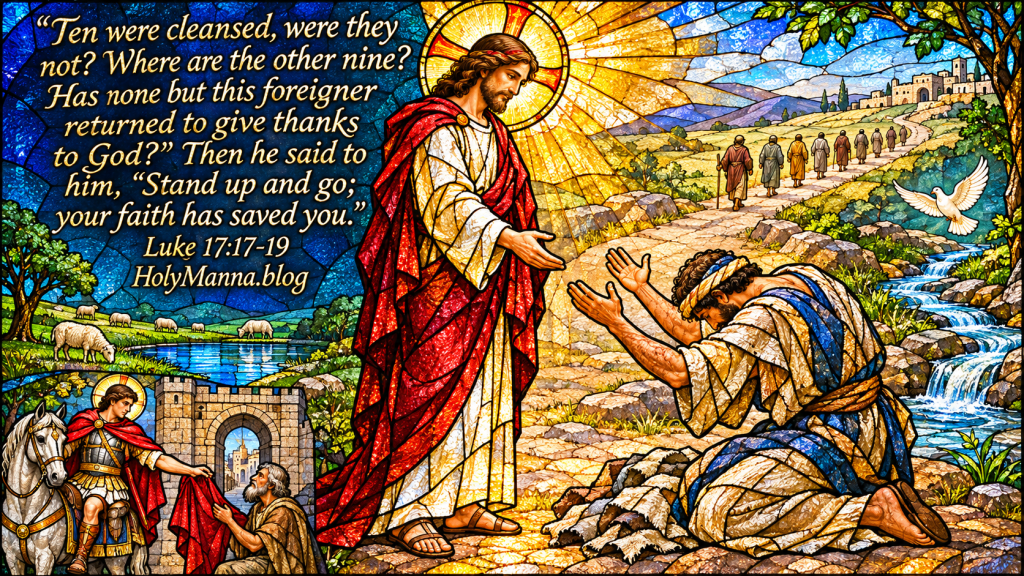
The passage fits the day’s theme exactly. Ten receive a gift none of them earned. One understands what has happened and comes back. Saint Martin’s entire life was that return trip.
Luke 17:11-19
As Jesus continued his journey to Jerusalem,
he traveled through Samaria and Galilee.
As he was entering a village, ten lepers met him.
They stood at a distance from him and raised their voice, saying,
“Jesus, Master! Have pity on us!”
And when he saw them, he said,
“Go show yourselves to the priests.”
As they were going they were cleansed.
And one of them, realizing he had been healed,
returned, glorifying God in a loud voice;
and he fell at the feet of Jesus and thanked him.
He was a Samaritan.
Jesus said in reply,
“Ten were cleansed, were they not?
Where are the other nine?
Has none but this foreigner returned to give thanks to God?”
Then he said to him, “Stand up and go;
your faith has saved you.”
Detailed Exegesis
Verse 11: “As Jesus continued his journey to Jerusalem, he traveled through Samaria and Galilee.”
Luke reminds the reader that the Cross is the destination; every healing on this road previews the mercy poured out there.
Verse 12: “As he was entering a village, ten lepers met him. They stood at a distance from him”
They keep the distance the Law required. Saint Cyril of Alexandria observed that “by the law of Moses they were shut out of the cities and villages, as being impure.” Jesus does not flinch.
Verse 13: “and raised their voice, saying, ‘Jesus, Master! Have pity on us!’”
They cannot approach, so they shout. The title “Master” is epistata, used in Luke’s Gospel only by people who already recognize Jesus’s authority. Their cry is the prayer the Church still makes at every Mass.
Verse 14: “And when he saw them, he said, ‘Go show yourselves to the priests.’ As they were going they were cleansed.”
Jesus heals them with a command that requires faith. They are sent to the priests while still visibly leprous. Cyril explains why: “He did not heal them first, but sent them to the priests, because the priests knew the marks of leprosy, and of its being healed.” The healing comes on the road, in the act of obedience.
Verse 15: “And one of them, realizing he had been healed, returned, glorifying God in a loud voice;”
The same loud voice that begged now praises. Luke’s word for what the man realized is that he had been “healed,” not merely “cleansed.” He understood the gift as a gift, and that understanding turned him around.
Verse 16: “and he fell at the feet of Jesus and thanked him. He was a Samaritan.”
He falls on his face, the posture of worship given to God alone. The Greek participle for “thanked” is eucharistōn. Then comes the twist Luke has been saving: the worshiper is a Samaritan, the outsider.
Verse 17: “Jesus said in reply, ‘Ten were cleansed, were they not? Where are the other nine?’”
He asks a question that has echoed for 2,000 years. The nine did nothing wrong by the Law; they were doing exactly what they were told. What they missed was the Giver.
Verse 18: “Has none but this foreigner returned to give thanks to God?”
The word “foreigner” is allogenēs, and it appears nowhere else in the New Testament. It is the word carved on the Temple barrier warning outsiders not to enter on pain of death. The man barred from the Temple is the one who has found the true place of worship, at the feet of Jesus.
Verse 19: “Then he said to him, ‘Stand up and go; your faith has saved you.’”
The verb is sesōken, saved, not merely healed. Ten received health. One received salvation. The difference was the return.
Teachings
Saint Augustine, in his Questions on the Gospels II.40, saw in the lepers’ errand to the priests a figure of the Church’s priesthood: “Now we find that of those upon whom our Lord bestowed bodily mercies, not one did He send to the priests, save the lepers, for the Jewish priesthood was a figure of that priesthood which is in the Church.” He then read the numbers as a parable of unity: “But he who gave thanks was approved of as a type of the one only Church.” In his Sermon 176, Augustine put the lesson more sharply: “Ten were cleansed, but only one was saved. Bodily health all received; but he who was thankful received salvation of soul.”
The Catechism explains why these healings matter. CCC 1503 teaches: “Christ’s compassion toward the sick and his many healings of every kind of infirmity are a resplendent sign that ‘God has visited his people’ and that the Kingdom of God is close at hand. Jesus has the power not only to heal, but also to forgive sins; he has come to heal the whole man, soul and body; he is the physician the sick have need of.”
On gratitude as the heart of Christian prayer, CCC 2637 teaches: “Thanksgiving characterizes the prayer of the Church which, in celebrating the Eucharist, reveals and becomes more fully what she is.” And CCC 1360 names the connection the Greek text already made: “The Eucharist is a sacrifice of thanksgiving to the Father, a blessing by which the Church expresses her gratitude to God for all his benefits, for all that he has accomplished through creation, redemption, and sanctification. Eucharist means first of all ‘thanksgiving.’”
Pope Francis, preaching on this Gospel on October 9th, 2016, said of the Samaritan: “This man was not content with being healed by his faith, but brought that healing to completion by returning to express his gratitude for the gift received.”
Saint Martin’s story is the same shape. Christ appeared to him wearing the half cloak and said to the angels, in Sulpicius Severus’s account, “Martin, who is still but a catechumen, clothed me with this robe.” He went to the font, and then he spent his life at the feet of the One who had claimed his cloak.
Reflection
Nine out of ten is not a statistic about ancient Samaria. It is a fair estimate of how often most people receive something good and move straight on to the next thing.
A concrete practice is to build a return trip into each day. Before sleep, name 3 gifts from the day and say thank you to God for each one out loud. Then carry that habit to Mass this Sunday, remembering that Eucharist means thanksgiving.
When did you last receive something from God and keep walking? What would it look like to turn around today, fall at his feet, and simply say thank you?
Come Back and Say Thank You
Everything in today’s readings moves in one direction: from God to the person, freely, before anything was deserved. Paul calls it “the kindness and generous love of God our savior.” David calls it a shepherd who leads, protects, feeds, and pursues. Luke shows it in a single sentence spoken to ten men who could not even come close.
And then the readings ask for one thing in return. Not payment, because there is no paying for this. Not perfection, because the nine were doing exactly what they were told. What God asks for is the turn, the loud voice, the face on the ground, the thank you.
Saint Martin understood that. A teenage soldier who gave away half his cloak found out the next night that he had given it to Christ. He went to the font. He spent the next 6 decades giving back what he could never repay, and when death came, he was still offering to keep working if his people needed him. That is what gratitude looks like when it has a body.
Today, do the simplest thing in the Gospel. Stop, turn around, and go back to the Giver. The nine were healed. The one was saved. The difference was a few steps in the other direction.
Engage With Us!
The conversation does not end here. Share your reflections in the comments below and let the HolyManna community pray and think alongside you.
- In Titus 3:1-7, Saint Paul says believers were saved “not because of any righteous deeds we had done but because of his mercy.” Where in your life are you still trying to earn what God has already given?
- In Psalm 23:1-6, David describes a table spread in the sight of his foes. What enemy, fear, or struggle is still in view while you receive the Eucharist, and how does that change the way you approach the altar?
- In Luke 17:11-19, nine men walked on and one came back. Which one are you most often, and what would it take to turn around more?
- All three readings insist that salvation is a gift received before it can be returned. How can gratitude become a daily habit in your prayer rather than an occasional feeling?
Living a life of faith is not about getting everything right. It is about remembering where the gift came from and going back to say so. Walk into this week with the mercy Jesus showed to ten strangers on a border road, and do everything in your home, your work, and your friendships with the love and mercy he taught us.
Sacred Heart of Jesus, we trust in You!
Immaculate Heart of Mary, pray for us!
Saint Michael the Archangel, defend us in battle!
Follow us on YouTube, TikTok, Instagram and Facebook for more insights and reflections on living a faith-filled life.


Leave a Reply