The Lawyer Who Lost His Case and Won His Soul
Every generation of the Church has its scandals, and every generation has its saints who answer them. Saint Andrew Avellino belongs to the generation that answered the upheaval of the sixteenth century. He was born in 1521, the same year Martin Luther stood before the Diet of Worms, and he died in 1608 as an old Theatine priest collapsing at the foot of an altar in Naples. In between, he spent more than fifty years reforming convents, founding religious houses, hearing confessions, and writing letters to anyone who asked him how to pray. The Roman Martyrology for November 10th remembers him as a man celebrated for his holiness and for his zeal for the salvation of souls, renowned for miracles, and inscribed in the catalogue of the saints by Pope Clement XI.
What makes Andrew so relatable is that he did not start out looking like a saint. He started out as a talented canon lawyer with a good career, and his conversion turned on something embarrassingly ordinary: a lie he told in a courtroom. That moment of honesty with himself led him to the Theatine Order, to a deep friendship with Saint Charles Borromeo, to the formation of the man who wrote The Spiritual Combat, and finally to the altar where he died.
Andrew holds several patronages. He is invoked against sudden death, against strokes, and for the grace of a holy death, and the Theatine General Curia records that Blessed Pius IX formally declared him patron against sudden death on June 25th, 1860. He is also honored as a patron of Naples and of Sicily, as patron of his hometown of Castronuovo di Sant’Andrea and of the Calabrian town of Badolato, and as co-patron of cities across southern Italy, including Palermo, Messina, and Milan, and even of the island of Mallorca. One liturgical note: on the current General Roman Calendar, November 10th belongs to the Memorial of Saint Leo the Great, while Saint Andrew Avellino is commemorated that day in the Roman Martyrology and kept as a feast in the 1962 Missal.
A Boy Named Lancelot
He was baptized Lancelotto, which English writers render as Lancelot, in the hill town of Castronuovo in the region of Basilicata, then part of the Kingdom of Naples. His parents were Giovanni and Margherita Appella. The town has since renamed itself Castronuovo di Sant’Andrea in his honor. Readers who look him up will notice that older references, including the 1907 Catholic Encyclopedia, call Castronuovo “a small town in Sicily.” The Theatine Order and the town itself place it firmly in Basilicata, and the confusion almost certainly comes from the old name of the realm, the Kingdom of the Two Sicilies, of which Naples was the mainland half. Most sources give 1521 as his birth year, though the Theatine Curia’s own materials say 1520. Older lives of the saint add that his mother taught him from childhood to fear God and to avoid sin. That detail comes from later devotional biographies and cannot be verified.
After elementary schooling at home he was sent to Venice to study the humanities and philosophy. The Catholic Encyclopedia records, with charming bluntness, that he was a handsome young man whose chastity “was often exposed to danger from female admirers,” and that to escape their attentions he received the clerical tonsure. From Venice he went to Naples to study canon and civil law, earned the degree of Doctor of Laws, and was ordained a priest around the age of twenty-six. He then took up work as an advocate in the ecclesiastical court of Naples. By every worldly measure, Father Lancelotto Avellino had arrived.
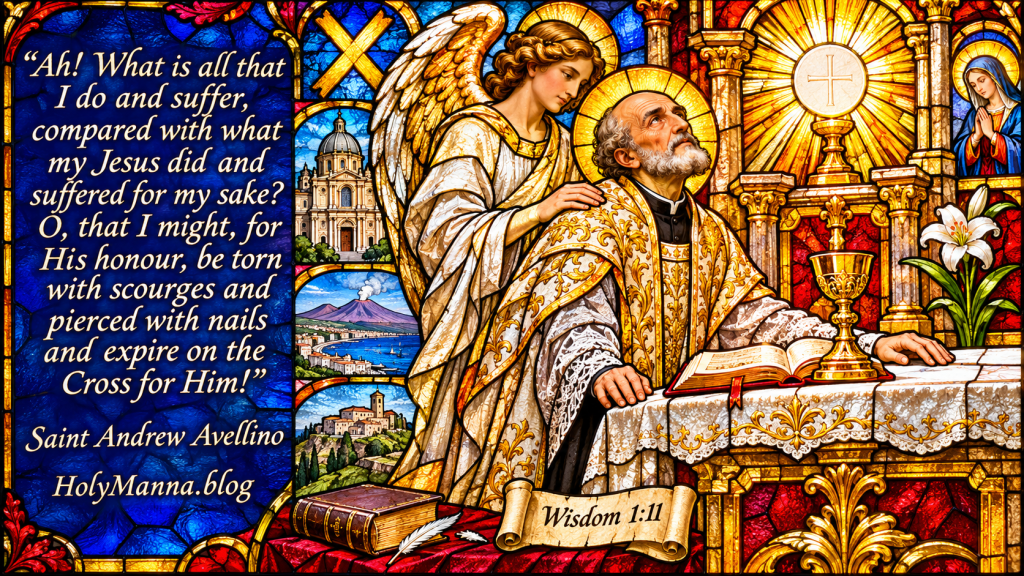
Then came the lie. While pleading the cause of a friend, in the heat of argument, a falsehood escaped his lips. Nobody caught him. The case went on. But a short time afterward his eyes fell on a verse from the Book of Wisdom: “The mouth that belieth killeth the soul” (Wis 1:11). The Catechism defines a lie as speaking a falsehood with the intention of deceiving and teaches that “the gravity of a lie is measured against the nature of the truth it deforms” (CCC 2482, CCC 2484). Andrew did not need a theologian to measure it for him. He felt what the Catechism calls interior repentance, “a radical reorientation of our whole life, a return, a conversion to God with all our heart” (CCC 1431). He renounced his profession as an ecclesiastical lawyer and gave himself for a time entirely to prayer and spiritual exercises. Older accounts say he bound himself by a vow never to practice law again.
He did not walk that road alone. His spiritual director in Naples was Blessed Giovanni Marinoni, one of the first companions of Saint Cajetan of Thiene, who had founded the Theatines in Rome in 1524 with Gian Pietro Carafa, the future Pope Paul IV, to restore the apostolic way of life among priests. Marinoni’s gentle holiness drew the young lawyer toward the order, though the final push came from a sword.
Master of Novices, Friend of Borromeo, Father of Souls
The Archbishop of Naples, recognizing Andrew’s zeal, commissioned him to reform a convent in the city whose lax discipline had become a public scandal. Certain men had grown accustomed to clandestine meetings with the nuns, and the new chaplain’s firmness ended the arrangement. The reform succeeded, but the men were furious. One night they ambushed him and left him severely wounded. Later lives give the details: three sword thrusts, a great loss of blood, and a full recovery that left no trace of injury. They add that the Viceroy of Naples offered to use all his authority to punish the attackers, and that Andrew refused, preferring their conversion to their punishment. One of the assailants, the same accounts say, was later killed by a man avenging the dishonor of his own family. These details come from later tradition rather than from the earliest records, and they cannot be verified.
What is well documented is where he was taken to recover: the Theatine house of San Paolo in Naples. There, surrounded by the men whose way of life he had been quietly admiring, he resolved to give himself entirely to God. On the vigil of the Assumption in 1556, at the age of thirty-five, he received the Theatine habit. He made his solemn profession on January 25th, 1558, at San Paolo Maggiore, and it was then that he changed his name. He chose Andrew out of love for the cross, remembering the Apostle who, according to ancient tradition, hung for two days on his own cross and preached to the crowd the entire time. To the three vows of poverty, chastity, and obedience, Andrew added a fourth of his own: always to act against his own will, and to advance ceaselessly, as far as his strength allowed, toward perfection. The Catechism explains why a vow like that is not grim but liberating, because the evangelical counsels are “a profession of these counsels, within a permanent state of life recognized by the Church”, and because “there is no holiness without renunciation and spiritual battle” (CCC 915, CCC 2015).
After his novitiate he obtained permission to make a pilgrimage to Rome to pray at the tombs of the apostles and martyrs. When he returned to Naples he was made master of novices, an office he held for ten years before being elected superior. The Theatine Curia adds that he later served as provost of several houses and as general visitor of the order. In 1570, at the personal request of Saint Charles Borromeo, he went north to found a Theatine house in Milan, and he founded another at Piacenza, where he worked alongside Blessed Paolo Burali to implement the decrees of the Council of Trent. By his efforts, the Catholic Encyclopedia says, many more Theatine houses rose up across the dioceses of Italy.
Borromeo became his intimate friend and consulted him on the most important affairs of the Church. The two men represent the Counter-Reformation at its best, a renewal of holiness from the inside. The Catechism describes exactly this dynamic when it teaches that the Church, “clasping sinners to her bosom, at once holy and always in need of purification, follows constantly the path of penance and renewal” (CCC 827). Andrew’s preaching in the region of Parma was so effective that several noble ladies entered religious life, and complaints about the sudden outbreak of piety reached the Duke of Parma, who summoned the preacher to explain himself. Andrew acquitted himself so well that the Duchess asked him to become her spiritual director. His penitents over the years, according to the Theatine Curia, included viceroys, bishops, cardinals, and popes.
His most famous spiritual son was Lorenzo Scupoli, who entered the Theatines around 1571 and made his novitiate under Andrew. Scupoli went on to write The Spiritual Combat, the little manual of interior warfare that Saint Francis de Sales carried in his pocket and read from every day for years. Whenever a Catholic today picks up that book, they are reading the fruit of Andrew’s novitiate. Andrew himself was a prolific writer. More than a thousand of his letters survive in the archive of San Paolo Maggiore, and they were published in Naples in two volumes in 1731, followed three years later by five volumes of his ascetical works and biblical commentary. He was also the first biographer of his own director, Blessed Marinoni, whom he described as a man of lovable nature, loved and esteemed by everyone, the good and the bad alike.
The Roman Martyrology calls Andrew renowned for miracles, though the earliest records are sparing with specifics. One story has come down through later Catholic writers. A man who did not believe in the Real Presence received Holy Communion only because of pressure from those around him. He removed the Host from his mouth and wrapped it in his handkerchief. When he later unfolded the cloth, he found it stained with blood. Terrified and repentant, he went to Andrew for counsel. The saint, so the story goes, published the account for the glory of God but kept the man’s name a secret so that he would not be arrested for sacrilege. The story illustrates two things Andrew cared about deeply: the truth that “in the most blessed sacrament of the Eucharist the body and blood, together with the soul and divinity, of our Lord Jesus Christ” are “truly, really, and substantially contained” (CCC 1374), and the mercy a confessor owes to a sinner who has finally come home. The story cannot be verified.
Three Sword Wounds and Fifty Years of Hidden Pain
Andrew was not a martyr, but his life was not comfortable. The ambush outside the convent was the most dramatic hardship, and it left him close to death. The quieter hardships lasted longer. Butler’s Lives of the Saints records that for fifty years he suffered from a painful rupture, yet he would never use a carriage, walking everywhere on his errands of preaching, confession, and visiting the sick. Older devotional lives add that in the last eighteen years of his life he ate neither meat, nor eggs, nor fish, nourishing himself on beans alone, cooked in a batch to last three days. That detail of his diet comes from later tradition and cannot be verified, but it matches the spirit of his fourth vow.
His humility was documented in the process for his beatification. The Prince of Stigliano, one of his penitents, testified to the Bollandists’ sources that when people began to speak of him as a saint during his lifetime, Andrew answered them simply: “Do not honor me now, while I am alive.” It is a line worth sitting with. He was not interested in the reputation of holiness; he was interested in holiness, and he knew the difference.
Then came November 10th, 1608. Andrew was in his late eighties, worn out by work and age, and so weak that he could scarcely reach the altar. He insisted on saying Mass anyway. He began the prayers at the foot of the altar, the psalm that opens with the words “I will go unto the altar of God” (Ps 42:4 in the old numbering), and some accounts say he had repeated the verse three times when the stroke struck him. He fell forward at the foot of the altar. His brothers carried him to a straw mattress, and after he had devoutly received Holy Viaticum, he died. The Catechism teaches that the Eucharist received at the moment of death is “the seed of eternal life and the power of resurrection”, the sacrament of “passing over” from this world to the Father (CCC 1524). Andrew, who had spent half a century going to the altar of God every morning, went to it one last time and did not come back.
Butler’s older account adds a scene that the Church has never defined but that generations of Catholics have loved. As his brothers prayed and wept around him, the devil is said to have appeared in visible form to claim his soul, and a voice, identified as the voice of Mary, commanded Andrew’s guardian angel to send the tempter back to hell. A calm smile settled on the dying man’s face, he offered a grateful salutation to an image of the Blessed Virgin, and he breathed out his soul. Another tradition records that in that final agony he heard voices telling him that the hour of his salvation had not yet come, and that he answered them with trust. These deathbed traditions cannot be verified. What the Church does teach is that every person has a guardian angel, “a protector and shepherd leading him to life” (CCC 336), and that Mary “did not lay aside this saving office but by her manifold intercession continues to bring us the gifts of eternal salvation” (CCC 969). Andrew’s death, however the details are told, is the Church’s teaching made visible: a man who had prayed all his life for the grace of a good death, and received it.
Blood That Stirred and a City That Remembered
His death was sudden, and that is exactly why the faithful began to pray to him against sudden death. The irony is only apparent. Andrew died suddenly but not unprepared; he died at the altar, in the state of grace, with the sacraments. A sudden death is only a tragedy when it finds a soul unready, and the whole point of invoking Andrew is to be ready. The old Latin litany painted on many of his images says it plainly: “By the intercession of Saint Andrew Avellino, stricken with apoplexy, from a sudden and unprovided death deliver us, O Lord.”
Tradition reports that after his death his face shone with an unusual radiance. Some of his blood was collected and preserved at San Paolo, and here the record becomes unusually solid, because the Bollandists, the Jesuit scholars who compiled the Acta Sanctorum, printed two sworn attestations from the Theatine fathers of Naples. The first, signed in Rome on January 21st, 1612, describes what happened on November 10th, 1611, the anniversary of his death: the blood, which had been hard and dry in its small glass flask in the chapel of relics, began to liquefy during the day, turned a bright color, ran freely when the flask was turned, and around one o’clock in the morning boiled and foamed while the provost held it up before the witnesses. The second, signed at Naples on March 8th, 1613, records the same phenomenon on November 10th, 1612, with the blood fully liquid by three in the morning and the glass left clean except for a single grain-sized spot. Eight Theatine priests signed the first attestation and several more the second. Neapolitan tradition holds that the blood continued to liquefy each year on his feast until 1950, when the phenomenon ceased. That later history is reported by local sources and cannot be verified, and the Church has never required anyone to believe in the liquefaction of any saint’s blood. What the Church does affirm is that “the religious sense of the Christian people has always found expression in various forms of piety surrounding the Church’s sacramental life, such as the veneration of relics” (CCC 1674).
Devotion grew fast. In October 1616, a letter from Cardinal Mellini to the Archbishop of Naples authorized a solemn feast, a Mass, and a sermon in his honor, and the crowds that year were so large that the silver votive offerings alone exceeded fifteen hundred ducats. Pope Urban VIII beatified him in 1624, only sixteen years after his death, and Pope Clement XI canonized him in 1712. Across Italy painters began producing the image that still defines him: an old priest in vestments collapsing at the altar, an angel catching him from behind. One eighteenth-century altarpiece places over his head the words “Persevere unto the end and you shall be saved,” an echo of the Lord’s own promise in Matthew 10:22.
His body rests today beneath an altar in the basilica of San Paolo Maggiore in Naples, the very church where he fell. In the crypt below lie Saint Cajetan, the founder of his order, and Blessed Giovanni Marinoni, the director who led him there. His hometown took his name, Castronuovo di Sant’Andrea, keeps a museum dedicated to his life and works, and celebrates him as patron on the third Sunday of May. In Badolato in Calabria, where he is patron, the whole town turns out on November 10th around a seventeenth-century gilded bust of the saint. The Theatines named a house for him in Messina, a statue of him stands in Milan, and his patronage reached as far as the Balearic island of Mallorca. He even crossed the Atlantic. In 1914, when a new parish was founded in Flushing, Queens, the bishop, concerned about the number of priests who had been dying of heart attacks, chose Saint Andrew Avellino as its patron, and the parish school that opened in 1925 still bears his name. The Catechism describes the mechanism behind all of this devotion: the saints “do not cease to intercede with the Father for us”, and “their intercession is their most exalted service to God’s plan” (CCC 956, CCC 2683).
Living Ready
Andrew’s life offers three lessons, and the first is about honesty in small things. He did not convert because of a great sin. He converted because of one lie in one argument, a lie that nobody else noticed. Most people are tempted to grade sin on a curve and to assume that the small dishonesties, the padded résumé, the exaggerated story, the convenient omission, do not really count. Andrew read one verse of Scripture and understood that they count. The Catechism is just as direct: “By its very nature, lying is to be condemned” (CCC 2485). Is there a small lie in your life right now that you have been treating as harmless? What would it look like to let one verse of Scripture reorganize your week the way Wisdom 1:11 reorganized Andrew’s life?
The second lesson is that it is never too late to begin. Andrew was thirty-five when he received the Theatine habit, with a doctorate and a career behind him. The best years of his ministry came after fifty. For a generation that often feels it has already missed the window for a real vocation, Andrew is proof that God’s timing has nothing to do with the world’s. Where have you decided that it is too late for God to ask something new of you?
The third lesson is the hardest and the most practical: he lived ready to die. His fourth vow, to act against his own will, sounds severe until one realizes that it is simply the daily, concrete practice of what Jesus asked of everyone: “If any man will come after me, let him deny himself, and take up his cross daily, and follow me” (Lk 9:23). The Catechism lists the ordinary forms this takes, “fasting, prayer, and almsgiving”, along with “gestures of reconciliation, concern for the poor”, and “the acceptance of suffering” (CCC 1434, CCC 1435). Andrew practiced them for fifty years, which is why a stroke at the altar found him with nothing left to settle. The Church has always prayed for exactly this grace: “From a sudden and unforeseen death, deliver us, O Lord” (CCC 1014).
Readers can start small. Go to confession this month, not because of a crisis but because Andrew would. Pray one Hail Mary each night for the grace of a holy death, the way Andrew saluted the image of Mary with his last breath. And choose one thing each day to do against one’s own preference, out of love: the dish left in the sink, the text that deserves a reply, the person who is easier to avoid. That is the fourth vow in miniature. If you were to collapse at the altar tomorrow morning, what would be unfinished in your soul, and what would it take to finish it today?
Engage With Us!
Share your thoughts and reflections in the comments below. Saint Andrew Avellino was a lawyer, a reformer, a confessor, and finally a very old man who died doing the one thing he loved most, and the HolyManna community would love to hear which part of his story spoke to you.
- Andrew’s conversion began with a single lie that no one else noticed. When was the last time a small, private dishonesty bothered your conscience, and what did you do about it?
- He took the name Andrew out of love for the cross. If you were to choose a name that expressed what you most want your faith to become, what would it be and why?
- His fourth vow was to act against his own will in order to advance toward perfection. What is one concrete area of your daily life where choosing against your own preference would be an act of love?
- Andrew died suddenly but fully prepared. What does it mean to you to live ready, and what one practice could you begin this week to prepare for a holy death?
- He formed Lorenzo Scupoli, whose book shaped Saint Francis de Sales and countless others. Who has formed your faith, and whom might God be asking you to form?
Saint Andrew Avellino spent his last morning walking to an altar he could barely reach, because the Eucharist was worth every step. Go to Mass this week with that same hunger. Receive the Lord with a clean heart, speak the truth even when it costs you, and let the cross you carry each day make you ready for the day you will lay it down. Live every moment with the love and mercy that Jesus taught us, and ask Saint Andrew Avellino to be with you at the hour of your death, bringing Jesus and Mary to your side.
Saint Andrew Avellino, pray for us!
Follow us on YouTube, TikTok, Instagram and Facebook for more insights and reflections on living a faith-filled life.


Leave a Reply