A Pope for an Empire Falling Apart
Imagine being handed the most important office in the Western world at the exact moment the world is coming apart. Barbarian armies are crossing the Alps, the emperor is weak, and the Roman order that held everything together for 5 centuries is visibly crumbling. That was the situation when a deacon named Leo was elected Bishop of Rome in the year 440. He would hold that office for 21 years, and by the time he died on November 10th, 461, the Church had given him a title no pope before him had ever received. She called him Leo the Great.
Saint Leo is remembered for 3 enormous achievements. He wrote the letter that the Council of Chalcedon received in 451 as the authentic teaching on who Jesus Christ is, true God and true man in one Person. He met Attila the Hun in 452 and persuaded him to leave Italy. And he articulated, more clearly than anyone before him, what it means that Peter still speaks through the Bishop of Rome. In 1754 Pope Benedict XIV named him a Doctor of the Church, one of only 2 popes to hold that honor alongside Saint Gregory the Great. The Church celebrates his memorial on November 10th, the anniversary of his death.
The Catechism explains why the Church lifts up men and women like Leo: “By canonizing some of the faithful, i.e., by solemnly proclaiming that they practiced heroic virtue and lived in fidelity to God’s grace, the Church recognizes the power of the Spirit of holiness within her and sustains the hope of believers by proposing the saints to them as models and intercessors” (CCC 828). Leo is a model for anyone who has had to lead while the ground was shifting underfoot.
A Deacon Nobody Could Spare
The documented facts about Leo’s early life are few. The Liber Pontificalis, the ancient book of the popes, records that he was a native of Tuscany and that his father was named Quintianus. Some later writers say he was born in Rome to a family of Tuscan origin, and the Catholic Encyclopedia concludes plainly that his birthplace is unknown. His birth is usually placed around the year 400, though a few sources push it back toward 391. Nothing is known about his mother or his childhood. What the sources do show is a man with an excellent Roman education, who wrote and preached in clear, rhythmic Latin, formed in the faith of Rome while the Church was still working out how to express the mystery of Christ in precise words.
By around 430 Leo was a deacon of Rome under Pope Celestine I, and no ordinary one. The monk John Cassian wrote his treatise against Nestorius at Leo’s urging, and Saint Cyril of Alexandria corresponded with him. Roman deacons handled the administration, finances, and charitable works of the Church, and Leo’s reputation for competence reached the imperial court.
That reputation led to one of the strangest papal elections in history. In 440 the Empress Galla Placidia, ruling for her young son Valentinian III, sent Leo to Gaul to make peace between 2 quarreling officials, the general Aëtius and the prefect Albinus. While Leo was away, Pope Sixtus III died on August 19th, 440. The clergy and people of Rome elected the absent deacon as their bishop and waited for him to come home. Leo returned and was consecrated on September 29th, 440. In his first sermon as pope he thanked the Roman faithful and begged them to pray for him, confessing openly that he saw no merit of his own in the choice.
There was no dramatic conversion in Leo’s story, no fall and rise like Augustine’s. His was a steady deepening, a life spent learning the faith so thoroughly that when the crisis came he could speak it without hesitation. That is its own kind of holiness, and it is the kind most Catholics are actually called to.
Twenty One Years at the Helm
Benedict XVI, in his catechesis of March 5th, 2008, made an observation that tends to surprise people. Leo is the first pope of whom there is evidence of regular preaching to the crowds at the liturgy. Nearly 100 of his sermons survive, along with about 150 letters. Before Leo, the popes are mostly names and dates. With Leo, a voice begins to speak.
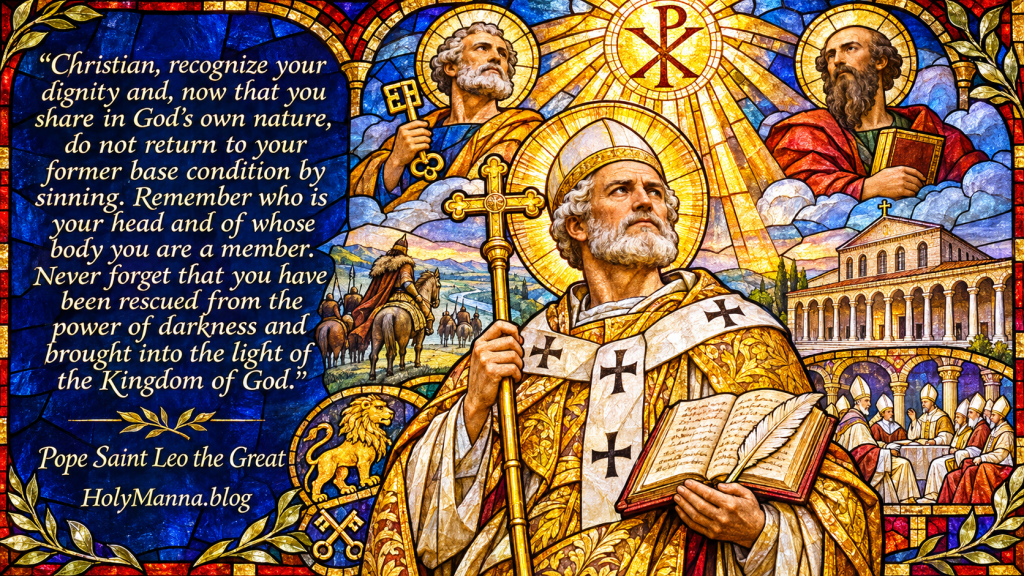
That voice preached the Incarnation above everything else. In his first Christmas sermon Leo gave the Church a line that the Catechism still quotes at the opening of its section on life in Christ: “Christian, recognize your dignity and, now that you share in God’s own nature, do not return to your former base condition by sinning. Remember who is your head and of whose body you are a member. Never forget that you have been rescued from the power of darkness and brought into the light of the Kingdom of God” (CCC 1691, quoting Sermon 21). For Leo the birth of Christ was not sentimental. It was the moment the human race was given back its worth, and it carried a moral consequence: a person who belongs to Christ’s Body must live like it.
Leo also taught something that sounds very modern about the liturgy. Preaching on the Ascension, he explained how Christ remains present in the Church: “What was visible in our Savior has passed over into his mysteries” (CCC 1115, quoting Sermon 74). The Catechism develops exactly this point when it teaches that “Christian liturgy not only recalls the events that saved us but actualizes them, makes them present” (CCC 1104). When Catholics today speak of the Mass as a real participation in Calvary rather than a memory of it, they are speaking Leo’s language.
He connected worship to the poor with equal insistence. During the seasonal fasts of Rome, Leo preached that fasting without almsgiving was incomplete, and he organized collections for the needy as a normal part of the liturgical year. The Catechism names the same 3 pillars he preached: “Scripture and the Fathers insist above all on three forms, fasting, prayer, and almsgiving, which express conversion in relation to oneself, to God, and to others” (CCC 1434).
Leo’s other great theme was Peter. Every year on the anniversary of his consecration he preached about the Apostle whose chair he occupied, and he was careful to put the honor where it belonged. “For the solidity of that faith which was praised in the chief of the Apostles is perpetual: and as that remains which Peter believed in Christ, so that remains which Christ instituted in Peter” (Sermon 3). In another anniversary sermon he said, “Out of the whole world one man, Peter, is chosen to preside at the head of all nations and to be set over all the apostles and all the fathers of the church” (Sermon 4). Leo did not understand this as personal grandeur. He understood it as the promise of Christ in The Gospel of Matthew: “You are Peter, and upon this rock I will build my Church, and the gates of the netherworld shall not prevail against it” (Mt 16:18). The Catechism teaches that “The Lord made Simon alone, whom he named Peter, the ‘rock’ of his Church. He gave him the keys of his Church and instituted him shepherd of the whole flock” (CCC 881). Leo lived that teaching before it was written down in those words.
He put the teaching to work. When former Pelagians in northern Italy were readmitted to communion without renouncing their errors, Leo ordered a synod to require public abjuration. When he discovered Manichaeans operating secretly in Rome in 443, he personally led the investigation alongside senators and priests, then warned the bishops of Italy and secured an imperial edict against the sect. When Bishop Turibius of Astorga wrote from Spain about the Priscillianist heresy, Leo answered with a long refutation and ordered councils to be held. On July 8th, 445, the Emperor Valentinian III issued an edict recognizing in civil law the primacy of the Bishop of Rome over the whole Church. Leo did not need the emperor’s permission to be Peter’s successor, but he welcomed any help in keeping the Church united.
As for miracles during Leo’s lifetime, the historical record is quiet. Neither the Catholic Encyclopedia nor the papal catecheses about him record any. What the record shows is a man through whom God worked by ordinary means: clear thinking, courage, faithful preaching, and a refusal to let the truth about Jesus Christ be blurred. Sometimes the miracle is simply that the right man was in the chair when the storm hit.
Robbers, Huns, and Vandals
Leo’s hardest trial began with a theological error. A monk in Constantinople named Eutyches, reacting against Nestorius, taught that after the Incarnation Christ had only one nature, the divine having absorbed the human. Flavian, the Archbishop of Constantinople, condemned him in 448, and Eutyches appealed to Rome. On June 13th, 449, Leo sent Flavian the letter history remembers as the Tome.
The Tome is one of the most important documents ever written by a pope. Leo insisted that the Son of God truly took a human nature from the Virgin Mary and that both natures remain fully intact in the one Christ. “For each of the natures retains its proper character without defect; and as the form of God does not take away the form of a servant, so the form of a servant does not impair the form of God” (Letter 28). He described the Incarnation with a rhythm the Church still reads in the Liturgy of the Hours: “Lowliness is assured by majesty, weakness by power, mortality by eternity” (Letter 28). Here Leo was simply unfolding The Gospel of John: “And the Word became flesh and made his dwelling among us” (Jn 1:14). The Catechism teaches the same truth today: “He became truly man while remaining truly God. Jesus Christ is true God and true man” (CCC 464).
Then things went badly. The Emperor Theodosius II called a council at Ephesus in August 449, but it was controlled by Eutyches’s allies. Leo’s legates were not permitted to read the Tome. Flavian was deposed, physically abused, and died shortly afterward. Leo refused to recognize the gathering and gave it the name that stuck: the Latrocinium, the Robber Synod. For 2 years he wrote letter after letter demanding a true council, and it seemed the East might be lost to heresy.
In 450 Theodosius died, and the new Emperor Marcian convened a general council at Chalcedon in October 451. There the bishops heard Leo’s Tome read aloud and received it as the expression of the apostolic faith. In Benedict XVI’s rendering of the acclamation, they cried out, “Peter has spoken through the mouth of Leo.” The Council’s definition, which the Catechism quotes at length, confesses “one and the same Son, our Lord Jesus Christ: the same perfect in divinity and perfect in humanity, the same truly God and truly man” and insists that he “is to be acknowledged in two natures without confusion, change, division, or separation” (CCC 467). Leo had won the doctrinal battle, though he refused to accept the Council’s 28th canon, which tried to elevate the see of Constantinople above its ancient rank. He confirmed the doctrine and rejected the politics. The Catechism describes this very task: “It is this Magisterium’s task to preserve God’s people from deviations and defections and to guarantee them the objective possibility of professing the true faith without error” (CCC 890).
Hardly a year after Chalcedon, a different kind of enemy came. Attila the Hun crossed into northern Italy in 452 and destroyed Aquileia, Milan, and Pavia. Rome had no army capable of stopping him. The emperor, the Senate, and the people agreed that the only hope was an embassy to beg for peace, and the pope agreed to lead it. Leo traveled north with the former consul Avienus and the prefect Trygetius and met Attila near the Mincio River, close to Mantua.
What happened at that meeting is told by a contemporary. Prosper of Aquitaine, who knew Leo and wrote within 3 years of the event, records that Attila “was so impressed by the presence of the high priest that he ordered his army to give up warfare and, after he had promised peace, he departed beyond the Danube.” That is documented history: a pope with no soldiers walked into the camp of the most feared man in Europe, and he went home. Historians add that plague in Attila’s army, a food shortage in Italy, and troops arriving from the Eastern Empire likely weighed on his decision as well. Attila died the following year.
A more dramatic story grew up around the meeting in the centuries that followed. According to this tradition, as Leo spoke, the Apostles Peter and Paul appeared beside him, dressed as bishops and holding drawn swords, and Attila alone could see them. When his officers asked why he had yielded so easily, he is said to have answered that 2 terrifying figures had stood over the pope and threatened him with death if he refused. This is the scene Raphael painted in the Vatican Palace and Algardi carved above Leo’s tomb. Prosper, who was in Rome at the time, says nothing about it; the earliest account comes from a later anonymous life of the pope. It is a beloved tradition, and it cannot be verified.
Three years later Leo faced a threat he could not turn back. In June 455 the Vandal king Gaiseric sailed from North Africa and landed at the mouth of the Tiber. The emperor had just been murdered by a mob, and Rome had no defender except her bishop. Leo went out, as Benedict XVI put it, defenseless and surrounded by his clergy, to plead for the city. He could not stop the sack. For 14 days the Vandals stripped Rome of everything of value and carried off thousands as captives, including the empress and her daughters. But Prosper records that Leo obtained a promise that there would be no killing, no burning, and no torture. The basilicas of Saint Peter, Saint Paul, and Saint John became sanctuaries for the terrified population, and they were spared. Afterward Leo refurnished the plundered churches and preached to a humiliated city that God had not abandoned it.
Leo was never martyred. His hardships were of a different kind: the loneliness of defending the truth against emperors and councils, the weight of being the only functioning authority in a dying capital, and the grief of watching his city suffer. He endured it all with a steadiness rooted in his conviction that Christ, not Leo, was carrying the Church. The Catechism describes the peace he labored for: “Peace is ‘the tranquillity of order.’ Peace is the work of justice and the effect of charity” (CCC 2304). Leo was a peacemaker in the full sense of the Beatitude: “Blessed are the peacemakers, for they will be called children of God” (Mt 5:9).
A Tomb Beneath Marble and a Name That Echoes
Leo died on November 10th, 461, and was buried in the entrance porch of Old Saint Peter’s Basilica, close to the Apostle whose voice he had carried. In 688 Pope Saint Sergius I moved his body inside the basilica itself and built an altar over it, the first time a pope’s relics were given that honor. When the ancient basilica was demolished and the present Saint Peter’s rose in its place, Leo’s relics were placed in 1715 by Pope Clement XI beneath the altar that still bears his name in the Chapel of Our Lady of the Column, near the Altar of the Chair.
Above that altar stands one of the treasures of Baroque Rome. Between 1646 and 1653 Alessandro Algardi carved a colossal marble high relief, roughly 25 feet tall, showing Leo confronting Attila while Peter and Paul descend from heaven with swords in hand. It is the only altarpiece in Saint Peter’s made of sculpted marble rather than mosaic. Pilgrims who turn toward the left transept can stand a few feet from Leo’s bones.
The Catechism teaches that the saints in heaven “do not cease to intercede with the Father for us” and that “their intercession is their most exalted service to God’s plan” (CCC 956). Catholics have sought Leo’s intercession for 15 centuries. Yet the honest record contains no documented miracles attributed to his relics or his prayers. His veneration has rested on the Church’s unbroken recognition that his teaching was true and his courage was holy. Benedict XIV formalized that recognition in 1754 by declaring him a Doctor of the Church. In 1961 John XXIII devoted the encyclical Aeterna Dei Sapientia to Leo on the 1,500th anniversary of his death, and in 2008 Benedict XVI called him one of the greatest pontiffs ever to grace the See of Rome.
A few medieval stories about Leo deserve mention, labeled for what they are. A 13th century collection of saints’ lives compiled by Jacobus de Voragine tells of a woman who kissed the pope’s hand at Mass and stirred in him a temptation, after which Leo cut off the hand in penance, and the Blessed Virgin Mary restored it so that he could continue to celebrate the Eucharist. The same collection speaks of Leo keeping a long vigil of prayer at Saint Peter’s tomb. These stories were told for centuries to illustrate his purity and humility. They appear nowhere in the sources of his own time, and they cannot be verified.
Leo’s influence on the liturgy has been enormous, even where exact attribution is uncertain. The Leonine Sacramentary, the oldest surviving collection of Roman Mass prayers, was compiled in the century after his death and contains prayers scholars believe come from his pen. Tradition credits him with shaping the Advent liturgy, though this cannot be confirmed. His sermons are read in the Liturgy of the Hours to this day, and his Tome is read on the Solemnity of the Annunciation.
His feast has moved over the centuries. The old Roman calendar kept it on April 11th, likely the date of an early translation of his relics. The 1969 reform placed it on November 10th, the day he died. The Byzantine churches, which also honor him, celebrate him on February 18th. His name has been taken by 13 successors, among them Leo XIII, author of Rerum Novarum, and the current Holy Father, Leo XIV, elected in 2025, who explained that he chose the name chiefly in honor of Leo XIII’s social teaching. Every pope who has borne the name has stood in the shadow of the first Leo.
What Leo Teaches a Restless Generation
Leo lived through the end of a world, and he did not panic. That alone is worth sitting with. Many people in their twenties, thirties, and forties today feel that institutions are failing and that nobody is really in charge. Leo felt all of that in 452 as Attila’s horsemen burned the cities of the north. His answer was not to retreat into private spirituality and wait it out. He went to the river and faced the problem in person. When the pressures of your own life feel overwhelming, do you tend to withdraw, or do you show up?
His first lesson is that you cannot give what you have not received. Leo could speak with authority at Chalcedon because he had spent decades learning the faith deeply enough to explain it. There is no shortcut for that. A practical way to imitate him is to read the Catechism slowly, a few paragraphs a day, until its language becomes your own. The Catechism says that the disciple “must not only keep the faith and live on it, but also profess it, confidently bear witness to it, and spread it” (CCC 1816). How well could you explain to a curious friend why Jesus must be both fully God and fully man?
His second lesson is the one he preached at Christmas: remember your dignity. Leo looked at ordinary Roman Christians, many of them poor and frightened, and told them they shared in God’s own nature and should refuse to live beneath it. That message is for you. The shame you carry and the quiet sense that you are not good enough for God are not the truth about you. Baptism is. What would change in your week if you believed you were a member of Christ’s Body and acted like it?
His third lesson joins worship to mercy. Leo would not let his people fast without also giving to the poor. Pick one concrete work of mercy this week, what the Catechism calls “charitable actions by which we come to the aid of our neighbor in his spiritual and bodily necessities” (CCC 2447), and attach it to your Sunday Mass or your Friday abstinence. Bring groceries to a parish pantry. Visit someone in a nursing home. Leo would recognize all of it.
His fourth lesson is about peace. Leo did not make peace by pretending the Huns and Vandals were not dangerous. He made peace by walking toward the danger with faith and asking for what could realistically be obtained. In your family, your workplace, and your parish, there are probably conflicts you have been avoiding. Is there a conversation God is asking you to have in person rather than over text, with courage rather than resentment?
Finally, Leo teaches love for the Church and her shepherd. He believed that Christ’s prayer for Peter in The Gospel of Luke, “I have prayed that your own faith may not fail; and once you have turned back, you must strengthen your brothers” (Lk 22:32), was still being answered in his own weak person. Pray for the pope by name each day, and for your bishop and your pastor. The Church survived the fifth century because men like Leo trusted that Christ had not abandoned the helm, and she will survive this century for the same reason.
Engage With Us!
The story of Pope Saint Leo the Great belongs to the whole Church, and your reflections help bring it to life. Please share your thoughts and reflections in the comments below. Here are a few questions to begin the conversation.
- Leo defended the truth that Jesus is fully God and fully man at great personal cost. Why does it matter for your daily life that Christ is both?
- Leo was elected pope while he was out of the country on someone else’s errand. When has God called you to something you were not looking for?
- Leo preached that fasting is incomplete without almsgiving. What is one act of mercy you could attach to your next Sunday Mass?
- When Leo faced Attila he had no army, only faith and a willingness to show up. What situation in your life is asking you to show up in person?
- Leo told his people to remember their dignity as members of Christ’s Body. What lie about yourself do you most need to replace with that truth?
Saint Leo the Great spent 21 years holding a frightened Church together with the truth about Jesus Christ and a shepherd’s love for his people. You do not need to be a pope to do the same in your corner of the world. Learn the faith deeply, remember who you are, give generously to the poor, walk toward the hard conversations, and pray for the Church. Do all of it with the love and mercy that Jesus taught us, and trust that the One who did not abandon Rome in 452 will not abandon you.
Pope Saint Leo the Great, pray for us!
Follow us on YouTube, TikTok, Instagram and Facebook for more insights and reflections on living a faith-filled life.


Leave a Reply