Memorial of Saint Leo the Great, Pope and Doctor of the Church – Lectionary: 492
When Grace Shows Up and Gets to Work
Some days the readings feel like a job description, and this is one of them. Paul hands Titus a list of what older men, older women, younger women, and younger men should look like. The psalmist says trust and do good, over and over. Then Jesus tells the Apostles that after they have done everything asked of them, the right thing to say is that they are unprofitable servants. Taken alone, that sounds exhausting. Taken together, it is one of the most freeing messages in the lectionary.
The thread that ties the 3 readings together is this: salvation comes from the Lord, grace comes first, and everything a Christian does is a grateful answer rather than a wage. Paul says it outright in Titus 2:11, where grace appears and starts training people. The psalm’s refrain repeats it 4 times: “The salvation of the just comes from the Lord.” The Gospel protects it from the inside, because the servant who claims no credit is the servant who has understood where the credit belongs.
The Church places these readings on November 10th, the memorial of Saint Leo the Great, who died on this date in 461. Leo wrote the Tome that the Council of Chalcedon acclaimed in 451 with the cry that Peter had spoken through Leo. He walked out to meet Attila the Hun in 452 and turned him back from Rome. Yet on the anniversary of his own elevation he preached that the dignity of his office was beyond anything he had earned, and that his confidence rested on Christ working in him. He was a great man who insisted that the greatness was not his. That is the posture of today’s readings, and it is the posture every believer is invited to practice.
First Reading — Titus 2:1-8, 11-14
A Letter to Crete and a Grace That Teaches
Paul left Titus on the island of Crete to finish organizing a young Church (Titus 1:5), and the letter does not hide how rough the setting was. Paul quotes a Cretan poet who called his own people liars and lazy gluttons (Titus 1:12). Into that culture Paul sends a short household code, the kind of instruction ancient moralists wrote for families, now rebuilt around Christ. The phrase translated “sound doctrine” is literally healthy teaching. The lectionary skips verses 9 and 10, which address slaves, and jumps to verses 11 through 14, the theological engine that drives the ethics. Those 4 verses are also the Second Reading at the Christmas Mass during the Night, and the word for “appeared” is the root of the word epiphany. Grace did not arrive as a concept. It arrived as a person who then started teaching. The demands of verses 1 through 8 are only possible because of the gift of verses 11 through 14.
Titus 2:1-8, 11-14
Beloved:
You must say what is consistent with sound doctrine,
namely, that older men should be temperate, dignified,
self-controlled, sound in faith, love, and endurance.
Similarly, older women should be reverent in their behavior,
not slanderers, not addicted to drink,
teaching what is good, so that they may train younger women
to love their husbands and children,
to be self-controlled, chaste, good homemakers,
under the control of their husbands,
so that the word of God may not be discredited.Urge the younger men, similarly, to control themselves,
showing yourself as a model of good deeds in every respect,
with integrity in your teaching, dignity, and sound speech
that cannot be criticized,
so that the opponent will be put to shame
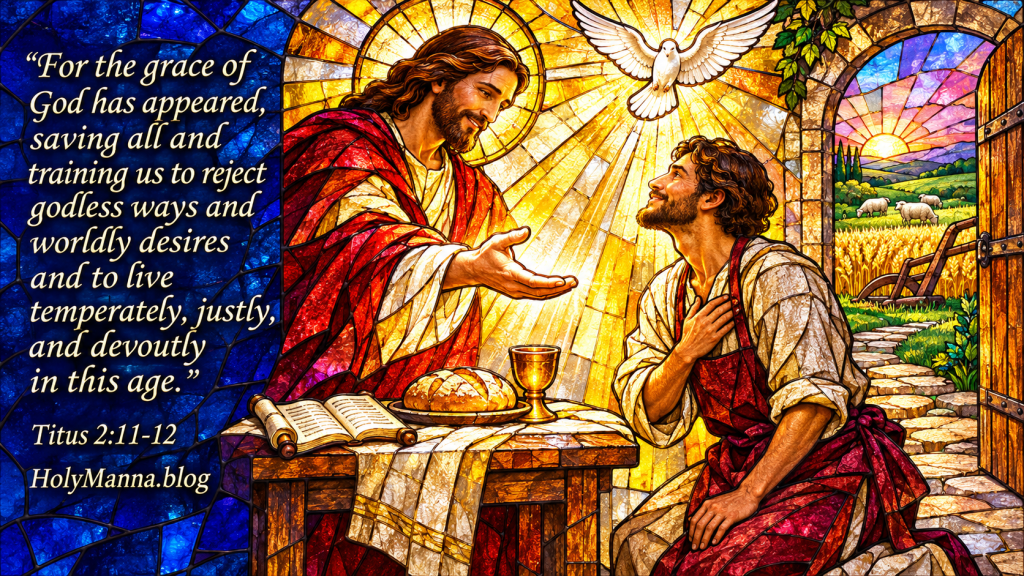
without anything bad to say about us.For the grace of God has appeared, saving all
and training us to reject godless ways and worldly desires
and to live temperately, justly, and devoutly in this age,
as we await the blessed hope,
the appearance of the glory of the great God
and of our savior Jesus Christ,
who gave himself for us to deliver us from all lawlessness
and to cleanse for himself a people as his own,
eager to do what is good.
Detailed Exegesis
Verse 1 “You must say what is consistent with sound doctrine,”
Titus is told to speak, not merely to believe. Healthy teaching produces healthy living, and the bishop’s first duty is to put sound words into the community’s air. The lectionary’s opening “Beloved” is a liturgical greeting rather than part of the verse.
Verse 2 “namely, that older men should be temperate, dignified, self-controlled, sound in faith, love, and endurance.”
The last 3 qualities echo Paul’s triad of faith, hope, and love, with endurance standing in for hope. A mature Christian man is defined by moderation and steadiness.
Verse 3 “Similarly, older women should be reverent in their behavior, not slanderers, not addicted to drink, teaching what is good,”
The word “reverent” describes behavior fitting for someone serving in a temple. Paul gives older women a genuine teaching office within the household and names the 2 temptations that would undermine it.
Verse 4 “so that they may train younger women to love their husbands and children,”
Love for a spouse and for children is presented as something learned, not simply felt, and the older generation hands down the art of loving well.
Verse 5 “to be self-controlled, chaste, good homemakers, under the control of their husbands, so that the word of God may not be discredited.”
The purpose clause matters most: a household that outsiders could respect protected the Gospel’s reputation in a hostile town. The language of submission belongs to the mutual self-giving of Ephesians 5:21-33, where husbands are commanded to love as Christ loved, laying down their lives.
Verse 6 “Urge the younger men, similarly, to control themselves,”
The younger men receive a single instruction, self-control, which Chrysostom observed is the hardest virtue at that age. Paul names the one battle that decides the rest.
Verse 7 “showing yourself as a model of good deeds in every respect, with integrity in your teaching, dignity,”
Titus is a young man, and he can only ask of others what he visibly does. The Greek word for “model” means a pattern pressed into wax. Leadership in the Church is imitation before it is instruction.
Verse 8 “and sound speech that cannot be criticized, so that the opponent will be put to shame without anything bad to say about us.”
Paul expects opposition and plans for it. The best apologetic in Crete was conduct that left critics with nothing to use.
Verse 11 “For the grace of God has appeared, saving all”
Here is the hinge. Everything before was command; everything after is gift. Grace has appeared in the flesh, and its reach is universal.
Verse 12 “and training us to reject godless ways and worldly desires and to live temperately, justly, and devoutly in this age,”
Grace is pictured as a teacher, and the verb is the word for raising a child. The 3 adverbs cover the whole of life: temperance toward oneself, justice toward one’s neighbor, devotion toward God.
Verse 13 “as we await the blessed hope, the appearance of the glory of the great God and of our savior Jesus Christ,”
Paul names Jesus “the great God and our savior” in one breath, one of the New Testament’s clearest affirmations of Christ’s divinity. Every Mass echoes this verse when the priest prays after the Our Father, “as we await the blessed hope and the coming of our Savior, Jesus Christ.”
Verse 14 “who gave himself for us to deliver us from all lawlessness and to cleanse for himself a people as his own, eager to do what is good.”
The passage ends where it began, with good works, but now they are the fruit of redemption rather than its price. Christ purchases a people, cleanses them, and makes them eager to do good.
Teachings
The Catechism defines the gift Paul is describing: “Our justification comes from the grace of God. Grace is favor, the free and undeserved help that God gives us to respond to his call to become children of God, adoptive sons, partakers of the divine nature and of eternal life” (CCC 1996). It also insists that grace is the cause of good behavior rather than its reward: “The preparation of man for the reception of grace is already a work of grace” (CCC 2001). That paragraph quotes Saint Augustine: “Indeed we also work, but we are only collaborating with God who works, for his mercy has gone before us.”
Saint John Chrysostom preached on these verses in his Homily 5 on Titus and summarized the gift simply: “And this is of grace, to deliver us from worldly things, and to lead us to Heaven.” On the blessed hope he added, “For nothing is more blessed and more desirable than that appearing.”
The hope Paul names is a theological virtue by which believers desire eternal life “placing our trust in Christ’s promises and relying not on our own strength, but on the help of the grace of the Holy Spirit” (CCC 1817). Paul’s worry that the Gospel might be discredited is the Church’s own: “In order that the message of salvation can show the power of its truth and radiance before men, it must be authenticated by the witness of the life of Christians” (CCC 2044).
Reflection
Paul’s lists can feel like a report card, but read them in light of verse 11 and they become a portrait of what grace does when it is allowed to work. The question is not whether you measure up but whether you are letting grace train you.
Pick one word from Paul’s list for your stage of life, whether temperate, reverent, self-controlled, or dignified, and make it your examination of conscience this week. Ask an older Catholic you respect how they learned to love their family well. Titus built a Church by letting generations teach each other, and that still works.
Which of Paul’s words would the people who live with you say describes you? When you do something good, do you feel like you have earned something or received something? What would it look like this week to live as someone eager to do good rather than obligated to?
Responsorial Psalm — Psalm 37:3-4, 18, 23, 27, 29, 39
An Alphabet of Trust for Anxious Hearts
Psalm 37 is an acrostic: in Hebrew, each new section begins with the next letter of the alphabet, the way a teacher might organize lessons so a student can memorize them. The psalm, attributed to David, answers a question every generation asks, which is why the wicked seem to prosper while the faithful struggle. Its answer is not an argument but a series of calm instructions, repeated from different angles. Trust, do good, delight in the Lord, turn from evil, wait. Verse 11 of this psalm, “the meek shall inherit the land,” is the source of the third Beatitude in Matthew 5:5. The refrain chosen for today, “The salvation of the just comes from the Lord,” is the hinge of the whole day. It sits between Paul’s teaching that grace comes first and Jesus’ teaching that the servant claims nothing, and it says in 8 words what both readings say at length.
Psalm 37:3-4, 18, 23, 27, 29, 39
R. (39a) The salvation of the just comes from the Lord.
Trust in the LORD and do good,
that you may dwell in the land and be fed in security.
Take delight in the LORD,
and he will grant you your heart’s requests.
R. The salvation of the just comes from the Lord.
The LORD watches over the lives of the wholehearted;
their inheritance lasts forever.
By the LORD are the steps of a man made firm,
and he approves his way.
R. The salvation of the just comes from the Lord.
Turn from evil and do good,
that you may abide forever;
The just shall possess the land
and dwell in it forever.
R. The salvation of the just comes from the Lord.
Detailed Exegesis
Verse 3 “Trust in the LORD and do good, that you may dwell in the land and be fed in security.”
Trust comes before doing, and the order is the lesson. Saint Augustine read “the land” as the Church and warned that it is possible to do good works outside it, cut off from the one who tends the field.
Verse 4 “Take delight in the LORD, and he will grant you your heart’s requests.”
The promise is not that God grants every wish but that a heart delighting in God finds its deepest request is God himself. Augustine’s commentary on this verse is blunt: the riches of the land are the Lord.
Verse 18 “The LORD watches over the lives of the wholehearted; their inheritance lasts forever.”
The word translated “wholehearted” means undivided or blameless. God’s attention rests on those who are not hedging, and what they inherit cannot be lost to any downturn.
Verse 23 “By the LORD are the steps of a man made firm, and he approves his way.”
Even the steps are God’s doing. The psalm gives no room for the idea that a person walks the right road on his own strength and then presents the journey to God for payment.
Verse 27 “Turn from evil and do good, that you may abide forever;”
The imperative of verse 3 returns, now with eternity attached. Conversion is described as a turning, a change of direction rather than a single act.
Verse 29 “The just shall possess the land and dwell in it forever.”
What the meek inherit in verse 11, the just possess here. In the light of Christ, the land is the Kingdom, and the possession is permanent.
Verse 39 “The salvation of the just comes from the Lord.”
The refrain closes the psalm and seals its argument. The just are not saved because they are just; they are just because the Lord saves them.
Teachings
Saint Augustine’s Exposition on Psalm 37 turns the psalm into a short catechesis on the Church. On the command to dwell in the land he wrote, “For it is the Church that is the Lord’s land,” and on the promise of being fed there he exclaimed, “Her riches are her Lord! Her riches are her God!” For Augustine, the psalm is not advice about real estate or retirement; it is an invitation to live inside the Body of Christ, where the only wealth that matters is God himself.
The Catechism captures the psalm’s balance of trust and effort when it comments on the petition for daily bread: “‘Pray and work.’ ‘Pray as if everything depended on God and work as if everything depended on you.’ Even when we have done our work, the food we receive is still a gift from our Father” (CCC 2834). That last sentence is the psalm in miniature and a bridge to the Gospel. The believer works, and the believer still receives everything as gift.
The Catechism also describes the hope the psalm teaches: “The virtue of hope responds to the aspiration to happiness which God has placed in the heart of every man; it takes up the hopes that inspire men’s activities and purifies them so as to order them to the Kingdom of heaven; it keeps man from discouragement” (CCC 1818). Psalm 37 is hope with its sleeves rolled up.
Reflection
This psalm was written for people watching others get ahead by cutting corners. If that is you, the psalm does not tell you to stop noticing. It tells you where to put your attention instead.
Try praying verse 3 as a breath prayer during the workday: trust in the Lord on the inhale, do good on the exhale. When envy or anxiety rises, say the refrain out loud. Choose one concrete good deed each day this week that nobody will see, and let it be your way of trusting that the Lord watches over the wholehearted.
Where in your life are you tempted to believe that security comes from somewhere other than the Lord? What is your heart’s deepest request, and have you ever asked whether it is really God? What would change if you believed that your steps were being made firm by someone other than yourself?
Holy Gospel — Luke 17:7-10
The Servant Who Comes In From the Field
This short parable sits inside Luke’s long journey toward Jerusalem (Luke 9:51 through 19:27), and it is addressed to the Apostles, not the crowds. It comes immediately after they beg, “Increase our faith” (Luke 17:5), and Jesus answers with the mustard seed. Then he tells them what mature faith sounds like: a servant who finishes a full day in the field, comes inside, serves dinner, and expects no thanks. The servant is a household bondservant, someone who belongs to the master and whose work is simply owed. The word translated “unprofitable” means having no claim, a servant to whom nothing is due. Jesus is not describing God’s attitude toward his people. He is describing the attitude his people should have toward their own service. The proof is Luke 12:37, where Jesus flips this very scene and promises that the master will gird himself and wait on the servants he finds watching. What no earthly master would do, God does. The parable guards the truth of the other readings: if salvation comes from the Lord and grace comes first, then no one can present a bill.
Luke 17:7-10
Jesus said to the Apostles:
“Who among you would say to your servant
who has just come in from plowing or tending sheep in the field,
‘Come here immediately and take your place at table’?
Would he not rather say to him,
‘Prepare something for me to eat.
Put on your apron and wait on me while I eat and drink.
You may eat and drink when I am finished’?
Is he grateful to that servant because he did what was commanded?
So should it be with you.
When you have done all you have been commanded, say,
‘We are unprofitable servants;
we have done what we were obliged to do.’”
Detailed Exegesis
Verse 7 “Who among you would say to your servant who has just come in from plowing or tending sheep in the field, ‘Come here immediately and take your place at table’?”
Jesus begins with a question whose answer is obvious to a first-century listener. A household servant who finishes outdoor work does not get seated as a guest. The Apostles would have nodded, and that nod is the trap, because Jesus is about to apply the scene to them.
Verse 8 “Would he not rather say to him, ‘Prepare something for me to eat. Put on your apron and wait on me while I eat and drink. You may eat and drink when I am finished’?”
The servant’s day is not over when the field work ends. Saint Ambrose drew the lesson that the Lord does not assign only one labor, because as long as a person lives there is always more to do. Discipleship does not clock out.
Verse 9 “Is he grateful to that servant because he did what was commanded?”
The master owes no thanks, because the servant has given nothing beyond what was owed. Saint Cyril of Alexandria explained that a master has the just and proper right to require subjection from servants as their bounden duty. The point is about what is owed, not about whether God is kind.
Verse 10 “So should it be with you. When you have done all you have been commanded, say, ‘We are unprofitable servants; we have done what we were obliged to do.’”
The sentence to be spoken is plural, a confession the whole Church makes together. Jesus does not say the servants are worthless. He says they must not think of their obedience as a credit. Saint Bede noted that they are servants because they were bought with a price, and unprofitable because the Lord has no need of their goods. The one who says this truthfully is the one who is finally free.
Teachings
The Catechism states the principle beneath the parable without softening it: “With regard to God, there is no strict right to any merit on the part of man. Between God and us there is an immeasurable inequality, for we have received everything from him, our Creator” (CCC 2007). Yet the next paragraph explains why good works still matter: “The merit of man before God in the Christian life arises from the fact that God has freely chosen to associate man with the work of his grace” (CCC 2008). Merit is real, but it is itself a gift.
The saints understood this instinctively. The Catechism records that “The saints have always had a lively awareness that their merits were pure grace” (CCC 2011) and then lets Saint Thérèse of Lisieux speak: “In the evening of this life, I shall appear before you with empty hands, for I do not ask you, Lord, to count my works. All our justice is blemished in your eyes. I wish, then, to be clothed in your own justice and to receive from your love the eternal possession of yourself.” That is the unprofitable servant’s prayer, said with joy.
Saint Ambrose, in his Exposition of the Gospel of Luke, warned against the pride that this parable targets: “You must not set yourself first, because you are called a son of God. Grace must be acknowledged, but nature not overlooked.” Saint John Chrysostom taught that Jesus gave this command so that his disciples would keep themselves at a great distance from the destructive passion of vainglory.
Saint Leo the Great, whose memorial this is, preached on the anniversary of his elevation that labor to the frail, exaltation to the humble, and dignity to the undeserving are dismaying things, and then added, “And yet we do not despair nor lose heart, because we put our trust not in ourselves but in Him who works in us” (Sermon 3). The pope who faced Attila spoke of himself exactly as the servant in this parable.
Reflection
Nobody likes being called unprofitable, but notice what the parable removes: the exhausting need to keep score. If you are not earning anything, you cannot fall behind, and you cannot be cheated. You can simply serve.
This week, do one thing for your family, your parish, or a coworker and refuse to mention it. When you are tempted to resent that your effort went unnoticed, pray the last line of the Gospel slowly and mean it. Then read Luke 12:37 and let the master’s promise sink in.
Where in your spiritual life are you keeping a ledger that you expect God to settle? What task has God given you that you have been treating as a favor to him rather than a duty you were made for? How would your prayer change if you came to God with empty hands, as Saint Thérèse did?
Empty Hands, Full Hearts
Put the 3 readings side by side and a single story emerges. Grace appeared in a stable and on a cross, and it has been training people ever since, teaching them to live temperately, justly, and devoutly while they wait for the blessed hope. The psalmist, centuries earlier, already knew the shape of that life: trust in the Lord, do good, delight in him, and let him make the steps firm, because the salvation of the just comes from him and from nowhere else. Then Jesus, speaking to the men who would carry the Gospel to the ends of the earth, told them how to hold all of that without pride. Do everything you were commanded, and then say that you are unprofitable servants.
Saint Leo the Great lived this. He wrote the letter that settled how the Church speaks about the two natures of Christ. He walked out unarmed to meet the most feared man in Europe. And he told his own congregation that his confidence was not in himself but in the one who works in him. Leo also left the Church a line the Catechism still quotes: “Christian, recognize your dignity and, now that you share in God’s own nature, do not return to your former base condition by sinning” (CCC 1691). Dignity and humility are not opposites. The servant who claims nothing is the servant who has been given everything.
So this week, serve without a ledger. Trust before you act, act without counting, and wait for the hope that has already appeared. Come in from the field, put on the apron, and discover that the master has been planning all along to seat you at his table.
Engage With Us!
Please share your reflections in the comments below. The readings for the memorial of Saint Leo the Great invite a conversation about grace, trust, and humble service, and other readers will be encouraged by what the Lord is showing you.
- In Titus 2:1-8, 11-14, Paul says that grace trains people to reject godless ways and to live temperately, justly, and devoutly. Which of those 3 areas, toward yourself, toward your neighbor, or toward God, is grace most clearly training you in right now, and which one are you resisting?
- In Psalm 37:3-4, 18, 23, 27, 29, 39, the refrain insists that the salvation of the just comes from the Lord. When you look at the people around you who seem to be winning by shortcuts, what helps you keep trusting that your steps are being made firm by God?
- In Luke 17:7-10, Jesus tells the Apostles to call themselves unprofitable servants after doing everything commanded. What would you have to let go of in order to say that sentence sincerely and joyfully?
- Across all 3 readings, the message is that grace comes first and good works are a grateful response rather than a wage. Where has God’s grace gone ahead of you in a way you only recognized later, and how does that change the way you serve today?
Living a life of faith does not mean earning a place at the table. It means trusting the one who already paid for it, doing good because he first did good, and serving with the love and mercy Jesus taught. Come in from the field, put on the apron, and let him surprise you.
Sacred Heart of Jesus, we trust in You!
Immaculate Heart of Mary, pray for us!
Saint Michael the Archangel, defend us in battle!
Follow us on YouTube, TikTok, Instagram and Facebook for more insights and reflections on living a faith-filled life.


Leave a Reply