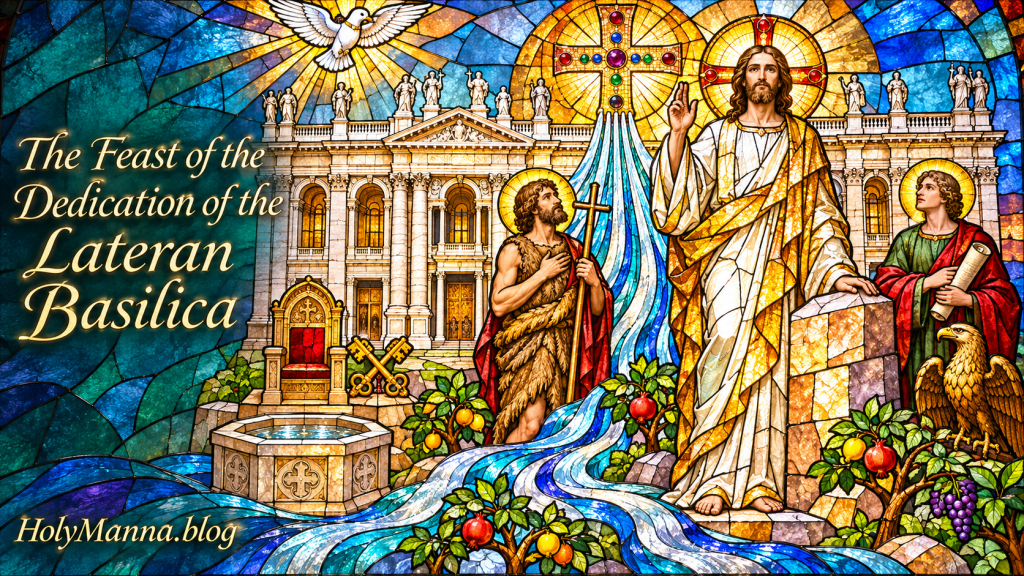
The Mother of All Churches
Every year on November 9th, the Church does something that puzzles a lot of people at first glance. The priest wears white, the Gloria is sung, and the whole Latin Church celebrates the anniversary of a building: not a saint, not a Gospel event in the usual sense, but the dedication of a church in Rome that most Catholics have never visited. The building is the Archbasilica of the Most Holy Savior and Saints John the Baptist and John the Evangelist in the Lateran, known to the world simply as Saint John Lateran, the cathedral of the Diocese of Rome and therefore the cathedral of the Pope.
The reason is carved into the basilica itself. Its facade bears the Latin title Omnium Urbis et Orbis Ecclesiarum Mater et Caput, “Mother and Head of all the Churches of the City and of the World.” Saint John Lateran is not the largest church in Rome. It is something more fundamental: the church where the Bishop of Rome has his chair, his cathedra, and in Catholic understanding every cathedral in the world is spiritually connected to this one. The Roman Martyrology for November 9th names the basilica “the Mother and Head of all the churches of the City and the world.”
That is why this feast matters to a Catholic in Houston or Manila just as much as to a Roman. The Catechism teaches that the Church is at once a visible society and a spiritual community, and that her visible structure is the means Christ chose to communicate truth and grace (CCC 771). The Lateran is the place where, for the first time in history, Christians were free to build, worship, and gather around their bishop openly. Its anniversary celebrates the Church’s freedom, her unity around Peter’s successor, and the truth that every baptized person is a living stone in a temple God Himself is building.
From a Roman Family’s Palace to the Pope’s Cathedral
The story begins not with a church but with a wealthy Roman family. The Laterani owned a palace on the Caelian Hill in the 1st century, and their name stayed with the property. The Catholic Encyclopedia records that the estate eventually came to the Emperor Constantine through his wife Fausta, which is why it was sometimes called the Domus Faustae. Constantine gave it to the Church, and he gave it early. A council against the Donatist schism met within its walls in 313, under Pope Miltiades, within months of the Edict of Milan granting Christians freedom of worship.
On that property, Constantine financed a great hall for Christian worship in the form of a basilica, the civic building type Romans used for law courts. The Catholic Encyclopedia notes an honest scholarly question about whether Constantine built a new structure or enlarged an existing hall of the palace, since Saint Jerome refers to the “former basilica of Lateranus.” What is not in doubt is the result: for the first time, the Church of Rome had a publicly visible house of worship, so splendid that it became known as the Basilica Aurea, the Golden Basilica.
Pope Saint Sylvester dedicated the basilica, and the date the Church keeps is November 9th, 324. The Vatican City State, the Vicariate of Rome, and Pope Benedict XVI’s 2008 Angelus all give 324, though Benedict XVI carefully says “about 324,” and some older sources give a slightly earlier year. The basilica was dedicated to the Most Holy Savior, not to Saint John, and that original dedication to Christ is the heart of the matter. The names of the two Saint Johns came later, and here the sources diverge in a way worth flagging. Benedict XVI stated that the names were added “only after the 6th century.” The Vatican City State account attributes Saint John the Baptist to Pope Sergius III in the early 10th century and Saint John the Evangelist to Pope Lucius II in the 12th, while the Catholic Encyclopedia ties the title to a Benedictine monastery of the two Saint Johns whose monks served the basilica’s liturgy. The accounts differ in detail rather than contradicting one another, but the precise dates remain a matter of historical reconstruction.
For roughly a thousand years, this was the center of the Catholic world. The popes lived in the adjoining Lateran Palace from the 4th century until the papacy moved to Avignon in 1309, and five ecumenical councils met here, in 1123, 1139, 1179, 1215, and 1512 to 1517. The Fourth Lateran Council of 1215, under Pope Innocent III, is among the most consequential in Church history. Its profession of faith is cited in the Catechism on the Trinity (CCC 253) and on creation from nothing (CCC 296), and it was the first council to use the word “transubstantiated” for what happens to the bread and wine at Mass, a doctrine the Catechism presents in CCC 1376.
The building has suffered nearly everything a building can suffer: an earthquake in 896 that the Catholic Encyclopedia says brought it down “from the altar to the doors,” fires in 1307 and 1360, and near ruin by the time the popes returned from Avignon. Francesco Borromini transformed the interior for the Jubilee of 1650, and in 1735 Alessandro Galilei added the monumental facade with its 15 colossal statues of Christ, the two Saint Johns, and Doctors of the Church. The apse mosaic completed by Jacopo Torriti around 1291 still shows Christ above a jeweled cross from which four rivers flow, an image drawn straight from the liturgy of this feast.
The feast itself was for centuries a local Roman celebration. Benedict XVI taught that “from 1565 onwards, it extended to the entire Church of the Roman rite,” the Roman Missal of Pope Saint Pius V in 1570 carried it to every Latin altar, and the 1969 reform of the General Roman Calendar retained it with the rank of Feast, one of only a handful of church dedications observed universally.
Stone, Water, and Living Stones
A feast about a building has to answer a hard question. Does God actually care about buildings? The Scriptures proclaimed on November 9th answer with surprising depth, because they show that the physical temple was always pointing beyond itself.
The Old Testament knew the dedication of a house for God. The Alleluia verse of the feast, from 2 Chronicles 7:16, recalls the Lord’s word at the dedication of Solomon’s Temple that He had chosen and consecrated that house for His name. Centuries later, after Babylon had destroyed that Temple, Ezekiel received a vision of a new one. In Ezekiel 47, the first reading of the feast, water flows from beneath the threshold of the temple and swells into a river too deep to cross. Wherever the river flows, “every sort of living creature that can multiply shall live.” Fruit trees line its banks, and “their fruit shall serve for food, and their leaves for medicine.” The Responsorial Psalm, Psalm 46, sings of a stream that gladdens the city of God. This is the river of the Torriti mosaic in the Lateran apse, and it is the river Pope Leo XIV invoked at the close of his 2025 homily in the basilica, with the hope that “those who approach the altar of Rome’s Cathedral go away filled with the grace” the Lord wishes to pour out upon the world.
The Gospel of the feast is John 2:13-22, the cleansing of the Temple. Jesus comes to Jerusalem for Passover, finds the Temple courts full of merchants and money changers, and drives them out with a whip of cords, saying, “stop making my Father’s house a marketplace.” The disciples remember the psalm, “Zeal for your house will consume me.” When the authorities demand a sign, Jesus gives the answer that defines this whole feast: “Destroy this temple and in three days I will raise it up.” The Evangelist explains, “But he was speaking about the temple of his body.” The Catechism dwells on this scene. Jesus honored the Temple and loved it with jealous love, yet He identified Himself with it, presenting His own body as God’s definitive dwelling place among men (CCC 583 through 586). The true Temple is Christ, and by grace Christians become temples of the Holy Spirit, “living stones out of which the Church is built” (CCC 1197).
Saint Paul draws the conclusion in the second reading, 1 Corinthians 3:9c-11, 16-17. He tells the Corinthians flatly, “you are God’s building.” The foundation is not negotiable: “no one can lay a foundation other than the one that is there, namely, Jesus Christ.” Then comes the line that gives the feast its edge: “Do you not know that you are the temple of God, and that the Spirit of God dwells in you?” Saint Caesarius of Arles, whose sermon on the anniversary of a church is read in the Office of Readings on November 9th, rejoices that “Today is the birthday of this church” and then turns to the people in the pews. God, he preaches, “dwells principally in the soul made according to his own image,” and therefore, in Caesarius’s words, “We, however, ought to be the true and living temple of God.” The stone church exists for the sake of the living one.
A Temple of Living Stones
The Catechism gathers these threads into its teaching on the nature of the Church. Among the images Scripture uses for her is that of a building: the Church is the building of God, with Christ as the rejected stone that became the cornerstone and the apostles as the foundation; she is called the house of God, the dwelling of God among men, and the holy temple, which the Fathers saw represented in churches built of stone, and in this building the faithful are the living stones built into it (CCC 756). That single paragraph is the whole theology of November 9th.
The Church also explains why Christians build churches at all. The worship of the New Covenant is not tied to any one place, because Christ is the true temple and believers are themselves temples of the Holy Spirit (CCC 1179). But when religious liberty is not thwarted, Christians construct buildings for divine worship, and these visible churches signify and make visible the Church living in that place (CCC 1180). A church, the Catechism says, is “a house of prayer in which the Eucharist is celebrated and reserved” (CCC 1181). Even entering a church is given meaning: crossing the threshold symbolizes passing from the world wounded by sin into the world of new life (CCC 1186). The Catechism’s section on prayer calls the church “the house of God” and the proper place for the liturgical prayer of the parish community (CCC 2691).
Why this church, out of all the churches in the world? Because of whose chair stands in it. The Catechism teaches that the Bishop of Rome, as Peter’s successor, is the perpetual and visible source and foundation of the unity both of the bishops and of the whole company of the faithful (CCC 881 and 882), and the Lateran is the seat from which that ministry of unity is exercised. This is why Saint Ignatius of Antioch, in the early 2nd century, could greet the Church of Rome as the one that “presides in charity” over the whole communion, a phrase Benedict XVI quoted in his 2008 Angelus to explain why honoring the Lateran expresses love for the Roman Church. Pope Leo XIV, celebrating Mass in the basilica on November 9th, 2025, insisted that Saint John Lateran “is much more than a monument or a historical memorial”; it is a sign of the living Church built of chosen and precious stones in Christ.
Behind all of this stands the deepest teaching of the feast: the Church is the Temple of the Holy Spirit, and what the soul is to the body, the Spirit is to the Body of Christ (CCC 797 and 798). Benedict XVI gave the feast its motto: “God desires to build himself a spiritual temple in the world.” Pope Leo XIV said it another way in his 2025 Angelus, reminding the faithful that “the true sanctuary of God is Christ who died and rose again” and that Christians are living stones of His body.
Pilgrims at the Lateran
Devotion to the Lateran has always meant pilgrimage. The basilica is one of the four papal basilicas of Rome, with Saint Peter’s, Saint Paul Outside the Walls, and Saint Mary Major, and the Church attaches a plenary indulgence, under the usual conditions, to a devout visit to any of them with an Our Father and the Creed on the basilica’s titular feast, on any holy day of obligation, or once a year on a day of the pilgrim’s choosing. The Catechism explains that an indulgence is a remission before God of the temporal punishment due to sins already forgiven, drawn from the treasury of the merits of Christ and the saints (CCC 1471).
Three places within the Lateran complex draw particular devotion. The first is the papal altar. The Catholic Encyclopedia notes that, unlike nearly every other great church in Rome, the Lateran was not built over a martyr’s tomb, and its high altar is unique in being made of wood rather than stone. According to a tradition recorded by the Encyclopedia, the wooden table enclosed within it is the altar on which Saint Peter himself celebrated the Eucharist, and the Gothic baldachin above it, completed in 1367, is held by tradition to contain reliquaries of the heads of Saints Peter and Paul. These are venerable traditions of the Roman Church, and they are presented here as traditions.
The second is the Lateran Baptistery, for centuries the only baptistery in Rome. Its octagonal form became the model for baptisteries throughout the West, fitting for the sacrament the Catechism calls the door to all the others (CCC 1213). A widely repeated tradition holds that Constantine was baptized here. That tradition should be flagged honestly: the earliest historical witness, Eusebius of Caesarea, records that Constantine was baptized near Nicomedia shortly before his death in 337, and most historians follow Eusebius. The Baptistery’s significance rests on the countless Romans reborn in its waters.
The third is the Scala Sancta, the Holy Stairs, housed across the piazza in what remains of the old Lateran Palace. Tradition holds that these 28 marble steps come from Pilate’s praetorium in Jerusalem, that Christ climbed them during His Passion, and that Saint Helena brought them to Rome. The historical claim cannot be verified and is presented here as tradition. What is beyond dispute is the devotion: for centuries pilgrims have climbed the stairs only on their knees, praying at each step, living out what the Catechism says of pilgrimages as evocations of the earthly journey toward heaven (CCC 2691).
One more devotion belongs to this feast, and it is the most important: prayer for the Pope. Because the Lateran is his cathedral, November 9th is a natural day for Catholics everywhere to pray for the Bishop of Rome and his ministry of unity. The custom of a newly elected pope formally taking possession of the Lateran, which Pope Leo XIV did on May 25th, 2025, makes the link visible. That evening the Holy Father borrowed the words of his patron, Saint Augustine, telling the people of Rome that with them he is a Christian and for them a bishop, and adding that he could now say that with them he is Roman. The Lateran’s feast is the whole Church’s chance to say it back.
How the World Keeps the Feast, and What the Liturgy Proclaims
In Rome, November 9th is kept as a solemnity within the basilica and the diocese, since it is the anniversary of the city’s own cathedral, and the Pope often presides. In 2025, Pope Leo XIV preached there on the Church as a building site where the only foundation is Christ. Benedict XVI used his 2008 Angelus to encourage every community to care for its own church as a religious and historical heritage.
Outside Rome, the feast is quieter, and that is part of its lesson. It is not kept with processions or popular customs the way a patronal feast might be, but the way the Church keeps every feast of the Lord: with the Mass. On Monday, November 9th, 2026, every Latin-rite parish in the world will set aside the readings of the 32nd Week in Ordinary Time and proclaim the proper readings of the Dedication, Lectionary number 671, in white vestments, with the Gloria, the Creed, and the Preface of the Dedication of a Church. Because the Lateran’s dedication ranks as a feast of the Lord, in years when November 9th falls on a Sunday in Ordinary Time, as it did in 2025, the feast replaces the Sunday liturgy entirely.
The Eastern Catholic Churches do not keep this Roman feast, since it belongs to the Latin Church’s own history, but the instinct behind it is fully shared. The Byzantine calendar keeps its own great dedication feast on September 13th, the Renewal of the Church of the Resurrection in Jerusalem, dedicated under Constantine in the same generation as the Lateran. East and West agree that the building is a sign of the people who fill it.
Ezekiel sees water flowing from the temple and bringing life wherever it goes. Paul tells the baptized that they are the temple in which the Spirit dwells. Jesus points to His own body as the temple that will be destroyed and raised. Water flows from the side of Christ on the cross, the Church is born from that water in Baptism and the Eucharist, and the whole world is meant to drink.
Building on the Only Foundation
What does a feast about a cathedral in Rome ask of a Catholic who may never see it? More than it seems.
Start with the foundation. In his 2025 homily at the Lateran, Pope Leo XIV said that builders know they must dig deep, and that the Church must do the same, examining herself and removing whatever is unstable before building. He urged the faithful to dig “unhindered by worldly criteria, which too often demand immediate results.” Apply that to your own life. The foundation Paul names is not a set of good intentions; it is Jesus Christ, the one foundation on which the whole building rests (CCC 756). Habits, friendships, ambitions, and the way you spend your evenings all rest on something. If the foundation is anything other than Christ, no amount of effort on the upper floors will hold.
Then take the cleansing of the Temple personally. Jesus drove out the merchants because His Father’s house had become something it was not meant to be, and Caesarius of Arles drew the obvious conclusion: if the church is to be honored, then the soul in which God principally dwells must be honored too. Through Baptism you became a temple of the Holy Spirit (CCC 1265). Has resentment, lust, cynicism, or the endless scroll quietly set up shop in that temple? The sacrament of Reconciliation is the whip of cords Christ uses gently, and the Fourth Lateran Council, held in this very basilica, is the council that first asked every Catholic to confess at least once a year, an obligation the Catechism still presents today (CCC 1457). A good confession before November 9th would be a fitting way to keep the feast.
Next, love your own parish church, because the Lateran’s feast is really about every church. That can mean arriving early to pray in silence, genuflecting with attention, or bringing a friend who has never crossed the threshold. The Catechism says that crossing that threshold is itself a sign of passing into new life (CCC 1186). Treat your parish doors that way, and you will be living this feast every Sunday.
Pray for the Pope. The Lateran is his cathedral, and the Catechism calls him the visible source and foundation of the Church’s unity (CCC 882). An Our Father and a Creed for the Holy Father on November 9th joins you to the pilgrims standing in his cathedral that morning.
Finally, let the river flow. Ezekiel’s vision is not a picture of a private spiritual life; the water leaves the temple and heals the sea. The grace you receive at your own parish is meant to leave the building with you, into your workplace, your home, your friendships, and your city. The Church is a building site, as the Holy Father said, and you are both a living stone and a laborer. The question the feast leaves on the table is what you intend to build with the grace you have been given.
Engage With Us!
Share your thoughts and reflections in the comments below. Have you ever visited Saint John Lateran, climbed the Holy Stairs, or prayed in your own cathedral on this feast?
- Saint Paul says plainly, “you are God’s building,” and that the only foundation is Jesus Christ. What have you been building your life on lately, and where might the foundation need to be dug deeper?
- Jesus cleansed the Temple because His Father’s house had become a marketplace. What has quietly set up shop in the temple of your own heart, and how might the sacrament of Reconciliation help you clear it out before November 9th?
- Saint Caesarius of Arles taught that God dwells principally in the soul made in His image. How would your week change if you treated your own soul with the reverence you show a church?
- The Lateran is called the Mother and Head of all the churches. How connected do you feel to your own parish and your diocese’s cathedral, and what is one concrete way you could love and care for your parish this month?
- Ezekiel’s river leaves the temple and brings life wherever it flows. Where in your workplace, family, or city is grace meant to flow through you, and what is holding the water back?
The feast of the Dedication of the Lateran Basilica is a reminder that God does not merely dwell in stone; He dwells in His people, and He is still building. Go to Mass this November 9th, say a prayer for the Holy Father, and then carry the grace of the altar out through the doors. Live a life of faith built on the one foundation, and do everything, every ordinary task and every difficult conversation, with the love and mercy that Jesus taught us.
Saint Peter & Saint John, pray for us!
Follow us on YouTube, TikTok, Instagram and Facebook for more insights and reflections on living a faith-filled life.


Leave a Reply