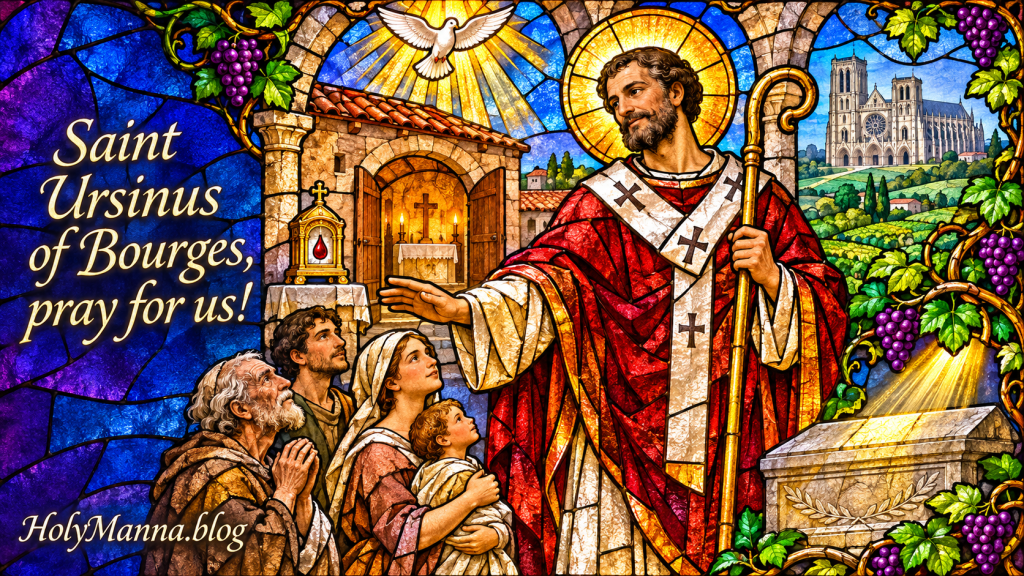
The Bishop Beneath the Vineyard
Every great cathedral has a first stone, and every ancient diocese has a first shepherd. For the Archdiocese of Bourges in the heart of France, that first shepherd is Saint Ursinus, known in French as Saint Ursin, honored on November 9th as the first bishop of the city and the apostle of the Berry region. He preached Christ to a handful of poor people in a Roman provincial town, found one wealthy man willing to give up his house so that the Mass could be celebrated, and then died and was buried so humbly that his own city forgot where he lay for three hundred years. The way the Church found him again is one of the loveliest stories Saint Gregory of Tours ever recorded.
Ursinus is honored as the patron of the city and the Archdiocese of Bourges, whose cathedral of Saint Stephen is traditionally said to stand on the very ground where his first church was built. The Church calls him a confessor rather than a martyr, meaning that he bore witness to Christ by the whole shape of his life rather than by shedding his blood. The Catechism explains why such a man matters: “The duty of Christians to take part in the life of the Church impels them to act as witnesses of the Gospel and of the obligations that flow from it” (CCC 2472). Ursinus was a witness at the beginning, when there was nothing in Bourges to witness to yet except the promise that Christ had come for everyone.
Out of the Mists
Readers should know from the start that almost everything known about Saint Ursinus comes from a single pen, that of Saint Gregory of Tours, the great bishop and historian who died in 594 and wrote roughly three centuries after Ursinus lived. Gregory tells the story twice, in two different books, and he does not tell it the same way both times.
In his History of the Franks, Gregory describes the persecution of the Emperor Decius around the year 250 and says that seven bishops were sent from Rome to preach in Gaul, among them Saint Denis to Paris, Saint Martial to Limoges, and Saint Gatian to Tours. Then he adds that one of their disciples went on to the city of Bourges and announced to its people that Christ the Lord had come as the Savior of all. In that passage Gregory does not even give the disciple’s name. In his later work, The Glory of the Confessors, written around the year 587, Gregory names him Ursinus, calls him a bishop who was ordained by disciples of the apostles and sent to Gaul, and says he was the first to establish and govern the Church of Bourges. Scholars who have compared the two texts suggest that between writing them, Gregory simply heard a fuller and more flattering local version of how the faith first came to Bourges.
What can be said with reasonable confidence is this. Ursinus most likely lived in the second half of the third century. Mgr. Louis Duchesne, the great French historian of the early Gallic Church, placed his episcopate near the close of the third century, and noted that Leo, who was bishop of Bourges in the year 453, was only the twelfth bishop of the see. The current Roman Martyrology agrees, dating him “around 300.” Local manuscripts of the Church of Bourges say he held the see for twenty-seven years. Nothing reliable is known of his birthplace, his parents, or his formation. The older Martyrology entries say he was ordained at Rome, and that is as close as history gets to an origin.
A much later tradition fills in the silence in a dramatic way. Beginning with a Life of the saint written around the eleventh century, at a time when the Church of Bourges was claiming primacy over all of Aquitaine and wanted apostolic roots, Ursinus came to be identified with Nathanael of The Gospel of John, the friend of Philip whom Jesus saw under the fig tree and praised with the words “Here is a true Israelite. There is no duplicity in him” (Jn 1:47). In this tradition, Ursinus was one of the seventy-two disciples, served as the reader at the Last Supper, stood among the witnesses of Saint Stephen’s martyrdom and gathered the protomartyr’s blood, received the Holy Spirit at Pentecost, and was sent to Gaul by Saint Peter himself. The tradition also gives him a traveling companion, a disciple named Just, who died on the road about seven miles short of Bourges; the village of Saint-Just near the city is named for him.
This tradition shaped the art of Bourges and Normandy for centuries, but it is a story rather than history. Duchesne found that the identification of Ursinus with one of the seventy-two first appears in an eleventh-century manuscript, and the chronology cannot hold if the saint lived in the third century. The Nathanael tradition cannot be verified. The Church honors Ursinus not because he sat at the Last Supper but because he did, in a small Roman town far from Jerusalem, exactly what the apostles had done.
A House Becomes a Church
What Saint Gregory tells of Ursinus’s ministry is short, but every line of it is precious. Ursinus arrived in Bourges and preached Christ. A few people believed. They were, Gregory says, mostly the poor, because the senators and leading men of the city were still devoted to the old pagan worship. Gregory pointed out that this was what the Lord had foretold when He said “Amen, I say to you, tax collectors and prostitutes are entering the kingdom of God before you” (Mt 21:31). From among those first believers Ursinus ordained priests, taught them how to sing the psalms, and instructed them in how a church should be built and how the worship of Almighty God should be carried out.
This is the whole of apostolic succession in miniature. The Catechism teaches that the apostles “consigned, by will and testament, as it were, to their immediate collaborators the duty of completing and consolidating the work they had begun” (CCC 861). Ursinus was one link in that unbroken chain.
Then came the problem every young parish knows. The community needed a place to worship, and the people who had space to give were not interested. Gregory says the believers asked one owner for a house and were refused. So they went to a man named Leocadius, whom Gregory calls the first senator of the Gauls, a member of the same family as Vettius Epagatus, the young nobleman martyred at Lyon in the year 177. Leocadius was still a pagan. The Christians told him both what they wanted and what they believed. His answer, as Gregory records it, is the only line of dialogue that survives from the founding of the Church of Bourges: “If my own house in the city of Bourges were worthy of this work I would not refuse to offer it.”
The Christians, poor as they were, gathered three hundred gold pieces and a silver dish and brought them to Leocadius as payment. He took three of the coins, as a blessing, and gave the rest back. And then, Gregory says, he believed in Christ and turned his own house into a church. That house became the first church of Bourges, and Gregory, writing in the sixth century, could say that it was by then built with marvelous skill and made famous by a relic of the blood of Saint Stephen the first martyr, which is why the cathedral of Bourges is dedicated to Saint Stephen to this day.
That exchange is the heart of the saint’s legacy. The Catechism says that visible churches “are not simply gathering places but signify and make visible the Church living in this place, the dwelling of God with men reconciled and united in Christ” (CCC 1180). Before Leocadius gave his house, the Church in Bourges had no visible dwelling. After he gave it, the city had an altar, and a senator had a Savior. Ursinus did not convert Leocadius by argument. He converted him by asking him, in faith, for something generous, and by letting the generosity itself do the work of grace. Tradition adds that Leocadius’s son Lusor, known in French as Ludre, was baptized as well; his tomb at Déols was already venerated in Gregory’s time.
Gregory records no miracles worked by Ursinus during his lifetime, and the Church has never claimed any for him. Readers may come across a story of a pagan temple miraculously thrown down in the Berry countryside; on inspection that episode belongs to Saint Martin of Tours, who passed through the region a century later. The miracle of Ursinus’s life was the ordinary miracle of the Gospel taking root where no one expected it. He teaches that the Church is built by preaching Christ to whoever will listen, forming the people God sends, and trusting that a house can become a church if someone has the courage to ask for it.
The Long Work of a Confessor
Saint Ursinus was not martyred. He died in peace, apparently in the last decades of the third century, after what local tradition counts as twenty-seven years as bishop. Some modern sources give the date of his death as December 29th, but no early document confirms it, and the Church keeps his memory on November 9th. His hardships were of a different kind than the sword, and in some ways they were harder to bear, because they had no end in sight.
Consider what it meant to be the first Christian bishop of a Roman provincial capital in the third century. The Decian persecution of 250 had demanded that every citizen sacrifice to the gods and obtain a certificate proving it. The Valerian persecution of 257 and 258 struck directly at bishops, priests, and deacons. Whether Ursinus arrived during that storm or just after it, he was a bishop in a world where being a bishop could get a man killed, and where the men who ran the city, Gregory says explicitly, were still committed to the worship that the empire demanded.
There was also the loneliness of the work. Gregory says the disciple went to Bourges alone, and the later tradition of the companion Just, buried seven miles short of the city, only deepens the picture of a man who started from nothing.
Saint Paul described the kind of community Ursinus was building when he wrote that “God chose the foolish of the world to shame the wise, and God chose the weak of the world to shame the strong” (1 Cor 1:27). The Catechism draws out why this is a grace rather than a disadvantage: “The Beatitudes reveal an order of happiness and grace, of beauty and peace” (CCC 2546), and it is the poor in spirit who inherit the kingdom. Ursinus endured the slow hardship of being poor among the poor, patiently, for the better part of three decades, and he handed on to his successor a Church that had an altar, a clergy, and a senator’s house. Then he was buried in an ordinary cemetery outside the walls, and within a generation or two nobody could say exactly where.
That last detail may be the most striking hardship of all. Gregory says frankly that from the time of Ursinus’s death until the days of Bishop Probianus in the middle of the sixth century, nobody spoke of him at all. The founder of the Church of Bourges spent nearly three hundred years in obscurity, with no shrine, no feast, and no name on anyone’s lips. The Church’s teaching that the saints “do not cease to intercede with the Father for us” (CCC 956) means that this silence was not absence. Ursinus went on praying for the city that had forgotten him, and in God’s time the city was reminded.
Found by a Vision, Carried by the Saint Himself
The story of how Bourges rediscovered its founder is told by Gregory of Tours in chapter 79 of The Glory of the Confessors, and because Gregory was writing within living memory of the events, it stands on firmer ground than most relic stories of the age.
In the middle of the sixth century, during the episcopate of Bishop Probianus of Bourges, there was a man named Agustus who had belonged to the household of an earlier bishop, Desideratus. Agustus had suffered from a severe disability and had built a small oratory in honor of Saint Martin at a place called Brives, where relics of Saint Martin had cured him. Bishop Probianus later built a church in honor of Saint Symphorian, the martyr of Autun, just outside the walls of Bourges, and he appointed Agustus its abbot.
One night Saint Ursinus appeared to Agustus in a vision, told him to find his grave, and led him by the hand to the place. Agustus went to Bishop Probianus and told him what he had seen. The bishop did not take it seriously. Then Ursinus appeared a second time, and this time he appeared not only to Agustus but at the same hour to Saint Germanus, the Bishop of Paris, who happened to be visiting Bourges. In the vision Ursinus led the two men together to the spot. The next morning the abbot and the visiting bishop compared what they had seen and found that they had dreamed the same dream. They went out to an old cemetery, dug beneath a vineyard, and found the tomb. The body inside, Gregory says, was uncorrupted.
The sarcophagus was raised and carried toward the church of Saint Symphorian, and Gregory records that it entered the church with the help of the saint himself, an event he presents as miraculous. After the celebration of Mass, Ursinus was laid to rest beside the altar while the people rejoiced, and Gregory adds that miracles were worked there. Because Saint Germanus died in 576, the discovery must have taken place before that year, most likely around 560. The church of Saint Symphorian came in time to be called the church of Saint-Ursin, and it grew into a collegiate church that stood in Bourges until the French Revolution. Its Romanesque doorway, known as the Porte Saint-Ours, still survives in the city.
The Catechism reminds the faithful that “the believer’s body and soul already participate in the dignity of belonging ‘in Christ’” (CCC 1004), and that the veneration of relics, visits to sanctuaries, and pilgrimages are among the forms of piety that “surround the Church’s sacramental life” (CCC 1674). The people of Bourges took that teaching to heart, and the relics of Saint Ursinus traveled a long road afterward. According to the Catholic iconographer Jacques Baudoin, when the Norsemen raided the heart of France in the ninth and tenth centuries, the relics were carried for safety to the Benedictine abbey of Vaucluse in the Jura mountains; a portion stayed behind in the church of Cour-Saint-Maurice when the main body of the relics returned to Bourges.
In the year 1055, Bishop Hugh of Lisieux in Normandy asked for and obtained a share of the relics, and from that day Ursinus has been venerated in Normandy nearly as warmly as in Berry. A story grew up in Lisieux to explain the city’s devotion. The relics, it was said, had been lent to Lisieux to drive out an epidemic, which the sources describe variously as plague or as the burning sickness caused by poisoned grain. When the time came to return them to Bourges, the beast pulling the cart stopped dead on the road outside the town and would go no farther, which the people took as the saint’s own wish to remain among them. A cross called the Croix Saint-Ursin marked the spot for centuries, and a procession went out to it every year on the Sunday after Easter. The historical society of Lisieux itself notes that the story of the halted cart probably arose to justify a devotion that was already old. It cannot be verified.
Ursinus became a healing saint across Burgundy and Normandy. He was invoked against painful inflammation of the legs, a complaint the people called the sickness of Saint Ursin, and in Normandy parents prayed to him for children suffering from intestinal worms. These are matters of popular devotion recorded by Catholic historians of Norman piety, and the individual cures behind them cannot be verified. Further relics are kept at La Chaussée-Saint-Victor near Blois, and a reliquary of the saint is honored in the church of Saint-André at Châteauroux. His devotion spread through the dioceses of Lisieux, Bayeux, Rouen, and Blois, and the little town of La Chapelle-Saint-Ursin lies just outside Bourges.
The greatest monument to him, though, is the cathedral of Bourges itself, one of the great Gothic cathedrals of France. Tradition holds that it rises on the ground of Leocadius’s house. Its west front has five portals, and the southernmost of them, carved between about 1240 and 1270, tells the life of Saint Ursinus in stone; a thirteenth-century stained glass window and fifteenth-century sculptures honor him as well. Every November 9th, the Church of Bourges keeps his feast as a local celebration even as the universal Church celebrates the Dedication of the Lateran Basilica, the mother church of Rome. The cathedral of the pope and the house of Leocadius were built for the same reason, so that the Church could be seen.
What a Forgotten Bishop Can Teach a Remembered Age
Saint Ursinus speaks with special force to an age that measures everything by visibility. He built the Church of Bourges and then vanished from its memory for three centuries, and heaven did not count that as failure. The Catechism teaches that “all the faithful of Christ, of whatever rank or status, are called to the fullness of the Christian life and to the perfection of charity” (CCC 2013). Holiness does not require an audience. Ursinus preached to a few poor people, formed a few priests, and asked one rich man for his house. That was enough to change a city forever.
Where in your own life are you tempted to think that your faithfulness does not count because no one sees it? The parent who takes a child to Mass week after week with no visible result and the worker who quietly refuses to cut a corner are building the Church of Bourges all over again.
He also teaches something hard about the poor. Gregory says plainly that the first Christians of Bourges were poor because the important people were not interested. The Church has never stopped saying that this is where she begins. The Catechism lists the works of mercy and adds that “giving alms to the poor is one of the chief witnesses to fraternal charity” (CCC 2447). A practical way to honor Saint Ursinus this week is to ask where the overlooked people are in one’s own parish or neighborhood, and to go sit with them, since they may well be the ones through whom God intends to build something.
Then there is Leocadius. He gave a house and got a Savior. Most people cannot give a house, but everyone owns something that the Church needs and has not yet been asked for: a spare evening, a skill, a car, a willingness to lector or to teach or to serve coffee after the early Mass. What is the house you have not yet offered? The Catechism says that Jesus “enjoins his disciples to prefer him to everything and everyone” (CCC 2544), and Leocadius discovered that preferring Christ cost him a building and gave him eternity.
Finally, Ursinus teaches patience with God’s timing. He was forgotten for three hundred years and then found by a dream shared between an abbot and a bishop from another city. The Catechism teaches that the saints “share in the living tradition of prayer by the example of their lives, the transmission of their writings, and their prayer today” (CCC 2683). Ursinus left no writings, so his contribution to that living tradition is his life and his prayer, and both went on working while his tomb lay under a vineyard. Is there some good work in your past that seems to have come to nothing? It may simply be waiting, as his did, for the hour God has chosen to bring it to light. A disciple who keeps sowing and lets God keep the calendar is living the way Saint Ursinus lived.
Engage With Us!
Readers are warmly invited to share their thoughts and reflections on Saint Ursinus of Bourges in the comments below. Here are some questions to carry into prayer this week.
- Saint Ursinus preached to a congregation made up mostly of the poor because the influential people of Bourges were not interested. Who are the people in your community that the influential are not interested in, and how might God be calling you to bring Christ to them?
- Leocadius gave his house, kept three coins out of three hundred, and found faith in the giving. What do you own, in time or possessions or talent, that the Church has not yet asked you for, and what would it mean to offer it before being asked?
- Ursinus ordained priests and taught them to sing the psalms before the community even had a building. How much of your own faith is built on the sacraments and the prayer of the Church, and how much on comfortable surroundings?
- The founder of Bourges was forgotten for three centuries and then found through a shared dream. Have you ever seen God bring an old act of faithfulness back to light long after it seemed lost?
- Ursinus is honored as a confessor, a saint who witnessed to Christ by the whole pattern of his life rather than by martyrdom. What would a confessor’s witness look like in your workplace, your family, or your friendships this week?
Saint Ursinus built a church out of a borrowed house and a handful of poor believers, and then let God handle the rest. That is still how the Church grows. May every reader find the courage to preach Christ where no one seems to be listening, the generosity to give what has not yet been asked for, and the patience to trust that nothing done for God is ever truly lost. Go and do everything with the love and mercy that Jesus taught.
Saint Ursinus of Bourges, pray for us!
Follow us on YouTube, TikTok, Instagram and Facebook for more insights and reflections on living a faith-filled life.


Leave a Reply