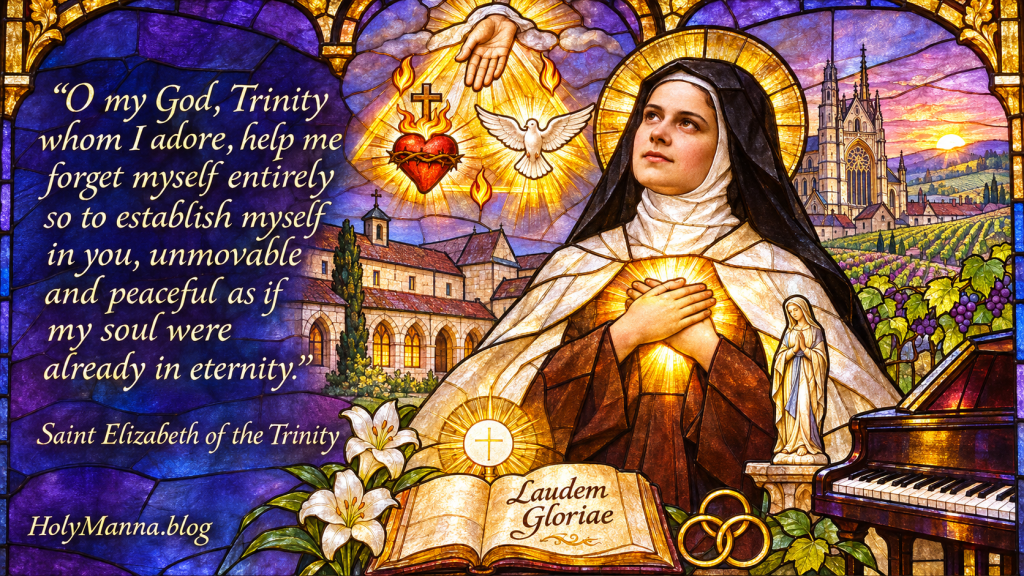
Heaven on Earth
For a world that scrolls endlessly, fills every silence with noise, and still feels hollow, the Church offers a 26 year old French nun who spent five years behind a cloister grille and left behind a single, searing conviction: God is not far away. He is here, in the baptized soul, right now, and the Christian life consists in learning to live with Him there.
Saint Elizabeth of the Trinity, born Élisabeth Catez in 1880 and dead by 1906, is one of the great modern teachers of the divine indwelling. She was a prize winning pianist, a lively young woman who loved parties and dancing, a daughter locked in a long struggle with a mother who did not want to lose her, and finally a Discalced Carmelite whose writings on the Trinity were so profound that the Catechism of the Catholic Church quotes her prayer in CCC 260. She is the only mystic of the 20th century to appear in its pages.
The Church remembers her on November 9th, the anniversary of her death, while the Carmelite family keeps her memorial on November 8th, since November 9th belongs to the Feast of the Dedication of the Lateran Basilica. Pope Saint John Paul II beatified her on November 25th, 1984, and Pope Francis canonized her on October 16th, 2016. In canonizing her, “the Church recognizes the power of the Spirit of holiness within her and sustains the hope of believers by proposing the saints to them as models and intercessors” (CCC 828). Elizabeth is a model for anyone who suspects that holiness is reserved for people with quieter personalities and more free time. She had neither, and she became a saint anyway.
The Captain’s Daughter with a Fiery Heart
Elizabeth was born on Sunday, July 18th, 1880, at the military camp of Avord near Bourges, in central France, where her father, Captain Joseph Catez, was stationed. Four days later she was baptized Marie Élisabeth in the camp chapel. Her father came from a modest farming family in the north of France; her mother, Marie Rolland, was the daughter of an officer. A sister, Marguerite, nicknamed Guite, followed in 1883, and the two girls remained exceptionally close for the rest of Elizabeth’s life.
The family moved to Dijon in 1882. On October 2nd, 1887, Captain Catez died suddenly of a heart attack. Elizabeth was seven. The widow and her daughters moved into an apartment whose balcony looked down on the garden of the Carmelite monastery.
Nothing about young Elizabeth suggested a future contemplative. She had a volcanic temper. Her mother described her as a little terror, and her outbursts were so frequent that Madame Catez threatened to postpone her First Communion until her behavior improved. Elizabeth later confided to her prioress that her persevering effort to conquer her temper began with her first Confession in 1887.
The turning point came on April 19th, 1891, when Elizabeth made her First Communion at the parish church of Saint Michel in Dijon. Witnesses recalled that tears ran down her face throughout the Mass. According to testimony gathered by her community, when a friend invited her to a celebration afterward, Elizabeth replied that she was not hungry because Jesus had fed her. That same afternoon, following local custom, the newly communicated girls visited the Carmel in their white dresses. The prioress, Mother Marie of Jesus, told Elizabeth that her name in Hebrew means “House of God.” The phrase lodged in her heart and never left it. The Catechism names the reality behind the prioress’s words: Baptism makes the Christian “a temple of the Holy Spirit” (CCC 1265). Elizabeth would spend her life learning to live inside that truth. She received Confirmation at Notre Dame de Dijon on June 8th of the same year.
Alongside her spiritual awakening, Elizabeth was developing a formidable musical gift. She entered the Dijon Conservatory as a young child and won first prize in piano at 13, and her mother hoped for a good marriage and a comfortable life for her talented daughter. God had other plans, and so did Elizabeth. At 14, after receiving Communion, she felt an irresistible call to give herself entirely to Christ and privately made a vow of virginity. Soon afterward she understood that she was being called to Carmel. When she told her mother, the answer was an absolute refusal. Madame Catez forbade her to visit the monastery and would not hear the word vocation spoken in the house. Elizabeth obeyed. For seven years she waited.
Those years were not spent sulking. Elizabeth lived the full social life of a young woman of her class: dances, parties, travel to Lourdes and the south of France, and marriage proposals she declined. At the same time she taught catechism, organized a choir for girls who worked in the local factories, and visited the sick. Her letters and diary show a young woman who had discovered that she could be alone with God in a crowded ballroom.
In 1899, during a parish mission in Dijon, Elizabeth began the portion of her diary that survives. On March 26th of that year her mother finally agreed that Elizabeth could enter Carmel at 21. Around the same time the prioress lent her the writings of a young Carmelite from Lisieux who had died two years earlier. The book was Story of a Soul, and Elizabeth recognized in Thérèse a sister in spirit.
One more encounter completed her formation. In early 1900 a Dominican, Father Irénée Vallée, explained to her the Church’s teaching on the indwelling of the Holy Trinity in the baptized soul. Elizabeth later said he had put words to something she was already living. Jesus had promised it in The Gospel of John: “If a man loves me, he will keep my word, and my Father will love him, and we will come to him, and make our home with him” (Jn 14:23). The Catechism places this verse at the center of its teaching on the Trinity and adds that “even now we are called to be a dwelling for the Most Holy Trinity” (CCC 260).
Behind the Grille
On August 2nd, 1901, Elizabeth knelt before her father’s photograph to ask his blessing, then walked with her mother and sister the short distance to the Carmel of Dijon and entered. She was 21, and she was given the name Sister Elizabeth of the Trinity. She received the habit on December 8th, 1901, the Solemnity of the Immaculate Conception, made her profession on January 11th, 1903, and received the black veil on January 21st of that year.
Her prioress and novice mistress was Mother Germaine of Jesus, barely 31 years old, who would become first her guide, then her disciple, and finally the guardian of her legacy. Elizabeth’s life in Carmel was outwardly unremarkable: the Rule, the housework, the long hours of liturgical and silent prayer, letters to family and friends. There were no visions, no ecstasies, no extraordinary phenomena. What she had instead was an ever deepening awareness of the three divine Persons living within her. She called them simply “my Three.”
The Catechism describes the heart of what Elizabeth experienced: “God himself is an eternal exchange of love, Father, Son and Holy Spirit, and he has destined us to share in that exchange” (CCC 221). For Elizabeth this was not an abstract doctrine but the most practical fact of daily existence. In a 1902 letter to a friend in the world she wrote the sentence that has become her signature: “It seems to me that I have found my heaven on earth, since heaven is God and God is in my soul. The day I understood that, everything became clear to me.”
Her prayer was contemplative in the precise sense the Church gives that word: “Contemplation is a gaze of faith, fixed on Jesus” (CCC 2715). Elizabeth did not seek feelings or consolations. She sought God Himself, in the dark light of faith, and she found Him most reliably in Scripture, above all in the letters of Saint Paul.
It was Saint Paul who gave her the second of the three names she believed God had chosen for her. In The Letter to the Ephesians Paul writes that the baptized are destined “to live for the praise of his glory” (Eph 1:12). In Latin the phrase is laudem gloriae. A praise of glory, she explained, is a soul so surrendered to God that His life pours through it unhindered, like light through crystal. She began signing her letters “Laudem Gloriae” and hoped it would be her name in heaven. A third name, “Host of Praise,” expressed her desire to be offered with Christ in the Eucharist. House of God, Praise of Glory, Host of Praise: the three titles summarize her whole spirituality.
On November 21st, 1904, the feast of the Presentation of Mary and the day Carmelites renew their vows, Elizabeth took a sheet torn from a notebook and wrote, in a single flow, the prayer that would make her famous. She told no one. It was found among her papers after her death. The Church has since placed its opening lines in the Catechism as a model of what it means to be a dwelling place of God:
“O my God, Trinity whom I adore, help me forget myself entirely so to establish myself in you, unmovable and peaceful as if my soul were already in eternity. May nothing be able to trouble my peace or make me leave you, O my unchanging God, but may each minute bring me more deeply into your mystery! Grant my soul peace. Make it your heaven, your beloved dwelling and the place of your rest. May I never leave you there alone but be wholly present, my faith wholly vigilant, wholly adoring, and wholly surrendered to your creative action” (CCC 260).
Elizabeth worked no miracles during her lifetime, and no healings or prodigies are attributed to her earthly years. Her miracle was quieter and in a sense more demanding. She demonstrated that an ordinary baptized person, with an ordinary temperament, can live in continual conscious union with God in the midst of ordinary duties. She wrote to busy mothers, to seminarians, and to her own sister raising small children, always with the same message: God is already in you. Make Him a little cell in your soul and go there often. The Catechism teaches that grace is “a participation in the life of God” that “introduces us into the intimacy of Trinitarian life” (CCC 1997).
The Long Crucifixion of Laudem Gloriae
Elizabeth was never martyred, but her last two years were a slow martyrdom of the body, borne in an age of persecution for the Church in France.
She entered Carmel in 1901, the very year the French government passed the Law on Associations that placed religious congregations under state control. In 1903 thousands of religious were expelled from France, and in 1905 the Law of Separation severed the Church from the state. Throughout her years in Carmel the Dijon community lived under the real possibility that the monastery would be dissolved and the nuns scattered into exile.
Then her body began to fail. In early 1905 she started showing symptoms no one could explain: crushing exhaustion, violent headaches, stomach pains, an inability to keep food down, and steady weight loss. Some nights after the Office she was so weak that she crawled up the stairs to her cell. The illness was Addison’s disease, a failure of the adrenal glands, then incurable and in most cases fatal within months of the acute phase.
On March 19th, 1906, the feast of Saint Joseph, Elizabeth was moved to the infirmary. On Palm Sunday, April 8th, her condition was so grave that she received the Anointing of the Sick and Holy Viaticum. Everyone expected her to die within days. Instead she rallied and lived another seven months.
The suffering was extreme. Her stomach ulcerated. She could take only tiny amounts of food and was, in effect, slowly starving. Yet it was in exactly these months that she produced her greatest writings. In August 1906 she wrote Heaven in Faith, a ten day retreat for her sister Guite, a wife and mother of small children, teaching her to live the contemplative life in a busy household. In the same month she composed her Last Retreat, 16 days of meditations on becoming a praise of glory. Shortly before her death she wrote a letter to Mother Germaine and hid it to be found afterward. In it she turned the Lord’s question to Peter upside down and told her prioress that God was not asking whether she loved Him more than the others, but was saying to her instead: “Let yourself be loved more than these.” It was her final teaching: before anything else, the soul must consent to be loved by God.
The Church teaches that Christ has given suffering a new meaning: “it can henceforth configure us to him and unite us with his redemptive Passion” (CCC 1505). Elizabeth understood her illness in exactly this light and offered it for the Church, for priests, for her Carmel, and for France. Through the Anointing of the Sick she had received the strength to unite herself more closely to Christ’s Passion that the Catechism describes (CCC 1521), and she used that gift to the full. The Catechism is honest that “there is no holiness without renunciation and spiritual battle” (CCC 2015). Elizabeth’s battle was fought in a convent infirmary, and it was ferocious. She clung to faith without feeling, repeating her conviction that God was present in her soul whether or not she could sense Him.
On October 31st, 1906, she received the Last Rites a second time, and on All Saints Day she received Holy Communion for the last time, since she could no longer swallow. In the early morning of November 9th, 1906, with her sisters gathered around her bed praying the prayers for the dying, Mother Germaine saw Elizabeth’s eyes fix on something above their heads. Her last audible words were: “I am going to Light, to Love, to Life.” She was 26 years old. She had been a Carmelite for five years and three months.
The Catechism, in its teaching on Christian death, quotes her Carmelite sister Thérèse: “I am not dying; I am entering life” (CCC 1011). Elizabeth said the same thing in her own words, and the Church has judged that she meant it.
From Dijon to the Altars
Elizabeth was almost unknown outside Dijon when she died. That changed quickly. In 1909 Mother Germaine published Elizabeth’s letters and writings with her own reminiscences, and the book spread across France and beyond. The Swiss theologian Hans Urs von Balthasar wrote a study of her, later paired with his study of Thérèse as Two Sisters in the Spirit, and credited Elizabeth with helping to shape his theology.
Her cause opened in Dijon in 1931, her writings were approved in 1944, and on July 12th, 1982, Pope John Paul II declared her Venerable.
The miracle accepted for her beatification was the healing from cancer of a French priest, Albert Decourtray, who attributed his cure to her intercession and later became Bishop of Dijon and then Cardinal Archbishop of Lyon. The Church’s investigation was conducted in Dijon in 1964 and 1965, and the decree recognizing the miracle was promulgated on February 17th, 1984.
On November 25th, 1984, in Saint Peter’s Basilica, John Paul II beatified Elizabeth of the Trinity. In his homily he presented her as a witness for a humanity that no longer knows how to find God, and he spoke openly of the influence her writings had on his own spiritual life. Carmelite sources record that he called her a prophet of the presence of God. The Catechism explains why a pope would propose such a figure to the whole Church: the saints “do not cease to intercede with the Father for us” (CCC 956), and “their intercession is their most exalted service to God’s plan” (CCC 2683).
The second miracle came in 2002 and concerned Marie-Paul Stevens, a Belgian religion teacher from Malmedy and a Secular Carmelite. At 39 she had been struck by Sjögren’s syndrome, a chronic and incurable autoimmune disease that left her unable to work and in constant pain. She had loved Elizabeth since adolescence and believed Elizabeth had already been helping her bear the illness. In thanksgiving, and expecting to die, she made a pilgrimage to the Carmel of Flavignerot, outside Dijon, where the community had relocated in 1979 and where Elizabeth’s cell and belongings are preserved, to pray for the grace of a happy death.
On Easter Tuesday, April 2nd, 2002, she prayed with all her strength in the monastery chapel. When she came outside she was suddenly and completely free of every symptom. Her family doctor, who had followed her through the entire illness, confirmed that the cure was medically inexplicable. The Archdiocese of Dijon conducted a formal inquiry from July 2011 to August 2012, hearing nine physicians and forty witnesses. On March 3rd, 2016, Pope Francis approved the healing as a miracle worked through Elizabeth’s intercession.
On October 16th, 2016, World Mission Sunday, Pope Francis canonized Saint Elizabeth of the Trinity in Saint Peter’s Square alongside six other new saints. A cloistered nun who never left Dijon was raised to the altars on the day the Church prays for her missions, fitting for a woman who believed her mission in heaven would be to draw souls into interior silence so that God could imprint Himself on them.
Her legacy is tangible as well as spiritual. Her major relics rest in the church of Saint Michel in Dijon, the parish where she made her First Communion. The Carmel of Dijon-Flavignerot welcomes pilgrims and keeps a small museum with her reconstructed cell and personal effects. First class relics are venerated in Carmelite churches around the world, and Cardinal François-Xavier Nguyễn Văn Thuận drew on her teaching when he preached the Lenten retreat to the Roman Curia in the Jubilee year 2000. Few saints who lived so briefly and so hidden have reached so far.
Finding the Heaven Within Your Own Soul
Elizabeth’s message is almost scandalously simple, and that is why it is so hard to live. God dwells in you. Not metaphorically, not eventually, but now, by virtue of your Baptism, as long as you remain in His grace. The Father, the Son, and the Holy Spirit have made their home in your soul, and they are waiting for you to come and keep them company.
Elizabeth did not discover this in a monastery. She discovered it as a teenager at parties, as a pianist at the keyboard, and as a daughter living under her mother’s refusal. Carmel gave her the silence to go deeper, but the foundation was laid in a life that looked very much like yours. When was the last time you paused in the middle of an ordinary day and simply acknowledged that God was present within you?
Her first lesson is about interior silence. Elizabeth loved to speak of making a little cell in the soul and retreating there often. This does not require a chapel. It requires a decision, repeated a hundred times a day, to turn inward for a moment and acknowledge the One who is there. What would change in your reactions, your words, and your choices if you believed the Trinity was present in you during every conversation?
Her second lesson is about self mastery. Elizabeth was not born gentle, and she spent years conquering her temper, beginning with the grace of Confession. If you struggle with anger, impatience, or a sharp tongue, she is proof that a difficult temperament is raw material for sanctity, not an excuse against it. What is the one recurring fault that, if you fought it with Elizabeth’s persistence, would most change the atmosphere of your home or workplace?
Her third lesson is about suffering. Elizabeth’s death was slow and painful, and she transformed it into an offering united with the Passion of Christ for the sake of the Church. You may not face Addison’s disease, but you face something: illness, grief, anxiety, a job that grinds you down. Elizabeth would tell you not to waste a single pain. Is there a suffering in your life right now that you have been enduring but not yet offering?
Her final lesson is the one she gave Mother Germaine from her deathbed. Let yourself be loved. So much modern religious anxiety comes from the assumption that holiness means performing well enough for God. Elizabeth insisted on the opposite order. God loves first, lavishly and freely, and the soul’s first task is to stop resisting that love. Can you sit for five minutes today without asking God for anything, without apologizing for anything, and simply let Him love you?
Pray her prayer to the Trinity slowly, once a day for a week, and notice which line stops you. Read Heaven in Faith, written for a busy mother, in ten short sittings. Above all, remember the name she would give you: House of God. You are that house. Go inside and find Him.
Engage With Us!
Saint Elizabeth of the Trinity invites every baptized person to discover heaven on earth in the depths of their own soul. Share your thoughts and reflections in the comments below. Has her teaching on the indwelling of the Trinity spoken to you or challenged you? Your experience may be exactly what another reader needs to hear.
Here are some questions to guide your reflection:
- Elizabeth learned at her First Communion that her name means “House of God.” If you took seriously that the Father, Son, and Holy Spirit dwell in you by Baptism, what single habit would you change this week?
- Elizabeth lived an active social life while developing a deep interior life. Where in your busiest, noisiest moments could you create a little cell for God?
- She fought a violent temper for years, beginning with Confession. What recurring fault is God inviting you to battle, and when did you last bring it to the sacrament of Reconciliation?
- Her last letter told her prioress to let herself be loved more than these. What makes it hard for you to receive God’s love without trying to earn it?
- Her last words were that she was going to Light, to Love, to Life. How does her peace in the face of death challenge or console your own view of eternity?
Saint Elizabeth of the Trinity found that heaven does not begin after death. It begins the moment a soul in grace turns inward and recognizes the God who is already there. You carry that same God within you today. Go to Him often, let Him love you first, offer Him what hurts, and let your whole life become a praise of His glory. Do everything, as Jesus taught us, with love and mercy, and you will find, as Elizabeth did, that you have never been alone for a single moment.
Saint Elizabeth of the Trinity, pray for us!
Follow us on YouTube, TikTok, Instagram and Facebook for more insights and reflections on living a faith-filled life.


Leave a Reply