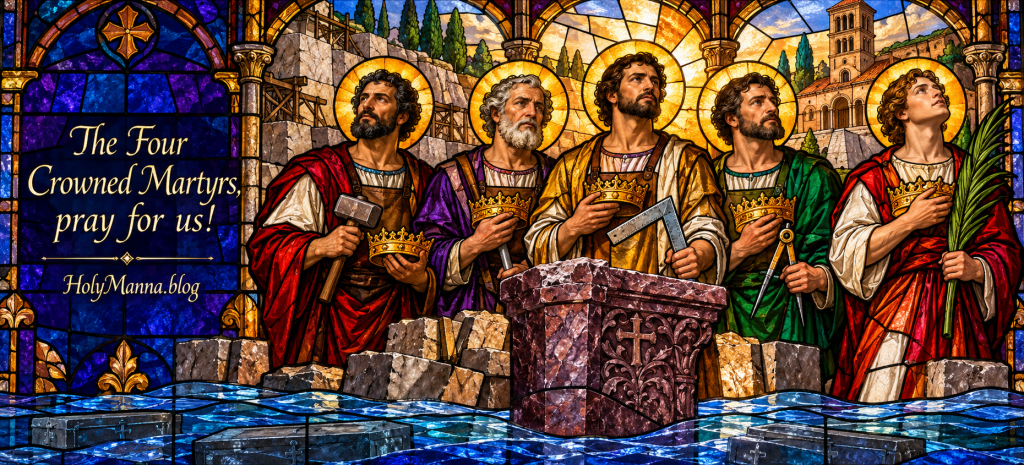
Chisels in the Name of Christ
Every November 8th the Church pauses to remember a group of craftsmen whose names most Catholics have never heard, yet whose title has echoed through 17 centuries of art, architecture, and devotion. The 2004 Roman Martyrology opens its entry for the day with these words: “Commemoration of the holy martyrs Symphorian, Claudius, Nicostratus, Castorius and Simplicius.” It goes on to describe them as stoneworkers of Sirmium in Pannonia, the Roman province along the middle Danube, who refused to carve a statue of the pagan god Aesculapius and were thrown into a river on the orders of the Emperor Diocletian. The Church calls them the Four Crowned Martyrs, the Quattuor Coronati, even though five of them are named. That little puzzle is part of their story, and it will be untangled below.
The Church holds these men up for admiration because they lived at the exact point where faith meets daily work. They were not bishops, hermits, or theologians. They were tradesmen with calloused hands who earned the emperor’s praise for their skill, who had no objection to carving decorative statues for a pagan court, and who drew one clear line at the moment they were ordered to produce an object of worship. For that line they died. The Catechism explains why such a death matters so much: “Martyrdom is the supreme witness given to the truth of the faith: it means bearing witness even unto death” (CCC 2473).
Their witness made them the beloved patrons of sculptors, stonemasons, and stonecutters. Throughout the Middle Ages the guilds that raised Europe’s cathedrals kept their feast, and in Renaissance Florence the stone and woodworkers’ guild commissioned one of the most important sculptures of the early Renaissance in their honor. Their relics rest to this day beneath the altar of an ancient basilica in Rome that still bears their name. These are saints for anyone who has ever wondered whether holiness is possible in a workshop, an office, or a job site.
Craftsmen of the Danube
Almost nothing is known about the birthplaces, families, or early years of Symphorian, Claudius, Nicostratus, Castorius, and Simplicius. No ancient source records their parents, their hometowns, or how they came to faith in Christ. What the Church possesses is a Passio, an account of their martyrdom, which the Catholic Encyclopedia attributes to a revenue officer named Porphyrius writing probably in the 4th century, although many modern scholars date the surviving Latin text later, perhaps to the 6th or 7th century. The Catechism teaches that such accounts hold a special place in the life of the Church: “The Church has painstakingly collected the records of those who persevered to the end in witnessing to their faith. These are the acts of the Martyrs. They form the archives of truth written in letters of blood” (CCC 2474).
The Passio introduces the martyrs as skilled stone carvers working in the imperial quarries of Pannonia, with Sirmium, today Sremska Mitrovica in Serbia, as the city most closely tied to their memory. Sirmium was no backwater; it was one of the great capitals of the late Roman Empire and a city that produced many martyrs in the early 4th century. Symphorian, whose name also appears as Simpronianus or Sempronianus in old manuscripts, together with Claudius, Nicostratus, and Castorius, were already secret Christians when the story begins. Simplicius, the fifth man, was a pagan colleague who came to the faith through watching them work.
One honest caution belongs here. The Passio describes the men quarrying and carving porphyry, the deep purple stone prized by emperors, yet the only porphyry quarry known in the ancient world lay in Egypt, not Pannonia. Scholars therefore suspect that the writer embellished the setting or borrowed details from elsewhere. The core of the story, that five Christian stoneworkers of Pannonia died under Diocletian for refusing to make an idol, is what the Catholic Encyclopedia calls substantially authentic. The decorative details around it should be read as the tradition the Church received, not as a verified chronicle.
Carving Every Stone with the Sign of the Cross
According to the Passio, the Emperor Diocletian himself came to the quarries of Pannonia and gathered the workers. Among hundreds of craftsmen, four stood out for their genius: Claudius, Castorius, Symphorian, and Nicostratus. The emperor gave them commission after commission, and they fulfilled each one. They carved a statue of the sun god with his chariot, figures of Victory, cupids, eagles, columns with leafy capitals, and ornate basins hollowed from a single 40-foot block of stone. None of these subjects troubled them. Decorative images of pagan mythology were part of the ordinary visual language of the Roman world, and the four men saw no sin in shaping them for the emperor’s palaces and public spaces.
What set them apart was how they worked. The Passio says that before every task they made the sign of the cross and carved in the name of Jesus Christ. Their work succeeded where the efforts of other craftsmen cracked and failed. That is the detail that caught the attention of Simplicius. According to the story, he marveled at their skill and asked what secret made their tools so sure. Symphorian and Castorius answered that it was God, the Creator and Lord of all things, who made His creation strong. Simplicius objected that surely the god Zeus had done all this. The four Christians patiently led him to the truth, and he came to believe. The tradition says he then went with them to a bishop named Cyril of Antioch, who had been condemned to labor in the quarries for his faith, and received the faith from him. This exchange is told as the Passio tells it and cannot be verified, but it is a beautiful picture of evangelization through excellence.
These men lived out, long before it was written, what the Catechism says about the dignity of labor: “Human work proceeds directly from persons created in the image of God and called to prolong the work of creation by subduing the earth, both with and for one another” (CCC 2427). They also embodied what the Church teaches about art itself: “Created ‘in the image of God,’ man also expresses the truth of his relationship with God the Creator by the beauty of his artistic works” (CCC 2501). The apostle Paul could have been describing their workshop when he wrote, “Whatever you do, do from the heart, as for the Lord and not for others” (Colossians 3:23).
A Catholic in the 21st century should remember and imitate them because the five stoneworkers prove that sanctity does not require leaving the world. They did not flee the emperor’s employment. They did not refuse to make beautiful things for pagans. They simply refused to let their art be turned into worship of a false god, and they let their daily work preach Christ before their words ever did. The Passio reports that Diocletian valued their skill so much that when accusations came against them, he at first insisted that such gifted artisans deserved to be cherished. Simplicius is the proof that this witness worked. One man watched four Christians do their jobs with integrity and joy, and he asked why. That question led him to baptism and, in the end, to the crown of martyrdom.
The Statue They Would Not Make
The crisis came when Diocletian ordered a statue of Aesculapius, the god of healing, to be carved for a temple. This was not a decorative figure for a courtyard. It was a cult image meant to receive sacrifice and incense. The five Christians refused. Other sculptors were given the task and finished the statue in 31 days, and when it was unveiled, the pagan philosophers who oversaw the quarries pointed at the five and denounced them as impious men and sorcerers who had defied the emperor’s command.
Summoned before Diocletian, the men did not hide. Claudius, according to the Passio, answered that they had always obeyed the emperor in everything, but they would not carve an image of that wretched idol, and he quoted the psalm that warns what becomes of those who make idols. Castorius simply declared that they were Christians. Scripture itself puts their argument plainly: “Their idols are silver and gold, the work of human hands. They have mouths but do not speak, eyes but do not see. They have ears but do not hear, noses but do not smell. They have hands but do not feel, feet but do not walk; they produce no sound from their throats. Their makers will be like them, and anyone who trusts in them” (Psalm 115:4 to 8). The Catechism cites that very psalm when it explains the first commandment and warns that “These empty idols make their worshippers empty” (CCC 2112).
It is worth pausing on the precision of their refusal, because the Church’s teaching depends on it. The five had carved statues of Victory and the sun god without scruple. What they would not do was fashion an object for adoration. The Catechism draws exactly this distinction: “The Christian veneration of images is not contrary to the first commandment which proscribes idols” (CCC 2132), while idolatry itself “consists in divinizing what is not God” (CCC 2113). The same paragraph adds, “Many martyrs died for not adoring ‘the Beast’ refusing even to simulate such worship” (CCC 2113). The stoneworkers of Sirmium were among them. They understood that to carve the god of healing for a temple would be to lend their hands to a lie about who heals and who saves.
The case was handed to a tribune named Lampadius. The Passio says he tried to persuade them, then lost patience and ordered them stripped and beaten with scorpions, the dreaded whips studded with metal, while a herald proclaimed that no one may despise the commands of the prince. The old Roman Martyrology confirms the outline: the five were first imprisoned, then scourged with metal-tipped whips, and when nothing could make them abandon the faith of Christ, “Diocletian ordered them to be thrown into the river.” Then comes a dramatic turn that belongs to tradition rather than documented history. The Passio reports that in the very hour Lampadius pronounced the sentence of scourging, he was seized by convulsions and died in his judgment seat. His wife and household ran wailing to the philosophers, and the uproar reached Diocletian, who in his fury ordered lead coffins to be made. The five men were sealed alive inside them and cast into the river, which later sources identify as the Sava, the great river that flows past Sirmium. This story of the tribune’s sudden death cannot be verified.
The Passio records the date as the 6th day before the Ides of November, which is November 8th. The year is less certain. The Catholic Encyclopedia places their death toward the end of 305, while other sources suggest earlier dates, as early as 298, and the broader range of 287 to 305 is sometimes given. Readers should know that the sources conflict on the year, though not on the day.
The significance of their martyrdom lies in its ordinariness. They were not caught in a sweeping roundup of Christians. They were asked to do one thing with the gifts God had given them, and that one thing was a betrayal of the God who gave the gifts. Our Lord’s promise and warning stood before them: “Everyone who acknowledges me before others I will acknowledge before my heavenly Father. But whoever denies me before others, I will deny before my heavenly Father” (Matthew 10:32 to 33). The Catechism teaches that “In situations that require witness to the faith, the Christian must profess it without equivocation” (CCC 2471). Five craftsmen on the Danube did exactly that, with chisels laid down and hands folded.
The River Gave Them Back
The tradition continues that a Christian named Nicodemus recovered the lead coffins from the river after 42 days and carried the bodies away for burial. The Passio adds that Bishop Cyril, still in prison, was overcome with grief when he heard of their deaths and himself passed to the Lord. Both details are told as the tradition tells them and cannot be verified. What is certain is that the relics of the five did not stay in Pannonia. At some unknown date they were brought to Rome, and from that moment the story of the Four Crowned Martyrs became entangled with the Eternal City.
Here the puzzle of their title must be explained. Ancient pilgrim guides to the Roman catacombs mention the tomb of the Four Crowned Martyrs at the cemetery of Saints Marcellinus and Peter on the Via Labicana, 3 miles outside the city. One of those guides lists their names as the five Pannonian sculptors. A later Roman tradition told a different story: that four Christian soldiers, officers called cornicularii, were martyred at Rome under Diocletian for refusing to offer incense to a statue of Aesculapius, were beaten to death with leaded whips, had their bodies left in the street for dogs, and were finally buried on the Via Labicana by Saint Sebastian and Pope Miltiades. Because no one knew these soldiers’ names, the tradition says, Pope Miltiades ordered that they be honored under the names of the Pannonian sculptors, who had died on the same date, and the title Four Crowned was used for the nameless martyrs. Later manuscripts claimed that the soldiers’ names were revealed years afterward as Severus, Severianus, Carpophorus, and Victorinus. The Catholic Encyclopedia states flatly that this account of four Roman soldiers has no historic foundation, and that those four names were borrowed from genuine martyrs of Albano whose feast fell in August. The great Bollandist scholar Hippolyte Delehaye concluded after long study that there was really only one group of martyrs, the stoneworkers, whose relics had come to Rome. The Church accepted this conclusion. The 2004 Roman Martyrology commemorates only the five sculptors on November 8th and moved the Albano martyrs to August 8th. The word crowned, it should be said, refers to the crown of martyrdom, the reward promised in Scripture: “Remain faithful until death, and I will give you the crown of life” (Revelation 2:10).
Their veneration in Rome is beyond doubt. By the 4th or 5th century a basilica dedicated to the Four Crowned Martyrs stood on the Caelian Hill, and it is first recorded by name among the signatures of a Roman synod in 595. Pope Saint Gregory the Great knew it. Pope Saint Leo IV, who had been its cardinal priest, rebuilt it around 850 as a great basilica and transferred the relics of the Four Crowned Martyrs from the Via Labicana to a crypt beneath the high altar, together with the relics of the five Pannonian sculptors. Leo’s bell tower still stands and is the oldest in Rome. The Norman army of Robert Guiscard burned the basilica in the sack of 1084, and Pope Paschal II rebuilt it on a smaller scale within the old walls early in the 12th century. The relics rest to this day in ancient marble basins in the crypt, where an inscription from Paschal’s time records them. Pilgrims who visit the Basilica of Santi Quattro Coronati find a fortress-like complex with two courtyards, a Cosmatesque cloister, the Chapel of Saint Sylvester with its famous 13th-century frescoes, and apse frescoes from 1630 telling the martyrs’ story. Augustinian nuns have kept the basilica for centuries, and it is one of the Lenten station churches of Rome, visited on the Monday of the 4th week of Lent.
The martyrs’ fame crossed the sea early. Saint Bede the Venerable, in his Ecclesiastical History of the English People, records that there was a church of the Four Crowned Martyrs in Canterbury before the year 624. He tells of a fire that was devouring the city and raging toward that church, and how Archbishop Mellitus, carried out to face the flames, prayed until the wind turned and the fire died. This is the one healing-type miracle linked to their name, and it comes from Bede’s report; it cannot be independently verified. A tradition says their relics were sent to England in 601, though that tradition cannot be verified either.
Then came the guilds. Because the martyrs were stoneworkers, the medieval craftsmen who cut and set the stones of Europe’s cathedrals adopted them as patrons. Flemish masons called them the Vier Ghecroonde. The oldest known English poem about the craft of masonry, the Regius manuscript written around 1390, devotes a section to the Four Crowned. In Florence around 1410 to 1416, the guild of stone and woodworkers commissioned Nanni di Banco to carve the Quattro Santi Coronati for its niche at the church of Orsanmichele. The four life-size marble figures, gathered in grave conversation as they realize what their refusal will cost, became a landmark of early Renaissance sculpture. Even a modern research lodge of Freemasons in London took the Latin name Quatuor Coronati in 1886, a sign of how completely the stoneworking trades had claimed these saints, though Catholics should remember that the Church forbids membership in Masonic associations, as the Congregation for the Doctrine of the Faith reaffirmed in 1983. Whoever borrows their name, the Four Crowned Martyrs belong first to Christ and His Church as patrons of sculptors, stonemasons, and stonecutters.
Building with Living Stones
A 4th-century workshop on the Danube has more to say to someone scrolling through this post between meetings than might be expected. The Four Crowned Martyrs are saints of the ordinary workday. They remind the Church that the first place most Christians will be asked to confess or deny Christ is not an arena but a job.
Consider first how they worked before the crisis ever arrived. They made the sign of the cross over every block of stone. They carved in the name of Jesus. Their excellence was itself a form of prayer, and it was that excellence, not a sermon, that drew Simplicius to ask about their God. Saint Paul wrote, “So whether you eat or drink, or whatever you do, do everything for the glory of God” (1 Corinthians 10:31). What would change in your work this week if you began each task by placing it in God’s hands? Is there a Simplicius in your office or on your crew, someone watching how you handle pressure and wondering what makes you different?
Consider next the precision of their refusal. They were not rigid. They carved pagan decorations without complaint because a statue in a courtyard is not an altar. They knew the difference between living in a non-Christian culture and bowing to it. The Catechism warns that idolatry “remains a constant temptation to faith” and names some modern idols plainly: “power, pleasure, race, ancestors, the state, money” (CCC 2113). Few people today will be ordered to carve Aesculapius. Many will be asked to shade a report, sign off on something dishonest, stay silent when the faith is mocked, or treat career, comfort, or reputation as the thing that finally cannot be sacrificed. Where is the line in your own work that you have decided in advance you will not cross? Have you decided it at all, or are you waiting for the moment to decide for you?
Consider finally the crown. These men lost everything that the world could measure: their reputation with the emperor, their livelihood, their lives. The Church calls them crowned. Saint James promises, “Blessed is the man who perseveres in temptation, for when he has been proved he will receive the crown of life that he promised to those who love him” (James 1:12). The Catechism teaches that the saints in heaven “do not cease to intercede with the Father for us” (CCC 956), and that devotion to them is not merely about imitation but about the union of the whole Church in the Spirit (CCC 957). The Four Crowned Martyrs are brothers who pray for the carpenter, the engineer, the nurse, the coder, and the student trying to be honest in a world that rewards compromise.
Some practical ways to bring their lessons home. Begin the workday with a short prayer and the sign of the cross, exactly as they did, and offer the day’s tasks to God. Pursue excellence in the craft God has given, since competence done with love is a witness that needs no words. Name one concrete thing that would be an idol if it ruled the heart, and ask the Lord for the courage of Claudius and Castorius to say no when the moment comes. Support the beauty of the Church by caring for sacred art and architecture, remembering that the men who built the great cathedrals prayed to these saints while they worked. And when a coworker asks why faith matters, answer as Symphorian answered Simplicius: God, the Creator and Lord of all things, makes His creation strong. Saint Peter gives the image that ties it all together: “like living stones, let yourselves be built into a spiritual house to be a holy priesthood to offer spiritual sacrifices acceptable to God through Jesus Christ” (1 Peter 2:5). The stonecutters of Sirmium became living stones in that house. What is God shaping in you?
Engage With Us!
The Four Crowned Martyrs have been interceding for people who work with their hands and minds for 1,700 years. Please share your thoughts and reflections in the comments below. HolyManna would love to hear how their story speaks to the work you do and the pressures you face.
- The five stoneworkers carved pagan decorations freely but refused to make an idol for worship. How do you discern the difference between living faithfully within a secular culture and participating in something that denies Christ?
- Simplicius came to the faith by watching Christians do excellent work in the name of Christ. Who has drawn you closer to God simply by the way they lived, and who might be watching you in the same way?
- The Catechism names power, pleasure, money, and the state among the idols that tempt believers today. Which modern idol is hardest for you to resist, and what would it look like to lay down your chisel before it?
- These martyrs are the patrons of sculptors, stonemasons, and builders. How might you offer your own profession or daily tasks to God as a form of prayer and witness?
- The Church calls them crowned because of the reward promised to those who remain faithful until death. What would help you keep eternity in view when fidelity is costly in the present?
Whatever stone life sets before you this week, pick up your tools with the sign of the cross and work in the name of Jesus. Do everything with the love and mercy He taught, refuse what would deny Him, and trust that the One who crowned five craftsmen on the banks of the Sava sees every faithful act you offer.
Saints Symphorian, Claudius, Nicostratus, Castorius, and Simplicius, pray for us!


Leave a Reply