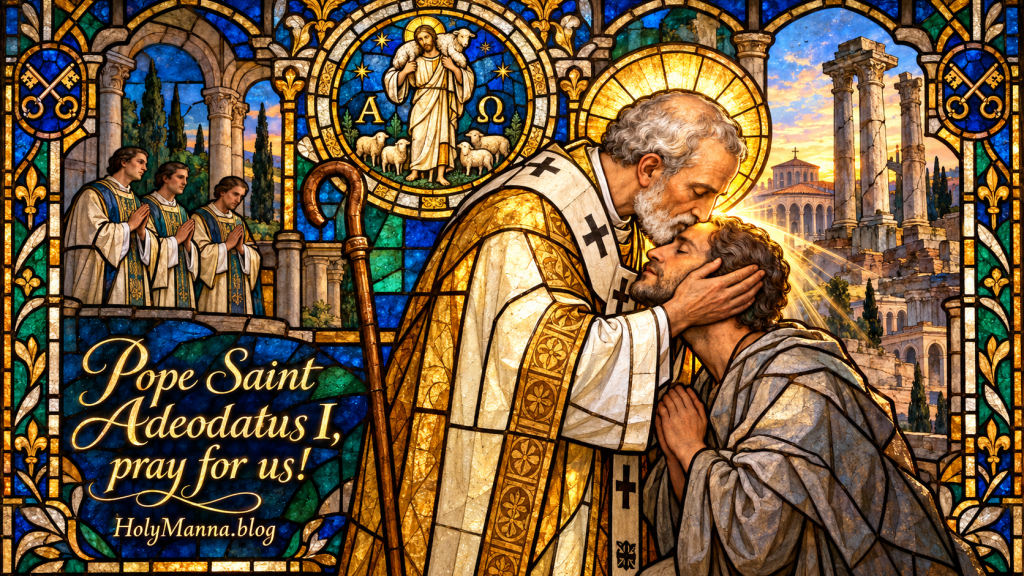
The Pope Who Kissed a Leper
Some saints fill whole libraries. Others leave behind a few lines in a chronicle, a lead seal the size of a coin, and a reputation for goodness that outlasted the empire they served. Pope Saint Adeodatus I belongs to the second group, and that is why he deserves attention on November 8th. He was the 68th successor of Saint Peter, a Roman priest for roughly forty years before anyone thought to make him pope, and he governed the Church for only three years and twenty-three days. In that short span Rome endured political revolt, an earthquake, and an epidemic, and the record agrees that this old priest met all of it by going out to his people.
He is known by two names, and both of them are a sermon in miniature. The Liber Pontificalis, the ancient book of papal biographies, calls him Deusdedit, meaning God has given. The 2004 edition of the Roman Martyrology and the official list of popes at the Vatican call him Adeodatus I, meaning given by God. Either way, the name was a confession of faith made by his parents before he could speak, and he spent his life proving it true.
He is remembered for three things, mostly. He loved his diocesan clergy and restored them to positions of responsibility after a generation in which monks had held most of the influence. He is traditionally credited as the first pope to seal his documents with a lead bulla, which is where the phrase papal bull comes from. And the older Roman Martyrology preserved a tradition that he once healed a leper simply by kissing him. The Catechism teaches that the Pope, as Bishop of Rome and Peter’s successor, “is the perpetual and visible source and foundation of the unity both of the bishops and of the whole company of the faithful” (CCC 882). Adeodatus held that office in a crumbling city, with a simplicity his successors carved into his tomb.
A Subdeacon’s Son in the Rome of Gregory the Great
Almost nothing survives about the childhood of Adeodatus, and a Catholic writer owes the reader honesty about that. The Liber Pontificalis gives one sentence of origin: “Deusdedit, a Roman by birth, son of the subdeacon Stephen.” His birth year is unknown. Some modern reference sites suggest around the year 570, but they flag the date as uncertain, and no ancient source confirms it.
What can be said with confidence is that he grew up inside the Church. His father Stephen was a subdeacon, one of the minor clerics who assisted at the altar and read the Epistle at Mass. A subdeacon’s son would have learned the Psalms, the liturgy, and the rhythm of the Roman stational churches from the time he could walk. There is no record of a dramatic conversion for Adeodatus, no road-to-Damascus moment, and the post will not invent one. His was a conversion of the slow and steady kind, the kind the Catechism describes when it says that “all Christians in any state or walk of life are called to the fullness of Christian life and to the perfection of charity” (CCC 2013).
He was ordained a priest and then did something remarkable in its ordinariness. He stayed a priest, in Rome, for about forty years. Catholic sources agree on that number. Four decades of baptisms, funerals, confessions, and Masses in a shrinking, impoverished city under constant Lombard threat. When the clergy of Rome finally elected him pope in 615, he became the first priest, rather than a deacon or a monk, to be raised to the Chair of Peter since Pope John II in the year 533. That detail reveals what kind of man the Roman Church wanted in a crisis: not a brilliant administrator or a celebrated ascetic, but a parish priest who had been faithful in small things for a very long time. Jesus had a word for that: “The person who is trustworthy in very small matters is also trustworthy in great ones” (Luke 16:10).
One note on dates. The Vatican’s official list gives his reign as October 19th, 615, to November 8th, 618. The 1908 Catholic Encyclopedia records those dates but adds alternatives in parentheses, November 13th, 615, for his consecration and December 3rd, 618, for his death, reflecting a disagreement among early chronologists. This post follows the Vatican dates while acknowledging the discrepancy.
Loving the Clergy and Rebuilding a Broken Church
The Liber Pontificalis summarizes his entire pontificate in two short clauses, and they repay slow reading: “He greatly loved the clergy; he restored the priests and clergy to their former places.” To understand why an ancient chronicler would bother to record this, one has to understand the Rome that Adeodatus inherited.
Saint Gregory the Great, who died in 604, had been a monk before he was pope, and he had filled the papal household and the key administrative posts with monks he trusted. His successors, including Pope Boniface IV, continued the pattern. Gregory’s choice was not a bad one, but it left the diocesan priests and deacons of Rome, the men who actually staffed the city’s parishes and tended its poor, feeling sidelined and, according to the Catholic Encyclopedia, financially impoverished by the political chaos of the age. Adeodatus knew their situation from the inside. He brought the secular clergy back into positions of responsibility, and Catholic reference works record that he ordained about fourteen priests, the first ordinations in Rome since Gregory’s pontificate. For more than a decade no new priests had been ordained in the capital of the Latin Church. Adeodatus saw a Church in danger of running out of shepherds and did the unglamorous work of making more of them.
The Church teaches that priests are the “prudent cooperators of the episcopal college and its support and instrument” (CCC 1567), and that through them the bishop’s ministry reaches every corner of the diocese (CCC 1562). A bishop who loses his priests loses his people. His love for the clergy, far from being clerical favoritism, was pastoral realism, and it echoed the charge of Saint Peter himself: “Tend the flock of God in your midst, overseeing not by constraint but willingly, as God would have it, not for shameful profit but eagerly. Do not lord it over those assigned to you, but be examples to the flock” (1 Peter 5:2 to 3).
Then there is the seal. The Catholic Encyclopedia says that Adeodatus “is said to have been the first pope to use leaden seals (bullae) for pontifical documents.” One of his seals survives to this day. On the front it shows the Good Shepherd standing among his sheep, with the letters Alpha and Omega beneath. On the back it reads simply Deusdedit Papae, of Pope Deusdedit. The claim that he was the very first to use such a seal is traditional rather than proven, and the Encyclopedia’s careful “is said to have been” should be respected. But the image he chose is beyond dispute, and it is the clearest window into his heart that history has left. When this pope wanted one picture to authenticate everything he wrote, he did not choose a crown or his own portrait. He chose Christ carrying sheep, the One who said, “I am the good shepherd. A good shepherd lays down his life for the sheep” (John 10:11), framed by the title Christ gives Himself in Revelation 1:8: “I am the Alpha and the Omega.”
Catholic sources record no documented miracles during his lifetime, with one exception that belongs to tradition and will be told below. What the record does show is a man whose daily holiness was itself a sign. Pope Honorius I, who reigned from 625 to 638, composed the verse epitaph for his tomb, and according to the summary preserved in Catholic reference works it described him as “simple, devout, wise, and shrewd.” The 2004 Roman Martyrology echoes the same memory in its entry for November 8th: “At Rome at Saint Peter’s, Saint Adeodatus I, pope, who loved his clergy and his people and was famous for his simplicity and wisdom.” Simplicity and wisdom together are rare. The Catechism places simplicity at the very root of the spiritual life when it teaches that “humility is the foundation of prayer” (CCC 2559), and it was from that foundation that the wisdom of Adeodatus grew.
When the Earth Shook and the Sick Filled the Streets
Adeodatus was not martyred, but no one should imagine that his three years were peaceful. He governed Rome in one of the most dangerous decades of the early Middle Ages, and his hardships came from three directions at once.
The first was political. Italy in 615 was a battered Byzantine province, ruled from Constantinople through an official called the exarch, who sat in Ravenna. The unpaid imperial soldiers mutinied. Revolts broke out in Ravenna and in Naples, and in Ravenna the mob killed the exarch and several of his officials. A new exarch, Eleutherius, marched south with an army to restore order, and the ancient sources record that he passed through Rome, where Pope Adeodatus received him with every honor, before he went on to crush the Naples rebellion. Meanwhile the Lombards pressed on the frontiers. In this world the Pope was not only the bishop of the city but, in practice, its civil protector. The Catechism acknowledges that “every human community needs an authority to govern it” (CCC 1897), and in seventh-century Rome that authority increasingly wore the fisherman’s ring whether he wanted to or not. Spanish Catholic biographers remember Adeodatus as a skilled and patient mediator with an empire that cared very little about Italy.
The second hardship was the earth itself. In August 618, an earthquake struck Rome. The marble buildings of the Forum, already weakened by two centuries of invasions, took what one Catholic biographer calls their finishing blow. The Psalmist’s words would have been on many Roman lips that month: “God is our refuge and our strength, an ever-present help in distress. Thus we do not fear, though earth be shaken and mountains quake to the depths of the sea” (Psalm 46:2 to 3).
The third hardship followed the second. After the earthquake came disease. The Liber Pontificalis uses the Latin word scabies, a general term for a disfiguring skin affliction; later Catholic writers call it leprosy, and some Spanish sources call it elephantiasis. Whatever the precise diagnosis, the sick multiplied in a city whose infrastructure had just collapsed, and those who caught it were the ones everyone else fled. Here the record becomes unanimous about the character of Adeodatus. The Catholic Encyclopedia states that “when his diocese was visited by a violent earthquake and the terrible scourge of leprosy he set an heroic example by his efforts to relieve the suffering.” Catholic biographers describe him going personally into the streets to tend the afflicted. He was, by any reasonable estimate, a man in his sixties or older, carrying the weight of a collapsing city, and he chose to spend his strength on people with contagious sores.
This is where documented history and venerable tradition meet, and the reader deserves to see the seam. The Roman Martyrology used by the Church from the sixteenth century until the revision of 2001 read, for November 8th: “At Rome, St. Deusdedit, pope, whose merit was so great that he cured a leper by kissing him.” Catholic sources trace this entry to Cardinal Baronius, the great sixteenth-century historian who edited the Martyrology, and ACI Prensa describes the tradition this way: during one of his visits to the sick, to the most abandoned of all, those attacked by leprosy, he embraced and kissed one of these unfortunates, and the man was healed. Some later writers expanded this into a general reputation as a wonder-worker who healed plague sores with his lips. The 2004 Roman Martyrology removed the leper miracle from its entry and replaced it with the description of his love for clergy and people and his famous simplicity and wisdom. The Church today, in other words, presents the healing as a pious tradition rather than established fact. This story cannot be verified.
Yet one should not rush past it either. Everything documented about Adeodatus, the forty years as a parish priest, the love for impoverished clergy, the Good Shepherd on his seal, the personal presence among the sick after the earthquake, makes the kiss plausible as an act even where the miracle remains unproven. And the kiss itself is the Gospel. When a leper came to Jesus and said, “Lord, if you wish, you can make me clean,” the Lord “stretched out his hand, touched him, and said, ‘I will do it. Be made clean’” (Matthew 8:2 to 3). Jesus did not need to touch him; He chose to. The Catechism teaches that “Christ’s compassion toward the sick and his many healings of every kind of infirmity are a resplendent sign that ‘God has visited his people’ and that the Kingdom of God is close at hand” (CCC 1503), and that Christ’s disciples, by following Him, “acquire a new outlook on illness and the sick” (CCC 1506). Whether or not a leper’s skin changed under the lips of Adeodatus, the Pope’s willingness to kiss him was already a sign that God had visited His people in a shaken city.
Adeodatus died on November 8th, 618, roughly three months after the earthquake. One nineteenth-century historian of Rome suggested he probably died of the epidemic itself, a victim of the very disease he had refused to flee. That suggestion is reasonable but cannot be verified; no ancient source states the cause of his death.
A Will, a Tomb, and a Memory That Refused to Fade
The Liber Pontificalis records what happened next in two plain sentences: “On his death he was buried in St Peter’s; for his funeral he left an entire stipend to all the clergy.” The Latin word is roga, the regular payment made to the Roman clergy for their support. Adeodatus made sure that his last act as their bishop was to pay them. Catholic sources describe this as the first recorded instance of a pope making such a bequest to his clergy, and some later writers embellish it into a gift of silver for every cleric present at the funeral. The embellishment cannot be verified, but the bequest itself rests on the earliest source there is. He did not leave behind a basilica with his name on it. He left behind a paid clergy and a quiet example. The Catechism reminds the faithful that “the Church encourages us to prepare ourselves for the hour of our death” (CCC 1014), and Adeodatus prepared for his by thinking about other people’s groceries.
Honesty requires saying plainly what the sources do not contain. Catholic reference works record no miracles attributed to the intercession of Adeodatus after his death. There is no documented cult of his relics, no medieval shrine, no pilgrimage route. His tomb lay in Old Saint Peter’s, and when that basilica was rebuilt in the sixteenth century the graves of many early popes were disturbed or lost; no identifiable relics of Adeodatus are venerated today. The epitaph that Pope Honorius I composed for him survives only in the summary that calls him simple, devout, wise, and shrewd.
What did endure was his name on the calendar. The Church kept November 8th as his memorial through every revision of the Roman Martyrology, from Baronius to the edition promulgated under Pope Saint John Paul II. The Eastern Orthodox Churches also honor him as one of the pre-Schism “Orthodox Popes of Rome,” a small but real reminder that East and West once venerated the same bishops. And in 2018, for the fourteen-hundredth anniversary of his death, Vatican City issued a postage stamp in his honor, designed by the Czech artist Marina Richterová. An obscure pope who governed for three years was still being remembered fourteen centuries later. That is its own kind of miracle, and it is the kind the Catechism describes when it says that the faithful cherish the saints “not merely by the title of example” but so that “by this devotion to the exercise of fraternal charity the union of the whole Church in the Spirit may be strengthened” (CCC 957).
His cultural footprint is almost entirely linguistic, and it is bigger than anyone realizes. Every time a Catholic or a journalist speaks of a papal bull, they are using a word that tradition traces back to the lead seal this pope pressed onto his letters. The Good Shepherd carrying His sheep, stamped onto the letters of a crumbling city, became the ancestor of every solemn papal document since. He would probably have preferred that nobody noticed.
Simple, Devout, Wise, and Shrewd: Four Words to Live By
The life of Adeodatus offers something that the lives of more spectacular saints sometimes cannot: a pattern that an ordinary Catholic can actually follow. You will probably never found a religious order or convert a nation. You may be asked to stay faithful in one place for a very long time, to love people who are undervalued, to show up when disaster strikes, and to die without a monument. That was his whole program.
Consider first his forty years as a priest before anyone noticed him. Many Catholics quietly wonder whether their unremarkable faithfulness counts for anything. Adeodatus answers that the long obedience is not the warm-up for the real vocation; it is the vocation. The Church was able to call him in a crisis precisely because he had already been trustworthy in small things for decades. Where in your life is God asking you to keep showing up without applause? Can you believe that the hidden years are forming you for something you cannot yet see?
Consider next his love for the clergy. Underneath his restoration of the secular priests was a man who noticed the overlooked and acted on their behalf. Every parish, workplace, and family has people who do the essential work and receive none of the credit. The Catechism teaches that “the works of mercy are charitable actions by which we come to the aid of our neighbor in his spiritual and bodily necessities” (CCC 2447), and sometimes the most needed mercy is simply to see someone and restore them to their proper place. Who in your circle is doing faithful, unnoticed work right now? What would it cost you to honor them this week?
Consider the kiss. Whether or not the leper was healed, the gesture stands as a challenge to every Catholic who has ever kept a safe distance from suffering. There are lepers in every age; the disease changes, but the isolation does not. The addict, the homeless man, the relative everyone has written off, the coworker going through a divorce. The Catechism says that “human misery elicits the compassion of Christ the Savior, who willingly took it upon himself and identified himself with the least of his brethren” (CCC 2448), and Jesus Himself promised, “Amen, I say to you, whatever you did for one of these least brothers of mine, you did for me” (Matthew 25:40). Adeodatus did not form a committee for the sick of Rome. He went to them. Who is the person you have been serving from a distance when Christ is asking you to come close?
Consider finally the seal and the will. On the seal he put the Good Shepherd, not himself. In the will he put the clergy, not a monument. Both choices flowed from the humility his epitaph praised. If you had to choose a single image to authenticate your whole life, what would it be? And when you are gone, will the people who depended on you find that you thought of them to the very end?
A few concrete ways to weave his example into an ordinary week might look like this. Pray for your parish priests by name, and tell one of them this month that you are grateful for him. Choose one person you have been avoiding because their suffering makes you uncomfortable, and make real contact, in person if you can. Reread the parable of the Good Shepherd in The Gospel of John, chapter 10, and ask whether your own leadership, at home or at work, carries sheep or merely counts them. And examine your plans for the end of life, your will, your relationships, your unfinished forgiveness, with the simplicity of a man who made sure his clergy were paid before he went to meet the Lord.
Engage With Us!
Pope Saint Adeodatus I left almost no words of his own, which makes it all the more important for his spiritual descendants to speak. Share your thoughts and reflections in the comments below. How does this quiet, almost forgotten pope speak to your own walk with Christ? Here are a few questions to get the conversation started:
- Adeodatus served as a priest for roughly forty years before being elected pope. Where in your life is God asking you to be faithful for the long haul without recognition, and how do you keep your heart from growing resentful or weary in that hiddenness?
- He restored the overlooked diocesan clergy to their proper places and left them his final bequest. Who are the overlooked, essential people in your parish, workplace, or family, and what is one concrete way you could honor and support them this month?
- Tradition holds that he kissed a leper during the epidemic of 618. Who is the leper in your own life, the person whose suffering or situation makes you keep a safe distance, and what would it look like to come close the way Christ did?
- His seal bore the Good Shepherd rather than his own image, and his epitaph called him simple, devout, wise, and shrewd. Which of those four virtues do you most need to grow in right now, and what is one practical step you can take toward it?
- The Church kept his memorial for fourteen centuries despite having almost no documents from his hand. What does that tell you about how God measures a life, and how might it change the way you measure your own?
Whatever your answer, let the example of this gentle Roman priest encourage you. You do not need a grand platform to become a saint. You need to show up, love the people in front of you, come close to the ones everyone else avoids, and leave this world having thought of others before yourself. Go and live your faith this week with the simplicity, devotion, wisdom, and shrewd charity of Pope Saint Adeodatus I, and do everything, large and small, with the love and mercy that Jesus taught us.
Pope Saint Adeodatus I, pray for us!
Follow us on YouTube, TikTok, Instagram and Facebook for more insights and reflections on living a faith-filled life.


Leave a Reply