Thirty-second Sunday in Ordinary Time – Lectionary: 154
Oil for the Long Wait
Everyone knows the feeling of waiting for something that takes far longer than expected: a delayed flight, a test result, a call that never comes. The readings for the Thirty-second Sunday in Ordinary Time, November 8th, 2026, are about that kind of waiting, except that the One being waited for is Christ Himself. The central theme uniting these 4 readings is watchful wisdom, the kind of heart that keeps seeking God, thirsting for Him, hoping in Him, and loving Him so steadily that it is ready whenever He arrives.
The liturgical year is winding down. In 2 weeks the Church will celebrate Christ the King, and these final Sundays of Ordinary Time turn the whole Church toward the Last Things. The Book of Wisdom, written in Greek by a devout Jew in Alexandria about a century before Christ, paints Wisdom as a radiant woman who rises before dawn to find those who seek her. Psalm 63, the prayer of David in the wilderness of Judah, gives voice to the thirst that drives that seeking. Saint Paul, writing to Thessalonica in what is probably the oldest book of the New Testament, answers the grief of a young community worried about friends who had died before the Lord’s return. And Jesus, teaching on the Mount of Olives days before His Passion, tells the story of 10 bridesmaids, 5 of whom ran out of oil.
Read together, these texts form a single movement. Desire leads to seeking, seeking leads to hope, and hope leads to readiness. The oil that keeps the lamp burning, as Saint Augustine taught, is charity, a gift that has to be received and kept, not borrowed at the last minute. What would it take to keep that flame alive through a long night?
First Reading — Wisdom 6:12-16
She Finds the Ones Who Look for Her
The Book of Wisdom, sometimes called The Wisdom of Solomon, was composed in Greek, most likely in Alexandria, Egypt, during the 1st century before Christ. It belongs to the deuterocanonical books the Catholic Church has always received as inspired Scripture. The author writes in the voice of King Solomon and addresses the rulers of the earth, warning them in the verses just before this passage that a stern judgment awaits the powerful. Then the tone changes. Beginning here, the book launches into its great hymn to Wisdom, which runs to chapter 11, and Wisdom is no longer an abstract quality but a radiant woman who goes looking for the people who love her.
That picture of Lady Wisdom comes from Proverbs chapters 8 and 9 and Sirach chapter 24. But the Jews of Alexandria lived surrounded by Greek philosophy and the cult of the goddess Isis, and the author wants them to know that true wisdom is a gift from the God of Israel. Christian readers hear something more. Saint Paul calls Christ “the power of God and the wisdom of God” (1 Corinthians 1:24), and the Church reads this passage as a portrait of the One who seeks every soul. Even the vocabulary points forward: the Greek word for “resplendent” in verse 12 shares its root with the word for the lamps in today’s Gospel. Wisdom is the light, and the wise are those who keep it burning.
Wisdom 6:12-16
Resplendent and unfading is wisdom,
and she is readily perceived by those who love her,
and found by those who seek her.
She hastens to make herself known in anticipation of their desire;
Whoever watches for her at dawn shall not be disappointed,
for he shall find her sitting by his gate.
For taking thought of wisdom is the perfection of prudence,
and whoever for her sake keeps vigil
shall quickly be free from care;
because she makes her own rounds, seeking those worthy of her,
and graciously appears to them in the ways,
and meets them with all solicitude.
Detailed Exegesis
Verse 12: “Resplendent and unfading is wisdom, and she is readily perceived by those who love her, and found by those who seek her.”
Wisdom is bright, and she does not fade. Everything else people chase, from beauty to money to status, dims with time. And she is not hidden; the only condition is love and seeking. The verse quietly reverses the way most people think about God. He is not hard to find. He is simply not found by those who are not looking.
Verse 13: “She hastens to make herself known in anticipation of their desire;”
Here is the heart of the reading. Wisdom does not wait to be discovered. She hurries, and she moves before the desire is even fully formed. This is grace in Old Testament language: God’s initiative comes first, stirring the longing that then goes looking for Him.
Verse 14: “Whoever watches for her at dawn shall not be disappointed, for he shall find her sitting by his gate.”
Dawn is the hour of vigilance and of prayer. The one who rises early to seek Wisdom discovers that she arrived first and is already waiting at the gate, the way a friend shows up before the door is unlocked.
Verse 15: “For taking thought of wisdom is the perfection of prudence, and whoever for her sake keeps vigil shall quickly be free from care;”
The author ties wisdom to prudence, the virtue of seeing clearly and choosing well, and then to keeping vigil, the very word the Gospel will use. Far from producing anxiety, this vigilance brings freedom from care. The watchful soul is the one finally at peace.
Verse 16: “because she makes her own rounds, seeking those worthy of her, and graciously appears to them in the ways, and meets them with all solicitude.”
The passage ends with Wisdom on patrol, walking the streets like a watchman, appearing to people on their ordinary paths and meeting them with tender concern. The Gospel bridegroom arrives at midnight; Wisdom is out making her rounds at every hour.
Teachings
The Catechism describes the virtue verse 15 praises. “Prudence is the virtue that disposes practical reason to discern our true good in every circumstance and to choose the right means of achieving it; ‘the prudent man looks where he is going.’ ‘Keep sane and sober for your prayers.’ Prudence is ‘right reason in action,’ writes St. Thomas Aquinas, following Aristotle. It is not to be confused with timidity or fear, nor with duplicity or dissimulation. It is called auriga virtutum (the charioteer of the virtues); it guides the other virtues by setting rule and measure” (CCC 1806). The wise virgins of the Gospel are prudent in exactly this sense. They looked where they were going and packed the oil.
Wisdom is also the first of the 7 gifts of the Holy Spirit. “The seven gifts of the Holy Spirit are wisdom, understanding, counsel, fortitude, knowledge, piety, and fear of the Lord. They belong in their fullness to Christ, Son of David. They complete and perfect the virtues of those who receive them. They make the faithful docile in readily obeying divine inspirations” (CCC 1831). That docility is what verse 13 describes: a heart so ready that Wisdom reaches it before the desire is even spoken.
Pope Benedict XVI preached on this reading at the Angelus of November 6th, 2011, and asked Mary, Seat of Wisdom, to teach the faithful true wisdom, which he identified with Jesus Himself, the Way to the Father.
Reflection
Wisdom is sitting by the gate at dawn. The practical question is whether anyone is awake to meet her. For most people, the first minutes of the day go to a phone screen, and Wisdom never gets a word in. Try reversing the order this week: 10 minutes of silence or Scripture before any notification, and watch what changes by Friday. Notice, too, the promise that vigilance brings freedom from care. The things you worry about most are often the things you have never brought to prayer. Where in your life are you still searching for something that has already come looking for you? What would it mean to let Wisdom set the agenda for your morning instead of the news?
Responsorial Psalm — Psalm 63:2-8
A Thirst That Tells the Truth
The heading of Psalm 63 places it with David “in the wilderness of Judah,” the rocky, waterless country between Jerusalem and the Dead Sea where he hid first from Saul and later from Absalom. A man who has been thirsty in that landscape knows what the opening image means. The psalm moves from physical thirst to spiritual longing, from longing to the memory of worship in the sanctuary, and from memory to praise, and it ends in the middle of the night with the psalmist lying awake and thinking about God.
The Church has treasured this psalm from the beginning. In the Liturgy of the Hours it opens Morning Prayer on Sunday of the first week, so that the whole Church begins its week thirsting. Saint Augustine preached a full sermon on it, and the Fathers understood the “night-watches” of verse 7 as the spiritual vigil today’s Gospel demands. Placed between Wisdom and the parable of the bridesmaids, the psalm names the engine behind both. People seek Wisdom and keep their lamps lit for one reason: they are thirsty for God.
Psalm 63:2-8
R. (2b) My soul is thirsting for you, O Lord my God.
O God, you are my God whom I seek;
for you my flesh pines and my soul thirsts
like the earth, parched, lifeless and without water.
R. My soul is thirsting for you, O Lord my God.
Thus have I gazed toward you in the sanctuary
to see your power and your glory,
For your kindness is a greater good than life;
my lips shall glorify you.
R. My soul is thirsting for you, O Lord my God.
Thus will I bless you while I live;
lifting up my hands, I will call upon your name.
As with the riches of a banquet shall my soul be satisfied,
and with exultant lips my mouth shall praise you.
R. My soul is thirsting for you, O Lord my God.
I will remember you upon my couch,
and through the night-watches I will meditate on you:
You are my help,
and in the shadow of your wings I shout for joy.
R. My soul is thirsting for you, O Lord my God.
Detailed Exegesis
Verse 2: “O God, you are my God whom I seek; for you my flesh pines and my soul thirsts like the earth, parched, lifeless and without water.”
The psalm begins with possession and pursuit at once: “my God whom I seek.” David already belongs to God, and he is still looking for Him. Body and soul both ache. This is not polite religious sentiment; it is the cry of a man who feels like cracked ground waiting for rain.
Verse 3: “Thus have I gazed toward you in the sanctuary to see your power and your glory,”
In the desert, David remembers the Temple. What sustains him is the memory of having seen God’s glory in worship. For Catholics the parallel is the Mass, and the verse quietly asks whether the memory of the altar is strong enough to carry a person through a dry season.
Verse 4: “For your kindness is a greater good than life; my lips shall glorify you.”
This is one of the boldest claims in the Psalter. God’s covenant kindness is worth more than life itself. The martyrs lived this verse literally. Praise is the natural response, and it begins on the lips.
Verse 5: “Thus will I bless you while I live; lifting up my hands, I will call upon your name.”
The lifted hands are the ancient posture of prayer, the one the priest still uses at Mass. David commits to a lifetime of blessing, not a single moment of relief.
Verse 6: “As with the riches of a banquet shall my soul be satisfied, and with exultant lips my mouth shall praise you.”
The thirst of verse 2 is answered with a feast, an image that anticipates the wedding banquet of the Gospel. God does not merely quench thirst; He satisfies abundantly.
Verse 7: “I will remember you upon my couch, and through the night-watches I will meditate on you:”
Here is the vigil. While others sleep, the psalmist keeps watch by remembering God. The wise virgins do fall asleep in the parable, but their lamps are ready because their hearts have practiced this kind of remembering.
Verse 8: “You are my help, and in the shadow of your wings I shout for joy.”
The psalm ends under the wings of God, an image of the cherubim over the Ark and of a mother bird sheltering her young. The one who thirsted in the desert ends up shouting for joy in the safest place in the world.
Teachings
Saint Augustine, preaching on this psalm, pressed his congregation on what they were truly thirsting for. “For there are they that thirst, but not for God. For every one that willeth anything to be granted to him, is in the heat of longing; the longing itself is the thirst of the soul.” He went on: “All men are inflamed with longing, and scarce is found one to say, ‘My soul hath thirsted for Thee.’ For men thirst for the world: and perceive not themselves to be in the desert of Idumaea, where their souls ought to thirst for God” (Expositions on the Psalms, Psalm 63). Everyone thirsts. The only question is for what.
The Catechism teaches that this thirst answers a prior thirst in God Himself. “‘If you knew the gift of God!’ The wonder of prayer is revealed beside the well where we come seeking water: there, Christ comes to meet every human being. It is he who first seeks us and asks us for a drink. Jesus thirsts; his asking arises from the depths of God’s desire for us. Whether we realize it or not, prayer is the encounter of God’s thirst with ours. God thirsts that we may thirst for him” (CCC 2560). This is the truth the First Reading expressed: Wisdom hastens to meet the desire she herself has stirred. The Catechism’s opening pages say the same. “The desire for God is written in the human heart, because man is created by God and for God; and God never ceases to draw man to himself. Only in God will he find the truth and happiness he never stops searching for” (CCC 27).
Reflection
Augustine’s test is uncomfortable but useful. Everyone is thirsty for something, and the honest way to find out what you thirst for is to notice what you reach for when you are tired, bored, or afraid. This week, try praying verse 2 out loud each morning and verse 7 each night, and let the psalm retrain your longing. Keep the memory of the altar alive by arriving at Mass a few minutes early to look at the tabernacle before anything else. What are you actually thirsting for right now, and how do you know? When was the last time you remembered God on your couch instead of reaching for a screen?
Second Reading — 1 Thessalonians 4:13-18
Grief With a Horizon
Thessalonica was the capital of the Roman province of Macedonia, a busy port on the Via Egnatia, the great road linking Rome to the East. Saint Paul founded the church there around the year 50, preached for only a few weeks, and was driven out by a riot, as Acts 17 records. He sent Timothy back to check on the young community and then wrote this letter from Corinth, probably in the year 50 or 51. That makes 1 Thessalonians very likely the oldest book in the New Testament.
Timothy had brought back one urgent worry. Some members of the community had died, and the survivors feared their loved ones would miss out when the Lord returned. Paul’s answer is the earliest written Christian teaching on death and resurrection. He uses the Christian vocabulary of “falling asleep,” a phrase so natural to believers that the word “cemetery” comes from the Greek for “sleeping place.” He describes the Lord’s coming with the word used for citizens going out of a city to welcome an arriving dignitary. And he builds everything on one foundation: because Jesus died and rose, those who die in Him will rise too. This reading supplies the hope that makes the vigilance of the Gospel joyful rather than fearful.
1 Thessalonians 4:13-18
We do not want you to be unaware, brothers and sisters,
about those who have fallen asleep,
so that you may not grieve like the rest, who have no hope.
For if we believe that Jesus died and rose,
so too will God, through Jesus,
bring with him those who have fallen asleep.
Indeed, we tell you this, on the word of the Lord,
that we who are alive,
who are left until the coming of the Lord,
will surely not precede those who have fallen asleep.
For the Lord himself, with a word of command,
with the voice of an archangel and with the trumpet of God,
will come down from heaven,
and the dead in Christ will rise first.
Then we who are alive, who are left,
will be caught up together with them in the clouds
to meet the Lord in the air.
Thus we shall always be with the Lord.
Therefore, console one another with these words.
Detailed Exegesis
Verse 13: “We do not want you to be unaware, brothers and sisters, about those who have fallen asleep, so that you may not grieve like the rest, who have no hope.”
Paul does not forbid grief. He forbids hopeless grief, the kind the pagan world knew well, where death was a wall with nothing beyond it. Christians mourn, but they mourn facing a horizon.
Verse 14: “For if we believe that Jesus died and rose, so too will God, through Jesus, bring with him those who have fallen asleep.”
This is the oldest creed of the New Testament in miniature: Jesus died and rose. The resurrection of believers flows directly from His. God will bring the dead with Jesus, which means they are already with Him.
Verse 15: “Indeed, we tell you this, on the word of the Lord, that we who are alive, who are left until the coming of the Lord, will surely not precede those who have fallen asleep.”
Paul claims the authority of the Lord Himself and answers the Thessalonians’ exact fear: the dead will not be left behind. If anything, they go first.
Verse 16: “For the Lord himself, with a word of command, with the voice of an archangel and with the trumpet of God, will come down from heaven, and the dead in Christ will rise first.”
The command, the archangel, and the trumpet are the language of a king’s arrival and of the final judgment. The Catechism quotes this verse directly when it teaches that the resurrection of the dead happens at the end of the world, at Christ’s return.
Verse 17: “Then we who are alive, who are left, will be caught up together with them in the clouds to meet the Lord in the air. Thus we shall always be with the Lord.”
The Latin word for “caught up” is the source of the English word “rapture.” The Church reads this verse not as a secret removal before a tribulation but as a picture of the whole Church, living and dead, going out together to welcome the returning King. The point is the last sentence: always with the Lord.
Verse 18: “Therefore, console one another with these words.”
Doctrine here becomes a ministry. The truth of the resurrection is meant to be spoken at gravesides and in hospital rooms, by Christians to one another.
Teachings
The Church’s faith follows Paul closely. “We firmly believe, and hence we hope that, just as Christ is truly risen from the dead and lives for ever, so after death the righteous will live for ever with the risen Christ and he will raise them up on the last day. Our resurrection, like his own, will be the work of the Most Holy Trinity” (CCC 989). On the timing, the Catechism answers with this very reading: “When? Definitively ‘at the last day,’ ‘at the end of the world.’ Indeed, the resurrection of the dead is closely associated with Christ’s Parousia: For the Lord himself will descend from heaven, with a cry of command, with the archangel’s call, and with the sound of the trumpet of God. And the dead in Christ will rise first” (CCC 1001).
Saint John Chrysostom, commenting on verse 13, observed why Paul begins by curing ignorance. “There are many things which from ignorance alone cause us sorrow, so that if we come to understand them well, we banish our grief” (Homily 7 on First Thessalonians). Knowing the truth about death does not remove sorrow, but it removes despair.
That is the virtue of hope. “Hope is the theological virtue by which we desire the kingdom of heaven and eternal life as our happiness, placing our trust in Christ’s promises and relying not on our own strength, but on the help of the grace of the Holy Spirit” (CCC 1817). Hope has a practical effect on grief: “it keeps man from discouragement; it sustains him during times of abandonment; it opens up his heart in expectation of eternal beatitude” (CCC 1818). The Church sums up the Christian view of death this way: “The Christian meaning of death is revealed in the light of the Paschal mystery of the death and resurrection of Christ in whom resides our only hope. The Christian who dies in Christ Jesus is ‘away from the body and at home with the Lord’” (CCC 1681).
Reflection
Many people are carrying a grief right now, and November, the month of the Holy Souls, is the Church’s invitation to carry it with hope. Have a Mass offered for someone you have lost. Visit a cemetery and pray for the dead by name. And take verse 18 literally: find one person who is grieving and console them, not with clichés but with the plain promise that the dead in Christ will rise. Is your grief the kind that has a horizon, or has it quietly become the hopeless kind Paul warns about? Who in your life needs to hear that they will always be with the Lord?
Holy Gospel — Matthew 25:1-13
The Oil Nobody Can Lend
This parable comes from the last great teaching of Jesus in The Gospel of Matthew, delivered on the Mount of Olives in the final days before His Passion. Chapters 24 and 25 are about the end: the fall of the Temple, the coming of the Son of Man, and the judgment of the nations. Jesus tells 3 stories in a row about readiness for a master who is delayed; this is the first.
In a Jewish wedding of that era, the bridegroom came to the bride’s home, often at night, to bring her in procession to his house for the feast. Bridesmaids waited with lamps, and delays were common. What the audience would not have expected is the ending: half the bridesmaids are shut out, and the door stays shut. The bridegroom is Christ, who used that title for Himself, and the Church is His bride. So the parable is about the end of the world and the end of every life, and about what it takes to be found ready.
Matthew 25:1-13
Jesus told his disciples this parable:
“The kingdom of heaven will be like ten virgins
who took their lamps and went out to meet the bridegroom.
Five of them were foolish and five were wise.
The foolish ones, when taking their lamps,
brought no oil with them,
but the wise brought flasks of oil with their lamps.
Since the bridegroom was long delayed,
they all became drowsy and fell asleep.
At midnight, there was a cry,
‘Behold, the bridegroom! Come out to meet him!’
Then all those virgins got up and trimmed their lamps.
The foolish ones said to the wise,
‘Give us some of your oil,
for our lamps are going out.’
But the wise ones replied,
‘No, for there may not be enough for us and you.
Go instead to the merchants and buy some for yourselves.’
While they went off to buy it,
the bridegroom came
and those who were ready went into the wedding feast with him.
Then the door was locked.
Afterwards the other virgins came and said,
‘Lord, Lord, open the door for us!’
But he said in reply,
‘Amen, I say to you, I do not know you.’
Therefore, stay awake,
for you know neither the day nor the hour.”
Detailed Exegesis
Verse 1: “Jesus told his disciples this parable: ‘The kingdom of heaven will be like ten virgins who took their lamps and went out to meet the bridegroom.’”
All 10 are virgins, all have lamps, all go out to meet Him. Saint Augustine saw in them every Christian soul, and in the number 5 the 5 senses every soul must govern. These are the baptized.
Verse 2: “Five of them were foolish and five were wise.”
The division is between wisdom and folly, the very contrast The Book of Wisdom has been drawing. Wisdom here is practical: it looks ahead.
Verse 3: “The foolish ones, when taking their lamps, brought no oil with them,”
The foolish are not malicious, only careless. They assumed the bridegroom would come soon and that what they had would be enough.
Verse 4: “but the wise brought flasks of oil with their lamps.”
The wise planned for delay. Not knowing when he would come, they prepared for the long version of the night.
Verse 5: “Since the bridegroom was long delayed, they all became drowsy and fell asleep.”
All 10 sleep. Augustine and Chrysostom both read this sleep as death. Sleep is not the sin; arriving at it without oil is.
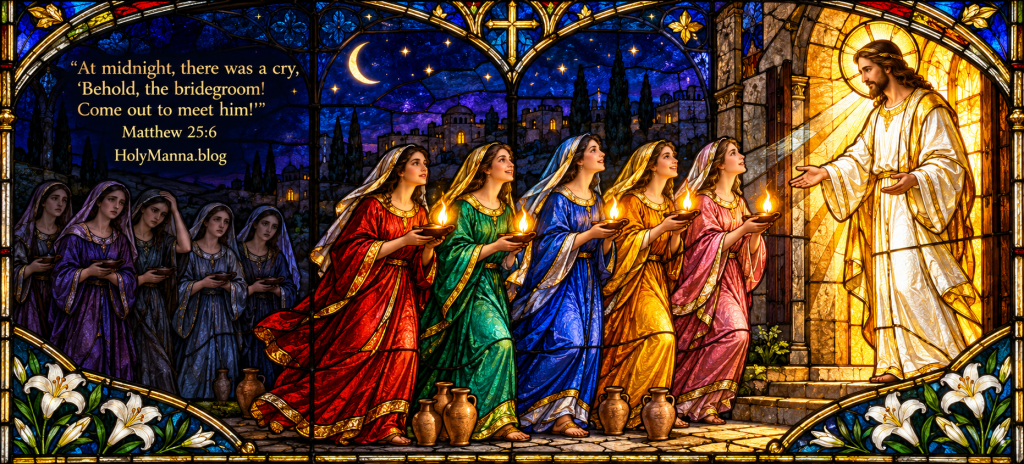
Verse 6: “At midnight, there was a cry, ‘Behold, the bridegroom! Come out to meet him!’”
Midnight is the hour nobody expects. The cry is sudden and public, like the trumpet in the Second Reading.
Verse 7: “Then all those virgins got up and trimmed their lamps.”
Everyone rises to give an account. The Fathers saw here the resurrection and the moment each soul examines what it has to show.
Verse 8: “The foolish ones said to the wise, ‘Give us some of your oil, for our lamps are going out.’”
Only now do the foolish discover the problem. Their oil is gone precisely when it matters most.
Verse 9: “But the wise ones replied, ‘No, for there may not be enough for us and you. Go instead to the merchants and buy some for yourselves.’”
This refusal troubles many readers, but the Fathers understood it. Good works cannot be transferred at the judgment. Chrysostom even identified the merchants: the poor, from whom the oil of mercy is purchased during life.
Verse 10: “While they went off to buy it, the bridegroom came and those who were ready went into the wedding feast with him. Then the door was locked.”
Readiness is the only qualification named, and the locked door says plainly that there is a moment after which it is too late.
Verse 11: “Afterwards the other virgins came and said, ‘Lord, Lord, open the door for us!’”
The double “Lord, Lord” echoes the Sermon on the Mount, where Jesus warned that saying it is not enough.
Verse 12: “But he said in reply, ‘Amen, I say to you, I do not know you.’”
To be known by the Bridegroom is to have lived in friendship with Him. A lamp with no oil is a profession of faith with no love.
Verse 13: “Therefore, stay awake, for you know neither the day nor the hour.”
The moral is not anxiety but vigilance. Since the hour is unknown, the only safe plan is readiness at every hour.
Teachings
Saint Augustine preached an entire sermon on this parable: “In the girded loins is virginity; in the burning lamps good works” (Sermon 93). He identified the oil with the charity of 1 Corinthians 13: “This, that is charity, is that way above the rest, which is with good reason signified by the oil.” The foolish virgins worked for the wrong audience: “They sought for what they had been wont to seek for, to shine that is with others’ oil, to walk after others’ praises.” His closing line: “Watch with the heart, watch with faith, watch with hope, watch with charity, watch with good works.”
Saint John Chrysostom read the oil as mercy toward the poor. “By lamps here, He means the gift itself of virginity, the purity of holiness; and by oil, humanity, almsgiving, succor to them that are in need” (Homily 78 on Matthew). Saint Gregory the Great, as preserved in the Catena Aurea, added that the foolish lamps go out because works that looked bright to men are dimmed within at the coming of the Judge. Pope Benedict XVI gathered these threads at the Angelus of November 6th, 2011: “True wisdom is making the most of mortal life in order to do works of mercy, for after death this will no longer be possible.”
The Catechism connects the parable to daily prayer. “When Jesus insists on vigilance, he always relates it to himself, to his coming on the last day and every day: today. The bridegroom comes in the middle of the night; the light that must not be extinguished is that of faith: ‘Come,’ my heart says, ‘seek his face!’” (CCC 2730). On the locked door: “Death is the end of man’s earthly pilgrimage, of the time of grace and mercy which God offers him so as to work out his earthly life in keeping with the divine plan, and to decide his ultimate destiny” (CCC 1013). Saint Teresa of Ávila turned the parable into prayer: “Hope, O my soul, hope. You know neither the day nor the hour. Watch carefully, for everything passes quickly” (CCC 1821).
Reflection
The oil is charity, and charity is bought from the poor. Pick one work of mercy this week and do it without telling anyone: a meal for a struggling neighbor, a visit to someone lonely, a gift to a family in need. Go to Confession before the month is out; a lamp cannot burn in a soul in mortal sin. And make Augustine’s line a nightly examination. If the cry came at midnight tonight, would your lamp be burning on oil you actually have, or on the reputation of good works done for applause? What act of mercy have you been putting off because the Bridegroom seems delayed?
When the Cry Comes at Midnight
Put the 4 readings side by side and a single story emerges. It begins with a woman who rises before dawn and walks the streets looking for anyone who wants her. It continues with a man in the desert whose throat is dry and whose soul is drier, who discovers that his thirst is itself a kind of prayer. It passes through a grieving church in a Roman port city, learning for the first time that the dead in Christ are not lost but asleep, and that the trumpet will wake them. And it ends at midnight, with 10 lamps and a cry in the dark, and a door that opens for those who are ready.
The thread running through all of it is wisdom, and the wisdom of these readings is not cleverness. It is the practical love that looks ahead, that packs the oil, that buys mercy from the poor while there is still time. Saint Augustine said the oil is charity, and charity cannot be borrowed. Saint Paul said the Lord Himself will come down with a word of command. Saint Teresa said to hope and to watch, because everything passes quickly. The Catechism says the Bridegroom comes on the last day and every day: today.
So the call of this Sunday is simple and urgent. Seek Wisdom at dawn. Thirst for God through the night. Grieve with hope, and console others with the promise of the resurrection. And keep the lamp lit with real oil: prayer, Confession, the Eucharist, and quiet works of mercy done for an audience of One. The Bridegroom is coming. The only question the parable leaves open is whether the lamp will be burning when He does.
Engage With Us!
Share your reflections in the comments below. These readings touch something everyone has felt: the long wait, the thirst, the grief, and the hope that holds them together. Your story of how they landed in your life may be exactly what another reader needs.
- The Book of Wisdom 6:12-16 promises that whoever watches for Wisdom at dawn “shall find her sitting by his gate.” What would it look like for you to give Wisdom the first minutes of your day this week?
- Psalm 63 2-8 begins with a soul thirsting “like the earth, parched, lifeless and without water.” What are you actually thirsting for right now, and how is God inviting you to bring that thirst to Him?
- 1 Thessalonians 4:13-18 commands Christians to “console one another with these words.” Who in your life is grieving, and how could you share the hope of the resurrection with them this month?
- Matthew 25:1-13 ends with the Bridegroom saying, “I do not know you.” What is one work of mercy that would add oil to your lamp before the week is over?
- Taken together, these readings describe a heart that seeks, thirsts, hopes, and stays awake. Which of those 4 movements is weakest in your spiritual life right now, and what is one step you can take to strengthen it?
A life of faith is not a nervous watch for a stern judge. It is a lamp kept burning out of love for a Bridegroom who is already on His way. Keep seeking Him at dawn, keep thirsting for Him at night, and do everything, large and small, with the love and mercy Jesus taught. He is coming, and He wants to find the light on.
Sacred Heart of Jesus, we trust in You!
Immaculate Heart of Mary, pray for us!
Saint Michael the Archangel, defend us in battle!
Follow us on YouTube, TikTok, Instagram and Facebook for more insights and reflections on living a faith-filled life.


Leave a Reply