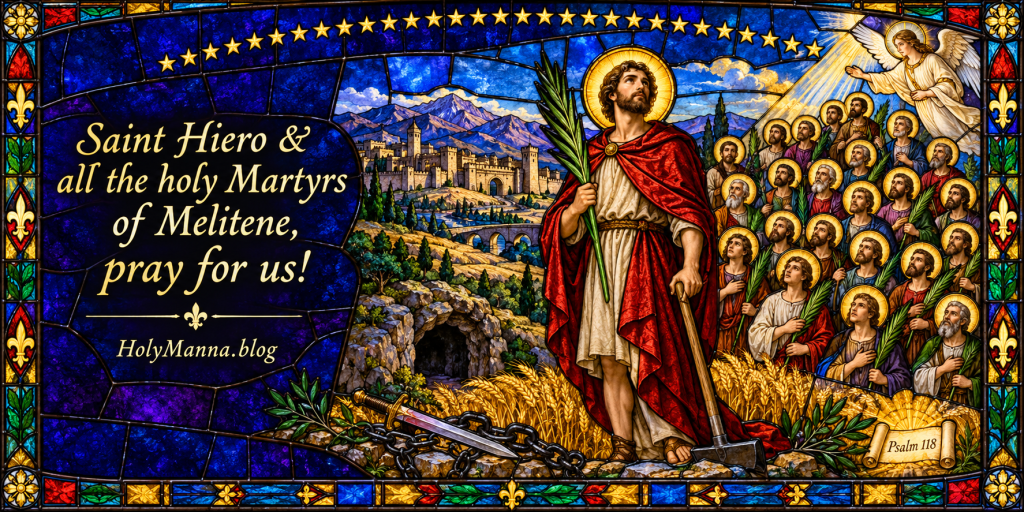
An Army God Recruited for Himself
On November 7th, the Roman Martyrology commemorates Saint Hiero and his companions, a band of thirty-three martyrs who were put to death at Melitene in Roman Armenia during the persecution of the emperor Diocletian. The Latin sources call him Hiero; the Greek sources that preserve his story call him Hieron. He was not a bishop, not a priest, not a monk, and not a scholar. He was a farmer from Cappadocia, a layman with calloused hands and a widowed world of responsibilities, and the empire wanted his strength for its army. God wanted it for something greater. His story, and the story of the thirty-two men who died beside him, is one of the oldest kinds of stories the Church tells: ordinary men asked to burn a pinch of incense to false gods, who decided that their souls were not for sale at any price.
The Church has always treasured such accounts. The Catechism teaches that “Martyrdom is the supreme witness given to the truth of the faith: it means bearing witness even unto death” (CCC 2473). The martyrs of Melitene are venerated on the same November date by the Catholic Church in the Roman Martyrology and by the Christian East, which means these thirty-three men belong to the undivided inheritance of the first centuries, a shared treasure from the age when the Church was young, illegal, and unafraid. Their witness comes from roughly the year 290, with some traditions placing it closer to 298, in a border city of the Roman Empire that is today Malatya in eastern Turkey.
A Son of Cappadocia and His Blind Mother
Hiero was born in Tyana, a city of southern Cappadocia in Asia Minor, in the second half of the 3rd century. The accounts that survive say little about his father, but they say a great deal about his mother. Her name was Stratonika, she was devout, and she was blind. Hiero was raised by her in the Christian faith from childhood, and the tradition remembers him as a kindly and good Christian long before anyone thought of him as a hero. His was not a dramatic conversion story; it was something quieter and in some ways harder, a faith received in infancy and kept faithfully through all the unglamorous years of adult life.
He worked the land. The sources describe him as a husbandman of great bodily strength and nobility of soul, a man known in his region for physical power and dexterity. And he was a devoted son. With his mother unable to see, Hiero served her with what the tradition calls true filial love, structuring his life around her care. The Catechism teaches exactly this duty: “As much as they can, they must give them material and moral support in old age and in times of illness, loneliness, or distress” (CCC 2218). Before Hiero ever confessed Christ before a governor, he confessed Christ in the daily, hidden fidelity of a son caring for a blind widow. Holiness was already at work in him at the kitchen table and in the field, long before it was tested in the arena of public persecution.
The test came under the co-ruling emperors Diocletian and Maximian, who reigned from 284 to 305. A military detachment under a commander named Lysias was sent into Cappadocia with a double mission: to stamp out Christianity in the region and to conscript strong, healthy men into the imperial army. Hiero, famous for his strength, was exactly the kind of recruit Lysias wanted. But Hiero refused, and the tradition gives two reasons. He could not abandon his helpless mother, and he knew that a soldier of Rome would be compelled to offer sacrifice to idols. For a Christian, that second requirement was not a formality. It was apostasy.
What happened next is one of the most vivid scenes in the tradition. Soldiers came to seize him while he was at work digging in his field, and Hiero, armed with nothing but his wooden farm tool, drove off the entire armed party, which fled in fear of his strength. He then hid in a cave with eighteen other Christians. Lysias, unwilling to lose soldiers storming a cave defended by such a man, lifted the siege on the advice of Hiero’s friend Cyriacus. Cyriacus then persuaded Hiero not to resist the authorities any further, and Hiero was taken with the other conscripts toward the city of Melitene. One strand of the tradition adds that he ultimately went of his own free will, ready to confess Christ openly before the governor. Both framings agree on the essential point. The man who could scatter soldiers with a farm tool chose, in the end, not to fight. His strength would be spent another way.
The Vision That Turned a Refusal into an Offering
The accounts of Saint Hiero record no healing miracles or wonders worked by his hands during his lifetime, and honesty requires saying so plainly. What the tradition records instead is a single, decisive intervention of God, and it came in the form of a vision. According to the traditional account, while Hiero was on the road to Melitene, a man clothed in a brilliant white garment appeared to him by night and said: “Behold, Hieron, I proclaim salvation to you: you shall not wage war for an earthly king, but for the Heavenly King you will complete your struggle, and you shall soon come to Him to receive honor and glory.” The tradition says Hiero’s heart was filled with inexpressible joy. This vision comes down through the ancient acts and the synaxaria rather than through verifiable historical documentation, and it is presented here as the tradition hands it down.
Yet notice what the vision accomplished in the story. It transformed a man’s refusal into an offering. Hiero had been saying no: no to conscription, no to leaving his mother, no to idols. The vision taught him what he was saying yes to. He was not deserting an army; he was enlisting in a greater one. That reframing is deeply biblical. Saint Paul tells Timothy to “Bear your share of hardship along with me like a good soldier of Christ Jesus” (2 Timothy 2:3). The Church has never despised soldiers; she has canonized many. What she condemns is idolatry, and The Catechism remembers that the earliest Christians faced exactly this test: “Many martyrs died for not adoring ‘the Beast,’ refusing even to simulate such worship” (CCC 2113). That refusal even to pretend was the precise line Hiero would not cross, and the Church still teaches the principle behind his stand: “We must obey God rather than men” (Acts 5:29, cited in CCC 2242).
At Melitene, Hiero was not alone. Thirty-two other men stood with him, and the synaxaria preserve their names: Hesychius, Nicander, Athanasius, Mamas, Barachius, Callinicus, Theogenes, Nikon, Longinus, Theodore, Valerius, Xanthius, Theodoulus, Callimachus, Eugene, Theodochus, Ostrychius, Epiphanius, Maximian, Ducitius, Claudian, Theophilus, Gigantius, Dorotheus, Theodotus, Castrichius, Anicletus, Themelius, Eutychius, Hilarion, Diodotus, and Amonitus. Most of them are nothing more to history than a name on a list. That is its own quiet lesson. Heaven keeps a fuller record than earth does, and the Lord who promised that “Everyone who acknowledges me before others I will acknowledge before my heavenly Father” (The Gospel of Matthew 10:32) has not forgotten a single one of them. In prison, the tradition says, Hiero strengthened these companions in the faith, the farmer becoming a shepherd to frightened men in their final days.
Four Days Between the Sword and the Crown
In Melitene, Lysias assembled the gathered conscripts and soldiers and ordered them to offer sacrifice to the pagan gods. Hiero and thirty-two others refused and openly confessed their faith in Christ. The response was swift and brutal. Lysias ordered the martyrs beaten, and he ordered Hiero mutilated; the accounts vary on the detail, with some saying his right hand was cut off and others that his arm was severed at the elbow. It was a calculated cruelty aimed at the very thing that had made Hiero famous, the strength of his hands. After prolonged tortures, the thirty-three were thrown into prison barely alive. There they waited four days. The tradition records that through their sufferings the martyrs chanted the psalm: “Give thanks to the LORD, for he is good, for his mercy endures forever” (Psalm 118:1). Men with broken bodies, singing gratitude in the dark.
Within those four days the tradition places one of the most sobering stories attached to this martyrdom. A kinsman of Hiero named Victor had been arrested with the group. On the day before the tortures, overcome by terror, Victor went secretly to the prison warden and begged to have his name removed from the list of the condemned, offering the warden his land in payment. The warden agreed and released him. But the story says that upon returning home, Victor died of natural causes at the very moment Hiero and his companions were dying for Christ. He lost his land, his companions, and his crown, all in a single bargain. This story cannot be verified. The tradition tells it not to gloat over a weak man but to warn every generation of a truth the Lord himself spoke: “What profit is there for one to gain the whole world and forfeit his life?” (The Gospel of Mark 8:36).
Four days after their torture, around the year 290, with some traditions placing it closer to 298, the thirty-three were led outside the city of Melitene and beheaded. The Church does not flinch from such details, because she knows what they mean. The Catechism says: “The Church has painstakingly collected the records of those who persevered to the end in witnessing to their faith. These are the acts of the Martyrs. They form the archives of truth written in letters of blood” (CCC 2474). The martyrs of Melitene are a page in those archives. Their deaths were not a defeat; they were the keeping of a promise made to every believer who endures: “Be faithful until death, and I will give you the crown of life” (Revelation 2:10).
A Head Worth Its Weight in Gold
What happened after the executions shows how fiercely the early Christians loved their martyrs. According to the tradition, when the Christians of the region sought to recover Hiero’s head, the governor demanded its weight in gold. A wealthy and devout Christian named Chrysanthus paid the full price and ransomed the martyr’s head. When the persecutions finally ceased, Chrysanthus built a church on the very place where the holy martyrs had been executed and enshrined the head within it. The bodies of all the executed saints, the tradition adds, were secretly buried by the Christians of Melitene.
One relic made a longer and more tender journey. The tradition records that two men, Anthony and Matronian, hid Hiero’s severed hand and carried it back to Tyana, to his blind mother Stratonika. Receiving the hand of the son who had cared for her all his life, she wept over it with words the tradition has preserved: “O my beloved son, I gave birth to you whole, and now I have only one part of you!” It is one of the most human moments in all the martyr traditions, a mother’s grief and a mother’s pride inseparably joined. She had raised him in the faith, and the faith she gave him had cost her everything and gained him everything. These relic stories come from the ancient acts and cannot be verified.
A further story carries the martyrs’ memory into the age of the Christian empire. It holds that in the reign of the emperor Justinian in the 6th century, during the construction of the church of Hagia Eirene, Holy Peace, the relics of the martyrs were uncovered and found incorrupt. This story cannot be verified. What can be said with confidence is that the veneration of these martyrs endured. The Christian East still celebrates them on November 7th with its own ancient hymns for the feast, and the Roman Martyrology has carried their names on the same date in the West, listing Hiero together with Nicander and Hesychius and their thirty companions, martyred under the governor Lysias in the reign of Diocletian. Melitene itself, today the Turkish city of Malatya, was a notable center of early Christianity, and though no major pilgrimage survives at the site, the Church’s liturgical memory is itself a kind of perpetual pilgrimage. The Catechism explains why the Church refuses to let such memories die: “When the Church keeps the memorials of martyrs and other saints during the annual cycle, she proclaims the Paschal mystery in those ‘who have suffered and have been glorified with Christ’” (CCC 1173). And the saints are not merely remembered; they are active. Of those who dwell in heaven, The Catechism teaches, “They do not cease to intercede with the Father for us” (CCC 956). Thirty-three intercessors, most of them known only by name, still stand before the throne on behalf of the Church that remembers them.
The Decisive Moment Comes for Everyone
The story of Saint Hiero is a story about strength, and about the surprising place where real strength lives. Here was a man who could drive off armed soldiers with a farm tool, and his greatest act was to stop fighting. He discovered that the strength God wanted from him was not in his arms but in his will, the strength to stand in a public square, surrounded by armed men, and refuse to pretend. Many people today will never be asked to die for the faith, but nearly everyone is asked, with some regularity, to simulate a little worship of the idols of the age, to laugh along, to stay quiet, to burn a small pinch of incense to whatever the culture has crowned. Hiero’s witness says that the small pinch is never small. Where in your life are you being asked to simulate agreement with something you know is false?
His story is also a story about hidden fidelity. Hiero was a saint in his field and at his mother’s side long before he was a martyr. The years of caring for blind Stratonika were not a prelude to his sanctity; they were his sanctity, the long obedience that made the final obedience possible. Anyone caring for an aging parent, a sick spouse, or a demanding household is standing exactly where Hiero stood for most of his life. Who has been entrusted to your care, and do you treat that care as a burden or as a path to heaven?
And his story is a story about the decisive moment, the lesson the tradition draws from poor Victor. There are moments when eternity presses into a single choice, and no one is told in advance which moment it will be. The only preparation is a habit of daily faithfulness, because people do not usually rise to the occasion; they fall back on their formation. The Catechism puts the standing obligation plainly: “The disciple of Christ must not only keep the faith and live on it, but also profess it, confidently bear witness to it, and spread it” (CCC 1816). Practical ways to live this are close at hand. A person can make a nightly examination of conscience that asks one honest question about where courage failed during the day. A family can speak the names of the saints and martyrs aloud at the dinner table so that children grow up knowing that faith costs something and is worth everything. A believer can resolve, in advance and in prayer, never to deny the faith in small social moments, because the sacrifice to idols rarely announces itself with an altar and a governor. And anyone facing a frightening act of fidelity can borrow the martyrs’ own prayer from the prison of Melitene, giving thanks to the Lord whose mercy endures forever, even before the outcome is known. If the decisive moment came today, what would your habits have prepared you to do?
Engage With Us!
The martyrs of Melitene were ordinary men, farmers and conscripts, and heaven now calls them by name. Their story belongs to every believer who has ever wondered whether quiet, daily faithfulness really matters. Readers are warmly invited to share their thoughts, their questions, and their own reflections on Saints Hiero and Companions in the comments below. To help the conversation begin, here are some questions to ponder:
- Saint Hiero spent years in hidden faithfulness, caring for his blind mother, before his public witness. What hidden duty in your life might God be using to prepare you for something greater?
- Hiero refused even to simulate worship of idols. What are the idols of today’s culture, and where are you most tempted to offer them a small, convenient pinch of incense?
- The tradition contrasts Hiero with his kinsman Victor, who traded his crown for safety and lost both. Has fear ever talked you out of a moment of witness, and what did you learn from it?
- Thirty-two companions died beside Hiero, most of them remembered only by name. How does it change your view of discipleship to know that heaven treasures the faithful whom history forgets?
- The martyrs sang Psalm 118 in their prison: “Give thanks to the LORD, for he is good.” What would it look like for you to practice gratitude in the middle of suffering rather than after it ends?
May the witness of Saints Hiero and Companions stir up courage in every heart that reads their story. The same Lord who met a Cappadocian farmer on the road to Melitene walks beside his people still, and he asks for the same undivided heart. Live this day, and every day, with faith that refuses to be simulated, with gratitude that sings even in prison, and with everything done in the love and mercy that Jesus taught us.
Saint Hiero and all the holy Martyrs of Melitene, pray for us!
Follow us on YouTube, TikTok, Instagram and Facebook for more insights and reflections on living a faith-filled life.


Leave a Reply