The Monk Who Crossed the Sea:
Every year on the Tuesday after Pentecost, tens of thousands of pilgrims pour into the small Luxembourg town of Echternach and do something that happens nowhere else on earth. Linked arm to arm in long rows, they hop and skip through the medieval streets to the music of a centuries-old melody, step by step, until they reach the crypt of a basilica and file past the tomb of a monk who died in the year 739. That monk is Saint Willibrord, the Apostle of the Frisians, the first Bishop of Utrecht, and one of the great missionary saints of the early Church. Celebrated on November 7th, he is the patron saint of Luxembourg, of the Netherlands, and of the Archdiocese of Utrecht, and he is traditionally invoked against epilepsy and convulsions, an intercession long connected to the prayerful hopping procession held in his honor. Nearly thirteen centuries after his death, entire nations still trace their faith back to this one quiet Englishman who got into a boat with eleven companions and sailed toward people who had never heard the name of Jesus Christ. The Catechism teaches that the Church is missionary by her very nature, because she “has her origin in the mission of the Son and the mission of the Holy Spirit” (CCC 850). Saint Willibrord lived that truth with his whole life, and his story reads like an adventure precisely because the Gospel is one.
A Boy Given to God Before He Could Walk
Willibrord was born around the year 658 in Northumbria, in the north of England, barely two generations after that land had itself been evangelized. His father, Wilgils, was a devout Saxon layman who eventually withdrew from the world altogether, building a small hermitage dedicated to Saint Andrew on a headland by the river Humber, where he lived out his days in prayer and penance and came to be honored as a saint himself. Holiness, in other words, ran in the family. Alcuin of York, the great scholar of Charlemagne’s court and a blood relative of Willibrord, wrote The Life of Saint Willibrord around the year 796 and relates that before the boy’s birth his mother dreamed she saw a new moon grow until it reached its fullness, a sign, the vita says, of the light her son would one day carry into darkness.
While still a small child, Willibrord was entrusted as an oblate to the Abbey of Ripon near York, where he was formed under the towering figure of Saint Wilfrid and embraced the Benedictine life. The Catechism describes religious life as a consecration that “is a sign which can and ought to attract all the members of the Church to an effective and prompt fulfillment of the duties of their Christian vocation” and which manifests the Church’s own longing for her Bridegroom (CCC 926, quoting the tradition of the Church on religious consecration as belonging to her life and holiness). Willibrord drank deeply from that well. At the age of 20, hungry for deeper learning and a stricter school of holiness, he crossed to Ireland, the land of saints and scholars, and spent 12 years at the monastery of Rathmelsigi under Saint Egbert. The exact location of Rathmelsigi is debated by historians, with older sources pointing to County Louth and modern scholarship favoring Clonmelsh in County Carlow, but what is certain is what happened there. In the silence of Irish monasticism, shaped by the Psalms, by lectio divina, and by the example of monks who treated exile for Christ as a privilege, Willibrord was ordained a priest around the age of 30 and heard the call that would define his life. Saint Egbert had long burned to evangelize the pagan peoples across the North Sea but was prevented from going himself. So in the year 690, he sent Willibrord in his place, together with 11 companions, 12 men in all, an apostolic number chosen on purpose, to Frisia, the coastal territory of the modern Netherlands, at the invitation of Pepin of Herstal, the Frankish ruler who had just taken part of that land from its pagan ruler Radbod. Willibrord would never live in England again.
Twelve Men in a Boat and a Continent to Win
What Willibrord found in Frisia was mission territory in the fullest sense, a people devoted to the old Germanic gods, sacred groves, sacred wells, and rulers for whom religion and political loyalty were welded together. He understood from the beginning that this work needed to be rooted in the heart of the Church, not freelanced. Twice he traveled to Rome. On the second journey, at Pepin’s request, Pope Sergius I consecrated him a bishop in the Church of Saint Cecilia in Trastevere in November of 695, gave him the pallium, and bestowed on him the name Clement. Sources differ on whether the consecration took place on November 21st or November 22nd of that year, but the meaning is not in dispute. Willibrord’s mission carried the full apostolic authority of the See of Peter, a living picture of what the Catechism teaches, that bishops receive “the mission to teach all peoples, and to preach the Gospel to every creature” (CCC 888) and that the mandate to evangelize is addressed to the whole Church (CCC 849).
Returning north, he established his see at Utrecht, where he built a church in honor of the Holy Redeemer as his cathedral and founded a monastery to raise up local clergy, because he was not interested in a mission that would die with him. In 698 came the foundation that would carry his name through history. Saint Irmina, abbess and daughter of King Dagobert II, gave him her villa at Echternach on the river Sûre, in what is now Luxembourg, and there Willibrord established the great Benedictine Abbey of Echternach, the place he loved most, the place he would retreat to again and again to care for his own soul, and the place where he would one day choose to be buried. His zeal did not stop at the borders Pepin could protect. He pushed into Denmark, where the hard-hearted King Ongendus gave him no welcome, yet even that apparent failure bore fruit. Willibrord purchased 30 Frisian boys who were being held as slaves, instructed them in the faith, baptized them, and brought them home to be raised as Christians, turning a slave market into a seedbed of the Church. He preached between the Maas and the Waal, in North Brabant, in Gelderland, and as far as Thuringia. In 714 he baptized the infant son of Charles Martel, and Alcuin relates that at that baptism Willibrord prophesied the child would surpass all his ancestors in glory. That child was Pepin the Short, who would become the first Carolingian king and the father of Charlemagne.
Alcuin, who knew the family memory of the man, left a portrait of Willibrord that has nothing stiff about it. He describes the saint as “comely of face, cheerful in spirit, wise in counsel, pleasing in speech, grave in character and energetic in everything he undertook for God.” Cheerful in spirit. That detail matters, because the miracles Alcuin records show exactly that warm, human holiness. On one journey, Willibrord met a band of poor beggars and had nothing to offer them but the four small flasks of wine his companions carried for the road. Alcuin relates that the saint blessed the flasks in the name of Him who at the marriage feast of Cana changed water into wine, recalling the sign Jesus worked in The Gospel of John, and about 40 people drank their fill from those little bottles. On another occasion, lodging with the steward of a friend, he found only one nearly empty cask of wine in the storehouse. He thrust his staff into it with a blessing and went his way, and that night, the vita says, the wine rose to the brim and overflowed. When a deadly pestilence struck the convent of Horrea, where Saint Irmina was abbess, Alcuin relates that the sickness ceased after Willibrord blessed water, had the houses sprinkled with it, and offered the Holy Sacrifice of the Mass there. These accounts come from a hagiography written within living memory of the saint, and the Church has always read such stories with both reverence and sobriety. They are told here as Alcuin told them, as the testimony of the generation that knew him, and they all point in one direction. God worked through this man, and the instruments God used were the ones He still uses, blessing, prayer, water, and the Mass.
Staring Down a Pagan King
If the miracles show Willibrord’s tenderness, his hardships show his spine. Sailing back from the failed Danish mission, he was driven by a storm onto an island the pagans called Fositesland, generally identified with Heligoland, a place so sacred to the god Fosite that no one dared kill an animal there, eat anything that grew there, or draw water from its spring except in absolute silence. Willibrord looked at all of it and saw souls enslaved to a lie. The Catechism is blunt about what he was confronting, teaching that idolatry “consists in divinizing what is not God” and that man commits idolatry whenever he honors a creature in place of the Creator (CCC 2113). So the bishop acted. He baptized three people aloud in the forbidden spring, with the water of the sacrament splashing in the sacred silence, and had some of the sacred cattle slaughtered to feed his hungry men. The islanders expected the god to strike them all dead on the spot. When nothing happened, word was sent to Radbod, the pagan ruler of the Frisians, who in his fury ordered lots to be cast three times a day for three days to choose a victim to appease the offended god. One of Willibrord’s companions was taken and martyred, dying for Christ on that island, one of the countless hidden martyrs of the missions. The Catechism teaches that martyrdom is “the supreme witness given to the truth of the faith,” the testimony of one who bears witness “even unto death” (CCC 2473).
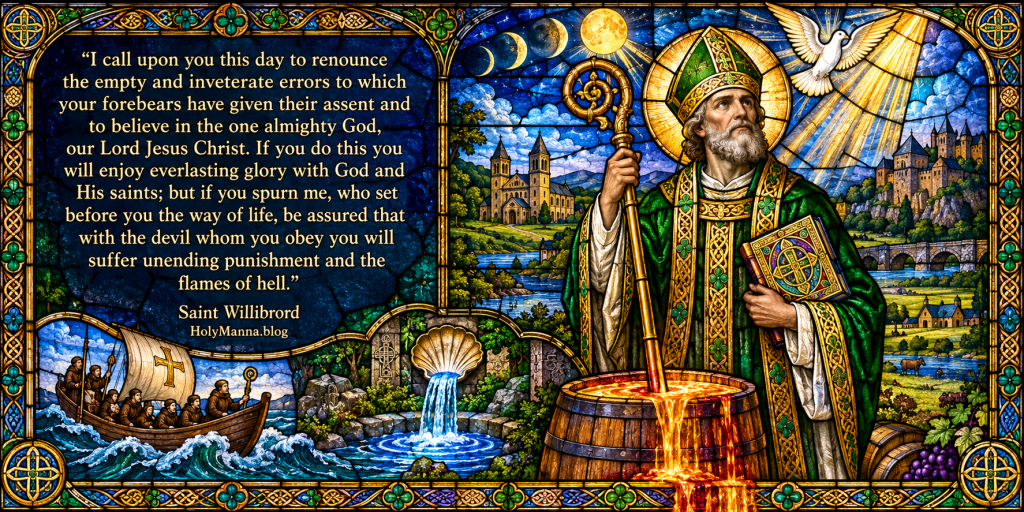
Then Willibrord himself was summoned before Radbod, and what happened next is one of the great recorded confrontations of the missionary age, preserved by Alcuin. With unruffled calm, the bishop looked at the man who had just killed his companion and said, “The object of your worship, O King, is not a god but a devil, and he holds you ensnared in rank falsehood in order that he may deliver your soul to eternal fire. For there is no God but one, who created heaven and earth, the seas and all that is in them; and those who worship Him in true faith will possess eternal life. As His servant I call upon you this day to renounce the empty and inveterate errors to which your forebears have given their assent and to believe in the one almighty God, our Lord Jesus Christ.” He went on to set before the king the choice between everlasting glory with God and His saints and the punishment of hell with the devil the king served. Radbod, astonished, answered, “It is clear to me that my threats leave you unmoved and that your words match your deeds.” He did not convert, but he sent the bishop back to Pepin with honor. Willibrord had looked a hostile ruler in the eye, with a fresh martyrdom behind him, and had not softened a single syllable of the Gospel.
The danger followed him elsewhere. At Walcheren, in the modern Netherlands, Willibrord smashed an idol of the old religion, and its enraged custodian struck the saint on the head with a sword. Alcuin relates that Willibrord was unharmed, and when his companions rushed forward to kill the attacker, the bishop rescued the man from their hands and forbade any retaliation, returning mercy for violence. The vita adds that the man was seized by a demon and died three days later. The hardest blow of all, though, came not from a sword but from history. When Pepin of Herstal died in December of 714, Radbod rose up and by 716 had retaken all of Frisia. He burned the churches Willibrord had built, raised pagan shrines in their place, and killed many of the missionaries. Decades of labor went up in smoke, and Willibrord, now nearing 60, was forced to withdraw to Echternach and watch his life’s work die. He did not despair, and he did not quit. When Radbod died in 719, the old bishop went straight back under the protection of Charles Martel and began rebuilding everything, church by church, soul by soul. For about three years he was joined in this work by a younger English missionary named Winfrid, whom the world remembers as Saint Boniface, the future Apostle of Germany, so that two of the greatest missionaries in the history of the Church labored side by side in those recovered fields, and the conversions, the sources say, were numberless. Willibrord was never martyred. His was the slower martyrdom of 50 years of preaching, shipwreck, exile, loss, and starting over, the daily perseverance the Catechism calls the endurance of faith, by which the disciple must not only keep the faith and live on it but also profess it and confidently bear witness to it (CCC 1816).
The Tomb That Would Not Stay Quiet
Willibrord spent his final years at his beloved Echternach and died there on November 7th, 739, at about 81 years of age, after roughly half a century of mission. At his own request he was buried in the oratory of the abbey. Alcuin relates a striking detail about the burial itself, that the stone sarcophagus prepared for the saint proved six inches too short for his body, yet was found to accommodate him perfectly, a wonder those present received as a sign from God. That story comes from the hagiography and is told here as Alcuin told it. What is beyond dispute is what happened next. The faithful began venerating Willibrord as a saint almost immediately, and Alcuin, writing within 60 years of the death, testifies that miracles and healings were already being reported at the tomb in his own day. Echternach became a place of pilgrimage from the moment of the burial and has never stopped being one. The Catechism teaches that the religious sense of the Christian people has always found expression in forms of piety surrounding the Church’s sacramental life, “such as the veneration of relics, visits to sanctuaries, pilgrimages, processions” (CCC 1674), and few places on earth embody that paragraph like Echternach.
On October 19th, 1031, the relics of the saint were solemnly placed in a shrine beneath the main altar of the newly built Romanesque basilica. Another solemn translation took place on June 4th, 1906, a celebration of staggering scale that included 15,085 dancers, 3,045 singers, 426 musicians, and 136 priests. Dancers, because Echternach honors its founder in a way found nowhere else in the world. Every Whit Tuesday, the Tuesday after Pentecost, the famous Hopping Procession of Echternach, the Sprangprëssioun, fills the town. Documented since around the year 1100, and taking a more defined form in the later Middle Ages when it was offered as a prayer against plague and illness, the procession gathers tens of thousands of pilgrims who link arms in rows and hop, step by step, through the streets to an ancient melody, praying with their whole bodies, until the procession pours into the basilica and down into the crypt, where the pilgrims pass one by one before the tomb of Saint Willibrord. It is the last traditional dancing procession in Europe, and on November 16th, 2010, it was inscribed on the UNESCO Representative List of the Intangible Cultural Heritage of Humanity. The connection between the procession and prayer for those suffering from epilepsy and convulsions is the root of the saint’s traditional patronage of those afflictions.
The site itself has shared in the dramas of history. In 1939, for the 1200th anniversary of the saint’s death, Pope Pius XII raised the abbey church to the rank of minor basilica. On December 26th, 1944, during the Battle of the Bulge, retreating German troops blew up part of the basilica, yet the 8th-century crypt holding Willibrord’s tomb came through essentially unscathed, and the rebuilt basilica was reconsecrated in 1953. Pilgrims today still hop to a tomb that survived a world war. Willibrord’s reach extends far beyond one town. He is venerated as the patron saint of Luxembourg and of the Netherlands, honored as the apostle of the Benelux countries, and remembered as the founder of the Church in Utrecht, where his successors sit to this day. His feast is kept on November 7th throughout the universal Church, and on November 29th in England by an arrangement of Pope Leo XIII. A few precious physical traces of the man survive as well. The Calendar of Saint Willibrord, preserved in Paris, contains a marginal note in the saint’s own handwriting recording dates from his own life, the only writing that can be attributed to him with certainty, and an ancient Irish Gospel book associated with him, likely carried from Ireland in that boat in 690, survives in the same library. The communion of saints, the Catechism reminds us, means that the holy ones in heaven do not cease to intercede for those still on the journey (CCC 956), and the Low Countries have been asking Willibrord’s intercession without interruption for almost 1,300 years.
What a 7th Century Monk Says to a Restless Generation
It would be easy to file Saint Willibrord under ancient history, a man of boats and kings and pagan islands. Look closer, and his life lands uncomfortably close to home. Willibrord left everything familiar, his country, his language, his comfort, because he believed the words of Jesus in The Gospel of Matthew, “The harvest is abundant but the laborers are few” (Mt 9:37), and he refused to let someone else answer for him. Most people today are not called to cross the North Sea, but every baptized person is called to mission, because the Catechism teaches that the vocation of the laity is to “seek the kingdom of God by engaging in temporal affairs and directing them according to God’s will” (CCC 898), and that lay people have the duty “to work so that the divine message of salvation may be known and accepted by all men throughout the earth” (CCC 900). The office, the group chat, the gym, the family dinner table, these are the Frisias of the present day, full of people who have never really heard the Gospel, or who heard a caricature of it and walked away. Who in your daily life has never seen what an actual, joyful, serious Christian looks like up close?
Willibrord also teaches the rhythm that keeps a soul alive. For all his activity, he returned again and again to Echternach, to silence, to prayer, to the care of his own soul, because he knew that no one can give what he does not have. He teaches courage without cruelty. Before Radbod he would not soften the truth, yet at Walcheren he physically shielded the man who had just tried to kill him. Conviction and mercy, in the same heart, at the same time. And he teaches perseverance after ruin. At nearly 60 he watched everything he had built burn, and his response was to wait on God, outlast the storm, and rebuild. Anyone who has watched a career collapse, a relationship fail, a parish empty out, or their own spiritual life go up in flames knows exactly what that moment feels like. When your work for God falls apart, do you conclude that God has failed, or do you pick up the stones and build again? Practical steps flow naturally from his example. Choose one person this month and pray for their conversion by name, daily, the way Egbert prayed for Frisia. Build a small Echternach into the week, a fixed appointment of silent prayer that does not move for anything. Practice one act of deliberate mercy toward someone who has wronged you. And when the opportunity comes to state what the Church actually teaches, say it plainly and charitably, without apologizing for it, remembering a bishop who said it to a king’s face. What is the one conviction of the faith you are most tempted to keep quiet about, and what would it cost you, really, to speak it with love?
Engage With Us!
Saint Willibrord crossed a sea for the Gospel, stared down a king, buried a martyred friend, lost everything, and rebuilt it all, and a basilica full of hopping pilgrims still thanks God for him every year. Now it is your turn to join the conversation. Share your thoughts and reflections in the comments below, and consider these questions as you pray with his story this week.
- Saint Willibrord was formed for 32 years, at Ripon and in Ireland, before his mission began. Where is God forming you right now, and are you treating this season as preparation or as a waiting room?
- Before Radbod, Willibrord spoke the whole truth with unruffled calm, even after losing a companion to martyrdom. Where do you feel pressure to water down your faith, and what would courageous charity look like there?
- At Walcheren, Willibrord protected the very man who attacked him. Who in your life has hurt you, and what would it mean to answer that hurt with mercy this week?
- At nearly 60, Willibrord watched his life’s work destroyed and then rebuilt it. What ruin in your own life might God be inviting you to rebuild with Him instead of mourning without Him?
- The pilgrims of Echternach pray with their whole bodies, hopping step by step to the tomb of the saint. What concrete, physical practice, a pilgrimage, a fast, kneeling in adoration, could pull your faith out of your head and into your whole life?
Saint Willibrord spent 50 years proving that one surrendered life can change the map of the faith. The same Holy Spirit who carried him across the North Sea lives in every baptized soul today. So go into your own Frisia, whatever it looks like, with his cheerfulness, his courage, and his stubborn hope, and do everything with the love and mercy that Jesus taught us.
Saint Willibrord, Apostle of the Frisians, pray for us!
Follow us on YouTube, TikTok, Instagram and Facebook for more insights and reflections on living a faith-filled life.


Leave a Reply