Saturday of the Thirty-first Week in Ordinary Time – Lectionary: 490
The Secret Hidden in a Thank You Note
Somewhere in a Roman prison around the year 62, a chained apostle picked up a pen to thank a small church for a care package, and Christians have been praying over that thank you note ever since. On this Saturday of the Thirty-first Week in Ordinary Time, November 7th, the Lectionary places the closing lines of Saint Paul’s Letter to the Philippians beside one of the most searching teachings on money in The Gospel of Luke, with Psalm 112 standing between them like a bridge.
The central theme uniting these readings is this: God Himself is the only true wealth, and money is merely a tool on loan and a test of the heart. Paul has learned the secret of contentment in hunger and abundance alike, because his treasure was never located in his circumstances. The psalmist paints the portrait of the man who fears the Lord, lends graciously, and gives lavishly to the poor, a man whose heart stays steadfast precisely because it clings to nothing that can be taken away. And Jesus, speaking just after the Parable of the Dishonest Steward, commands his disciples to convert passing wealth into eternal friendships, because “No servant can serve two masters.”
The world of these readings knew money intimately. Philippi was a proud Roman colony on a major trade road, full of veterans, merchants, and ledgers. Mammon was an everyday Aramaic word for property, the thing a person leans on for security. Both texts were addressed to people who paid bills, worried about the future, and felt the daily pull of wealth. That is exactly why they still read as if they were written this morning.
First Reading — Philippians 4:10-19
The Saint Who Learned to Need Nothing but God
Saint Paul wrote these lines from imprisonment, traditionally in Rome in the early 60s, to the first church he founded on European soil. Acts 16 tells that story: a riverside prayer meeting, a businesswoman named Lydia, a jailer converted at midnight. Philippi was a Roman colony of veterans and merchants, and its little church loved Paul fiercely. When news of his chains reached them, they sent a financial gift through a man named Epaphroditus, who nearly died making the delivery. This passage is Paul’s thank you note, and it doubles as a masterclass on the day’s central theme. Paul can receive money without craving it and lack money without fearing it, because his wealth was never money in the first place. His wealth is Christ.
Philippians 4:10-19
Brothers and sisters:
I rejoice greatly in the Lord
that now at last you revived your concern for me.
You were, of course, concerned about me but lacked an opportunity.
Not that I say this because of need,
for I have learned, in whatever situation I find myself,
to be self-sufficient.
I know indeed how to live in humble circumstances;
I know also how to live with abundance.
In every circumstance and in all things
I have learned the secret of being well fed and of going hungry,
of living in abundance and of being in need.
I have the strength for everything through him who empowers me.
Still, it was kind of you to share in my distress.You Philippians indeed know that at the beginning of the Gospel,
when I left Macedonia,
not a single church shared with me
in an account of giving and receiving, except you alone.
For even when I was at Thessalonica
you sent me something for my needs,
not only once but more than once.
It is not that I am eager for the gift;
rather, I am eager for the profit that accrues to your account.
I have received full payment and I abound.
I am very well supplied because of what I received from you
through Epaphroditus,
“a fragrant aroma,” an acceptable sacrifice, pleasing to God.
My God will fully supply whatever you need,
in accord with his glorious riches in Christ Jesus.
Detailed Exegesis
Verse 10: “I rejoice greatly in the Lord that now at last you revived your concern for me. You were, of course, concerned about me but lacked an opportunity.”
Paul rejoices in the Lord, not in the gift itself. The word translated “revived” is a gardening image, like a plant blooming again after winter. Notice his charity: he assumes the best about their delay, naming their lack of opportunity rather than any lack of love.
Verse 11: “Not that I say this because of need, for I have learned, in whatever situation I find myself, to be self-sufficient.”
The Greek word behind “self-sufficient” was a favorite of Stoic philosophers, who prized independence from circumstances. Paul baptizes the term. His sufficiency does not come from an iron will but from Christ. Just as important, he says he has learned it. Contentment is not a temperament a person is born with; it is a discipline acquired through trial.
Verse 12: “I know indeed how to live in humble circumstances; I know also how to live with abundance. In every circumstance and in all things I have learned the secret of being well fed and of going hungry, of living in abundance and of being in need.”
The phrase “learned the secret” uses initiation language that pagan mystery cults applied to their secret rites. Paul’s initiation happened in shipwrecks, prisons, and full tables alike. Strikingly, he treats abundance as something that must also be learned, because prosperity tests the soul as surely as poverty does.
Verse 13: “I have the strength for everything through him who empowers me.”
This beloved verse is often printed on athletic gear, but its original context is endurance, not achievement. Paul is saying that grace makes him equal to hunger, abundance, chains, and freedom. The strength is real, yet it is received, flowing moment by moment from the living Christ.
Verse 14: “Still, it was kind of you to share in my distress.”
Having insisted he needed nothing, Paul immediately honors the gift. The word for “share” is drawn from koinonia, the rich biblical term for communion. Their donation was not a transaction; it was a participation in his sufferings for the Gospel, which makes it a participation in Christ.
Verse 15: “You Philippians indeed know that at the beginning of the Gospel, when I left Macedonia, not a single church shared with me in an account of giving and receiving, except you alone.”
Paul borrows bookkeeping language, the ledger of debits and credits familiar to any Philippian merchant. Of all his churches, only Philippi held this account with him. Generosity, it turns out, has a memory, and the Apostle never forgot theirs.
Verse 16: “For even when I was at Thessalonica you sent me something for my needs, not only once but more than once.”
Their giving was a habit, not an impulse. While Paul labored in the larger city of Thessalonica, the smaller church kept quietly funding the mission. Much of the New Testament world was evangelized on the repeated sacrifices of ordinary believers like these.
Verse 17: “It is not that I am eager for the gift; rather, I am eager for the profit that accrues to your account.”
Here the ledger image turns heavenly. Paul wants their generosity to earn interest, credited not in denarii but in grace. The gift leaves their hands and starts working for them in eternity, which is precisely the logic Jesus will use in the day’s Gospel.
Verse 18: “I have received full payment and I abound. I am very well supplied because of what I received from you through Epaphroditus, ‘a fragrant aroma,’ an acceptable sacrifice, pleasing to God.”
“Full payment” echoes the wording of an ancient receipt, as if Paul were signing an invoice with a smile. Then the language suddenly ascends to the Temple. “A fragrant aroma” recalls the sacrifices of Genesis 8:21 and Exodus 29:18, and Ephesians 5:2 applies the same phrase to Christ’s own self-offering. Their donation was secretly a liturgy, rising to God like incense.
Verse 19: “My God will fully supply whatever you need, in accord with his glorious riches in Christ Jesus.”
The reading closes with one of Scripture’s great promises. The Philippians gave out of scarcity, and Paul assures them that God will supply their needs out of infinite riches. God is never outdone in generosity, and His measure is not the giver’s wallet but His own glory in Christ.
Teachings
Saint John Chrysostom preached directly on this passage in his Homilies on Philippians, Homily 15, and his opening line still startles: “almsgiving hath been introduced not for the sake of the receivers, but of the givers, for the latter are they which make the greatest gain.” He also warns that wealth tests virtue as sharply as poverty: “For as want inclines us to do many evil things, so too doth plenty.” And on verse 13 he insists that Paul claims nothing for himself: “The success is not mine own, but His who has given me strength.”
The Catechism grounds this same freedom. CCC 1723 teaches that “True happiness is not found in riches or well-being, in human fame or power,” but in God alone, the source of every good and of all love. And CCC 2547 observes soberly that “The Lord grieves over the rich, because they find their consolation in the abundance of goods.” Paul grieved over nothing, because his consolation was Christ.
Reflection
Contentment is learned the way Paul learned it, inside real circumstances rather than around them. Try naming your current season honestly, whether it feels like abundance or need, and then praying verse 13 over it word by word. Consider also keeping a ledger like Philippi’s: one concrete act of material generosity this week, offered deliberately to God as “a fragrant aroma.”
Which situation in life right now feels hardest to be content in, and what would it mean to invite Christ’s strength into it? Does abundance tempt the heart more subtly than need does? Who is the “Paul” that could be supported quietly and repeatedly this month?
Responsorial Psalm — Psalm 112:1-2, 5-6, 8-9
A Portrait of the Heart That Fears Nothing but Losing God
Psalm 112 is a carefully crafted acrostic poem, each line beginning with a successive letter of the Hebrew alphabet, and it is the twin of Psalm 111. The pairing is deliberate and beautiful. Psalm 111 praises the Lord, who is gracious, merciful, and just; Psalm 112 then describes the man who fears the Lord, and gives him the very same qualities. The person who reveres God slowly starts to resemble Him. That is why this psalm sits so naturally between Paul’s gratitude and Jesus’s warning about mammon. It answers the question both readings raise: what does a life actually look like when God, not money, holds the center? The refrain says it plainly: “Blessed the man who fears the Lord.”
Psalm 112:1-2, 5-6, 8-9
R. Blessed the man who fears the Lord.
or:
R. Alleluia.
Blessed the man who fears the LORD,
who greatly delights in his commands.
His posterity shall be mighty upon the earth;
the upright generation shall be blessed.
R. Blessed the man who fears the Lord.
or:
R. Alleluia.
Well for the man who is gracious and lends,
who conducts his affairs with justice;
He shall never be moved;
the just one shall be in everlasting remembrance.
R. Blessed the man who fears the Lord.
or:
R. Alleluia.
His heart is steadfast; he shall not fear.
Lavishly he gives to the poor;
his generosity shall endure forever;
his horn shall be exalted in glory.
R. Blessed the man who fears the Lord.
or:
R. Alleluia.
Detailed Exegesis
Verse 1: “Blessed the man who fears the LORD, who greatly delights in his commands.”
Fear of the Lord is not terror but awe, the reverence that Proverbs 9:10 calls the beginning of wisdom. Notice the pairing with delight. This man does not grit his teeth through obedience; he greatly delights in God’s commands, the way a person delights in the voice of someone deeply loved.
Verse 2: “His posterity shall be mighty upon the earth; the upright generation shall be blessed.”
Biblical blessing is never a private possession. A life of reverence ripples outward into children, grandchildren, and an entire upright generation. Holiness, like generosity, compounds across time, shaping people the faithful man will never meet.
Verse 5: “Well for the man who is gracious and lends, who conducts his affairs with justice.”
Here the psalm walks straight into the marketplace. The blessed man is gracious with his money, lending to those in need, and the Law behind this verse forbade squeezing interest from the poor, as Exodus 22:24 shows. His business dealings and his prayer life speak the same language, which is justice.
Verse 6: “He shall never be moved; the just one shall be in everlasting remembrance.”
Markets crash and fortunes evaporate, but this man is unshakable, because his footing was never his portfolio. The world forgets the wealthy with remarkable speed; it is the just whom God holds in everlasting remembrance.
Verse 8: “His heart is steadfast; he shall not fear.”
This is one of Scripture’s quietest and boldest promises. Anxiety loosens its grip on the person whose treasure cannot be stolen. A steadfast heart is not naturally fearless; it is fearless because it is fastened to Someone stronger than every circumstance.
Verse 9: “Lavishly he gives to the poor; his generosity shall endure forever; his horn shall be exalted in glory.”
The psalm saves its most extravagant word for giving: lavishly. The “horn” is an ancient image of strength and honor. Saint Paul quotes this exact verse in 2 Corinthians 9:9, right beside his famous teaching that God loves a cheerful giver, proof that the early Church read this psalm as a blueprint for Christian generosity.
Teachings
The Catechism treats generosity to the poor not as an optional extra but as essential Christian worship. CCC 2447 teaches that “The works of mercy are charitable actions by which we come to the aid of our neighbor in his spiritual and bodily necessities,” and adds that “giving alms to the poor is one of the chief witnesses to fraternal charity: it is also a work of justice pleasing to God.” That last phrase matters. The psalmist’s gracious lender is not merely being nice; he is being just, returning to God’s poor what God entrusted to him.
The steadfast heart of verse 8 is also a lesson in virtue. CCC 1803 defines it memorably: “A virtue is an habitual and firm disposition to do the good.” The man of Psalm 112 was not born fearless and generous. He practiced reverence, justice, and giving until they became the stable shape of his soul, which is exactly how the Church understands growth in holiness.
Reflection
This psalm invites an honest audit. Generosity and anxiety tend to move in opposite directions, so one practical step is to schedule giving the way bills are scheduled, making lavishness a habit rather than a mood. Another is to examine one business or financial dealing this week by a single standard: justice.
Which line of this psalm describes a quality already present, and which one exposes a gap? What would it take for giving to feel like delight rather than duty? Where does fear about money still have a vote that belongs to God?
Holy Gospel — Luke 16:9-15
What Money Is Actually For, According to Jesus
These verses come from the long journey to Jerusalem that shapes the heart of The Gospel of Luke, and they follow immediately after the Parable of the Dishonest Steward, the story of a manager who shrewdly used his master’s money to secure his future. Jesus now draws out the lessons, and he does it with a word his listeners used every day: mammon, an Aramaic term for wealth and property, connected by many scholars to a root meaning “that in which one trusts.” The name itself is the diagnosis. Money quietly asks for trust, and trust is the one thing that belongs to God alone. Luke tells the reader that Pharisees who loved money were standing in the crowd, which turns this teaching into a live confrontation rather than an abstract lecture, and it lands squarely on the day’s central theme.
Luke 16:9-15
Jesus said to his disciples:
“I tell you, make friends for yourselves with dishonest wealth,
so that when it fails, you will be welcomed into eternal dwellings.
The person who is trustworthy in very small matters
is also trustworthy in great ones;
and the person who is dishonest in very small matters
is also dishonest in great ones.
If, therefore, you are not trustworthy with dishonest wealth,
who will trust you with true wealth?
If you are not trustworthy with what belongs to another,
who will give you what is yours?
No servant can serve two masters.
He will either hate one and love the other,
or be devoted to one and despise the other.
You cannot serve God and mammon.”The Pharisees, who loved money,
heard all these things and sneered at him.
And he said to them,
“You justify yourselves in the sight of others,
but God knows your hearts;
for what is of human esteem is an abomination in the sight of God.”
Detailed Exegesis
Verse 9: “I tell you, make friends for yourselves with dishonest wealth, so that when it fails, you will be welcomed into eternal dwellings.”
Jesus is not endorsing dishonesty. “Dishonest wealth,” literally the mammon of iniquity, names money as it exists in a fallen world, entangled with injustice and guaranteed to fail at death. The command is to convert it, through almsgiving, into something that lasts: friends. The Church Fathers heard in this the poor of Matthew 25, who will recognize their benefactors at heaven’s door.
Verse 10: “The person who is trustworthy in very small matters is also trustworthy in great ones; and the person who is dishonest in very small matters is also dishonest in great ones.”
Character is built in the small and revealed in the large. Saint Thérèse of Lisieux, a Doctor of the Church, built her entire little way on this principle, writing in Story of a Soul that “Love proves itself by deeds,” and offering God the smallest acts with the greatest love. Heaven watches how a person handles twenty dollars, an expense report, a borrowed tool.
Verse 11: “If, therefore, you are not trustworthy with dishonest wealth, who will trust you with true wealth?”
Here is a staggering reframe: money is the small matter. Earthly wealth turns out to be the entrance exam, and the true wealth is grace, the Kingdom, and God Himself. A person’s bank account is practice for a person’s eternity.
Verse 12: “If you are not trustworthy with what belongs to another, who will give you what is yours?”
Every possession “belongs to another,” because everything is God’s property on loan. The Christian is a steward, not an owner. What is truly “yours” is the inheritance prepared in Christ, and stewardship here below is how a soul learns to receive it.
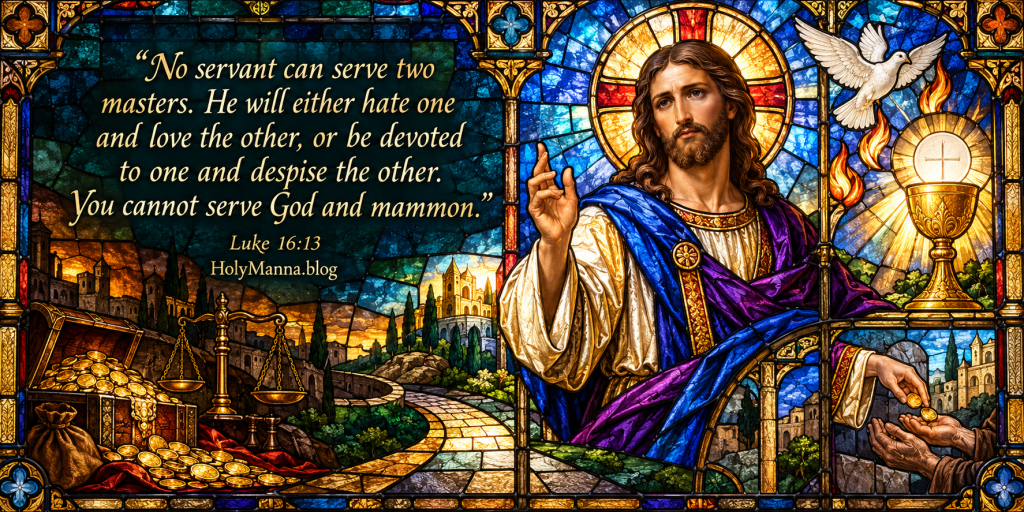
Verse 13: “No servant can serve two masters. He will either hate one and love the other, or be devoted to one and despise the other. You cannot serve God and mammon.”
Jesus personifies mammon as a rival lord demanding service, because that is how wealth behaves when it rules a heart. The language of hating and loving is a Semitic idiom for decisive preference. There is no diversified portfolio of masters; the heart’s throne seats exactly one.
Verse 14: “The Pharisees, who loved money, heard all these things and sneered at him.”
The Greek verb pictures them turning up their noses. Luke’s detail is devastating: deeply religious men, fluent in Scripture, whose real master was money. The sneer is what avarice sounds like when it is cornered by the truth.
Verse 15: “You justify yourselves in the sight of others, but God knows your hearts; for what is of human esteem is an abomination in the sight of God.”
Echoing 1 Samuel 16:7, Jesus moves the courtroom from public opinion to the heart, where God alone presides. Reputation can be curated; hearts cannot. What the world applauds, including polished religiosity wrapped around a love of money, can stand as an abomination before God.
Teachings
Saint Augustine preached an entire sermon on verse 9, Sermon 63 on the New Testament, and asked who these friends are who welcome souls into eternal dwellings. His answer points to the poor and the saints, those who are received because “they who serve their need, and minister cheerfully to their necessities” befriend them in this life. He is careful to close a loophole: “Give alms of your righteous labours: give out of that which you possess rightfully,” since God cannot be bribed with stolen goods. Then he compresses the whole Gospel economy into one line: “Lose, that you be not lost: give, that you may gain: sow, that you may reap.”
The Catechism names the stakes precisely. CCC 2113 teaches that “Idolatry consists in divinizing what is not God,” listing money among the idols, and concludes that idolatry “rejects the unique Lordship of God; it is therefore incompatible with communion with God.” And CCC 2446 quotes Saint John Chrysostom’s thunderbolt: “Not to enable the poor to share in our goods is to steal from them and deprive them of life. The goods we possess are not ours, but theirs.” Serving God with mammon, rather than serving mammon itself, is the only safe way to hold it.
Reflection
Jesus offers a practical strategy, not just a warning: spend what fails on what lasts. Pick one recurring expense this month and redirect it to someone in real need, deliberately making an eternal friend. Then practice fidelity in one small matter, handled as carefully as if it were great, because in God’s accounting it is.
Which master would an honest audit of time, worry, and spending reveal? Who are the “friends” that generosity could be making right now? Is there a small matter, financial or otherwise, that God is using as an invitation to greater trustworthiness?
The Wealth That Never Fails
Every reading today circles the same quiet revelation: the richest man in these pages is a prisoner. Paul sits in chains, dependent on a care package from a small church hundreds of miles away, and yet he writes like a man who lacks nothing: “I have the strength for everything through him who empowers me.” His secret was never a strategy; it was a Person. The psalmist sketches the same freedom from the outside, a man so anchored in the fear of the Lord that he lends graciously, gives lavishly, and sleeps without fear, because nothing he treasures can be taken from him. Then Jesus hands over the strategy itself: wealth is going to fail, every bit of it, so spend it now on what cannot fail. Feed the hungry, lift the struggling, fund the Gospel, and watch passing money become everlasting friendship.
The choice underneath it all is stark and simple. Mammon makes a demanding master and a surprisingly useful servant, and every heart decides daily which arrangement it will live under. The Pharisees sneered because the teaching cut close to the bone, and it still does. But the readings are not a scolding; they are an invitation to the better deal in the universe, trading what fails for what endures.
So take the next step today. Hold money loosely, give some of it away deliberately, and pray for the contentment Paul learned in every circumstance. The God who supplied Philippi “in accord with his glorious riches in Christ Jesus” has not grown poorer in two thousand years. He remains the one treasure that never fails, and He is already more than enough.
Engage With Us!
These readings touch the most practical corner of life, the wallet, which means everyone has a story to tell. Share your reflections in the comments below. Your experience of learning contentment, wrestling with generosity, or choosing God over mammon might be exactly the encouragement another reader needs today.
Here are some questions to pray with:
- In Philippians 4, verses 10 through 19, Saint Paul says he has learned the secret of contentment in abundance and in need alike. Which of those two circumstances tests your contentment more, and why?
- Psalm 112, verses 1 through 2, 5 through 6, and 8 through 9 paints a man who gives lavishly and fears nothing. What is one fear about money that deeper generosity might begin to heal in your life?
- In Luke 16, verses 9 through 15, Jesus commands his disciples to make friends with wealth that is destined to fail. What would it look like this week to convert some of your money into an eternal friendship?
- Taken together, how do today’s readings change the way a follower of Christ should think about security, and what is one concrete step you can take toward trusting God as your only true wealth?
However these questions land, take heart. The same God who taught a chained apostle to abound is patiently teaching you, one small act of trust at a time. Stay faithful in the little things, hold every gift with open hands, and do everything this week with the love and mercy Jesus taught. The One who knows your heart is also the One who supplies its every need.
Sacred Heart of Jesus, we trust in You!
Immaculate Heart of Mary, pray for us!
Saint Michael the Archangel, defend us in battle!
Follow us on YouTube, TikTok, Instagram and Facebook for more insights and reflections on living a faith-filled life.


Leave a Reply