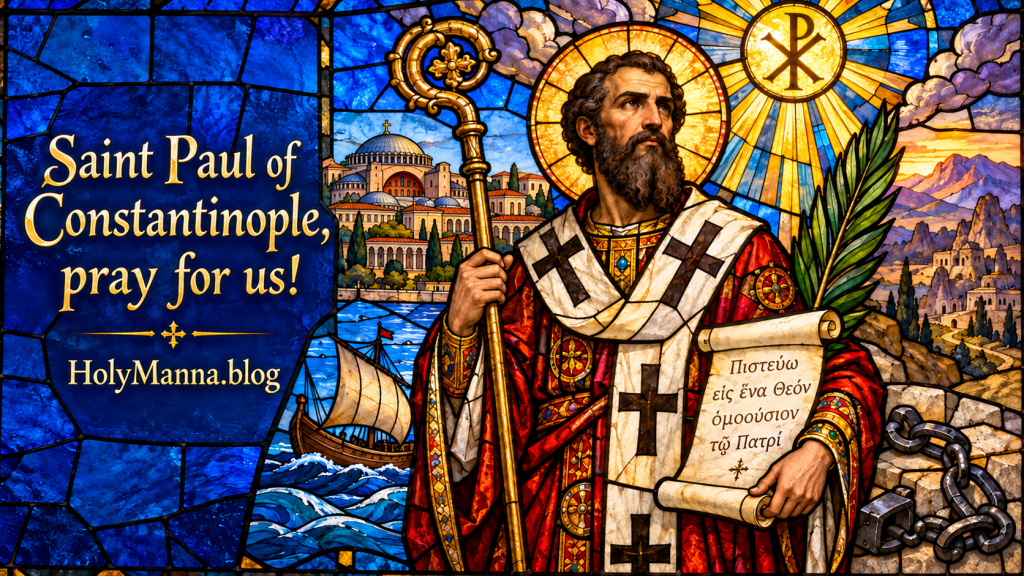
The Bishop Who Would Not Bend
On November 6th, the Church remembers Saint Paul of Constantinople, a bishop of the imperial capital in the 4th century and a martyr for the faith that Catholics still profess aloud every Sunday. When the congregation stands at Mass and declares that Jesus Christ is “begotten, not made, of the same substance (homoousios) as the Father” (CCC 465), it is repeating the very confession for which Paul was deposed, exiled 5 times, starved, and finally strangled in a remote mountain town. He did not die for a vague spiritual feeling. He died for a single Greek word, consubstantial, because that word protects the whole truth about who Jesus Christ is.
Paul’s era was one of the most dangerous moments in the history of the Church, the Arian crisis, when a plausible and popular heresy taught that the Son of God was a creature rather than true God. Emperors took sides, bishops were installed and removed like chess pieces, and faithful shepherds paid for their fidelity with their lives. Paul stood in the storm’s center, holding the see of Constantinople, the city of the emperor himself, and refusing to surrender it to error. The old Roman Martyrology summarizes his whole life in a single breath: “For the Catholic faith, he was often expelled from his see by the Arians, and restored to it by the Roman Pontiff, St. Julius.” In the Byzantine East he is venerated on this same day, November 6th, under the affectionate title Paul the Confessor, a man whose entire episcopate was one long act of confession. His older commemoration in the Western martyrology falls on June 7th, but East and West honor one and the same courage.
From Thessalonica to the City of the Emperor
Paul was born in Thessalonica, the Greek city to which Saint Paul the Apostle had once written two letters of the New Testament. The sources record nothing reliable about his family or his early formation, and honesty requires saying so plainly rather than inventing a childhood for him. History first finds him in Constantinople as a priest of the city and as secretary to its aged bishop, Saint Alexander of Constantinople. That detail matters enormously. Alexander was the bishop who had personally resisted the heresiarch Arius, and the ancient Church historians Socrates Scholasticus and Sozomen record that as Alexander approached death, he pointed to Paul as a worthy successor, while the Arian party preferred a deacon named Macedonius. Paul had been formed at the side of a confessor, and the old man’s dying judgment proved prophetic in both directions. Paul would defend the faith; Macedonius would one day give his name to a new heresy.
To understand what Paul inherited, the reader has to understand what was at stake. In the year 325, the Council of Nicaea had answered Arius by confessing that the Son is truly God, and The Catechism teaches that the Church at Nicaea “confessed in its Creed that the Son of God is ‘begotten, not made, of the same substance (homoousios) as the Father’” (CCC 465). But a conciliar definition does not end a controversy overnight. In the decades after Nicaea, Arian and semi-Arian bishops gained the ear of the imperial court, and the sons of Constantine divided the empire between them. Constantius II, who ruled the East from Antioch, sympathized with the Arian party. Into this political furnace, around the year 337, Paul was elected bishop of Constantinople and consecrated in the Church of Peace, near the site where the great Hagia Sophia would later rise. Some sources place Alexander’s death and Paul’s election closer to the year 340, and that conflict in the ancient chronology deserves honest acknowledgment rather than false precision. What is certain is that Paul was chosen by the Catholic party of the city, that the Arians opposed him from the first hour, and that the emperor had not been consulted. Constantius never forgave him for it.
A Shepherd Without Wonders, A City Without Peace
The historical record preserves no miracles worked by Paul during his lifetime, no healings, no visions, no dramatic signs. That silence is itself worth contemplating, because the Church did not canonize his memory for wonders. She canonized his fidelity. His miracle, so to speak, was that a man surrounded by every incentive to compromise never compromised. In an age when bishops could secure wealth, safety, and imperial favor simply by softening one word of the Creed, Paul would not soften it. The Catechism teaches that “the disciple of Christ must not only keep the faith and live on it, but also profess it, confidently bear witness to it, and spread it” (CCC 1816), and Paul’s whole episcopate was that sentence lived out at the highest possible cost.
The cost arrived quickly. Constantius, angry that the capital had elected a Nicene bishop without his approval, convened a synod of Arian-minded bishops that declared Paul unfit and banished him, installing in his place Eusebius of Nicomedia, the most politically powerful Arian churchman of the age, around the year 339. Paul did what persecuted Eastern bishops of that generation learned to do. He went west, to Rome, to the successor of Peter. There Pope Saint Julius I examined his case alongside that of another famous exile, Saint Athanasius of Alexandria, and found both men orthodox and unjustly deposed. The friendship between Paul and Athanasius, two bishops hunted by the same heresy and sheltered by the same pope, is one of the most moving facts of this story. The Catechism teaches that the Roman Pontiff, as successor of Peter, “is the perpetual and visible source and foundation of the unity both of the bishops and of the whole company of the faithful” (CCC 882), and in the 4th century that was not an abstraction. For Paul it was a lifeline. The Roman Martyrology remembers precisely this, that he was expelled by the Arians and “restored to it by the Roman Pontiff, St. Julius.”
When Eusebius of Nicomedia died in 341, Paul returned to his city and his people received him with joy. But the Arian faction answered by consecrating Macedonius as a rival bishop, and Constantinople descended into factional violence. The emperor, residing at Antioch, sent his cavalry general Hermogenes with orders to expel Paul by force. What followed is documented by the ancient historians: a mob loyal to Paul burned the general’s house, killed Hermogenes, and dragged his body through the streets. There is no evidence that Paul ordered or wanted any of it, and the episode shows how combustible the city had become. Constantius rode to Constantinople in fury, intending to punish the whole population; when the citizens met him in tears and supplication, he settled for cutting the city’s grain allowance in half, and he drove Paul out once more. A shepherd can be blameless and still bear the consequences of the wolves circling his flock.
Five Exiles, Iron Chains, and a Hidden Martyrdom
Paul’s later years read like a map of the Roman world drawn in suffering. His friend and contemporary Saint Athanasius, writing in History of the Arians, preserved the itinerary of his persecutions, recording that Paul was banished “first into Pontus,” then “sent bound with iron chains to Singara in Mesopotamia,” then “from thence transferred to Emesa,” and “a fourth time… banished to Cucusus in Cappadocia.” Athanasius’s mention of a first banishment under Constantine sits uneasily with the usual dating of Paul’s election after that emperor’s death, and scholars have long flagged the tension; the ancient chronology of these years is genuinely tangled, and the sources disagree on details even while agreeing completely on the substance. Paul was hunted from one end of the empire to the other for the crime of believing what Nicaea taught.
For a time, the West protected him. He appears to have found refuge at Trier, though the sources state this with less than full certainty, and around the year 344 he was restored to Constantinople through the intervention of the Western emperor Constans, a defender of the Nicene cause who threatened his brother Constantius with war if Paul were not reinstated. For a few years, the threat held. Then, in the year 350, Constans was murdered in a palace coup, and Paul’s last human shield was gone. Constantius acted almost immediately. He ordered Philip, the Prefect of the East, to remove Paul and install Macedonius. Socrates Scholasticus records how it was done, and the account deserves telling because it reveals how feared Paul’s people were. Philip did not dare arrest the bishop publicly. He invited Paul to the public baths of Zeuxippus as if for ordinary conversation, showed him the imperial order privately, and had him slipped out a back door to a waiting ship before the city knew anything had happened. The bishop of the imperial capital was smuggled out of his own see like contraband.
What followed was deliberately hidden from the world, and the truth survives because Athanasius gathered the testimony of those who were there. Paul was taken in chains through Singara and Emesa to Cucusus, a bleak, remote town in the Taurus mountains on the borders of Cappadocia and Armenia. There he was shut up in a dark, confined place and simply left without food. Athanasius records the testimony of the deputy-governor Philagrius about what happened next: “when after six days they went in and found him still alive, they immediately set upon the man, and strangled him.” His killers announced that he had died after a short sickness. Athanasius adds that “they said that Philip who was Prefect was their agent in the perpetration of this murder.” The year was around 350, though some sources give 351. The Roman Martyrology renders its verdict without hedging: he was “barbarously strangled, and thus departed for the heavenly kingdom.”
A later Byzantine tradition tells the story even more vividly, that the Arians burst in upon Paul while he was celebrating the Divine Liturgy and strangled him with his own omophorion, the episcopal vestment worn about the shoulders. It is a powerful image, the shepherd killed at the altar with the very sign of his office. It is told here as the tradition it is; it does not appear in the near-contemporary account of Athanasius, and it cannot be verified.
However the final moments unfolded, the Church’s judgment on their meaning is clear. The Catechism teaches that “martyrdom is the supreme witness given to the truth of the faith: it means bearing witness even unto death” (CCC 2473). Paul bore that witness in the most literal way, and he bore it for the specific truth that Jesus Christ is true God from true God. Our Lord had promised his apostles, “If they persecuted me, they will also persecute you” (The Gospel of John, Jn 15:20), and in Paul of Constantinople that promise was kept to the letter.
The Emperor Who Brought Him Home
Paul’s story did not end in the dark room at Cucusus, because God writes longer stories than emperors do. For 3 decades his rival Macedonius and the Arian party held sway in Constantinople, and Macedonius went further still, fathering a new heresy that denied the full divinity of the Holy Spirit. Then the tide turned completely. In the year 381, the First Council of Constantinople, meeting in Paul’s own city, vindicated everything he had suffered for, reaffirming the Creed of Nicaea and condemning both Arianism and the Macedonian heresy. That very same year, the Catholic emperor Theodosius the Great ordered Paul’s body brought home. Roughly 30 years after his murder, the martyr’s relics traveled in honor from Cucusus back to Constantinople, and the ancient historians record where Theodosius placed them: in the church that Macedonius himself had built, which from that day forward bore the name of Saint Paul. The usurper’s monument became the martyr’s shrine. It is difficult to imagine a more complete reversal, and the faithful of the city understood exactly what it meant.
The journey of his relics continued across the centuries. In the 13th century his remains were translated to Venice, where they rest today in the church of San Lorenzo; Western sources give the year as 1226, while Orthodox sources record 1326, and that discrepancy in the records is noted here honestly. Eastern tradition also reports that a portion of his skull is venerated at the Monastery of Simonopetra on Mount Athos and that a fragment of his relics is kept at the Saint Alexander Nevsky Lavra in Saint Petersburg; these reports are received from the Eastern churches’ own accounts of their treasures. The sources reviewed for this post preserve no specific, named miracle stories of healings at his tomb, and none will be invented here. His documented legacy after death is of a different kind: vindication, veneration across both halves of Christendom, and a feast kept on November 6th by Catholics and Orthodox alike.
One more detail completes the picture, and it is almost too fitting. About 55 years after Paul died at Cucusus, another bishop of Constantinople was driven into exile by an empress and her court, and the place chosen for his banishment was the same obscure mountain town. Saint John Chrysostom spent the hard years of his exile at Cucusus, walking the same ground where Paul had been martyred. Constantinople’s two most famous persecuted bishops were joined by one forgotten village, as if God wished to consecrate that place twice over. The Catechism teaches why the Church treasures such memories: “It is not merely by the title of example that we cherish the memory of those in heaven; we seek, rather, that by this devotion to the exercise of fraternal charity the union of the whole Church in the Spirit may be strengthened” (CCC 957).
Standing Firm When the Ground Keeps Shifting
Saint Paul of Constantinople speaks with surprising directness to the present moment. He lived in an age when the pressure to compromise did not come from outside the Church but from within it and above it, from powerful voices insisting that the faith needed updating, softening, one small word adjusted to fit the times. He answered that pressure not with anger but with endurance. Five times he was thrown out of his city. Five times he refused to purchase peace at the price of truth. The Catechism teaches that “fortitude is the moral virtue that ensures firmness in difficulties and constancy in the pursuit of the good” (CCC 1808), and Paul is what that paragraph looks like with a human face.
Where in your life are you tempted to soften a truth of the faith because holding it costs too much? Most believers will never face an emperor, but nearly all face the quiet modern equivalents: the conversation at work where staying silent is easier, the family gathering where the faith is mocked, the slow social pressure to treat the Creed as negotiable. Paul’s witness suggests a concrete practice: pray the Nicene Creed slowly once this week, outside of Mass, pausing on the words consubstantial with the Father, and remember that men died so that those words would reach this generation intact.
Paul also teaches something about time. He never saw his vindication. He died in the dark, apparently defeated, with a lie told over his body. The council that confirmed everything he believed met 31 years after his murder. Can you keep doing the right thing when there is no evidence it is working? The Lord’s own promise answers for Paul and for everyone who imitates him: “Blessed are they who are persecuted for the sake of righteousness, for theirs is the kingdom of heaven” (The Gospel of Matthew, Mt 5:10). And Saint Paul the Apostle, writing from his own chains, gave the words that his namesake of Constantinople could have made his own: “I have competed well; I have finished the race; I have kept the faith” (2 Timothy, 2 Tim 4:7).
A practical path forward looks like this. Choose one truth of the faith that the surrounding culture finds hardest, and learn it well enough to explain it with charity. Befriend fellow believers the way Paul befriended Athanasius, because confessors are rarely solitary; they hold each other up. And when a season of failure or exile comes, whether in family life, in work, or in the parish, resist the conclusion that God has lost the thread. The story of Saint Paul of Constantinople insists that the last chapter belongs to God, and that fidelity, not visible success, is what heaven crowns.
Engage With Us!
Saint Paul of Constantinople held fast to one unchanging Creed through 5 exiles and a hidden martyrdom, and his witness still asks each believer what they are willing to endure for the truth. Share your thoughts and reflections in the comments below; this community grows stronger when readers pray and think together. Here are some questions to begin the conversation.
- Which words of the Nicene Creed do you most take for granted, and how does knowing their cost change the way you will pray them this Sunday?
- Saint Paul was sustained by the friendship of Saint Athanasius and the support of Pope Saint Julius I. Who strengthens your faith when standing firm becomes difficult, and whom are you strengthening in return?
- Paul never saw the vindication of the year 381. Where is God asking you to remain faithful without seeing results, and what would endurance look like for you this month?
- The emperor’s power filled Paul’s whole horizon, yet it is the exiled bishop whom the Church remembers. What worldly pressure in your life looks permanent right now but will not outlast your fidelity?
May the courage of Saint Paul of Constantinople stir every reader to profess the faith boldly, to endure trials with patient hope, and to trust that God vindicates His faithful ones in His own time. Go into this week resolved to live a life of faith, and to do everything with the love and mercy that Jesus taught us.
Saint Paul of Constantinople, pray for us!
Follow us on YouTube, TikTok, Instagram and Facebook for more insights and reflections on living a faith-filled life.


Leave a Reply