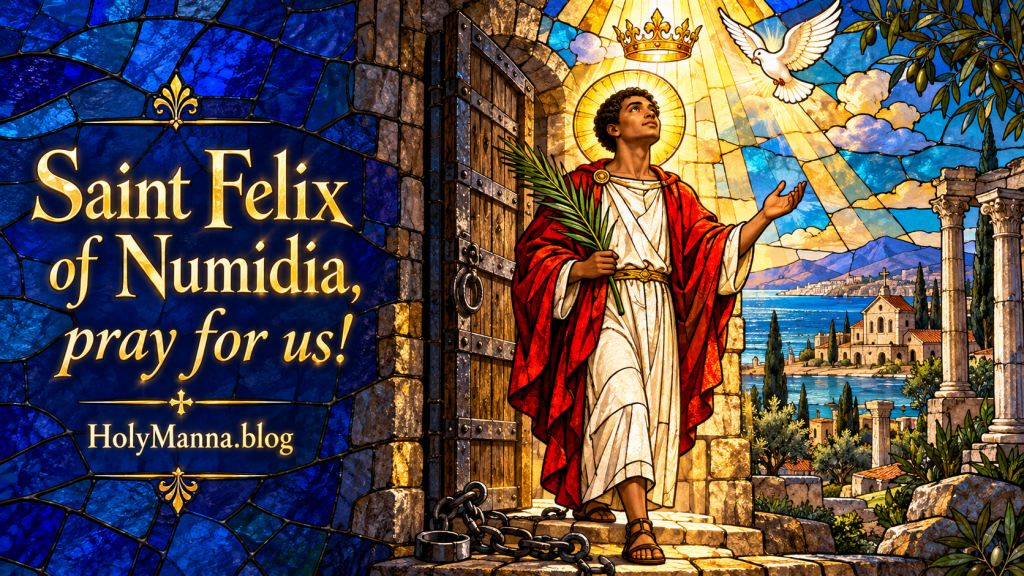
Happy in Name and in Crown
Every November 6th, the Roman Martyrology pauses over a name that most Catholics have never heard: Felix, martyr of Thynissa, a small town in Roman North Africa near the city of Hippo Regius, in the region tied to ancient Numidia. History has preserved almost nothing about him; no birthplace, no family tree, no collection of sayings, no shrine. What it has preserved is better than all of that. It has preserved the testimony of a Doctor of the Church. Saint Augustine of Hippo stood before his people on Felix’s feast day and preached about him by name, opening with a play on words that has carried this martyr through 16 centuries: “Felix the Martyr, truly Felix, i.e. ‘Happy’ both in his name and his crown, whose birthday this is, despised the world.” In Latin, felix means happy, blessed, fortunate. Augustine’s point is that this man did not merely bear the name; he earned it, because he confessed Christ when it cost him his life. The Church has never forgotten him. Both the traditional edition of the Roman Martyrology and the current 2004 Martyrologium Romanum keep his commemoration on November 6th. The Catechism explains why the Church guards such memories so jealously: “The Church has painstakingly collected the records of those who persevered to the end in witnessing to their faith. These are the acts of the Martyrs. They form the archives of truth written in letters of blood” (CCC 2474). Felix’s archive is short, a single luminous paragraph, but it is written in exactly that ink.
A Son of the Church That Bled for Christ
Honesty demands a plain admission at the start of this section: nothing is documented about Felix’s birth, his parents, his occupation, or the path that led him to the faith. The sources record no conversion story, and inventing one would dishonor him. What can be said with confidence is where and when he lived, and that context explains everything about the kind of Christian he became. Felix belonged to the Church of Roman Africa, the strip of the empire covering modern Tunisia and Algeria, which by the year 300 had become the beating heart of Latin Christianity. This was the Church of Tertullian of Carthage, who told the persecuting empire in his Apology, “The blood of Christians is seed,” a line the world now knows in its popular paraphrase, that the blood of the martyrs is the seed of the Church. This was the Church of the Scillitan Martyrs, of Saints Perpetua and Felicity, and of Saint Cyprian of Carthage, bishops and mothers and catechumens who went to the beasts and the sword rather than burn a pinch of incense to the genius of Caesar. African Christians were formed from the cradle to expect that faith might one day present its bill. Scholarship places Felix’s death sometime after the year 300, which makes the Great Persecution under the Emperor Diocletian, unleashed between 303 and 305, the most probable setting for his arrest. That dating is a reasonable inference rather than a documented fact, and it should be held as such; Augustine, the one witness, never names the persecutor. What Augustine does make clear is the only biographical fact that ultimately mattered: when the summons came, Felix did not flinch. He stood before the authorities and confessed that he was a Christian. In the early Church, that single sentence, Christianus sum, “I am a Christian,” was itself the whole trial, the whole crime, and the whole glory.
The Hidden Faithfulness Before the Famous Hour
No miracles are recorded from Felix’s lifetime, and this post will not manufacture any. Yet his very obscurity is the reason he matters, and the reason he deserves to be remembered and imitated. Most of the saints on the calendar left behind monasteries, writings, or decades of visible holiness. Felix left behind one act. Everything else about him, the years of ordinary prayer, ordinary work, ordinary fidelity in an African town nobody famous ever visited, is hidden in God. But that hidden life is precisely what made the famous hour possible. Nobody confesses Christ under threat of torture as a spontaneous improvisation. A confession like that is the fruit of a thousand small, unrecorded confessions: showing up to the Eucharist when it was dangerous, refusing the easy compromises of pagan civic life, teaching children to pray in a world that mocked it. The Catechism teaches that “Martyrdom is the supreme witness given to the truth of the faith: it means bearing witness even unto death” (CCC 2473), and it adds in the same paragraph that the martyr “endures death through an act of fortitude.” Fortitude is a virtue, and virtues are habits, built in secret long before they are tested in public. Felix’s life is therefore the biography of nearly every Christian who will ever read about him: unremarkable on the outside, and known fully only to God. The Church does not canonize him for what the world could see. She venerates him because, when the one moment arrived in which heaven and hell both leaned in to listen, the habits of a hidden lifetime spoke, and they said Christ.
The Prison They Closed on His Body, Not His Spirit
Here is what happened, as Augustine told it to the congregation that still kept Felix’s feast. Felix confessed Christ before the tribunal. The judge did not execute him on the spot; instead, Felix was remanded to prison, with his torture and execution deferred to the following day. The old Roman Martyrology summarizes it in one breath: “having confessed Christ, was sent to prison, his execution being deferred. But the next day he was found dead, as is related by St. Augustine, in his exposition of a psalm to the people on the feast of the saint.” When the jailers and executioners arrived in the morning, ready to break his body until it renounced its Lord, they found only that body. Felix was gone. Augustine preached it with awe: “Ye are aware, brethren, that he suffered not the death that other martyrs suffered. For he confessed, and was set aside for torments; on another day his body was discovered lifeless.” And then the great bishop delivered one of the most beautiful sentences ever spoken over a martyr: “They had closed the prison to his body, not to his spirit. The executioners found him gone; when they were preparing to torture, they spent their rage for nought. He was lying dead, without sense to them, that he might not be tortured; with sense with God, that he might be crowned.” Some might ask whether a man who died in his cell before the rack was ever assembled truly counts as a martyr. The Church’s answer, standing with Augustine, has always been yes. Felix died in chains for the confession of Christ; the sentence had been passed in substance the moment he refused to deny his Lord. God simply collected him early. The Lord who promised in Revelation 2:10, “Be faithful unto death, and I will give you the crown of life,” accepted the fidelity and skipped the torturers entirely, fulfilling in Felix the word of Psalm 116:15, “Precious in the sight of the Lord is the death of his saints.” One sober historical note belongs here. The older printed Martyrology located Felix “at Tunis,” while the Benedictine editors of Augustine’s works, followed by modern scholarship, place his martyrdom at Thynissa, also spelled Thinissa or Thimisa, near Hippo. The Thynissa reading is the stronger one, since it explains why Hippo’s own bishop was preaching on his feast; the “Tunis” reading appears to be a later corruption of the town’s name.
The Feast a Doctor of the Church Kept
Felix’s legacy after death is unusual among the saints, and refreshingly honest to describe: no healings at his tomb are recorded, no translations of relics, no pilgrimage routes, no national devotions. If such stories ever circulated, they have not survived, and none will be invented here. What did survive is in some ways rarer and more precious: a living liturgical cult, attested at the highest possible level. Within roughly a century of his death, the Church around Hippo was still celebrating his natalis, his heavenly birthday, every November 6th, and on one of those feasts, sometime in the decades around the year 400, Saint Augustine mounted the steps and preached his Enarratio on Psalm 127, numbered Psalm 128 in most English Bibles, applying the whole psalm to Felix. The psalm begins, “Blessed are all who fear the Lord, who walk in his ways” (Ps 128:1), and goes on to promise the happy man a fruitful wife and children around his table. Augustine asked his people whether Felix, who may have had none of those earthly consolations, had missed the blessing, and answered that Felix possesses every one of those promises perfectly, in the Body of Christ, because he scorned things present in order to receive things future. From Hippo, Felix’s name passed into the historical martyrologies of the medieval Church and finally into the universal Roman Martyrology, where he remains today; modern scholarly projects cataloguing the early cult of the saints still carry his file. Care is needed not to confuse him with his many namesakes, including a different Saint Felix, a monk of Fundi in Italy, who shares the very same November 6th entry, as well as Saint Felix of Thibiuca, the African bishop martyred in 303, and Saint Felix of Nola. Why does the Church keep repeating so small a name for so many centuries? The Catechism answers: “It is not merely by the title of example that we cherish the memory of those in heaven; we seek, rather, that by this devotion to the exercise of fraternal charity the union of the whole Church in the Spirit may be strengthened” (CCC 957). Felix is not a museum piece. He is family, alive in Christ, and his feast is a yearly family reunion.
What a Quiet Death Says to a Loud World
Felix’s story lands differently than the grand martyrdoms, and that is exactly its gift to you. His witness teaches, first, that God measures the test to the person. Augustine marveled that Felix was spared the torments other martyrs endured; God accepted the confession and carried him home before the instruments were even warm. The Catechism teaches that “In death, God calls man to himself” (CCC 1011), and in that same paragraph it hands you the words of Saint Thérèse of Lisieux, “I am not dying; I am entering life.” Felix entered life from a prison cot, unnoticed by his guards. You can trust that same God with your own unknown hour. Second, Felix teaches that an entire life can be justified by fidelity in a single moment, and that the moment is prepared for in the hidden years. The decisive confessions of your life, in a hospital room, at an office lunch where the faith is being ridiculed, in a quiet decision nobody else will ever know about, will be spoken with whatever strength your daily habits have banked. Where in your ordinary routine are you quietly practicing the courage you hope to have when it counts? Third, Felix teaches the freedom of being unknown. He has no patron page, no medal, no basilica, and he is gloriously indifferent to that fact, because his name is written in heaven. If every public trace of your accomplishments vanished and only your fidelity to Christ remained, would there be enough left to preach a sermon about? Practically, his feast suggests simple resolutions: pray Psalm 128 slowly this week and let its blessings reframe what happiness means; make a habit of confessing Christ in small, concrete ways, a visible grace before meals, an unembarrassed mention of Sunday Mass; go to confession so that, like Felix, you are ready to be found by God on any given morning; and learn the names of the early martyrs, who are praying for you by name even if the world has forgotten theirs. What would change in this day if it were lived as if it might be the day the prison door opens into heaven?
Engage With Us!
Saint Felix of Numidia confessed Christ once, and that once was enough for eternity. Share your thoughts and reflections in the comments below; this community grows stronger every time someone speaks honestly about the faith. Here are some questions to pray with and respond to:
- Augustine said the prison was closed to Felix’s body but not to his spirit. What situation in your life feels like a locked prison, and how might God already be free within it?
- Felix’s name meant “happy,” and he proved it by despising what the world calls happiness. Where has the world’s definition of happiness been quietly shaping your decisions more than the Gospel’s?
- If your entire recorded biography were reduced to one act of faith, which moment of your life so far would you want it to be, and what does that answer tell you?
- Felix was ready when the summons came without warning. What one habit could you begin this week so that your soul is ready to be found by God on any morning?
- Who are the hidden, faithful Christians in your own life, the ones no one will ever write about, and how can you honor and imitate them?
Saint Felix was ordinary, obscure, and utterly faithful, and that combination was enough to win a crown and a sermon from a Doctor of the Church. The same crown is offered to you. Live this day, and every day, with your confession ready on your lips and charity ready in your hands, doing everything with the love and mercy that Jesus taught us, so that when your name is finally spoken in full, it too will mean happy.
Saint Felix of Numidia, pray for us!
Follow us on YouTube, TikTok, Instagram and Facebook for more insights and reflections on living a faith-filled life.


Leave a Reply