Friday of the Thirty-first Week in Ordinary Time – Lectionary: 489
Dual Citizens on the Road Home
Everyone has felt it at some point, that quiet ache of being somewhere that is not quite home. The readings for Friday of the Thirty-first Week in Ordinary Time, November 6th, name that ache and give it a destination. The central theme uniting all three readings is heavenly citizenship lived with holy prudence. In other words, Christians belong to another country, and they are expected to spend this life skillfully preparing to arrive there.
Saint Paul opens the day by telling the Philippians, residents of a proud Roman colony, that “our citizenship is in heaven.” The image would have landed instantly. Philippi lived by Roman law, spoke of Rome with pride, and waited for the emperor’s favor from afar. Paul takes that entire civic identity and relocates it to heaven, where the true Savior reigns.
Psalm 122 then gives the day its soundtrack. It is a Song of Ascents, one of the pilgrim hymns Israelites sang as they climbed the road to Jerusalem for the great feasts, the same road the Holy Family walked each year. The psalm turns the journey itself into joy, because the pilgrim already knows where the road ends.
Finally, in The Gospel of Luke, Jesus tells the strange story of a dishonest steward who, facing disaster, acts with stunning cleverness to secure his future. The Lord does not praise the man’s fraud but his foresight, and he asks a piercing question of every believer: if worldly people work that hard for a future that ends, why do the children of light work so little for a future that never does?
First Reading — Philippians 3:17—4:1
A Colony of Heaven Planted on Earth
Around the year 50, Saint Paul arrived in Philippi, a Macedonian city with a privileged status in the ancient world. According to Acts 16:12, Philippi was a Roman colony, settled largely by veterans of Rome’s civil wars. Its citizens enjoyed Roman citizenship, lived under Roman law, and took enormous pride in belonging to a capital most of them would never visit. Years later, writing from prison, Paul sent this beloved community a letter, and in today’s passage he reaches its emotional summit. He weeps over those who live as “enemies of the cross,” then hands the Philippians the most powerful image he could have chosen: their true citizenship is not Roman at all. It is heavenly. This reading anchors the day’s central theme, since the pilgrim psalm and the shrewd steward both flow from the question of where a Christian truly belongs.
Philippians 3:17—4:1
Join with others in being imitators of me, brothers and sisters,
and observe those who thus conduct themselves
according to the model you have in us.
For many, as I have often told you
and now tell you even in tears,
conduct themselves as enemies of the cross of Christ.
Their end is destruction.
Their God is their stomach;
their glory is in their “shame.”
Their minds are occupied with earthly things.
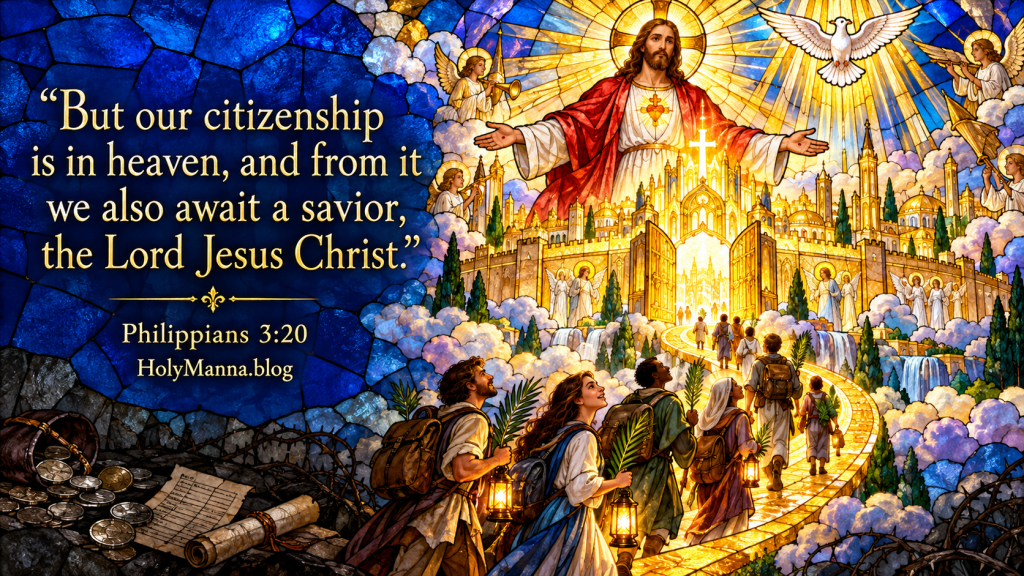
But our citizenship is in heaven,
and from it we also await a savior, the Lord Jesus Christ.
He will change our lowly body
to conform with his glorified Body
by the power that enables him also
to bring all things into subjection to himself.Therefore, my brothers and sisters,
whom I love and long for, my joy and crown,
in this way stand firm in the Lord, beloved.
Detailed Exegesis
Verse 17: “Join with others in being imitators of me, brothers and sisters, and observe those who thus conduct themselves according to the model you have in us.”
Paul’s invitation sounds bold to modern ears, but it rests on something he said earlier in the same letter, that he strives to imitate Christ crucified. He is not asking the Philippians to admire his personality but to copy a pattern of life, the cruciform pattern. The Church has always worked this way, which is why CCC 2030 teaches that the faithful learn holiness from the witness of the saints. Faith is caught from living models before it is learned from books.
Verse 18: “For many, as I have often told you and now tell you even in tears, conduct themselves as enemies of the cross of Christ.”
Notice who makes Paul cry. Not the pagans, not the persecutors, but people inside the community whose comfortable lives contradict the cross they claim. The “enemies of the cross” are not those who attack it but those who quietly refuse to carry it. Paul’s tears reveal a pastor’s heart; he grieves rather than gloats.
Verse 19: “Their end is destruction. Their God is their stomach; their glory is in their ‘shame.’ Their minds are occupied with earthly things.”
Paul sketches a four-part portrait of the earthbound life: its destination, its deity, its boast, and its mindset. A god of the stomach means appetite has taken the throne, whether for food, pleasure, or comfort. Glorying in shame means boasting about the very things that should drive a soul to confession. The diagnosis is as current as any social media feed.
Verse 20: “But our citizenship is in heaven, and from it we also await a savior, the Lord Jesus Christ.”
Here is the hinge of the day. The Greek word politeuma means commonwealth or citizenship, and in a Roman colony that word carried weight. The Philippians understood living far from the capital while belonging to it completely, and Paul says the baptized live that way with respect to heaven. Even the title “savior” is pointed, since emperors claimed it for themselves. The Christian waits for a greater Savior than Caesar.
Verse 21: “He will change our lowly body to conform with his glorified Body by the power that enables him also to bring all things into subjection to himself.”
Christian hope is not escape from the body but transformation of it. The same power that will subject the entire cosmos to Christ will be applied, astonishingly, to tired, aging, ordinary human bodies. The resurrection of Jesus is the preview; the believer’s resurrection is the sequel.
Verse 4:1: “Therefore, my brothers and sisters, whom I love and long for, my joy and crown, in this way stand firm in the Lord, beloved.”
Paul piles up endearments, calling this community his joy and his crown. The conclusion of all this theology is wonderfully practical: stand firm. Heavenly citizenship is not a daydream; it is a posture of stability in the Lord.
Teachings
The Church enshrined this reading’s central image in her earliest self-understanding. The Catechism of the Catholic Church quotes a second-century text, the Epistle to Diognetus, when it teaches on the opening words of the Our Father. In CCC 2796 the Church hands on that ancient description of believers: “Christians are in the flesh, but they do not live according to the flesh. They spend their lives on earth, but are citizens of heaven.” That anonymous author described Christians who looked outwardly ordinary yet lived by the laws of another kingdom.
Saint John Chrysostom, Doctor of the Church, preached on this very passage in his Homily 13 on Philippians, thundering at what makes someone an enemy of the cross: “Your Master was crucified, and do you seek ease? Your Master was pierced with nails, and do you live delicately?” For Chrysostom, the opposite of the cross is not hatred but comfort worship, and he offered the remedy in one unforgettable line: “Crucify yourself, though no one crucify you.” He meant dying to sin and self-indulgence, never harming oneself. On the great promise of verse 20, he preached: “Let us not then seek for ease here; there do we shine, where also our citizenship is.”
On the destiny of the body, CCC 999 quotes today’s very verse, affirming that Christ “will change our lowly body to be like his glorious body.” The faith of the Church is unblushingly physical. Heaven is not the abandonment of the body but its glorification.
Reflection
Paul’s portrait of the enemies of the cross is uncomfortable precisely because it describes tendencies, not monsters. Everyone has days when the stomach, broadly understood, sits on the throne. The question is not whether appetite exists but whether it governs.
A concrete way to live this reading is to practice one small, deliberate act of self-denial each day this week, a skipped snack, purchase, or hour of scrolling, offered for someone who is struggling. Another is to choose a model, as Paul suggested, picking one saint to study this month and one habit of that saint to imitate.
Where in your life has comfort quietly become a god? If someone examined your calendar and your spending, which citizenship would they conclude you hold? What would it look like, this week, to stand firm in the Lord rather than merely drift?
Responsorial Psalm — Psalm 122:1-5
The Song You Sing When You Know Where Home Is
Psalm 122 belongs to a beloved collection called the Songs of Ascents, Psalms 120 through 134, the hymnal of pilgrims climbing the long uphill road to Jerusalem for the three great annual feasts. Jerusalem sits high in the Judean hills, so every journey there was literally a journey up, sung mile by mile. The Gospel of Luke records that Jesus made this pilgrimage with Mary and Joseph every year for Passover, so the Lord himself likely sang these very words on dusty roads with his family and neighbors. In today’s liturgy, the psalm supplies the emotion that matches Paul’s doctrine. Paul declared that “our citizenship is in heaven”; the psalmist shows what citizens sound like when they are headed to the capital. They sound joyful. Read anagogically, as the Church reads it, earthly Jerusalem becomes a sign of the heavenly city, and this pilgrim song becomes the anthem of every soul walking home to God.
Psalm 122:1-5
R. (1) Let us go rejoicing to the house of the Lord.
I rejoiced because they said to me,
“We will go up to the house of the LORD.”
And now we have set foot
within your gates, O Jerusalem.
R. Let us go rejoicing to the house of the Lord.
Jerusalem, built as a city
with compact unity.
To it the tribes go up,
the tribes of the LORD.
R. Let us go rejoicing to the house of the Lord.
According to the decree for Israel,
to give thanks to the name of the LORD.
In it are set up judgment seats,
seats for the house of David.
R. Let us go rejoicing to the house of the Lord.
Detailed Exegesis
Verse 1: “I rejoiced because they said to me, ‘We will go up to the house of the LORD.’”
The psalm opens not with arrival but with invitation. Joy begins the moment the invitation is spoken. Notice also that the invitation is plural. Nobody makes this pilgrimage alone; the journey to God is undertaken as a people. The refrain of today’s liturgy, “Let us go rejoicing to the house of the Lord,” captures this communal gladness, and it should describe the heart of every Catholic walking into Mass.
Verse 2: “And now we have set foot within your gates, O Jerusalem.”
Here is the wonderful shift from anticipation to arrival: the pilgrim stands still, feet planted inside the gates, and simply marvels. For the Christian, this verse is a preview of a greater arrival, the moment of standing within the gates of the heavenly Jerusalem that Revelation 21 describes. Every Mass offers a foretaste, since the liturgy on earth joins the worship of heaven.
Verse 3: “Jerusalem, built as a city with compact unity.”
The pilgrim admires the city’s tightly joined construction, and the ancient commentators saw more than architecture here. A city bound in “compact unity” became an image of God’s people themselves, and Saint Peter uses exactly this image for the Church, built of living stones into a spiritual house.
Verse 4: “To it the tribes go up, the tribes of the LORD. According to the decree for Israel, to give thanks to the name of the LORD.”
Twelve scattered tribes converge on one city three times a year because God commanded it. Worship here is not a private hobby but a covenant obligation that gathers a divided people into one. The purpose named is thanksgiving, and the Greek word for thanksgiving gives the Church her greatest treasure, the Eucharist. The tribes went up to give thanks; Catholics go up to the altar for the same reason.
Verse 5: “In it are set up judgment seats, seats for the house of David.”
Jerusalem was not only the place of worship but the place of justice, where the Davidic king judged rightly. For the Christian, this verse points straight to the Son of David who now occupies that seat forever. The city of praise is also the city of judgment, which quietly prepares the heart for the Gospel’s parable about giving an account.
Teachings
The Church teaches four senses of Scripture, and this psalm is a textbook case of the fourth. CCC 117 explains the anagogical sense, through which realities are viewed “in terms of their eternal significance, leading us toward our true homeland: thus the Church on earth is a sign of the heavenly Jerusalem.” When Catholics pray Psalm 122, they are not engaging in nostalgia for an ancient city. They are rehearsing their own homecoming.
Saint Augustine, Doctor of the Church, loved this way of reading. In The City of God he draws on the traditional interpretation of Jerusalem’s name as “vision of peace,” and throughout his Expositions on the Psalms he treats the Songs of Ascents as the music of the heart climbing toward that peace which no earthly city can give. For Augustine, the whole Christian life is one long ascent sung in hope.
The Catechism also grounds this psalm in the life of Jesus himself. CCC 583 teaches: “Like the prophets before him Jesus expressed the deepest respect for the Temple in Jerusalem.” The Lord was presented there as an infant, found there at twelve, and went up year after year as a pilgrim. When believers sing this psalm, they are singing words that passed through the lips of the Word made flesh, which gives the refrain a tenderness the original pilgrims could never have imagined.
Reflection
Honesty time: how many Catholics can say the first verse truthfully? “I rejoiced” is not always the first feeling on a Sunday morning. Yet joy in worship is less a mood than a decision rooted in knowing what the Mass actually is, the gates of the heavenly city cracked open on an ordinary weekend.
A practical step is to recover the pilgrim mindset. Arrive at Mass five minutes early this week and pray verse 1 slowly before the opening hymn. Another step is to stop going up alone; the tribes went together, so invite one person, a friend, a sibling, a coworker drifting from the faith, to Mass with you this month.
When you walk into your parish, do you see a building or a gate? Who first said to you, “We will go up to the house of the Lord,” and have you ever thanked them? Whom could you invite to go up with you?
Holy Gospel — Luke 16:1-8
The Most Puzzling Compliment Jesus Ever Gave
This parable has startled readers for two thousand years, because at first glance Jesus seems to hold up a crook as a role model, but the historical background softens the shock. In first-century Palestine, a wealthy landowner entrusted his estate to a steward, an oikonomos, with full legal authority to lend, collect, and contract debts in his name. Debts were commonly recorded in kind, in measures of olive oil or wheat, on promissory notes. Some modern scholars suggest the steward was canceling his own commission or hidden surcharges when he slashed the bills, though that remains a hypothesis rather than a certainty. Jesus praises one thing only, the man’s clear-eyed urgency about the future. After Paul’s declaration of heavenly citizenship and the psalm’s pilgrim joy, this Gospel supplies the day’s challenge: citizenship and joy must become strategy, pursued with the energy a desperate manager spends saving his career.
Luke 16:1-8
Jesus said to his disciples, “A rich man had a steward
who was reported to him for squandering his property.
He summoned him and said,
‘What is this I hear about you?
Prepare a full account of your stewardship,
because you can no longer be my steward.’
The steward said to himself, ‘What shall I do,
now that my master is taking the position of steward away from me?
I am not strong enough to dig and I am ashamed to beg.
I know what I shall do so that,
when I am removed from the stewardship,
they may welcome me into their homes.’
He called in his master’s debtors one by one.
To the first he said, ‘How much do you owe my master?’
He replied, ‘One hundred measures of olive oil.’
He said to him, ‘Here is your promissory note.
Sit down and quickly write one for fifty.’
Then to another he said, ‘And you, how much do you owe?’
He replied, ‘One hundred measures of wheat.’
He said to him, ‘Here is your promissory note;
write one for eighty.’
And the master commended that dishonest steward for acting prudently.
For the children of this world
are more prudent in dealing with their own generation
than the children of light.”
Detailed Exegesis
Verse 1: “Jesus said to his disciples, ‘A rich man had a steward who was reported to him for squandering his property.’”
Jesus tells this story to disciples, not to the crowds; it is insider teaching about handling what has been entrusted. The verb for “squandering” is the same one Luke 15 used for the prodigal son wasting his inheritance. Every human being is this steward, managing a life, a body, time, and talents that belong to God.
Verse 2: “He summoned him and said, ‘What is this I hear about you? Prepare a full account of your stewardship, because you can no longer be my steward.’”
The summons lands like a thunderclap. An account must be rendered, and the stewardship has an expiration date. The Church hears in this verse an echo of the particular judgment, when each soul gives its reckoning to God. The master’s question is worth sitting with in prayer, because every soul will eventually face it.
Verse 3: “The steward said to himself, ‘What shall I do, now that my master is taking the position of steward away from me? I am not strong enough to dig and I am ashamed to beg.’”
Luke loves interior monologues, and this one is brutally honest: no strength for manual labor, too much pride for begging. Strangely, that honesty is the beginning of his turnaround, since self-knowledge, even the uncomfortable kind, is the first step of any real conversion.
Verse 4: “‘I know what I shall do so that, when I am removed from the stewardship, they may welcome me into their homes.’”
Here is the flash of insight the whole parable celebrates. The steward realizes that the resources still in his hands today can secure friends who will receive him tomorrow. That is precisely the logic Jesus wants his disciples to apply to eternity, using earthly goods now, especially through generosity to the poor, to be welcomed into eternal dwellings.
Verse 5: “He called in his master’s debtors one by one. To the first he said, ‘How much do you owe my master?’”
The steward acts immediately and personally, one debtor at a time, with no delay between decision and execution, exactly where most spiritual resolutions die. He understands that his future depends on people rather than hoarded assets.
Verse 6: “He replied, ‘One hundred measures of olive oil.’ He said to him, ‘Here is your promissory note. Sit down and quickly write one for fifty.’”
One hundred measures of olive oil was an enormous commercial debt, and cutting it in half was a life-changing favor. The word “quickly” captures the urgency pulsing through the whole parable.
Verse 7: “Then to another he said, ‘And you, how much do you owe?’ He replied, ‘One hundred measures of wheat.’ He said to him, ‘Here is your promissory note; write one for eighty.’”
A hundred measures of wheat represented a vast harvest, and even this smaller discount was worth months of wages. The steward tailors each reduction, showing calculation rather than panic, and that methodical shrewdness, applied to holiness, is what Jesus finds lacking among the devout.
Verse 8: “And the master commended that dishonest steward for acting prudently. For the children of this world are more prudent in dealing with their own generation than the children of light.”
The master praises the steward’s prudence, not his honesty, and Jesus draws a stinging conclusion. Worldly people pursue worldly goals with brilliance and hustle, while the children of light too often pursue heaven halfheartedly. The phrase “children of light” became a treasured name for believers, appearing again in 1 Thessalonians 5:5 and Ephesians 5:8. The parable is less a scandal than a dare.
Teachings
Saint Augustine, Doctor of the Church, faced this parable head-on in his Sermon 359A, resolving its difficulty in a few piercing lines: “It is not because that servant cheated, but because he exercised foresight for the future. When even a cheat is praised for his ingenuity, Christians who make no such provision blush.” In the same sermon he pressed the comparison into a question that still stings: “He was worried about the life that comes to an end, and you, are you not concerned about eternal life?” For Augustine the argument runs from the lesser to the greater: if a swindler plans so carefully for a few mortal years, how much more should the baptized plan for unending ones.
The Church defines the commended virtue precisely. CCC 1806 teaches: “Prudence is the virtue that disposes practical reason to discern our true good in every circumstance and to choose the right means of achieving it.” The same paragraph recalls this virtue’s ancient title, “auriga virtutum”, the charioteer of the virtues, because prudence steers all the others. The steward had natural prudence aimed at a passing goal; the saint possesses supernatural prudence aimed at God.
On stewardship itself, CCC 2404 teaches: “The ownership of any property makes its holder a steward of Providence, with the task of making it fruitful and communicating its benefits to others, first of all his family.” Nothing in a believer’s hands is a private hoard; all of it is managed on behalf of a Master who will ask for the books.
Reflection
Consider how much planning goes into an ordinary life, retirement accounts, career moves, travel itineraries, and how much goes into eternity. The parable asks whether the gap between the two should cause some holy embarrassment.
A concrete response is to make an actual plan for the soul, the way the steward made a plan for his future. Write down one spiritual goal for the next ninety days, such as weekly Confession, a daily Rosary, or a monthly holy hour. Another response is to imitate the steward’s best move, converting present resources into eternal friendships, by setting up a recurring gift to a Catholic charity or quietly covering a struggling family’s grocery bill.
If God asked tonight for a full account of your stewardship, what would the books show? Where do you show more hustle for passing things than for eternal ones? What is one asset, time, skill, or money, that you could convert into treasure in heaven this week?
The Pilgrim’s Portfolio
Put the whole day together and a single storyline emerges. Paul stands in a Roman colony and announces that the baptized carry a better passport, since “our citizenship is in heaven.” The psalmist takes that citizenship and sets it to music, rejoicing at the words, “We will go up to the house of the LORD.” Then Jesus, with a storyteller’s mischief, introduces a scoundrel whose one redeeming quality is that he took his future seriously, then asks why the children of light so rarely do the same.
The message of November 6th is that belonging to heaven is not a sentiment but a strategy. The pilgrim who knows where home is walks differently, spends differently, loves differently. Saint Augustine’s challenge deserves to echo through the weekend: when even a cheat plans brilliantly for a future that ends, Christians who make no provision for a future that never ends should blush. The remedy is not anxiety but prudence, the charioteer of the virtues, harnessed to joy.
So here is the invitation. Treat this day as the start of a holy audit. Look at the calendar, the budget, the habits, and ask what they say about the destination. Then make one shrewd move for eternity: schedule the Confession, invite the lapsed friend to Mass, redirect one indulgence toward the poor. Heaven is not won by cleverness, for it is pure gift, but grace deserves at least the energy sinners spend on lesser things. The gates of the true Jerusalem are already in view. “Let us go rejoicing to the house of the Lord.”
Engage With Us!
Every reader is warmly invited to share reflections, questions, and stories in the comments below. This community grows when pilgrims compare notes on the road, and an honest comment today may be exactly the encouragement another soul needs tomorrow.
Here are reflection questions for each of today’s readings:
- In Philippians 3:17—4:1, Paul weeps over those whose minds are occupied with earthly things and declares that “our citizenship is in heaven.” What is one earthly occupation of your mind that you could surrender this week in order to live more visibly as a citizen of heaven?
- In Psalm 122:1-5, the pilgrim rejoices at the invitation to go up to the house of the Lord. What would need to change in your heart, or in your Sunday routine, for “I rejoiced” to honestly describe the way you approach the Mass?
- In Luke 16:1-8, the master commends the dishonest steward for acting prudently about his future. Where in your spiritual life is Jesus inviting you to show the same urgency, creativity, and follow-through that you already give to your career or finances?
- Taking all the readings together, heavenly citizenship calls for holy prudence on the pilgrim road. What is one concrete, scheduled step you will take in the next seven days to invest in your eternal homeland?
Keep walking, keep singing, and keep planning for the country where your true passport was issued at Baptism. Live this day, and every day, with the love and mercy Jesus taught, and let every shrewd move of your life point toward the Father’s house.
Sacred Heart of Jesus, we trust in You!
Immaculate Heart of Mary, pray for us!
Saint Michael the Archangel, defend us in battle!
Follow us on YouTube, TikTok, Instagram and Facebook for more insights and reflections on living a faith-filled life.


Leave a Reply