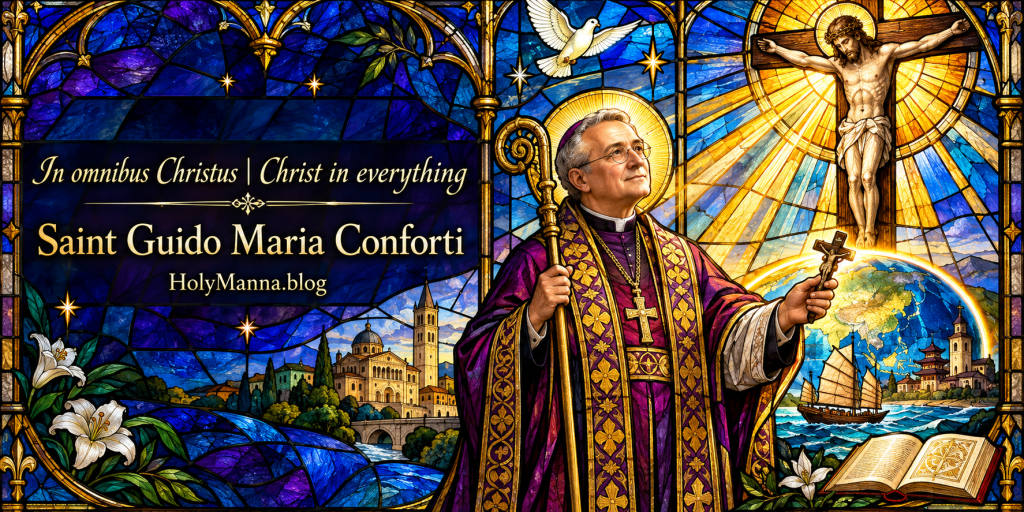
The Bishop Who Saw the Whole World from the Foot of the Cross
Some saints change the world by going to its farthest edges. Saint Guido Maria Conforti changed it by staying home and sending his heart everywhere. Born near Parma, Italy, in 1865, he longed his whole life to be a foreign missionary, and his body never allowed it. Chronic illness closed the door to the Jesuits, closed the door to the Salesians, and nearly closed the door to the priesthood itself. Yet by the time he died on November 5th, 1931, this frail diocesan bishop had founded the Xaverian Missionaries, helped reawaken the missionary conscience of the entire Catholic clergy, and shepherded the Diocese of Parma for 24 years with such holiness that the city simply called him their holy bishop. Cardinal Angelo Giuseppe Roncalli, the future Pope Saint John XXIII, summed him up in a single line, calling him “Bishop of Parma, but a Missionary for the entire world.”
Saint Guido is the patron of the Xaverian Missionaries, the religious family he founded in 1895 and placed under the protection of Saint Francis Xavier. His life is a standing answer to anyone who has ever felt that their limitations disqualify them from serving God. The Catechism teaches that the Church is missionary by her very nature, sent by God to the nations as the universal sacrament of salvation (CCC 849), and Guido Conforti proved that this mission belongs even to those who never board the ship. He was beatified by Pope Saint John Paul II on March 17th, 1996, and canonized by Pope Benedict XVI on October 23rd, 2011, fittingly on World Mission Sunday. His feast is celebrated on November 5th, the day he entered eternal life.
The Boy Who Stopped to Talk with a Crucifix
Guido Maria Conforti was born on March 30th, 1865, at Casalora di Ravadese, a farming hamlet in the countryside outside Parma, and he was baptized the very same day. He was the 8th of 10 children born to Rinaldo Conforti and Antonia Adorni, a landowning farm family of plain, sturdy Catholic faith. Nothing about his origins suggested anything extraordinary. His father expected him to grow up, take over the management of the family land, and live the respectable life of a Parma farmer.
God had other plans, and He revealed them in the most ordinary way imaginable: on the walk to school. Beginning in 1872, young Guido attended the elementary school run by the Brothers of the Christian Schools in Parma, and each day on his way there he stopped at the Church of Peace to pray before a large crucifix above the altar. Something happened in front of that crucifix that marked him for the rest of his life. Years later, as a bishop, he described those childhood visits in words his missionaries have treasured ever since: “I looked at Him and He looked at me, and it seemed as though He was telling me many things.” He came to speak of it as his miraculous crucifix, telling a friend plainly, “I owe my vocation to it.”
This is not pious decoration added after the fact. It is the documented key to everything Conforti ever did. The Catechism teaches that the desire for God is written in the human heart, because man is created by God and for God, and God never ceases to draw man to Himself (CCC 27). In that Parma church, a schoolboy let himself be drawn, and the dialogue never stopped. From that encounter came his call to the priesthood, and when he announced his intention to enter the seminary, his father Rinaldo opposed it, still hoping his son would run the farm. His mother supported him, and Guido held firm. In 1876, at only 11 years old, he entered the seminary of Parma.
It was in seminary that the second great fire of his life was lit. He read a biography of Saint Francis Xavier, the Jesuit who had carried the Gospel across India and Japan and died in 1552 on the island of Shancian, within sight of the China he never entered. Conforti was seized by the same longing. He wanted to give his life proclaiming Christ to those who had never heard His name. He applied to the Jesuits, and he was refused. He applied to the Salesians, and he was refused again. The reason both times was the same: his health was too poor. A serious nervous illness afflicted him so severely that it even placed his ordination as a diocesan priest in doubt. He was carried through that dark stretch by the steady support of his seminary rector, Fr. Andrea Ferrari, the future Cardinal Archbishop of Milan, who was himself beatified in 1987. Sustained by that friendship and by his daily converse with the Crucified Lord, Guido persevered, and on September 22nd, 1888, he was ordained a priest of the Diocese of Parma.
Christ in Everything
What does a man do when God gives him a missionary’s heart and a body that cannot leave home? Guido Conforti’s answer became one of the quiet masterpieces of modern Church history: if he could not go, he would form and send others. While serving as vice-rector of the Parma seminary, he began gathering resources, prayers, and young men. In 1893 he purchased a house on Borgo Leon d’Oro in Parma to serve as a first seminary. Then, on December 3rd, 1895, the feast of Saint Francis Xavier, the 30-year-old priest founded the Pious Society of Saint Francis Xavier for Foreign Missions, known to the world ever since as the Xaverian Missionaries. Pope Leo XIII approved the young institute in 1899, and that same year, according to the congregation’s own records, Conforti handed the missionary crucifix to his first 2 sons, Fr. Caio Rastelli and Fr. Odoardo Mainini, and sent them to China, the land Francis Xavier had died longing to enter.
Conforti gave his missionaries a motto drawn straight from Scripture: “Caritas Christi urget nos”, the love of Christ impels us, from 2 Corinthians 5:14. It is worth pausing on the fact that The Catechism cites this very verse when it explains why the Church is missionary at all: because the love of Christ urges her on, and because God desires everyone to be saved and to come to the knowledge of the truth (CCC 851). Conforti did not invent a spirituality; he simply took the Church’s deepest logic seriously. He described the identifying mark of his missionary family in his own words, as “a spirit of living faith which enables us to see God, to seek God, to love God in all.” He asked of his Xaverians total consecration to the mission through the vows of poverty, chastity, and obedience, and a lifetime given entirely to the peoples who did not yet know Christ.
Meanwhile the Church had plans for Conforti himself. In 1902 Pope Leo XIII named him Archbishop of Ravenna, one of the most venerable sees in Italy. He took as his episcopal motto “In omnibus Christus”, Christ in everything, and he meant it literally; it was the program of his entire existence, and the Xaverians later adopted that spirit as their own. His Ravenna years, however, broke his already fragile health, and after roughly 2 years he resigned the see in October 1904, returning to Parma and to his young congregation. The resignation looked like failure. It was in fact a redirection of Providence, because in 1907 the Holy See turned to him again, and on December 12th, 1907, he was installed as Bishop of Parma, his home diocese, which he would shepherd for the next 24 years until the day he died.
As bishop, Conforti was tireless in a way that astonishes anyone who remembers how sick he was. He conducted systematic pastoral visitations of his entire diocese, parish by parish, including the poorest mountain communities. Xaverian sources record that he was the first in Italy to organize a catechetical week, convinced that a faith that is not known cannot be loved or lived; in this he anticipated what The Catechism itself insists upon, that catechesis is the effort to put people in communion and intimacy with Jesus Christ (CCC 426). In a pastoral letter of 1908 he publicly denounced landowners who neglected the Christian formation of the workers in their care, a bold act for a bishop in agricultural Emilia. During the Modernist crisis of 1907 he held his priests close to the Church, asking them to reaffirm their fidelity. And through it all, he remained a father to his missionaries. In 1912, in the Cathedral of Parma, he consecrated Fr. Luigi Calza as the first Xaverian bishop, Vicar Apostolic of Cheng-chow in China.
His missionary heart refused to stay within diocesan borders, and here Conforti left his mark on the universal Church. In 1916 he joined Blessed Paolo Manna in launching the Missionary Union of the Clergy, an association designed to set every priest in Italy, and eventually the world, on fire for the missions, and Conforti served as its first president. Catholic sources further report that he provided initiative behind Pope Benedict XV’s 1919 apostolic letter Maximum Illud, the document often called the Magna Carta of modern Catholic missionary work; this influence is attributed to him by his biographers rather than formally documented, and it is presented here as such. What is beyond dispute is that the missionary renewal of the early 20th century bears his fingerprints. The Catechism teaches that each bishop, while caring for his own particular Church, bears together with all his brother bishops a solicitude for all the Churches (CCC 1560). Few bishops in modern history have lived that paragraph more completely.
In 1921, on August 15th, he finished his Testament Letter, the spiritual charter accompanying the approved Constitutions of his congregation. In it he urged his sons to live so that in every circumstance they would “keep Christ in mind”, promising that Christ would then be with them in prayer, at the altar, in study, and in all their labors. It reads like the whole of his life compressed into a counsel.
Trials Accepted as the Hand of Providence
Saint Guido Maria Conforti was not a martyr, but his road was lined with crosses from beginning to end, and the way he carried them is precisely why the Church canonized him. His hardships began in childhood with his father’s opposition to his vocation, and they never really stopped. The illness that barred him from the Jesuits and Salesians, that nearly prevented his ordination, and that forced his resignation from Ravenna remained his lifelong companion. For a man whose single burning desire was the foreign missions, there are few sufferings sharper than being told, over and over, that his own body disqualified him.
The early years of his congregation brought their own griefs. Resources were thin, vocations were fragile, and the China mission was heartbreakingly costly; his beloved first missionary, Fr. Caio Rastelli, died young in the field. The Boxer period made China a dangerous place for Christians, and Conforti had to father his sons from thousands of miles away, through letters, with no power to protect them. Then history itself seemed to conspire against his work. His episcopate unfolded across the bitter conflict between Church and State in newly unified Italy, the catastrophe of World War I, which emptied his seminaries and sent his young men to the trenches, the social upheavals that followed, and the rise of Fascism, with the Lateran Pacts coming only in 1929, 2 years before his death.
What made him a saint was not that he escaped any of this, but how he received it. At his canonization, Pope Benedict XVI taught that Conforti first lived what he later asked of his missionaries, namely that “perfection consists in doing the will of God, following the model of the crucified Jesus.” The pope described a man who accepted every situation with docility as an indication of the path Providence had traced for him, recognizing God’s plan even in debilitating illness. This is The Catechism‘s teaching on Christian perfection in flesh and blood: the way of perfection passes by way of the Cross, and there is no holiness without renunciation and spiritual battle (CCC 2015). Conforti did not merely endure his crosses; he contemplated the Crucified until his crosses became conversation.
Two touching accounts from his later years show what that lifelong dialogue produced. His biographers record that at his own father’s deathbed in 1895, Guido gently persuaded the dying Rinaldo to sign a document asking the Church’s forgiveness in case the family’s long-ago purchase of a former monastic farm at a very low price had wronged her in any way; the son who had once been opposed became the instrument of his father’s peace. And testimony preserved within the Xaverian family relates that when Conforti was around 60 years old and bishop, his sister would often find him rapt in prayer, absorbed as if in ecstasy, before the very crucifix of his childhood. That second account rests on family testimony handed down by his congregation and cannot be independently verified, but it is entirely of a piece with everything that is documented about him.
His final cross was also his final joy. From September to December of 1928, old and gravely ill, he undertook the long voyage to China to see his missionaries with his own eyes, to confirm them in their labors, and to stand at last in the mission land he had been denied his whole life. Some secondary sources place this visit in 1929, but the congregation’s official timeline records 1928. He returned to Parma spent. On November 5th, 1931, at the age of 66, Guido Maria Conforti died a holy death in his episcopal city. His funeral drew all of Parma into the streets, the poor above all, mourning the shepherd who had belonged to them for a quarter of a century.
From Burundi to Brazil
Conforti was first buried in the Cathedral of Parma, but in 1942 his body was transferred to the church of the Xaverian Motherhouse in Parma, where it rests today in the center of the apse, surrounded by the congregation he fathered. Almost immediately his successor in Parma, Bishop Evasio Colli, recognized the signs of sanctity and set in motion the process that would carry him to the altars. The decree recognizing his heroic virtues was issued on February 11th, 1982.
The miracle that opened the way to his beatification reached back to 1965 and to the heart of Africa. In Burundi, where Xaverian sisters were serving, a 12-year-old girl named Sabina Kamariza lay dying of pancreatic cancer. The sisters turned to their founder and begged his intercession, and Sabina was cured. After rigorous examination, the Church recognized the healing as miraculous by the decree of April 6th, 1995, and on March 17th, 1996, Pope Saint John Paul II beatified Guido Maria Conforti. There is a quiet poetry in the fact that the man who could never go to the missions worked his first recognized miracle in mission territory, for a child of the very peoples he had spent his life trying to reach.
The second miracle, the one required for canonization, came from another continent entirely. In August 2003, in Brazil, a premature newborn suffered complications from prolonged cardio-respiratory arrest, the kind of crisis that medicine expects to end in death or devastating injury. The baby’s family and parish community prayed a novena to Blessed Conforti, and the child survived and recovered. Pope Benedict XVI approved the decree recognizing this miracle on December 10th, 2010, announced the canonization at the consistory of February 21st, 2011, and on October 23rd, 2011, World Mission Sunday, canonized Guido Maria Conforti in Saint Peter’s Square alongside Saint Luigi Guanella and Saint Bonifacia Rodríguez de Castro. The Catechism explains what the Church does in such a moment: by canonizing some of the faithful, she recognizes the power of the Spirit of holiness within her and sustains the hope of believers by giving them models and intercessors (CCC 828).
His impact continues to spread far beyond Parma. The Xaverian Missionaries he founded now serve on 4 continents, in roughly 25 nations, carrying his charge to the ends of the earth. At a departure ceremony he once sent his sons out with words that still define them: “Go and preach the universal brotherhood proclaimed by Christ.” From that vision the Xaverians drew the phrase that remains their banner, the call to make of the world one family. Pilgrims today visit his tomb and the Conforti memorial rooms at the Motherhouse in Parma, and the humble plaster crucifix of his childhood, carefully preserved, still draws visitors who want to stand where a schoolboy once heard the silent eloquence of the Crucified. His feast is kept on November 5th, and his entry in the Roman Martyrology commemorates him as the bishop and founder who burned with zeal for the spread of the Gospel.
What the Crucifix Still Says Today
It would be easy to file Saint Guido Maria Conforti under the heading of founders and bishops and move on, but his life speaks with uncomfortable directness to anyone living in the 21st century, and especially to young adults trying to figure out what God wants from them. Consider the shape of his story. He discovered his vocation not in a dramatic vision but on the walk to school, in a daily habit of stopping, looking, and letting himself be looked at. The Catechism calls contemplative prayer a gaze of faith fixed on Jesus (CCC 2715), and that is exactly what a boy in Parma practiced until it rewrote his entire future. There is no app for that, and there is no shortcut either; there is only the decision to stop in front of the Lord today, and again tomorrow. What would change in your life if you gave Jesus 5 unhurried minutes of silence on your way to work or school each day?
Consider also what Conforti did with rejection. The 2 religious orders he loved turned him away, his health humiliated him publicly more than once, and the single dream of his heart, to be a missionary in a foreign land, was denied him until he was 63 years old. He did not grow bitter, and he did not quit; he asked what God was actually making possible, and the answer turned out to be larger than his original dream. Thousands of missionaries have gone where he could not go, because he accepted the version of the call that Providence actually gave him. Where in your own life might God be redirecting a closed door into a wider mission than the one you planned for yourself?
Finally, consider his motto, Christ in everything. Conforti refused to split his life into a spiritual compartment and a practical one. The same man prayed before the crucifix, organized catechetical weeks, confronted unjust landowners, visited mountain parishes, and wrote letters to China, and it was all one single act of love. The Catechism teaches that lay people and clergy alike are called to seek the Kingdom of God by engaging in temporal affairs and ordering them according to God’s will (CCC 898), which means a spreadsheet, a commute, a family dinner, and a hospital shift can all become mission territory. Readers can imitate Saint Guido this week in concrete ways: by adopting his habit of a daily pause before a crucifix, even one on a phone lock screen or a rosary in a pocket; by praying by name for one person who does not know Christ; by supporting missionaries with a sacrifice, an offering, or a note of encouragement; and by treating their own limitations, whether health, finances, or circumstances, not as disqualifications but as the raw material of the particular mission God is entrusting to them. Who is the one person in your life that the love of Christ is impelling you to reach?
Engage With Us!
Saint Guido Maria Conforti spent his whole life in conversation, first with a crucifix, then with his missionaries scattered across the world, and now, from heaven, with everyone who asks his intercession. Keep that conversation going here. Share your thoughts and reflections in the comments below; your story of a closed door, a daily habit of prayer, or a missionary heart might be exactly what another reader needs today. To guide the discussion, consider these questions:
- Saint Guido heard his vocation by stopping daily before a crucifix. What daily habit of prayer could you realistically commit to this week, and what is currently stopping you?
- He was rejected by the Jesuits and the Salesians because of his health, yet became the father of thousands of missionaries. How has a rejection or limitation in your own life unexpectedly opened a different path to serving God?
- His motto was Christ in everything. Which area of your life, work, relationships, finances, or free time, have you been keeping separate from Christ, and what would it look like to hand it over?
- The love of Christ impels us, he told his missionaries, echoing 2 Corinthians 5:14. Who in your life has never really heard the Gospel, and what small, loving step could you take toward them this month?
- Conforti finally reached China at 63, after a lifetime of waiting. Is there a holy desire you have been tempted to abandon because it is taking too long, and how might God be asking you to keep trusting Him with it?
May the witness of Saint Guido Maria Conforti stir up a missionary heart in every reader. Stop before the Crucified Lord and let Him look at you, because He still has many things to say. Then go, with whatever strength and whatever limits you carry, and live this day as mission territory, doing everything with the love and mercy that Jesus taught us.
Saint Guido Maria Conforti, pray for us!
Follow us on YouTube, TikTok, Instagram and Facebook for more insights and reflections on living a faith-filled life.


Leave a Reply