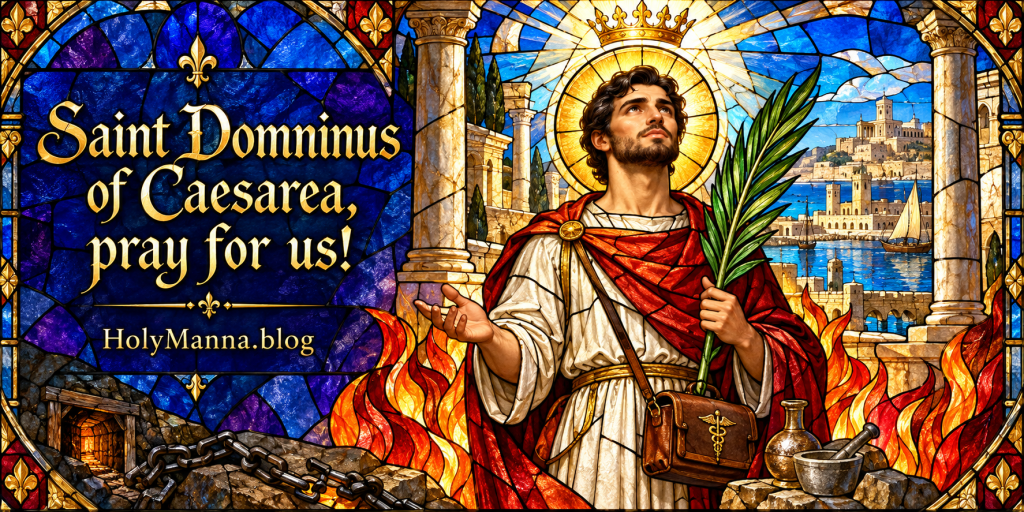
The Physician Who Walked Into the Fire
Some saints left behind cathedrals, religious orders, and shelves of writings. Saint Domninus of Caesarea left behind two paragraphs. Yet those two paragraphs, written by a man who lived in his city and watched the persecution unfold with his own eyes, have carried this young physician’s name through seventeen centuries of Christian memory. Domninus was a doctor in Caesarea Maritima, the Roman capital of Palestine, during the most ferocious persecution the early Church ever endured, the Great Persecution launched by the Emperor Diocletian in 303. He was young, respected, professionally accomplished, and utterly unafraid to be known as a Christian. For that, he was first sentenced to hard labor in the imperial copper mines, and then, on November 5th, in roughly the year 307 or 308, he was burned alive by order of the governor Urbanus.
The Church has never forgotten him. The traditional Roman Martyrology for November 5th reads, “At Caesarea in Palestine, the holy martyrs Domninus, Theotimus, Philotheus, Silvanus, and their companions, under the emperor Maximinus.” The Churches of the East commemorate him on the very same day, grouping him with the other martyrs of Palestine who suffered in that terrible season. What makes Domninus so precious is not the length of his story but its credibility. His witness comes to the present day not through centuries of pious retelling but through the pen of Eusebius of Caesarea, the father of Church history, who recorded the martyrs of his own province in a work called The Martyrs of Palestine, written around the year 311, while the ashes of the persecution were still warm. The Catechism of the Catholic Church explains why the Church treasures records like this one: “The Church has painstakingly collected the records of those who persevered to the end in witnessing to their faith. These are the acts of the Martyrs. They form the archives of truth written in letters of blood” (CCC 2474). Saint Domninus belongs to those archives, and his page, though short, is written in exactly that ink.
A Young Doctor in Caesarea
Honesty demands a plain admission at the start: history preserves nothing about Domninus’s birthplace, his parents, his education, or the moment he first came to faith in Jesus Christ. The ancient sources are silent on his family and his formation, and any detail beyond what Eusebius wrote would be invention. What the record does preserve, however, is a portrait vivid enough to make him feel like someone a person might actually know. The longer Syriac text of Eusebius’s Martyrs of Palestine describes him as “a certain man, admirable in all his conduct, and excellently skilled in the science of medicine,” and continues that he was “a young man of tall stature and handsome, and celebrated for the holiness of his life, and the purity of his soul, and his modesty.”
Sit with that description for a moment. Domninus was not a hermit on the margins of society. He was a young professional with a demanding career, good standing, and, by the sound of it, every natural advantage. He lived in Caesarea Maritima, a gleaming Herodian port city on the Mediterranean coast, the seat of Roman government for the whole province of Palestine. It was a city of commerce, politics, pagan temples, and a vibrant Christian community that had been growing there since the days of the Acts of the Apostles, when Saint Peter baptized the centurion Cornelius in that very city, as recorded in Acts 10. By the early fourth century, Caesarea was home to one of the greatest Christian libraries in the world, built up by the priest Pamphilus, and to the young scholar Eusebius, who would one day write Domninus’s story.
Medicine in that world was a vocation of real service. The Old Testament itself honors the healer’s art: “Honor the physician with the honor due him, according to your need of him, for the Lord created him; for healing comes from the Most High” (Sirach 38:1 to 2). The Catechism teaches that “life and physical health are precious gifts entrusted to us by God” (CCC 2288), and a Christian physician of Domninus’s day stood at the meeting point of natural skill and supernatural charity, tending bodies while bearing witness to the Lord who heals souls. Whatever the details of his conversion, which no source records, the fruit of it was unmistakable. Eusebius says Domninus “was well known to all in Palestine for his exceeding fearlessness.” The Greek word behind “fearlessness” literally means freedom, the bold, open frankness of a man who would not hide what he believed. In a province where confessing Christ could cost a person everything, the young doctor’s faith was common knowledge from one end of Palestine to the other.
Holiness With a Stethoscope’s Worth of Credibility
Why does Domninus matter, and why should anyone remember and imitate him? Because he shows that sanctity does not require a dramatic resume. It requires fidelity. Eusebius, in the shorter Greek text, calls him “a man who was illustrious through numerous other confessions.” That phrase deserves attention. Before the day of his death, Domninus had already been hauled before the authorities more than once and had confessed Christ every single time. The Syriac account adds that “previously to his receiving consummation by martyrdom, had endured torture in the copper mines.” The mines in question were almost certainly the dreaded copper mines of Phaeno, in the desert southeast of the Dead Sea, where condemned Christians were worked in brutal conditions, often after being deliberately maimed. Domninus had been there. He had suffered there. And when he came out, he did not quietly relocate, change his name, and keep his head down. He went on being openly, famously Christian in the capital city of the persecution.
Here, too, honesty matters. Eusebius records no miracles worked by Domninus during his lifetime, no healings beyond the ordinary mercy of his medical practice, no wonders or visions. The scholarly record confirms that the ancient account of his suffering contains no reference to miraculous events at all. That absence is not a weakness in his story; it is the story. The one marvel Eusebius thought worth preserving was the supernatural steadiness of an ordinary layman under extraordinary pressure. The Church has a name for that steadiness. “Fortitude is the moral virtue that ensures firmness in difficulties and constancy in the pursuit of the good,” teaches the Catechism, and “the virtue of fortitude enables one to conquer fear, even fear of death, and to face trials and persecutions” (CCC 1808). Domninus practiced medicine with his hands and fortitude with his whole life, and his repeated confessions were the slow, faithful training for the final one. In him the words of Scripture found a living illustration: “God did not give us a spirit of timidity but a spirit of power and love and self control” (2 Timothy 1:7).
One Hour of Cruelty on the 5th of November
The persecution in Palestine ground on year after year, and Eusebius counted its anniversaries the way a prisoner counts days. In what he calls the fifth year of the persecution, the governor Urbanus presided over a day of concentrated cruelty in Caesarea that Eusebius never forgot. The Greek text dates it precisely: “Afterwards on the fifth of the month Dius, on the Nones of November according to the Romans,” that is, November 5th. Scholars debate whether the year was 307 or 308, and that disagreement should be stated plainly rather than papered over; some later summaries even give 310, though the near contemporary evidence points to 307 or 308. Whatever the year, the date itself, November 5th, is why the Church keeps his memory on this day.
On that single day, Urbanus unleashed a catalogue of sentences that reads like a tour of Roman brutality. The priest Silvanus, a confessor who would soon be made bishop of Gaza and would later win his own martyr’s crown, was condemned along with his companions to the copper mines of Phaeno. Elsewhere in the same account, Eusebius describes condemned confessors having the tendons of their ankles seared with hot irons before being sent to those mines. Three young men were sentenced to the gladiatorial school to fight for the crowd’s amusement. An elderly Christian named Auxentius was thrown to the wild beasts. Others were mutilated. Consecrated virgins were handed over to brothels, a sentence designed to break the spirit where torture had failed. Still others were thrown into prison, and shortly afterward the great priest and scholar Pamphilus, the beloved teacher of Eusebius himself, was arrested and jailed. The Syriac account summarizes the horror with chilling brevity: “Now all these things which we have described did this arrogant judge perpetrate in one hour.”
And in the middle of that hour stood the young physician. Eusebius writes that the governor “delivered to the flames a man who was illustrious through numerous other confessions. This was Domninus.” The Syriac text explains the sentence: “on account of his patience under his confession he was condemned to the punishment by fire.” Read that carefully. It was not stubbornness, not sedition, not any crime of violence that earned Domninus the stake. It was patience. His calm, unbreakable perseverance in confessing Jesus Christ so offended the court that only fire seemed sufficient to answer it. He was burned alive in the city where he had healed the sick, under the eyes of neighbors who knew him, and he went to his death with the same fearlessness that had made him famous across Palestine. The Lord’s own promise covers such a death completely: “Be faithful unto death, and I will give you the crown of life” (Revelation 2:10). The Catechism teaches that “martyrdom is the supreme witness given to the truth of the faith: it means bearing witness even unto death” (CCC 2473), and on November 5th the physician of Caesarea gave that supreme witness in full.
Eusebius adds a sobering epilogue about the judge. Within a very short time, Urbanus, the man who had sat enthroned over Palestine dispensing agony, was suddenly ruined. The Syriac account says he was “in one night stripped of all his splendour and all his honours, and reduced to the condition of a private individual,” and that in Caesarea itself, the very city of his crimes, he was condemned to death by Maximinus, the same tyrant he had served, and died amid public insult and humiliation. Eusebius presents this not as coincidence but as a foretaste of divine judgment. The contrast is the whole lesson of the martyrs in miniature: the governor’s power evaporated in a night, while the condemned doctor’s name is still spoken at altars seventeen hundred years later.
A Memory the Fire Could Not Consume
What happened after Domninus’s death? Here again, the honest answer is the humble one. No miracles are recorded at his tomb, because no tomb is recorded; the ancient sources describe no recovery of relics, no shrine, no documented healings, and no pilgrimage site dedicated to him. Caesarea itself, the stage of his martyrdom, declined in later centuries and eventually fell into ruin, and whatever local veneration the Christians of Caesarea offered him in the years right after his death, and the careful recording of his exact date of death suggests they did commemorate him there, has left no monument of stone. The Church’s rule for such cases is simple: report nothing that cannot be supported, and let the verified witness shine on its own.
Yet Domninus’s afterlife in the Church’s memory is real and remarkable. In the West, his name entered the Roman Martyrology on November 5th, joined with Theotimus, Philotheus, Silvanus, and their companions. In the East, the Byzantine calendars keep the same day for the martyrs of Palestine, listing Domninus first among names such as Timothy, Theophilus, Theotimus, Dorotheus, Eupsychius, Carterius, Silvanus, and Pamphilus. Later Eastern tradition filled in details about those companions, recounting, for example, that Timothy, Theophilus, and Theotimus were beaten to death and that the priest Dorotheus was torn apart by animals. These expanded accounts are tradition handed down in the synaxaria rather than eyewitness history, and they cannot be verified. Vatican News, in its Saint of the Day listing for November 5th, still presents the core of the story today, remembering Domninus as a young doctor who died at the stake during the persecution of Diocletian, with Theotimus and companions given to the wild beasts.
There is also a quieter, deeper impact worth naming. The man who wrote Domninus’s story, Eusebius of Caesarea, survived the persecution and became the first great historian of the Church, and his teacher Pamphilus, arrested in the same wave of terror that killed Domninus, died a martyr whose memory Eusebius spent his life honoring. The courage of the Caesarean martyrs, Domninus among them, directly shaped the Church’s conviction that the stories of her witnesses must be gathered, guarded, and handed on. Every Catholic who has ever been moved by the acts of the martyrs is, in some small way, in the debt of that November day in Caesarea. The Catechism describes the living bond that makes such memory more than nostalgia: in venerating the saints, “it is not merely by the title of example that we cherish the memory of those in heaven; we seek, rather, that by this devotion to the exercise of fraternal charity the union of the whole Church in the Spirit may be strengthened” (CCC 957). Domninus is not a museum piece. He is family, alive in Christ, and praying for the Church on earth.
What a 4th Century Doctor Says to a Modern Monday
It would be easy to file Saint Domninus under ancient history and move on. Resist that. His situation is strikingly close to the situation of many believers today, especially young adults building careers in environments where open faith carries a social cost. Domninus was a competent, well liked professional whose Christianity was public knowledge. He did not pick fights, and the sources praise his modesty, not his combativeness. But he also refused the quiet apostasy of simply never mentioning Christ. His faith was visible, repeatedly, at real personal risk, and that visibility is exactly what the Lord asks: “Let your light so shine before men, that they may see your good works and give glory to your Father who is in heaven” (Matthew 5:16). When colleagues, classmates, or friends think of you, do they know whom you serve?
His story also reframes suffering that comes in installments. Domninus did not face one heroic moment; he faced the mines, then release, then continued pressure, then the fire. Most crosses arrive the same way, not as a single dramatic choice but as a long series of smaller confessions: the Sunday Mass kept when the weekend fills up, the honest answer given when silence would be easier, the moral line held at work when holding it costs a promotion or a friendship. The Catechism calls every baptized person to exactly this steady witness, teaching that the disciple of Christ must “not be ashamed then of testifying to our Lord” and must be ready to confess him “in situations that require witness to the faith” (CCC 2471 to 2472). Fortitude, the virtue Domninus embodied, is a gift of the Holy Spirit that grows with use (CCC 1808, 1831). What small confession of faith have you been postponing, and what would it look like to make it this week?
Finally, Domninus sanctified his profession before he ever sanctified a pyre. He healed people. He did his daily work with excellence and holiness at the same time, which is precisely the vocation of the laity described in the Catechism: lay people are called to “seek the kingdom of God by engaging in temporal affairs and directing them according to God’s will” (CCC 898). A practical way to imitate him is to pick one concrete act of mercy inside ordinary work this week, treating a difficult client with patience, checking on a struggling coworker, doing hidden tasks well when no one is watching, and to offer it consciously to God. Another is to pray for persecuted Christians, who still today face what Domninus faced, and to let their courage put everyday inconveniences in perspective. The Lord’s arithmetic has not changed since Caesarea: “For whoever would save his life will lose it; and whoever loses his life for my sake and the gospel’s will save it” (Mark 8:35). If following Jesus suddenly carried a real cost in your life, what, honestly, would you do?
Engage With Us!
Saint Domninus’s story is short, but the conversation it starts does not have to be. Share your thoughts and reflections in the comments below; hearing how God is working in the lives of readers is one of the great joys of this community. Here are some questions to pray with and respond to:
- Saint Domninus was known across an entire province for his fearlessness about the faith. On a scale from hidden to fearless, how visible is your faith to the people around you, and why?
- He endured the mines before he endured the fire. What repeated, unglamorous trial in your life might God be using to train you in fortitude right now?
- Domninus lived his holiness through his profession as a physician. What is one concrete way you could turn your daily work into an offering to God this week?
- The governor who condemned him lost everything within a short time, while the martyr gained eternity. Where in your life are you tempted to trade lasting goods for passing security or approval?
- No miracles or famous sayings of Saint Domninus survive, only his faithfulness. If faithfulness were the only thing history remembered about you, what would you want it to say?
Take Saint Domninus with you into this week. Be brave in small things, be excellent in hidden things, and be unashamed of the name of Jesus in public things. The same Holy Spirit who steadied a young doctor in Caesarea is poured out on every baptized soul today, and heaven is cheering for every quiet confession of faith. Live boldly, love generously, and do everything with the love and mercy that Jesus taught, trusting the promise he keeps for all who persevere: “Be faithful unto death, and I will give you the crown of life” (Revelation 2:10).
Saint Domninus of Caesarea, pray for us!
Follow us on YouTube, TikTok, Instagram and Facebook for more insights and reflections on living a faith-filled life.


Leave a Reply