Thursday of the Thirty-first Week in Ordinary Time – Lectionary: 488
When the Seeker Discovers He Was Being Sought
Every person who has ever searched for God eventually stumbles onto a startling secret: He was searching first. The readings for November 5th, Thursday of the Thirty-first Week in Ordinary Time, circle around one radiant theme, the joy of seeking and being found. Saint Paul opens the day by emptying his pockets of every credential he ever earned, declaring in Philippians 3:3-8a that his flawless pedigree and blameless record amount to loss next to “the supreme good of knowing Christ Jesus my Lord.” The Responsorial Psalm, Psalm 105:2-7, answers with a command that sounds almost like a promise: “Rejoice, O hearts that seek the LORD!” Then the Gospel, Luke 15:1-10, pulls back the curtain on the whole mystery. While the Pharisees grumble that Jesus “welcomes sinners and eats with them,” He tells of a shepherd who leaves ninety-nine sheep to chase one stray and a woman who turns her house upside down for a single coin, because heaven erupts in joy “over one sinner who repents.”
The cultural backdrop sharpens the picture. In the ancient world, religious standing was currency: ancestry, ritual observance, and table company defined who belonged. Paul had all of it. The tax collectors crowding around Jesus had none of it. Yet both discover the same truth from opposite directions, that belonging to God is not earned by résumé or forfeited by failure. It is given by a God who goes out looking. As Ordinary Time draws toward its final weeks and the Church turns her gaze to last things, these readings ask a disarmingly simple question. If God is already out searching the desert and sweeping the house, what is still worth clinging to that keeps a soul from being found?
First Reading — Philippians 3:3-8a
The Most Impressive Résumé in Israel Goes in the Trash
Philippi was the first city in Europe where Saint Paul planted the Gospel, a proud Roman colony in Macedonia populated by veterans who treasured their citizenship and their status. Paul writes to this beloved community from prison, most likely in Rome around the year 62, and the letter overflows with joy. That makes this passage all the more striking. Agitators, often called Judaizers, had been telling Gentile converts that faith in Christ was not enough; real belonging required circumcision and full observance of the Mosaic law. Paul does not answer with an abstract argument. He answers with his own story. He lays out the most impressive religious résumé imaginable and then declares the whole portfolio a loss. The reading fits the day’s theme perfectly, because this is a man who went out to defend God’s honor and was instead found by God on the Damascus road, and everything got repriced in that moment.
Philippians 3:3-8a
Brothers and sisters:
We are the circumcision,
we who worship through the Spirit of God,
who boast in Christ Jesus and do not put our confidence in flesh,
although I myself have grounds for confidence even in the flesh.If anyone else thinks he can be confident in flesh, all the more can I.
Circumcised on the eighth day,
of the race of Israel, of the tribe of Benjamin,
a Hebrew of Hebrew parentage,
in observance of the law a Pharisee,
in zeal I persecuted the Church,
in righteousness based on the law I was blameless.But whatever gains I had,
these I have come to consider a loss because of Christ.
More than that, I even consider everything as a loss
because of the supreme good of knowing Christ Jesus my Lord.
Detailed Exegesis
Verse 3: “We are the circumcision, we who worship through the Spirit of God, who boast in Christ Jesus and do not put our confidence in flesh.”
Paul boldly redefines who belongs to God’s covenant people. The prophets had long insisted that God desires circumcision of the heart, as Deuteronomy 30:6 and Jeremiah 4:4 make clear, and Paul declares that this interior reality is now accomplished in those who worship through the Spirit. Identity before God rests on Christ, not on ancestry, ritual pedigree, or human performance, which Paul sums up with the loaded word “flesh.”
Verse 4: “Although I myself have grounds for confidence even in the flesh. If anyone else thinks he can be confident in flesh, all the more can I.”
Paul is not dismissing privileges he never possessed, like a man scorning wealth he could never earn. He is about to beat the Judaizers at their own game. Whatever they can claim, he can top, which makes his coming renunciation impossible to wave away.
Verse 5: “Circumcised on the eighth day, of the race of Israel, of the tribe of Benjamin, a Hebrew of Hebrew parentage, in observance of the law a Pharisee.”
The first four credentials were inherited. Circumcision on the eighth day, exactly as Leviticus 12:3 prescribes, marks him as born into the covenant rather than a convert. Benjamin was the tribe that gave Israel her first king, Saul, the apostle’s own namesake, and remained loyal to Judah when the kingdom split. Raised in a Hebrew-speaking household despite growing up in Tarsus, he then chose the fifth credential himself, joining the Pharisees, the most rigorous school of the law, and studying under the great Gamaliel, as Acts 22:3 records.
Verse 6: “In zeal I persecuted the Church, in righteousness based on the law I was blameless.”
In Paul’s world, zeal was a badge of honor, recalling heroes who defended the covenant with fierce devotion. His persecution of the Church, which he elsewhere grieves, was at the time the crown jewel proving his sincerity. “Blameless” means no one could point to an external violation of the law. This is confidence in the flesh at its absolute peak, and it still left him without Christ.
Verse 7: “But whatever gains I had, these I have come to consider a loss because of Christ.”
Paul reaches for accounting language. Everything once listed in the asset column has been moved, deliberately and permanently, to the liability column. The hinge of this reversal is the encounter on the road to Damascus in Acts 9, when the risen Christ found the man who thought he was defending God against Him. The Greek verb tense signals a settled judgment that still stands, not a passing mood of spiritual enthusiasm.
Verse 8a: “More than that, I even consider everything as a loss because of the supreme good of knowing Christ Jesus my Lord.”
The claim expands from “whatever gains I had” to “everything.” Not just religious credentials, but anything at all that competes with Christ. The knowing Paul describes is not information about Jesus; in the biblical sense, knowledge means intimate personal communion. Notice the quiet intimacy of the phrase “my Lord.” The persecutor has become a man in love.
Teachings
The Church treasures this passage so deeply that she places it at the foundation of all teaching about Jesus. The Catechism declares in CCC 428, “Whoever is called ‘to teach Christ’ must first seek ‘the surpassing worth of knowing Christ Jesus’; he must suffer ‘the loss of all things. . .’ in order to ‘gain Christ and be found in him,’ and ‘to know him and the power of his resurrection, and [to] share his sufferings, becoming like him in his death, that if possible [he] may attain the resurrection from the dead.’ In other words, no one can hand on the faith as a mere subject matter. The teacher must first be a finder of the treasure.
Centuries later, Saint Ignatius of Loyola, himself a proud man stripped of his ambitions by a cannonball at Pamplona, distilled Paul’s logic into the famous prayer from his Spiritual Exercises known as the Suscipe: “Take, Lord, and receive all my liberty, my memory, my understanding, and my entire will, all that I have and possess. You have given all to me. To you, O Lord, I return it. All is yours; dispose of it wholly according to your will. Give me your love and your grace, for this is enough for me.” Both the apostle and the soldier discovered the same arithmetic. When Christ is gained, nothing surrendered counts as a loss.
Reflection
Every age has its version of Paul’s résumé. Today it looks like degrees, job titles, follower counts, fitness milestones, and carefully curated reputations. None of these things is evil, and Paul never says his heritage was worthless in itself. The danger is confidence, quietly trusting the portfolio instead of the Person. One concrete practice can help this week: take 10 minutes in prayer and actually write out a personal list of credentials, the things that make self-worth feel secure. Then read Philippians 3:7 over the list and ask Jesus for the grace to hold every item with open hands. Another step is to reclaim the word “knowing.” Trade 15 minutes of scrolling each day for 15 minutes with the Gospels, not to study Christ but to meet Him. What sits in your asset column that quietly competes with Christ for your confidence? If everything on that list vanished tomorrow, would Jesus be enough? What would it look like, this week, to pursue knowing Christ with the same energy once spent polishing the résumé?
Responsorial Psalm — Psalm 105:2-7
A Song for People Prone to Forgetting
Psalm 105 is one of the great historical psalms of Israel, a sweeping hymn that retells the covenant story from Abraham through Joseph, Moses, and the Exodus. Its opening verses carry a fascinating pedigree: nearly the same words appear in 1 Chronicles 16, the song of thanksgiving appointed when King David brought the Ark of the Covenant into Jerusalem amid dancing, trumpets, and sacrifice. This was Israel’s liturgy of memory. In the biblical mind, remembering is not nostalgia; it is a covenant act that makes God’s saving deeds present again, which is why the psalmist piles up commands to sing, proclaim, glory, rejoice, look, seek, and recall. Placed between Paul’s renunciation and the parables of the lost, the psalm supplies the day’s refrain and its emotional key. Seeking the Lord is not grim duty. It is the one search that ends in joy, precisely because the Seeker on the other end never stopped first.
Psalm 105:2-7
R. (3b) Let hearts rejoice who search for the Lord.
or:
R. Alleluia.
Sing to him, sing his praise,
proclaim all his wondrous deeds.
Glory in his holy name;
rejoice, O hearts that seek the LORD!
R. Let hearts rejoice who search for the Lord.
or:
R. Alleluia.
Look to the LORD in his strength;
seek to serve him constantly.
Recall the wondrous deeds that he has wrought,
his portents, and the judgments he has uttered.
R. Let hearts rejoice who search for the Lord.
or:
R. Alleluia.
You descendants of Abraham, his servants,
sons of Jacob, his chosen ones!
He, the LORD, is our God;
throughout the earth his judgments prevail.
R. Let hearts rejoice who search for the Lord.
or:
R. Alleluia.
Detailed Exegesis
Verse 2: “Sing to him, sing his praise, proclaim all his wondrous deeds.”
The psalm opens this selection with doubled song, because gratitude that stays silent tends to evaporate. The “wondrous deeds” are God’s concrete interventions in history, and proclaiming them is Israel’s original evangelization, telling the story aloud so the next generation inherits the memory.
Verse 3: “Glory in his holy name; rejoice, O hearts that seek the LORD!”
Here is the refrain verse, and it contains a quiet paradox. Ordinarily people rejoice when a search ends, yet the psalmist commands joy for those still seeking. In the biblical grammar of grace, the search itself is already a gift, because no one seeks God who has not first been stirred by Him.
Verse 4: “Look to the LORD in his strength; seek to serve him constantly.”
Seeking is not a weekend hobby but a constant orientation, and it leans on God’s strength rather than human willpower. The verse points Israel toward the sanctuary, where the Ark embodied the Lord’s powerful presence, and points the Christian toward the tabernacle.
Verse 5: “Recall the wondrous deeds that he has wrought, his portents, and the judgments he has uttered.”
Memory is the fuel of faith. The portents recall the signs worked in Egypt, and the judgments are God’s authoritative words that shaped a people. Forgetting these deeds was Israel’s recurring road to idolatry, which is why remembering is commanded like a survival skill.
Verse 6: “You descendants of Abraham, his servants, sons of Jacob, his chosen ones!”
The psalmist names his audience by their family tree, children of the promise made to Abraham and renewed to Jacob. Election here is not privilege for its own sake but vocation, a people chosen to carry blessing to all nations, a thread Saint Paul picks up when he redefines Abraham’s true descendants by faith.
Verse 7: “He, the LORD, is our God; throughout the earth his judgments prevail.”
The selection closes with a creed in miniature. The God of this one small people is no tribal deity; His judgments run to the ends of the earth. The psalm quietly anticipates the Gospel scene, where the Lord of all the earth goes searching for one sheep and one coin.
Teachings
It is no accident that when the Catechism opens its very first chapter on man’s capacity for God, it reaches for this exact verse. CCC 30 teaches, “‘Let the hearts of those who seek the Lord rejoice.’ Although man can forget God or reject him, He never ceases to call every man to seek him, so as to live and find happiness. But this search for God demands of man every effort of intellect, a sound will, ‘an upright heart,’ as well as the witness of others who teach him to seek God.” The same paragraph then hands the microphone to Saint Augustine, the restless seeker who spent decades chasing lesser loves before being found, whose words from the Confessions remain the most famous sentence in Christian literature outside Scripture: “you have made us for yourself, and our heart is restless until it rests in you.” The Doctor of Grace discovered what the psalmist sang a thousand years earlier. The ache to seek God is itself evidence of God, planted in the heart by the One who wants to be found.
Reflection
Modern life is engineered for forgetting. Notifications bury last year’s answered prayers under this morning’s noise, and a heart that cannot remember what God has done will struggle to trust what God will do. The psalm offers a practical remedy: recall, then proclaim. Start a simple “wondrous deeds” note on your phone or in a journal, and each evening write one line recording where God showed up that day, a provision, a conversation, a mercy. Within a month there will be a personal Psalm 105, a private record of a faithful God. Then take the harder step and proclaim it, sharing one of those deeds out loud with a friend, a spouse, or a coworker this week. When was the last time you recounted, out loud, something God has done for you? Does your pursuit of the Lord feel constant, or does it flare up only in a crisis? What daily habit could turn remembering God’s faithfulness into the rhythm of your life?
Holy Gospel — Luke 15:1-10
The Scandal of Mercy at the Dinner Table
In first-century Judaism, sharing a table was never casual. Eating with someone signified acceptance, fellowship, and even covenant solidarity, which is why the Pharisees were not merely annoyed by Jesus’s dinner guests; they were theologically scandalized. Tax collectors collaborated with Rome and were presumed dishonest, while “sinners” covered everyone whose life or trade placed them outside respectable observance. By welcoming them, Jesus seemed to blur the very boundaries that protected holiness. His answer is the magnificent fifteenth chapter of The Gospel of Luke, three parables of the lost, of which the Lectionary gives the first two today. Behind the shepherd image stands Ezekiel 34, where God condemns Israel’s failed shepherds and promises, “I myself will pasture my sheep.” Jesus eating with sinners is that promise keeping itself. The seeking God has arrived in person.
Luke 15:1-10
The tax collectors and sinners were all drawing near to listen to Jesus,
but the Pharisees and scribes began to complain, saying,
“This man welcomes sinners and eats with them.”
So Jesus addressed this parable to them.
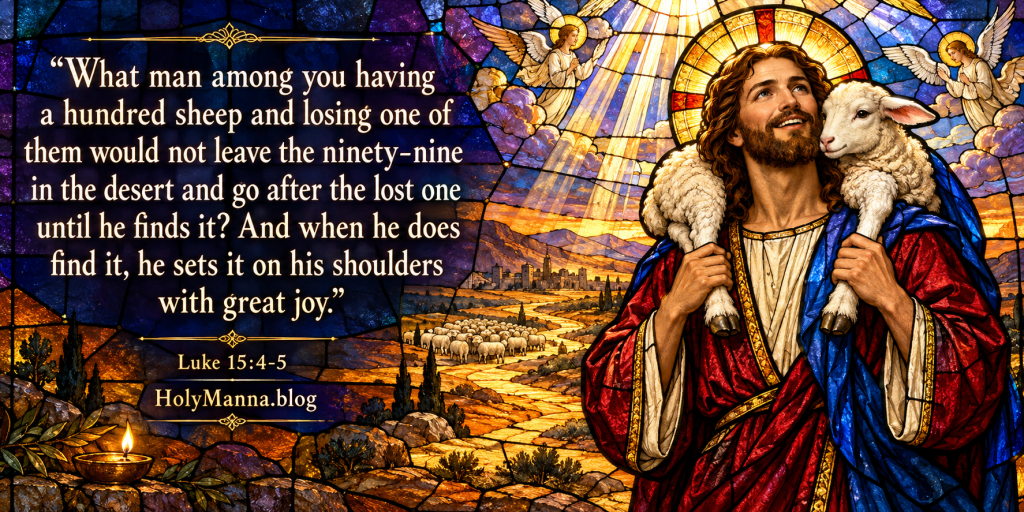
“What man among you having a hundred sheep and losing one of them
would not leave the ninety-nine in the desert
and go after the lost one until he finds it?
And when he does find it,
he sets it on his shoulders with great joy
and, upon his arrival home,
he calls together his friends and neighbors and says to them,
‘Rejoice with me because I have found my lost sheep.’
I tell you, in just the same way
there will be more joy in heaven over one sinner who repents
than over ninety-nine righteous people
who have no need of repentance.
“Or what woman having ten coins and losing one
would not light a lamp and sweep the house,
searching carefully until she finds it?
And when she does find it,
she calls together her friends and neighbors
and says to them,
‘Rejoice with me because I have found the coin that I lost.’
In just the same way, I tell you,
there will be rejoicing among the angels of God
over one sinner who repents.”
Detailed Exegesis
Verse 1: “The tax collectors and sinners were all drawing near to listen to Jesus.”
Luke notes that “all” were drawing near. The people furthest from religious respectability felt safest close to perfect Holiness, which says everything about how Jesus carried mercy.
Verse 2: “But the Pharisees and scribes began to complain, saying, ‘This man welcomes sinners and eats with them.’”
The complaint is meant as an accusation, yet the Church has always heard it as an accidental Gospel summary. Their grumbling echoes Israel’s murmuring in the desert, religion soured into resentment.
Verse 3: “So Jesus addressed this parable to them.”
Jesus aims the parable not at the sinners but at the grumblers. He does not defend Himself with doctrine; He tells a story designed to expose what their hearts are missing, the joy.
Verse 4: “What man among you having a hundred sheep and losing one of them would not leave the ninety-nine in the desert and go after the lost one until he finds it?”
The question sounds rhetorical, but the economics are reckless. No prudent shepherd risks ninety-nine for one. That is the point. Divine love does not calculate percentages, and the words “until he finds it” reveal a seeking that refuses to quit.
Verse 5: “And when he does find it, he sets it on his shoulders with great joy.”
A stray sheep often lies down exhausted and must be carried. There is no scolding in this verse, only shoulders and joy. The Church’s earliest art in the Roman catacombs chose this image of the Good Shepherd as her favorite portrait of Christ.
Verse 6: “And, upon his arrival home, he calls together his friends and neighbors and says to them, ‘Rejoice with me because I have found my lost sheep.’”
Finding overflows into celebration, and private mercy becomes communal feast. The shepherd’s invitation quietly rebukes the Pharisees, who were invited to rejoice over returning sinners and chose to complain instead.
Verse 7: “I tell you, in just the same way there will be more joy in heaven over one sinner who repents than over ninety-nine righteous people who have no need of repentance.”
Jesus pulls back the veil on heaven’s emotional life. The phrase about the righteous carries gentle irony, since Scripture insists no one is without need of repentance. Those who think they need no mercy simply exclude themselves from the party.
Verse 8: “Or what woman having ten coins and losing one would not light a lamp and sweep the house, searching carefully until she finds it?”
The drachma was roughly a day’s wage, a serious loss in a poor household with a dirt floor and a single small door for light. A tradition of interpretation suggests the ten coins may have been part of a woman’s dowry, though that remains a suggestion rather than a certainty. Strikingly, Jesus casts a woman as the image of the seeking God.
Verse 9: “And when she does find it, she calls together her friends and neighbors and says to them, ‘Rejoice with me because I have found the coin that I lost.’”
The pattern repeats deliberately: losing, searching, finding, rejoicing together. The coin did nothing to be found. Grace arrives first, and the Fathers noted that the coin, stamped with the ruler’s image, pictures the soul stamped with the image of God.
Verse 10: “In just the same way, I tell you, there will be rejoicing among the angels of God over one sinner who repents.”
Every confession, every quiet return to God, sets off celebration among the angels. Repentance on earth is a party in heaven, and the grumbling Pharisees are left standing outside the joy.
Teachings
The Catechism confirms that the meal was the message. CCC 589 teaches, “Jesus gave scandal above all when he identified his merciful conduct toward sinners with God’s own attitude toward them. He went so far as to hint that by sharing the table of sinners he was admitting them to the messianic banquet.” CCC 545 adds, citing this very Gospel, “Jesus invites sinners to the table of the kingdom: ‘I came not to call the righteous, but sinners.’ He invites them to that conversion without which one cannot enter the kingdom, but shows them in word and deed his Father’s boundless mercy for them and the vast ‘joy in heaven over one sinner who repents.’” Mercy, in other words, never cancels conversion; it makes conversion possible and joyful.
The Church Fathers read these parables with breathtaking depth. Saint Ambrose, Doctor of the Church, asks in his Exposition of the Gospel of Luke, “Who are these three persons: the shepherd, the woman, the father? Is not Christ the Shepherd, the Church the woman, and God the Father? Christ Who took upon Himself your sins bears you upon His own Body; the Church searches for you; the Father receives you back.” Saint Gregory the Great, preaching on this passage in his Homily 34 on the Gospels, saw the whole cosmos in the ten coins: “He who is signified by the shepherd, is signified also by the woman. For it is God Himself, God and the wisdom of God… The woman had ten pieces of silver, because there are nine orders of angels, but, that the number of the elect might be filled up, man, the tenth, was created.” Humanity is the missing tenth coin heaven refuses to live without.
Reflection
These parables land differently depending on where you are standing. If you have wandered far, hear the shepherd’s footsteps; no distance outruns the search, and the confessional is where He sets the found sheep on His shoulders. Make a concrete plan to return to the Sacrament of Reconciliation this month. If you are among the faithful ninety-nine, check your heart for the grumble, that quiet resentment when mercy reaches people who seem not to deserve it. Pray by name this week for one person who has left the faith, and extend one genuine welcome, a meal, a message, an invitation, to someone the respectable crowd overlooks. Which character in these parables are you right now: the lost sheep, the swept-for coin, the grumbler, or a friend invited to rejoice? Whose repentance would make you celebrate, and whose would secretly bother you? What is one step you can take this week to join God’s search party?
Carried Home on His Shoulders
Picture the day’s three scenes side by side. A chained apostle in Rome tears up the finest religious résumé in Israel and calls it loss, because somewhere on a dusty road the Christ he was persecuting found him first. A choir in Jerusalem sings before the Ark, commanding every heart that seeks the Lord to rejoice, because the search itself is already touched by grace. And in Galilee, a Shepherd answers His critics not with an argument but with a party, describing a God who leaves the ninety-nine, lights the lamp, sweeps the floor, and will not stop “until he finds it.”
Stitch the scenes together and the message of November 5th comes into focus. The spiritual life is not a performance review; it is a rescue story, and heaven keeps the champagne ready. Paul teaches what to release, the psalmist teaches what to remember, and Jesus reveals Who has been searching all along. Saint Ambrose put it simply: Christ carries, the Church seeks, the Father receives.
So here is the invitation this Thursday in Ordinary Time. Stop clutching the credentials and the failures alike, since both make poor substitutes for being carried. Let the memory of God’s wondrous deeds, in Scripture and in a personal story, fuel a constant and joyful seeking. And if the distance has grown long, come home; the Sacrament of Reconciliation is where the lost get found and the angels start rejoicing. Somewhere today a sinner will whisper a genuine act of contrition, and the halls of heaven will erupt like a stadium at the final buzzer. There is no reason that sinner cannot be the very one reading these words, and no reason the rejoicing cannot begin tonight.
Engage With Us!
These readings were made for conversation, so please share your reflections in the comments below. Your story of seeking, or of being found, might be exactly the encouragement another reader needs today. Here are a few questions to pray with before you write:
- In Philippians 3:3-8a, Saint Paul counts his finest credentials as loss next to knowing Christ. Which achievement, credential, or identity marker would be hardest for you to release, and what would it take to hold it with open hands?
- Psalm 105:2-7 commands hearts that seek the Lord to rejoice and to recall His wondrous deeds. What is one wondrous deed God has worked in your own life that you need to remember and proclaim this week?
- In Luke 15:1-10, heaven rejoices over one sinner who repents. Where do you find yourself in these parables today: the lost sheep being carried home, the coin waiting to be found, the grumbler at the edge of the party, or the friend invited to rejoice?
- Taking all the readings together, the God who is worth everything is also the God who searches for everyone. What would change in your daily life if you truly believed that heaven throws a celebration over you personally?
Living a life of faith is not about polishing a spiritual résumé; it is about staying close to the Shepherd who carries His sheep and joining His search for the ones still missing. Keep seeking Him with a rejoicing heart, keep returning when you stray, and do everything this week with the love and mercy Jesus taught us.
Sacred Heart of Jesus, we trust in You!
Immaculate Heart of Mary, pray for us!
Saint Michael the Archangel, defend us in battle!
Follow us on YouTube, TikTok, Instagram and Facebook for more insights and reflections on living a faith-filled life.


Leave a Reply