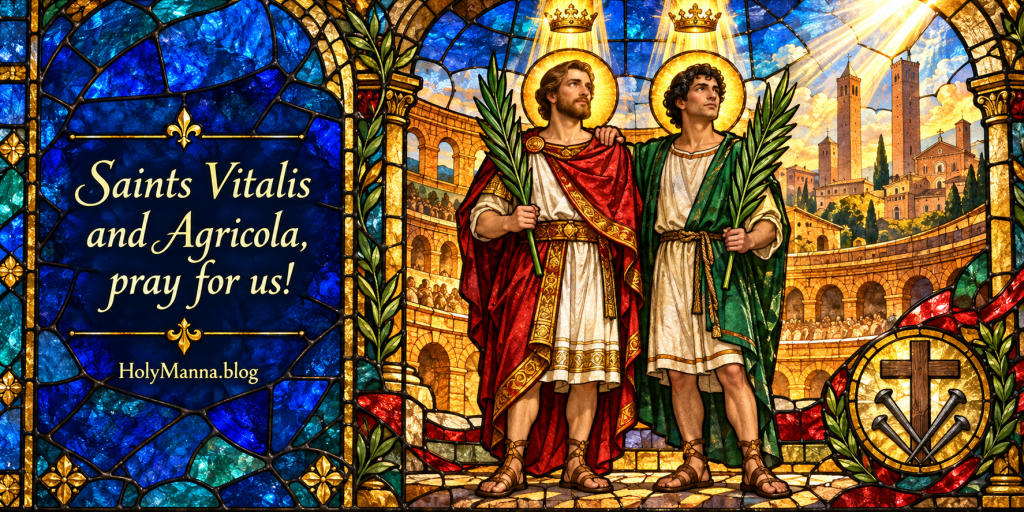
Master and Servant, Brothers in the Crown
On November 4th, the Church remembers two men whose names have traveled together through 17 centuries, Saints Vitalis and Agricola, the protomartyrs of Bologna. One was a master. The other was his slave. In the eyes of the Roman Empire, the distance between them was the distance between property and person. In the eyes of God, there was no distance at all. Around the year 304, during the ferocious persecution of the Emperor Diocletian, both men gave their lives for Jesus Christ in the same city, within days of each other, and the Church has refused ever since to speak of one without the other. The ancient Roman Martyrology for November 4th puts it with beautiful economy: “Vitalis was a slave belonging to Agricola, to whom, in suffering martyrdom, he became an equal and a companion.” That single sentence carries the whole revolution of the Gospel inside it. The Catechism teaches that “Martyrdom is the supreme witness given to the truth of the faith: it means bearing witness even unto death” (CCC 2473), and these two laymen, neither of them a bishop, a priest, a monk, or a scholar, bore that witness side by side. They are venerated as the protomartyrs of Bologna, the first of that city to shed their blood for Christ, and Catholic tradition honors them as heavenly protectors and patrons of Bologna, where their relics rest to this day. Their feast once stood on the universal calendar; today November 4th belongs to the Memorial of St. Charles Borromeo, yet the Roman Martyrology still faithfully names Vitalis and Agricola on this date, and the Church of Bologna has never let their memory grow cold.
A Gentle Master and the Servant Who Was Watching
Almost nothing is known about the early lives of these two men, and honesty demands saying so plainly. There is no record of their birthplaces, their parents, their childhoods, or their formation. What history has preserved comes from a single precious source: St. Ambrose of Milan, a Father and Doctor of the Church, who stood at their graveside in the year 393 and preached about them in a sermon called the Exhortatio Virginitatis, the Exhortation to Virginity. Everything the Church knows about Vitalis and Agricola flows from the first chapters of that oration, and from the early writers who drew on it, including the great 18th century hagiographer Alban Butler in his Lives of the Saints.
Here is what that source tells. Agricola was a Christian citizen of Bologna, a city in northern Italy, in the final decades of the 3rd century. He was known above all for his gentleness. Butler, drawing on Ambrose, records that Agricola’s conduct in the world “had engaged the affection of the idolaters amongst whom he lived.” Think about what that means. In an age when Christians were slandered as atheists and enemies of the human race, this man was so kind, so decent, so plainly good that even the pagans of Bologna loved him. His household included a slave named Vitalis. Vitalis did not learn the faith from a pulpit or a catechism class. He learned it by watching his master live it, day after day, at close range, in the one place where hypocrisy cannot hide, the home. Agricola converted Vitalis to Christianity, and the two became deeply attached to each other. The bond between them stopped being the bond of owner and property and became the bond of brothers in baptism. St. Paul had written exactly this to the Galatians: “There is neither Jew nor Greek, there is neither slave nor free person, there is not male and female; for you are all one in Christ Jesus” (Gal 3:28). Butler summarizes the lesson of their story in the same spirit, writing that “the servant and the freeman are one and the same thing in Christ.” The Catechism carries this teaching forward to the present day, insisting that every form of social or cultural discrimination in fundamental personal rights “must be curbed and eradicated, as incompatible with God’s design” (CCC 1935). In the friendship of Agricola and Vitalis, the Church sees an early, luminous proof of that design.
St. Ambrose even found meaning in their names. He preached that Vitalis, whose name means living, won true and eternal life by holding this passing life in contempt, and that Agricola, whose name means farmer, sowed the good fruits of spiritual grace and watered them with his own blood. The names read like a parable. One man planted the faith. The other came alive because of it.
Faith Without Spectacle
Here honesty must again come first: no miracles are recorded from the lifetimes of Vitalis and Agricola. There are no accounts of healings worked by their hands, no visions, no wonders, and nothing of the sort will be invented here. The historical record is a single sermon by St. Ambrose, and even the early Church felt its thinness; St. Gregory of Tours, writing at the end of the 6th century, openly lamented that no written account of their passion existed. And yet this very silence is part of why these two saints matter so much, especially for ordinary believers today.
Their miracle, if it can be called that, was the quiet one that The Catechism describes when it teaches that “the witness of a Christian life and good works done in a supernatural spirit have great power to draw men to the faith and to God” (CCC 2044). Agricola evangelized without a single recorded word. His gentleness was his preaching. His daily integrity was his apologetics. He won the affection of pagans and the soul of his own servant simply by being visibly, consistently good, and that ordinary holiness proved strong enough to carry two men through torture and death. The Church remembers plenty of saints who commanded crowds, founded orders, and wrote volumes. In Vitalis and Agricola she remembers something humbler and, for most people, far more imitable: a layman who lived his faith at home and at work, and a worker who paid attention. Why should anyone remember and emulate them? Because most Christians will never preach a sermon, but every Christian has a household, a workplace, and someone watching. These two men prove that sanctity needs no stage. It needs only fidelity, charity, and the courage to keep both when the cost arrives.
The Arena and the Cross
The cost arrived around the year 304. The Emperor Diocletian had unleashed the last and most savage of the great Roman persecutions, determined to erase Christianity from the empire. The traditional date of 304 rests on this historical context rather than on a dated document, and sources differ slightly on the exact year, but the substance of what follows comes from St. Ambrose himself. Both men were seized in Bologna for their faith.
Vitalis, the slave, was taken first, and the persecutors made him the opening act of their cruelty. He was tortured in the amphitheatre, his body torn until, in Butler’s unforgettable phrase drawn from Ambrose, no part of him was left “which was not covered with wounds and blood.” Through all of it, Vitalis did not curse, did not recant, and did not fall silent. He praised God for as long as he had the use of his tongue. The tradition handed down from Ambrose relates that at the end, Vitalis prayed to Jesus Christ to receive his soul and to grant him the crown that his angel had shown him, and that the moment his prayer ended, he died. The current Roman Martyrology summarizes his agony starkly, recording that Vitalis “suffered such torments that there was no longer any part of his body without wound.” The slave had become the firstborn. The servant outran his master to heaven.
The executioners then turned to Agricola, and here their cruelty became psychological. His execution was deliberately delayed. The persecutors calculated that time, flattery, and above all the memory of what they had done to Vitalis would break the gentle master’s resolve. They calculated wrong. Ambrose relates that the example of his faithful servant did not daunt Agricola; it animated and encouraged him. The man who had taught Vitalis the faith now let Vitalis teach him how to die for it. When the judges and the crowd saw that neither torture nor charm would move him, Butler records that their old affection for this beloved citizen “was converted into fury.” They sentenced Agricola to the most degrading death Rome knew, the death of slaves and of the Lord Himself: crucifixion. He was hung on a cross and his body was pierced with nails so numerous and so large that, in the detail Ambrose preserved, the number of his wounds surpassed the number of his limbs. The Roman Martyrology confirms that Agricola, “not at all terrified by the torture of his slave,” imitated him in martyrdom by undergoing crucifixion.
The significance of that death is hard to overstate. Agricola, a free Roman citizen, died the death of a slave, nailed to wood like his own servant’s Master. In his flesh, the last social distinction between him and Vitalis was abolished. The early Church treasured exactly this kind of witness; The Catechism quotes Tertullian’s famous testimony that “the blood of martyrs is the seed of Christians” (CCC 852), and in Bologna that seed was sown by a master and a slave in the same soil. The two bodies were laid to rest together in the Jewish cemetery of the city, a detail Ambrose records without explanation. Some historians suggest the Jewish community of Bologna may have offered the bodies refuge, or that the burial ground was simply the one available to the despised; the reason cannot be verified, but the fact is documented by Ambrose, and there the two martyrs waited, side by side and forgotten by almost everyone, for nearly 90 years.
Blood, Nails, and the Wood of a Cross
In the year 393, or possibly 392, since the sources differ on the year, God brought their memory back into the light through two bishops. Eusebius, bishop of Bologna, whom some scholarship names Eustatius, announced the discovery of the relics of Vitalis and Agricola among the graves of the Jewish cemetery, and he reburied them with Christian rites in a moment of enormous public devotion. Standing beside him was the most influential churchman in the West, St. Ambrose of Milan. Ambrose did not merely attend; he became the great apostle of their veneration. He took for himself some of the blood found at the bottom of the grave, together with the nails and the wood of the cross on which Agricola had died, the very instruments of the martyrdom.
Ambrose carried these treasures to Florence, where a saintly widow named Juliana had built a church and invited him to dedicate it. He placed the relics beneath the altar, and at the dedication he preached the Exhortatio Virginitatis, addressed with special tenderness to Juliana’s three virgin daughters, urging them to receive with reverence these presents of salvation. That sermon, preached in 393 or 394, is the only historical source for everything known about the two martyrs, which makes it one of the most precious documents in the history of the Church of Bologna. In that same sermon, Ambrose added a remarkable testimony of his own: he declared that before these relics, demons were compelled to confess, an early witness to the power God attaches to the remains of His martyrs. Paulinus of Milan, Ambrose’s secretary and biographer, confirms in his Life of Ambrose that the bishop established a basilica in which he deposited the relics of the martyrs Vitalis and Agricola, whose bodies he had raised up in the city of Bologna. The Catechism teaches that the religious sense of the Christian people has always found expression in forms of piety surrounding the Church’s sacramental life, “such as the veneration of relics, visits to sanctuaries, pilgrimages, processions” (CCC 1674), and few saints illustrate that teaching earlier or better than these two.
From Florence and Milan, devotion to the Bolognese martyrs spread with astonishing speed across the Christian West. By the year 396, relics had been sent to St. Victricius, bishop of Rouen in Gaul, who listed Agricola among the saints whose relics graced his city and who, he testified, performed healing miracles at their burial place and elsewhere. Around the same time, relics went to St. Paulinus of Nola. Within a single generation of their rediscovery, a Bolognese master and his slave were being venerated from northern Italy to the Atlantic coast of Gaul.
The richest harvest of miracle stories comes from St. Gregory of Tours, the 6th century bishop and historian, in chapter 43 of his Glory of the Martyrs. Gregory is candid that he possessed no written passion of the saints and learned what follows from an account of trustworthy men, so these stories are received on his testimony as a bishop of the Church. He relates that the tombs of the martyrs in Bologna stood above ground, where the faithful constantly touched and kissed them, so much so that the custodian of the church was warned to keep the irreverent away. One audacious thief lifted the lid of a tomb to steal something from the sacred ashes, and as he put his head inside, the great lid came down and crushed him; he was barely freed by bystanders and left in confusion, returning later to approach the tombs of the saints with proper respect. This story cannot be verified beyond Gregory’s account.
Gregory tells a second story, of a collector of public taxes who, while traveling, carelessly lost a bag of money entrusted to him. Approaching Bologna and realizing the loss, he knelt before the tombs of the martyrs and prayed through tears that by their power he might recover what was lost, for otherwise he, his wife, and his children would be reduced to captivity to pay the debt. As he stepped out into the courtyard, he met a man who had found the money lying beside the road, and under careful questioning the finder said he had discovered the sack at precisely the hour when the tax collector was begging the help of the martyrs. This story likewise cannot be verified beyond Gregory’s account.
The third and most beautiful story concerns Namatius, the mid 5th century bishop of Clermont in Gaul, who was building the great church of his city and piously sought relics of Vitalis and Agricola to enshrine within it. He sent a priest to Bologna, and the priest returned with the treasure. When the priest invited the bishop to inspect the blessed relics, Namatius gave an answer the Church has never forgotten: “For me it is greater to believe these things than to see them.” He was echoing the Lord’s own words to Thomas, “Blessed are those who have not seen and have believed” (Jn 20:29). Gregory relates that God honored such faith visibly. As the relics were carried in procession toward Clermont, the sky suddenly darkened and a rainstorm so heavy broke over the countryside that rivers were seen running along the roads. Yet within the space of about two thirds of an acre surrounding the holy relics, not a single drop fell. The storm followed the procession at a distance, as if offering homage, refreshing the people but never touching those who carried the martyrs. Bishop Namatius then dedicated his church with great celebration, distinguished forever by these relics. This story also cannot be verified beyond Gregory’s account.
Veneration always remained centered on Bologna itself, where a basilica was raised to hold the relics. Today the church of Santi Vitale e Agricola in Arena, part of the famous seven church complex of Santo Stefano in Bologna, is held by tradition to stand over the remains of the Roman amphitheatre where the martyrdom took place; that location is a tradition and cannot be verified. The crypt of the two martyrs within it dates to the 11th century, and the ancient sarcophagi of St. Vitalis and St. Agricola are still venerated in the city. Bologna has never treated these two as museum pieces. In 1992 and 1993 the archdiocese solemnly celebrated the 16th centenary of the discovery and translation of its only two martyrs, producing new scholarship and renewed devotion. One further note belongs to honest history: centuries after their deaths, a passion narrative was forged under Ambrose’s name, and from that unreliable text arose the separate figure venerated as St. Vitalis of Ravenna. The Church and her historians carefully distinguish the documented Vitalis of Bologna, the slave and companion of Agricola, from that later Ravennate tradition.
Holiness Has No Hierarchy
The story of Vitalis and Agricola lands with surprising force in the 21st century, precisely because it is so stripped down. There are no visions here, no founding of orders, no eloquent trial speeches. There is a boss who was genuinely good, an employee who noticed, a friendship that became a brotherhood, and a shared fidelity that held when everything else was taken away. The Catechism teaches that the saints in heaven “do not cease to intercede with the Father for us” (CCC 956), and these two intercessors understand ordinary life, workplaces, households, and the slow evangelization that happens through character rather than argument.
Consider Agricola first. He converted his own servant not by pressure but by presence. Modern life hands almost everyone some version of his position: a manager over a team, a teacher before students, a parent before children, an older sibling, a shift lead, anyone with a measure of authority over another person. Agricola shows what Christian authority looks like: gentleness so consistent that even people hostile to the faith cannot help respecting it. How do the people under your authority, at work or at home, experience your faith; as warmth and integrity, or as something invisible? Then consider Vitalis. He had every worldly reason for resentment, yet he was humble enough to receive the Gospel from the very man who owned him, and brave enough to go first into the fire. Is there someone whose quiet example God has placed in your life, and have you been humble enough to learn from them? Consider, finally, what their double martyrdom says about human dignity. Rome sorted these men into owner and property; the Gospel declared them, in Butler’s phrase, one and the same thing in Christ; and the Church still proclaims that every discrimination in fundamental rights is incompatible with God’s design (CCC 1935). Who in daily life gets treated as less, by the culture or by personal habit, and what would it cost to treat that person as a brother or sister bound for the same crown?
Practical imitation of these saints is refreshingly concrete. Let goodness do the preaching for a season: pick one relationship, at work or at home, and commit to a month of Agricola’s gentleness in it, without announcing anything. Pray for the person at work or in the family who seems furthest from God, and ask Saints Vitalis and Agricola to intercede for that soul. Honor the dignity of hidden labor, thanking by name the people whose service is easiest to overlook. And when faith becomes costly in small ways, in mockery, in exclusion, in professional risk, remember Namatius before the unopened reliquary and choose to believe rather than demand to see. When the moment comes to stand with Christ at real cost, will the habits being built today hold?
Engage With Us!
Readers are warmly invited to share their thoughts and reflections on Saints Vitalis and Agricola in the comments below. Their story of friendship, dignity, and shared courage touches nearly every corner of ordinary life, and hearing how it speaks to different hearts builds up the whole community. Here are some questions to spark reflection and discussion:
- Agricola evangelized his household through gentleness long before he witnessed through blood. What is one concrete way personal conduct this week could preach Christ without words?
- Vitalis received the faith from his own master and then led the way into martyrdom. Who has God placed in your life as an unlikely teacher, and what might He be saying through them?
- The Roman world saw a master and a slave; God saw two equal heirs of the crown. Where does modern culture, or personal habit, still rank people by status, and how can that be resisted this week?
- Bishop Namatius said it was greater to believe than to see. In what area of life is God currently asking for trust without proof?
- The persecutors delayed Agricola’s execution hoping fear would wear him down. What slow pressures today quietly erode faith, and what daily practice could strengthen endurance against them?
Saints Vitalis and Agricola stood side by side in the arena because they had first stood side by side in ordinary life, in prayer, in work, and in friendship. The same path is open to everyone reading this. Live the faith visibly and gently, honor the dignity of every person as a potential companion in glory, and hold nothing back from Christ, trusting that the crown shown to a Roman slave 17 centuries ago is the same crown promised to the faithful now. Go out this week and do everything, the big sacrifices and the small kindnesses alike, with the love and mercy that Jesus taught.
Saints Vitalis and Agricola, protomartyrs of Bologna, pray for us!
Follow us on YouTube, TikTok, Instagram and Facebook for more insights and reflections on living a faith-filled life.


Leave a Reply