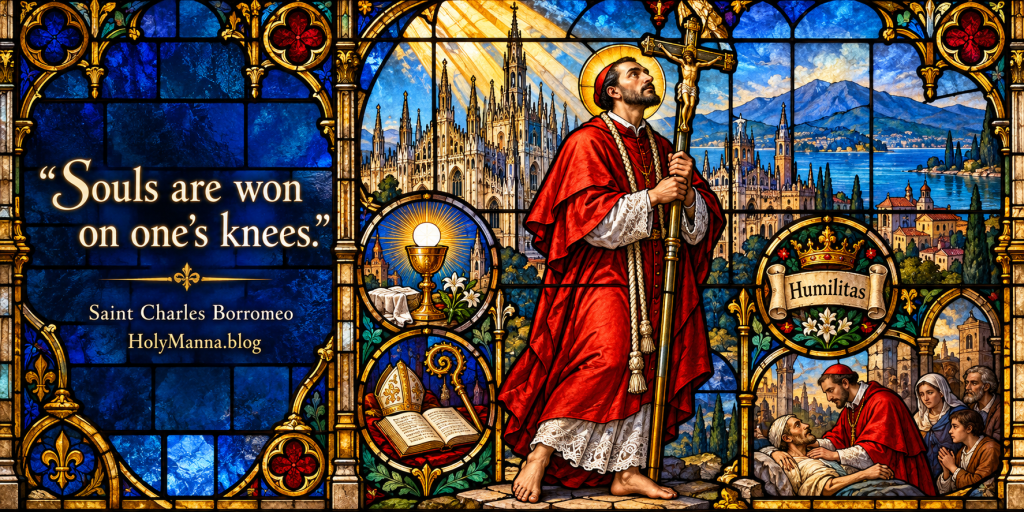
The Shepherd Who Stayed
Every November 4th, the Church celebrates one of the great heroes of the Counter-Reformation, Saint Charles Borromeo, Cardinal and Archbishop of Milan. Alongside Saint Ignatius of Loyola, Saint Philip Neri, and Pope Saint Pius V, Charles stands among the handful of men whom God raised up in the sixteenth century to renew a Church battered by scandal, corruption, and the Protestant revolt. He helped bring the Council of Trent to its completion, supervised the creation of the Roman Catechism, invented what the world now knows as Sunday school, and founded the modern seminary system that still forms priests today. When the plague came to Milan and nearly everyone with money and power ran, he stayed. When an assassin’s bullet struck him at prayer, he finished the prayer.
Charles Borromeo holds a remarkable list of patronages. He is the patron of bishops, cardinals, seminarians, catechists, catechumens, and spiritual directors, and he is traditionally invoked against stomach ailments, ulcers, and intestinal disorders, as well as being a traditional patron of apple orchards. He is also the patron of Lombardy in Italy, of Monterey in California, and of São Carlos in Brazil. His life is a standing answer to anyone who believes the Church cannot be reformed, because The Catechism teaches that by canonizing certain of the faithful the Church “recognizes the power of the Spirit of holiness within her” (CCC 828). Charles is proof of that power at work in one man who decided that reform begins in the mirror.
Born in a Castle, Formed for the Cross
Carlo Borromeo was born on October 2nd, 1538, in the family castle at Arona, perched above the blue waters of Lake Maggiore in northern Italy. His father was Gilberto Borromeo, Count of Arona, and his mother was Margherita de’ Medici of the Milanese branch of that famous family. Her brother, Giovanni Angelo de’ Medici, would one day be elected Pope Pius IV, a fact that would change Charles’s life forever. The Borromeo family was one of the most ancient and wealthy noble houses in all of Lombardy. Sources differ slightly on his place among the children; Butler’s Lives of the Saints records six children, naming Charles the second son after his elder brother Federico, while other accounts call him the fourth child when the daughters are counted. A pious tradition, preserved in the old Roman Breviary, holds that on the night of his birth a bright light shone over the chamber where his mother lay, a foretoken of his holy life. This story cannot be verified.
What can be verified is just as striking. Butler records that as a small boy Charles loved prayer, was diligent in his studies, and spent his playtime building little chapels, decorating altars, and singing the divine office. At about twelve years old he received the tonsure, and the income of the wealthy Benedictine abbey of Saints Gratinian and Felinus, a longtime perquisite of his family, was turned over to him. Even as a child, he insisted that this money belonged to God and to the poor, and the surplus beyond his education went to the needy. He carried a lifelong speech impediment, a reminder that God chooses instruments the world would overlook, yet he excelled in his studies at Pavia and earned a doctorate in civil and canon law in 1559 at the age of 21.
That same year everything accelerated. His uncle was elected Pope Pius IV, and in 1560 the pope made his 22-year-old nephew a cardinal, entrusting him with duties equivalent to Secretary of State and the administration of the Archdiocese of Milan. This was the age of nepotism, and Charles received his office the old way; the miracle is what he did with it. In Rome he founded a learned academy, the Noctes Vaticanae, and worked with tireless discipline. Then, in 1562, his elder brother Federico died suddenly. The family begged Charles to leave the clerical state, marry, and carry on the line. Instead, the death shook him into a profound conversion. Influenced by holy reforming bishops of his day, he resolved to live out the full dignity and duty of a bishop exactly as the Council of Trent was then drafting it. He was secretly ordained a priest in 1563, was consecrated a bishop soon after, and took as his episcopal motto a single word that became his emblem, Humilitas, humility, crowned upon the Borromeo shield.
The Reformer Who Finished Trent and Rebuilt a Diocese
Charles’s first great labor was the Council of Trent itself. The council had dragged on in fits and starts since 1545, suspended and resumed across decades. Working from Rome as the pope’s right hand, Charles organized its third and final session from 1562 to 1563 and is widely credited with driving the council to completion when it could easily have collapsed. Afterward he supervised the writing of the Roman Catechism, the Catechism of the Council of Trent, and contributed to the reform of the liturgical books. A lover of sacred music, he was a patron of Palestrina at the very moment the Church was debating the place of polyphony in worship. In 1565, he was summoned to the deathbed of Pius IV, where he assisted the dying pope alongside another future saint, Philip Neri. Heaven has a way of gathering its saints into the same rooms.
Then came the decision that defined him. Cardinals of his rank routinely governed dioceses from Rome and collected the revenues. Charles instead made his formal entry into Milan as its archbishop on September 23rd, 1565, the first resident archbishop the city had seen in roughly eighty years. What he found was a vast diocese in spiritual ruin, with clergy who were ignorant or scandalous and a people starved of teaching. His response became the template for every Catholic diocese in the world. He held provincial councils and diocesan synods whose decrees, gathered in the Acta Ecclesiae Mediolanensis, were copied by bishops across Europe. He founded seminaries, colleges, and communities for the education of candidates for holy orders, which is why seminarians still claim him as their patron. The Catechism explains why this mattered so much: in the ordained minister “it is Christ himself who is present to his Church” (CCC 1548), and Charles understood that a renewed Church required priests formed to let Christ, and not themselves, be seen.
He did not stop with the clergy. Charles organized the Confraternity of Christian Doctrine throughout his diocese, gathering children and adults for regular instruction in the faith, and he is credited with establishing the tradition that the world now calls Sunday school. His catechetical centers were so effective that Protestantism made no headway in Milan at all. This is the heart of why he is the patron of catechists and catechumens, for The Catechism describes catechesis as an education in the faith which aims at initiating hearers into the fullness of Christian life (CCC 5), and Charles built that education into the ordinary rhythm of an entire city. He also opened his arms to English Catholics fleeing the persecutions under Elizabeth I, giving pastoral care to exiles who had lost everything for the faith. When famine struck Lombardy in 1569 and 1570, he fed thousands of the hungry daily at his own expense for months, selling what he had to do it. In 1578 he founded the Congregation of the Oblates of Saint Ambrose, a society of diocesan priests bound to the bishop for whatever mission the Church needed. Across his episcopate he completed three full pastoral visitations of his sprawling diocese, traveling into Alpine valleys to confirm, correct, and teach, building churches, schools, colleges, and hospitals as he went.
As for wonders during his lifetime, the most famous concerns the night a bullet could not stop him, and his contemporaries did not hesitate to call it miraculous. His preservation through two years of daily contact with the plague, while ministering to the dying with his own hands, was likewise regarded by the faithful of Milan as the protection of God upon their shepherd. The formal miracles examined by the Church belong to the period after his death, and those will be told in their place, but Milan needed no tribunal to believe that God was with Charles Borromeo.
An Assassin’s Bullet and a City of the Dying
Real reform makes real enemies, and Charles faced them in both palace and cloister. He fought lengthy jurisdictional battles with the Spanish civil authorities who governed Milan, and several religious orders bristled under his discipline. None resisted more bitterly than the Humiliati, an order that had grown wealthy and decayed, reduced to about 170 members sitting atop enormous revenues. When Charles pressed their reform, a conspiracy formed within the order. On the evening of October 26th, 1569, as Charles knelt at prayer in the chapel of the archiepiscopal palace with his household, a Humiliati priest named Girolamo Donato, called Farina, fired an arquebus at the archbishop’s back. The shot struck him, and those present expected death, yet the ball only bruised him, and Charles, believing himself mortally wounded, calmly commended himself to God and had the prayer continue. His survival was immediately regarded as miraculous. It should be noted that one account places the attempt on October 22nd and describes the shot grazing his side, so the precise details vary across sources, though the event itself is thoroughly documented. What happened next reveals the man: Charles pleaded for clemency for Farina and his accomplices. The civil process went forward despite his appeals, and the conspirators were executed, and in February 1571 the Humiliati order was suppressed entirely. Centuries later, Pope Saint John Paul II, who was baptized Karol, which is Charles, and who venerated Borromeo as his patron, would himself survive an assassin’s bullet, a parallel the Polish pope knew well.
The greater trial came in 1576. That August, as Milan prepared festivities for the visit of Don Juan of Austria, the hero of Lepanto, plague erupted inside the city walls on August 11th. Panic followed. The governor, the nobility, and nearly everyone with means fled the city. Charles was away for the burial of a bishop friend when the news reached him, and he turned back toward Milan at once. He had written that a bishop belongs with his flock, and now he proved it with his life. Our Lord declared in The Gospel of John that “the good shepherd lays down his life for the sheep” (Jn 10:11), and Milan watched its shepherd do exactly that for two years.
Charles threw himself into the crisis on every front. He organized the clergy, visited the plague hospital called the Lazzaretto, and personally ministered to the sick and dying. When quarantine confined the people to their homes, he had altars erected in the streets and at crossroads so that the sick could assist at Mass daily from their windows, and priests brought the Holy Eucharist to the afflicted at their windows; columns topped with crosses from those street altars can still be seen around Milan today. Early lives record that when some priests hid in fear, Charles warned his clergy not to prefer a late death to a holy one, and his example shamed and inspired them back to their posts. He emptied his own fortune for the relief of the suffering, and when money ran short he had the banners and tapestries of his household and the cathedral cut up to clothe the naked. In October 1576 he led three great penitential processions through the stricken city. Barefoot, with a thick rope tied around his neck like a condemned criminal, the Cardinal Archbishop of Milan walked the streets carrying the relic of the Holy Nail of the Crucifixion, offering himself to God as a victim for the sins of his people. The crucifix he carried through the plague is preserved to this day in the sacristy of the Duomo. The Catechism teaches that interior penance finds expression in visible signs, gestures, and works of penance (CCC 1430), and no image in the history of the episcopate expresses it more powerfully than Charles with that rope around his neck. By the time the city was declared free in early 1578, roughly 17,000 of Milan’s 124,000 people had died, and the epidemic has been known ever since as the plague of Saint Charles, named not for its horror but for the heroism of the shepherd who stayed.
Charles was never martyred, but his austerities, vigils, fasts, and labors consumed him like a slow martyrdom. In the autumn of 1584 he made a retreat at the Sacro Monte di Varallo, praying intensely before its shrines of the Passion, and there he was seized with an intermittent fever. He insisted on continuing his duties as long as his body obeyed, then returned to Milan to die. On the night of November 3rd, 1584, at only 46 years old, Charles Borromeo gave his soul back to God. Early accounts report that his last words were “Ecce venio”, which means “Behold, I come”; this report rests on the testimony of early biographers and pious tradition. Some older sources give his death as November 4th, since he died in the night, and the Church keeps his feast on the 4th.
The Crypt Beneath the Duomo
Devotion to Charles began the moment he died. The people of Milan venerated him immediately as a saint, and the Church moved with unusual speed: he was beatified on May 12th, 1602 by Pope Clement VIII and canonized on November 1st, 1610 by Pope Paul V, only 26 years after his death. The canonization process, together with the great 1610 biography by Giovanni Pietro Giussano, who had known the saint personally, gathered numerous testimonies of healings and favors attributed to his intercession, many of them reported at his tomb in the years after his death. The individual details of many of these reported cures vary across the old accounts and cannot be independently verified today, and they are handed down as the testimony of that first generation of devotion. The faithful of Milan also invoked his protection in later calamities, above all during the terrible plague of 1630, when the city that remembered 1576 turned instinctively to the shepherd who had carried it through the first one. In trusting his intercession they stood on solid doctrine, for The Catechism teaches of the saints that “they do not cease to intercede with the Father for us” (CCC 956).
His tomb became, and remains, one of the great pilgrimage destinations of northern Italy. Charles rests in the crypt of the Cathedral of Milan, the magnificent Duomo, in a chapel called the Scurolo di San Carlo directly beneath the high altar, where his relics are venerated in a casket of rock crystal and silver, surrounded by panels of silver foil depicting scenes from his life. He had asked for a humble burial, and Milan, unable to help itself, gave him glory instead. His heart was taken to Rome, where it is venerated in the church of Santi Ambrogio e Carlo al Corso, commonly called San Carlo al Corso, one of several Roman churches dedicated to him. Each year around his feast, the Duomo displays the Quadroni, an enormous cycle of paintings commissioned in the seventeenth century narrating his life and miracles.
His homeland built him a monument unlike any other. On the hill above Arona, his birthplace, his cousin and successor Cardinal Federico Borromeo promoted a Sacro Monte in his honor around the time of the canonization, and in 1698 the project’s crown was completed: a colossal statue of Saint Charles in copper and granite, affectionately nicknamed the Sancarlone, the Big Saint Charles. Sources give its height variously, around 28 meters for some and roughly 35 meters with its pedestal for others, and pilgrims can climb a staircase inside the statue and look out over Lake Maggiore through the saint’s own eyes. It is commonly recounted that this seventeenth-century giant served as a forerunner and study model for the Statue of Liberty. Beyond stone and copper, his impact ran through nations. Two years after his death the Catholic cantons of Switzerland, where he had labored on visitation, formed the Borromean League in defense of the faith. His seminary legislation formed the priesthood of the entire modern Church, his Roman Catechism taught the faith for four centuries, and parishes, schools, seminaries, and cities from California to Brazil bear his name today.
What a 16th Century Cardinal Says to a Scrolling Generation
Charles Borromeo speaks with unnerving directness to Catholics in their twenties, thirties, and forties, because he faced the same temptations in grander clothing: comfort, career, image, and the quiet conviction that someone else should fix the Church. He answered all of it with one principle, preserved in the sermon from his last synod that the Church still reads in the Office of Readings on his feast: “Be sure that you first preach by the way you live.” Reform of the world begins with reform of the self, and The Catechism confirms that the Church, “at once holy and always in need of purification”, constantly follows the path of penance and renewal (CCC 827). Complaining about scandal costs nothing; becoming a saint costs everything, and it is the only strategy that has ever worked. Where in life is there a gap between what is professed on Sunday and what is lived on Monday?
Charles also teaches the primacy of prayer for busy people, and no one was busier. Governing the largest diocese in Italy, he still insisted to his priests, in that same sermon, “nothing is more necessary than meditation”, and he counseled, “When you celebrate Mass, reflect on the sacrifice you are offering”, so that, as he concluded, everything done for others becomes a work of love. A saying long attributed to him, quoted even on the Vatican’s own pages though not traceable to a specific sermon, puts it in five words: “Souls are won on one’s knees.” For a generation drowning in notifications, his counsel is almost embarrassingly practical: guard a daily block of silence with God the way he guarded his hours of prayer between audiences and visitations. What would change in a week if 15 minutes of scrolling became 15 minutes of meditation on the Gospel?
Finally, Charles models presence in crisis. He ran toward the plague while the powerful ran from it, because the corporal works of mercy were not optional extras to him, and The Catechism teaches that these works of mercy, feeding the hungry, clothing the naked, visiting the sick, are among the chief witnesses of charity (CCC 2447). Few will ever carry a relic barefoot through a dying city, but everyone knows a hospital room nobody visits, a grieving coworker everyone avoids, a family member quarantined by loneliness rather than disease. Emulating Charles can be as concrete as showing up there, giving until the budget feels it, teaching the faith to one child, or offering one honest act of penance for the sins of the Church. Who in this season of life is waiting for someone to stay instead of flee?
Engage With Us!
Saint Charles Borromeo lived only 46 years, yet he reformed himself so thoroughly that God used him to reform an entire Church. His story deserves conversation, so share thoughts, questions, and reflections in the comments below; this community grows when readers speak up. To help prayer and discussion go deeper, consider the following questions.
- Charles was handed privilege through nepotism and turned it into holiness; what advantages in life is God asking to be converted into service?
- His motto was a single word, Humilitas; what one-word motto would honestly describe the current direction of your life, and what word should it be?
- Charles stayed in a plague-stricken city when leaving was the reasonable choice; where is God asking for costly presence instead of convenient distance?
- He taught that preachers must first preach by the way they live; what is one habit that undermines the witness of your words, and what will replace it?
- If souls are truly won on one’s knees, what concrete time and place will daily prayer hold this week?
Saint Charles proves that no era of the Church is too broken for God to raise up saints, and this era will be no exception if ordinary believers answer the call. Let his rope of penance, his seminaries, his street altars, and his final “Ecce venio” stir up courage for the week ahead. Live the faith boldly, pray on bended knee, stay with the suffering, and do everything, at home, at work, and online, with the love and mercy that Jesus taught us.
Saint Charles Borromeo, pray for us!
Follow us on YouTube, TikTok, Instagram and Facebook for more insights and reflections on living a faith-filled life.


Leave a Reply