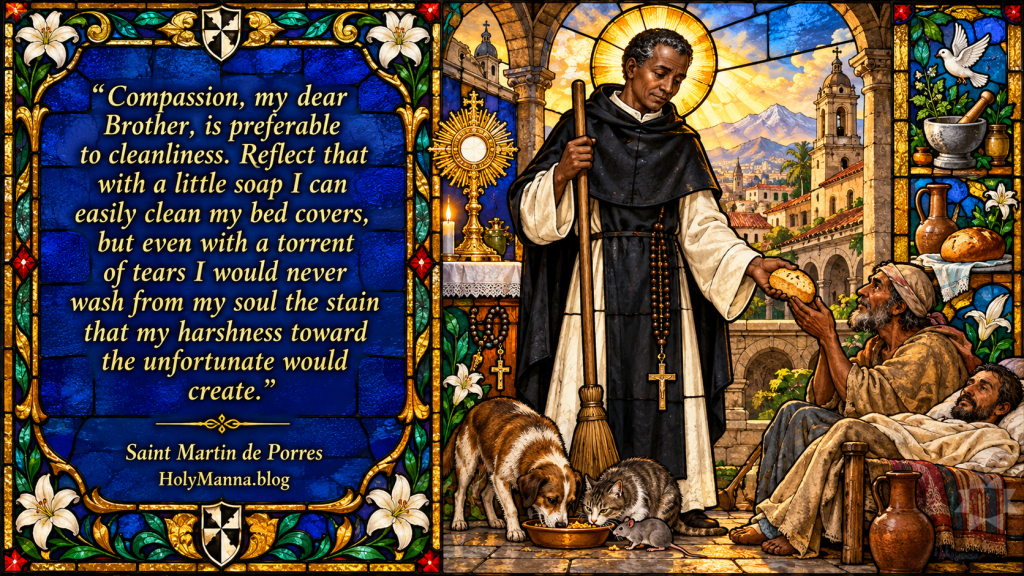
A Broom, a Dog, a Cat, and a Mouse
Walk into almost any Catholic church in Latin America, and sooner or later a particular statue appears: a dark-skinned Dominican brother in a black scapular, holding a broom, with a dog, a cat, and a mouse resting peacefully at his feet. That is Saint Martin de Porres, and the broom is not an accident. Martin spent his life convinced that no task was too lowly to become a prayer, and no person was too lowly to be loved. Born in 1579 in Lima, Peru, the illegitimate son of a Spanish nobleman and a freed Black woman from Panama, Martin rose from the margins of a rigidly stratified colonial society to become one of the most beloved saints in the history of the Americas. He was a barber, a surgeon, a healer, a friend of the poor, a mystic, and a Dominican lay brother whose charity was so extravagant that the people of Lima called him “Martin the Charitable” long before the Church ever opened his cause. Pope Saint John XXIII canonized him on May 6th, 1962, and he is widely honored as the first Black saint of the Americas. Today he holds a remarkable range of patronages: he is the patron of people of mixed race and of racial harmony, of social justice, of barbers and hairdressers, of innkeepers, of public health workers, and of the poor, and he is popularly invoked against rats and mice, for reasons that will become delightfully clear. His feast is celebrated on November 3rd, the day he entered eternal life in 1639.
The Boy the Baptismal Register Tried to Hide
Martin de Porres was born in Lima on December 9th, 1579, in the Viceroyalty of Peru, during the height of Spanish colonial power. His father was Don Juan de Porres, a Spanish nobleman and knight. His mother was Ana Velázquez, a freed Black woman from Panama, of African and possibly also Native descent. His parents never married, and tradition holds that his baptismal record listed him simply as the son of an unknown father. In the brutal social mathematics of colonial Lima, that single line defined everything the world expected of him: a mixed-race child, illegitimate, poor, and invisible.
His sister Juana was born about 2 years later, and shortly afterward Don Juan abandoned the family altogether. Ana supported her two children by taking in laundry, and Martin grew up knowing real poverty. Accounts differ on what happened next with his father. Some early sources say Don Juan never officially acknowledged Martin at all; others report that when Martin was about 8 years old, his father claimed both children and paid for a short period of schooling before returning Martin to his mother’s care. Honest biographers flag the discrepancy rather than smooth it over, and so does this post. What all the sources agree on is that Martin received only about 2 years of primary education before being apprenticed, around age 12, to a barber-surgeon. In that era, a barber did far more than cut hair; the trade included bloodletting, treating wounds, setting bones, and preparing medicines. Martin absorbed it all, and God would spend the next 4 decades putting that training to extraordinary use.
Even as a boy, Martin’s faith ran deep. He was known to spend hours of the night in prayer, a practice that only intensified as he grew older. At age 15, in 1594, he knocked on the door of the Dominican Convent of the Holy Rosary in Lima, today the Basilica and Convent of Santo Domingo. He did not ask to become a friar. He could not. Colonial law and custom barred descendants of Africans and Indians from full religious profession. So Martin asked for the lowest place available, that of a donado, a lay servant who wore the habit and lived with the community while doing its most menial work. He swept floors, cleaned toilets, worked in the kitchen, laundered clothes, and cut the friars’ hair. He did it all with such visible joy that it unsettled people. For Martin, this was not a stepping stone to something better. The lowest place was exactly where he wanted to be, because it was the place closest to his crucified Lord. His whole life can be read as a living commentary on the Church’s teaching that “the vocation of humanity is to show forth the image of God and to be transformed into the image of the Father’s only Son” (CCC 1877). Martin showed forth that image with a broom in his hands.
The Infirmary That Became an Altar
After about 9 years of watching this young man outpray and outserve everyone in the house, the community could no longer pretend the law made sense. The prior, Juan de Lorenzana, decided to set aside the racial restriction, and in 1603, at age 24, Martin professed vows as a Dominican lay brother. He was eventually placed in charge of the infirmary, a post he held until his death, and it was there that his barber-surgeon training, his prayer, and his boundless compassion fused into something the city of Lima had never seen.
Martin cared for everyone. Spanish nobles and African slaves, wealthy merchants and dying beggars, friars and strangers, all received the same tenderness. When ships arrived in Lima carrying enslaved Africans, sick and traumatized from the voyage, Martin went to care for them personally. When epidemics swept the city, he seemed to be everywhere at once, and witnesses in his canonization process testified under oath that this was sometimes literally true. Fellow religious reported that locked doors did not stop him; on more than one occasion he was found at the bedside of a sick man inside a room no one had opened. The testimony of Brother Fernando de Aragonés captures the sheer scale of his labor: “Many were the offices to which the servant of God, Brother Martin de Porres, attended. Each of these jobs was enough for any one man, but alone he filled them all with great liberality, promptness and care.”
The most famous story of his charity is well attested in the early biographical tradition and is retold by Vatican News to this day. Martin found a beggar in the street, covered with ulcers and filth, and carried him back to the convent, laying him in his own bed to nurse him. A fellow religious rebuked him for the mess. Martin’s answer has echoed for 4 centuries: “Compassion, my dear Brother, is preferable to cleanliness.” A longer version of the reply, preserved in the tradition, adds that a little soap can clean bed covers, but not even a torrent of tears could wash from his soul the stain of harshness toward the unfortunate. When the prior himself ordered Martin to stop bringing the sick into the convent, Martin obeyed, but his response disarmed everyone: “Forgive my error, and please instruct me, for I did not know that the precept of obedience took precedence over that of charity.” The prior, moved, gave him liberty to follow his conscience in works of mercy. Martin was living out, 4 centuries early, what The Catechism would later state so plainly: “The works of mercy are charitable actions by which we come to the aid of our neighbor in his spiritual and bodily necessities” (CCC 2447).
His charity organized itself into institutions. With the help of patrons he moved among Lima’s wealthy, Martin helped establish a residence and school for orphans and abandoned children, the Orphanage of the Holy Cross, where the city’s forgotten little ones were fed, educated, and formed in the faith. He became a formidable fundraiser, gathering enormous sums to provide dowries for poor girls so they could marry honorably or enter religious life. He planted fruit trees along roadsides so that the hungry would have something to eat, and he distributed food to the poor at the convent gate.
Then there are the gifts that defy natural explanation. Witnesses in the canonization process testified to instantaneous cures, to Martin levitating in ecstasy before the crucifix, and to bilocation. People who knew him personally reported encountering him in Mexico, in Africa, in China, in Japan, and in the Philippines, though Martin never once left Lima. His healing work carried a traditional saying that Peruvians still repeat, “Yo te curo, Dios te sana,” which means, “I treat you, God heals you.” That saying is a traditional attribution rather than a documented verbatim quotation, but it perfectly captures how Martin understood his medicine.
His gentleness extended to every creature God made. The most charming story in the whole tradition concerns the mice. When vermin infested the convent wardrobe, the friars wanted them poisoned. Martin instead is said to have caught a mouse and spoken to it, asking the mice to relocate to the far end of the garden, where he promised to feed them daily. The story goes that they obeyed, and that Martin kept his word every day. From this tradition comes the beloved image of a dog, a cat, and a mouse eating peacefully from the same dish at his feet, a little parable of the peace his holiness created around him. These animal stories cannot be verified. Another story, preserved in The Saint Martin de Porres Prayer Book, tells of Martin kneeling in prayer before the Blessed Sacrament one night when the altar step beneath him caught fire; in the chaos that followed, he remained motionless, so absorbed in God that he never noticed the flames. This story also cannot be verified. What can be verified is the devotion behind it, because every witness agreed that the Eucharist was the furnace of Martin’s charity. The Catechism teaches that “the Eucharist commits us to the poor” (CCC 1397), and nobody in colonial Lima embodied that commitment like the brother in the black scapular. It is no coincidence that his closest friends were saints themselves, Saint Rose of Lima and Saint John Macías, both of whom shared his hidden life of prayer and service in the same small corner of the world. Heaven, it seems, likes to work in clusters.
He Asked to Be Sold
Martin de Porres was not a martyr, but his whole life was a slow martyrdom of humiliations, and the way he carried them is the deepest lesson he has to teach. From childhood he absorbed the contempt that colonial society reserved for the illegitimate and the mixed-race. The law that barred him from religious profession was only the legal face of a thousand daily insults. Even inside the convent, some did not let him forget what he was. There is testimony that he was mocked for his birth and his color, called a mulatto dog, and treated as less than his brothers. Martin never answered insult with insult. In a humility so radical it almost scandalizes the modern reader, he took the slurs and turned them into his own self-description, habitually calling himself a poor slave and a poor mulatto. The early biographical tradition preserves the most astonishing expression of this: when the convent fell into serious debt, Martin went to his superior and offered a solution. “I am only a poor mulatto, sell me.” That offer comes from the early accounts of his life and is told here as the tradition hands it down. His superiors, needless to say, refused, but the offer tells you everything about how completely Martin had died to his own ego.
It must be said clearly, and the Church says it clearly, that the racism Martin endured was and is gravely evil. The Catechism teaches that “every form of social or cultural discrimination in fundamental personal rights on the grounds of sex, race, color, social conditions, language, or religion must be curbed and eradicated as incompatible with God’s design” (CCC 1935). Martin’s holiness does not baptize the injustice he suffered; it exposes it. What makes him heroic is not that he was mistreated, but that he refused to let mistreatment poison him. Where bitterness would have been understandable, Martin chose mercy, and he chose it daily for decades. Pope Saint John XXIII, canonizing him more than 3 centuries later, put it in words the Church now reads in the Office of Readings on his feast: “He excused the faults of others. He forgave the bitterest injuries, convinced that he deserved much severer punishments on account of his own sins.”
To these exterior trials Martin added voluntary ones. He never ate meat, fasted continuously, practiced severe penances, and slept little, spending whole nights in prayer before the Blessed Sacrament and the crucifix. He bore the exhaustion of the infirmary, the weight of a city’s suffering, and the hidden interior trials that always accompany the mystics, and he bore it all with a serenity that made people seek him out as a spiritual director, this unlettered lay brother counseling learned priests.
The end came in the autumn of 1639. Martin fell ill with a violent fever and knew his hour had arrived. The great of Lima crowded his cell; tradition reports that the Viceroy of Peru himself, the Count of Chinchón, knelt at the dying brother’s bedside to ask his blessing. As his Dominican brothers chanted the Creed around him, Martin de Porres died on November 3rd, 1639, at 59 years of age. The city went into mourning. Bishops and nobles carried his coffin, and the crowds pressed in so insistently to snip relics from his habit that it had to be replaced more than once before burial.
A Fragrance That Never Faded
Death did not end Martin’s work; by every account it accelerated it. The faithful of Lima began asking his intercession immediately, and reports of favors and healings multiplied. Dominican sources report that when his body was exhumed about 25 years later, it was found intact and gave off a sweet fragrance, a sign the tradition associates with heroic sanctity. The process for his beatification opened quickly, but then history intervened. A series of delays, natural disasters, and even shipwrecks that swallowed the official documents stretched the cause across generations. Pope Gregory XVI finally beatified him on October 29th, 1837, nearly 2 centuries after his death, and then the cause waited again.
The 2 miracles the Church approved for his canonization both happened within living memory, which makes them especially striking. The first occurred in 1948 in Asunción, Paraguay, where Dorotea Caballero Escalante, an 89-year-old woman, suffered an intestinal blockage and a heart attack and was given only hours to live; her family had already begun arranging the funeral. After prayer to Blessed Martin, she recovered completely by the next day. The second occurred in 1956 in Tenerife, in the Canary Islands. A young boy named Antonio Cabrera Pérez-Camacho had his leg crushed by a falling block of cement during a childhood prank, and gangrene set in; amputation seemed certain. A relative devoted to Blessed Martin urged the family to pray, a relic was applied, and the boy’s leg healed so completely that the only trace left was a scar. The diocesan tribunal investigated the case rigorously, and Antonio himself, who grew up to become a dental surgeon, attended the canonization in Rome and has recounted the miracle publicly as an adult. Both healings passed the Church’s formal scrutiny and stand as approved miracles.
On May 6th, 1962, Pope Saint John XXIII canonized Martin de Porres in Saint Peter’s Basilica, just months before the opening of the Second Vatican Council, and the pope made the timing deliberate, holding up this humble lay brother as a model of the holiness the Council hoped to awaken in the whole Church. The moment carried a second providence. The canonization of the first Black saint of the Americas came precisely as the civil rights movement was reaching its height, and Catholics fighting for racial justice found in Martin a heavenly patron who understood their wounds from the inside. In canonizing him, the Church did what The Catechism describes: “By canonizing some of the faithful, the Church recognizes the power of the Spirit of holiness within her and sustains the hope of believers by proposing the saints to them as models and intercessors” (CCC 828).
Devotion to Saint Martin now circles the globe. Pilgrims stream into the Basilica and Convent of Santo Domingo in Lima, where his relics rest alongside those of his friends Saint Rose of Lima and Saint John Macías, 3 saints from one city block of colonial Lima. His birthplace in Lima is preserved and venerated. In the United States, the National Shrine of St. Martin de Porres in Memphis, Tennessee draws the faithful, and parishes, schools, hospitals, and ministries bearing his name serve the poor on every continent. Across Latin America his image, broom in hand, watches over homes and shops, and the popular custom of invoking him against rats and mice continues, a smiling echo of the garden where he fed the creatures nobody else wanted. He remains what Lima called him in life, “Martin the Charitable,” the saint who proves that the Church’s confidence in the intercession of the saints is well placed, for as The Catechism teaches, the saints “do not cease to intercede with the Father for us” (CCC 956).
Picking Up the Broom
Saint Martin de Porres is dangerous to read about, because he removes every excuse. He had no advantages. He had no status, no wealth, no formal education, no legal standing, and no reason, humanly speaking, to expect anything from the world that had rejected him at baptism. And with nothing, he became everything, because he let God’s love flow through whatever was in his hands: a broom, a razor, a bandage, a loaf of bread. Holiness, Martin insists, is not waiting for better circumstances. It is loving God and neighbor inside the circumstances already given.
Start where Martin started, with hidden work done for love. The dishes, the laundry, the emails, the diaper changes, the tasks nobody notices and nobody thanks; all of it can be offered to God and transformed into prayer. What is the broom in your life, the humble, repetitive work you could begin offering to God instead of resenting?
Then look at how Martin treated people. He saw the face of Christ in every single person, especially the ones society had discarded, because he took the Lord’s words with total seriousness: “Amen, I say to you, whatever you did for one of these least brothers of mine, you did for me” (The Gospel of Matthew 25:40). In an age still wounded by racial division, Martin is a providential patron. He does not merely forgive those who demeaned him; he becomes the meeting point where enemies learn to eat from the same dish, like his dog, cat, and mouse. Is there a person, or a whole category of people, you have quietly decided is beneath your attention? What would change this week if you treated that person the way Martin treated the beggar in his bed?
Finally, notice the engine underneath it all. Martin’s activism never replaced his adoration; it flowed from it. Nights before the Blessed Sacrament produced days among the sick. A practical rule of life in his spirit might look like this: one holy hour or one visit to the tabernacle each week, one concrete work of mercy each week, and one deliberate act of kindness toward someone easy to overlook each day. Small, steady, hidden, and real; that is the Porres method. When you are wronged, do you reach for resentment or for mercy? What would it cost you to answer your next insult the way Martin answered his?
Engage With Us!
Saint Martin de Porres has a way of getting under the skin, in the best sense, and his story lands differently for everyone. Share your thoughts and reflections in the comments below; your experience might be exactly the encouragement another reader needs today. Here are some questions to pray with and discuss:
- Martin asked for the lowest place in the convent and found joy there. Where is God inviting you to serve without recognition, and what makes that hard for you?
- Martin answered a lifetime of racial contempt with mercy instead of bitterness. Who do you need to forgive, and what is one step you can take toward that forgiveness this week?
- Martin’s charity was fueled by nights before the Blessed Sacrament. What would it take to add even 15 minutes of Eucharistic adoration to your week?
- The Catechism teaches that the works of mercy meet our neighbor in both spiritual and bodily necessities (CCC 2447). Which work of mercy is God placing in front of you right now, and who specifically needs it?
- Martin said that compassion is preferable to cleanliness. Where have you let comfort, order, or convenience keep you from loving someone who is messy, inconvenient, or difficult?
Saint Martin de Porres proves that no beginning is too low, no work is too small, and no person is too wounded for God to make a saint. Take up whatever broom is in your hands today and sweep for the glory of God. Love the people in front of you, especially the ones the world overlooks, and do everything, the big things and the hidden things alike, with the love and mercy that Jesus taught.
Saint Martin de Porres, pray for us!
Follow us on YouTube, TikTok, Instagram and Facebook for more insights and reflections on living a faith-filled life.


Leave a Reply