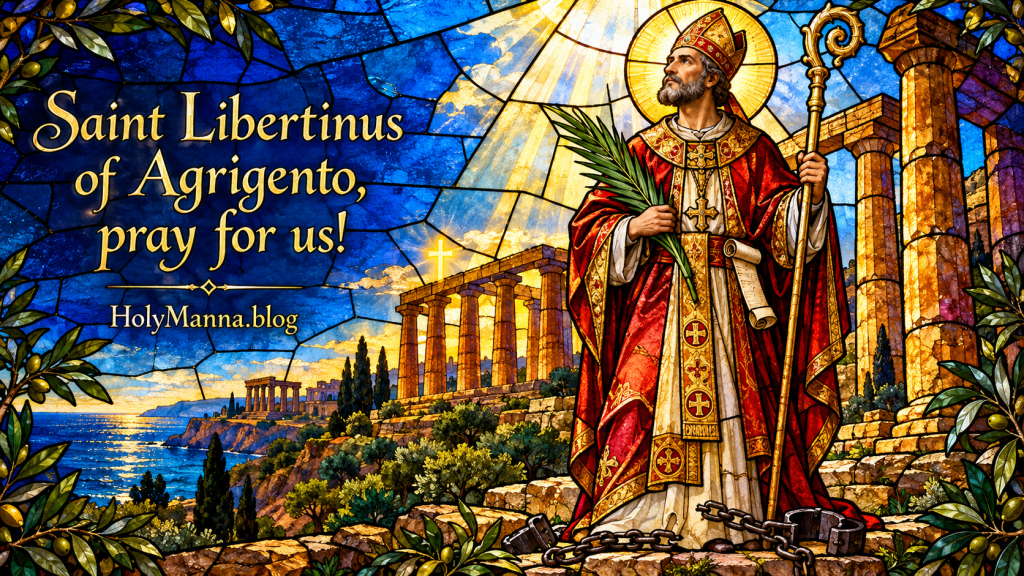
The Bishop Who Took His Bones to Heaven
On November 3rd, the Church remembers one of the most mysterious and haunting figures in the long story of Sicilian Christianity: Saint Libertinus, Bishop and Martyr, venerated as the very first bishop of Agrigento. The older editions of the Roman Martyrology record him simply and solemnly for this day as Saint Libertine, Bishop of Agrigento and Martyr. Behind that single line stands a story that stretches from the shadow of Greek temples to the terror of Roman persecution, and from a bishop’s final cry to a plague-stricken city digging desperately in the earth 16 centuries later.
Agrigento, the ancient Greek Akragas and Roman Agrigentum, was one of the glories of the classical Mediterranean. Its famous Valley of the Temples still bristles with columns raised to Zeus, Hera, Concordia, and the rest of the pagan pantheon. Into that world, according to a tradition cherished by the people of Agrigento for many centuries, walked a man sent by Saint Peter himself, carrying nothing but the Gospel of Jesus Christ. Libertinus matters because he represents the first link in an apostolic chain that still holds today. The Catechism teaches that the apostles “left bishops as their successors” and gave them “their own position of teaching authority” (CCC 77), and that this apostolic succession is how the Church remains the same Church Christ founded (CCC 861 to 862). Every Catholic who has ever knelt at Mass in Agrigento, and every Catholic reading these words today, stands downstream of men like Libertinus who carried the faith to places that had never heard the name of Jesus.
From the Hands of Peter
Honesty requires saying up front that very little about Saint Libertinus can be established as documented history, and the traditions themselves admit as much. He was not a native of Agrigento, and even the oldest local accounts confess that no one knows where he came from. Nothing is recorded of his family, his birthplace, or his formation. He arrives in the story already formed, already a believer, already a man on mission.
The tradition, gathered and handed down by Sicilian historians and writers up through the 18th century, holds that Saint Peter sent Libertinus to Agrigento around the year 44 to preach the Gospel and shepherd the first Christians of the city. The Cathedral of San Gerlando in Agrigento still preserves a painting by Francesco Narbone that captures this founding moment: Saint Peter handing Libertinus the parchment that institutes him as bishop of Agrigento. The Agrigentine canon and historian Raimondo Gaglio, writing in 1779, summed up what his city had always believed: “Saint Libertinus was the first bishop of Girgenti. He lived in the first centuries of Christ and brought there, before all others, the light of the Gospel.” His name stands first on the traditional chronological lists of the bishops of the diocese, including the series published in Sicilia Sacra at the start of the 20th century.
Here the historical record must be allowed to speak with its real uncertainty. Scholars who have studied the earliest Sicilian dioceses, including Francesco Lanzoni, Paul Kehr, and Cesare Mercurelli, agree only that Libertinus belongs somewhere between the 1st and the 3rd century. He may indeed have been a missionary of the apostolic age, or he may have lived two centuries later and been martyred during the great persecutions of the emperor Decius around the year 250, or of Diocletian in the first years of the 4th century. The sources conflict, and no one can resolve them. What no serious source doubts is the core: Agrigento venerated a protobishop named Libertinus from a very early date, believed he had evangelized the city, and honored him as a martyr. The connection to Saint Peter is a pious tradition rather than established fact, and it should be received as such. Yet even as tradition, it expresses something true about what a bishop is. Whether Peter handed him a parchment or not, Libertinus received his office from the apostles through the Church, because, as the Catechism teaches, “the whole Church is apostolic, in that she remains, through the successors of St. Peter and the other apostles, in communion of faith and life with her origin” (CCC 863).
Planting the Gospel Among the Temples
Whatever the century, the Agrigento that Libertinus entered was a thoroughly pagan city. The tradition describes him finding its citizens, in the vivid old phrasing, buried in the darkness of paganism and immersed in belief in false gods. The temples that tourists photograph today were then living centers of worship. The Catechism does not soften what that means: “Idolatry consists in divinizing what is not God” (CCC 2113), and it remains, in every age, “a constant temptation to faith.” Libertinus did not come to admire the architecture. He came to announce that the idols were empty and that God had raised Jesus from the dead.
And his preaching worked. The tradition records that his evangelization was effective and fruitful, that he converted many Agrigentines, and that Christianity began to resound among the very temples of the old gods. He is said to have governed the small Christian community tirelessly and to have built the city’s first church. Even here the traditions diverge; one account places that first church on the site later occupied by Santa Maria dei Greci, itself built over a Greek temple, while another suggests the site of the present cathedral. Both cannot be confirmed, and both are reported here as traditions. Archaeology adds a sober footnote: the consolidation of a formally organized diocese in Agrigento under Rome’s direct influence is only clearly documented in the 4th and 5th centuries, and three early Christian churches have been identified in the city, including a small cemetery basilica outside the walls at the foot of the eastern slope of the hill of the Temples.
The traditions also say, in a general way, that Libertinus performed miracles during his life. No specific miracle account from his lifetime has survived, and so none will be invented here. That silence is worth sitting with rather than papering over. The real miracle on display in his story is the one Jesus promised when he sent out his missionaries: “Whoever listens to you listens to me” (The Gospel of Luke 10:16). A pagan city began, person by person, to listen. Hearts changed. A Church was born where there had been none. The Catechism calls this the Church’s deepest identity, for she “exists in order to evangelize” and is missionary by her very nature, sent to all peoples (CCC 849 to 850). Libertinus should be remembered and emulated not because of wonders attached to his name, but because he did the unglamorous, dangerous, patient work of first evangelization, the work on which everything else in Agrigento’s 2,000 years of Catholic life was built.
Betrayed, Chained, and Faithful to the End
Whether under Decius or Diocletian, the storm that broke over Libertinus is well documented as a general fact of Roman history: imperial edicts outlawed the Christian religion, and it became illegal simply to be a Christian. Sicily was not spared. The tradition says that Libertinus continued his mission anyway, carrying it out in great secrecy, so that the informers working for the Roman authorities could not easily reach the protobishop. When neither flattery nor threats succeeded in breaking up the young Christian community, the pagan authorities turned to violence against innocent citizens.
Then came the wound that the tradition never forgot: betrayal. According to the account handed down in Agrigento, the people of a city quarter that hated the Christians sold the bishop out and led the Romans to the house where Libertinus was staying. He was seized and put in chains. The historian Silvano, as reported in the Agrigentine tradition, records that deceptions and threats were used to make him apostatize, which strongly suggests a trial, imprisonment, and perhaps torments. Libertinus refused. The tradition says he preferred to remain faithful to Christ, and to the Petrine mission he had received, to the very end.
On the manner of his death the traditions conflict, and the conflict should be stated plainly rather than smoothed over. One tradition says he was martyred and his body then burned. Others say he was stoned to death, or killed with the sword, or dispatched with a blow to the chest or the head. What every strand agrees on is that he died a martyr for the faith, and that he did not die alone; he was martyred together with Saint Peregrinus, known in Italian as San Pellegrino, a companion whose name has remained joined to his in the local memory of the Church of Agrigento.
The most famous element of the whole story belongs to this moment, and it must be told carefully. The tradition holds that before dying, standing before the people who had betrayed him, Libertinus cried out in Latin: “Gens iniqua, plebs rea, non videbis ossa mea,” that is, “Iniquitous people, guilty people, you will not see my bones.” This story cannot be verified. The scholar Giuseppe Fumagalli documented that this exact rhyming verse was a stock saying found in many communities that did not possess the relics of their patron saint, which makes it very likely that the words were attached to Libertinus later rather than spoken by him. A related local story claims that the name of Agrigento’s northern gate, Bibbirria, is a corruption of these dying words, though scholars consider it far more likely that the name comes from the Arabic phrase Bab er-riah, meaning Gate of the Winds. That story likewise cannot be verified.
What can be affirmed without hesitation is the meaning of the martyrdom itself. The Catechism teaches that “martyrdom is the supreme witness given to the truth of the faith: it means bearing witness even unto death” (CCC 2473). The martyr, it continues, “endures death through an act of fortitude” (CCC 2473), and fortitude is precisely “the moral virtue that ensures firmness in difficulties and constancy in the pursuit of the good” (CCC 1808). Chained, threatened, deceived, and abandoned by neighbors, Libertinus held firm. Scripture gives the martyr’s reward in the Lord’s own words: “Be faithful unto death, and I will give you the crown of life” (The Book of Revelation 2:10).
The Bones That Were Never Found
Veneration of Libertinus in Agrigento is not a modern invention; it is demonstrably ancient. The Life of Saint Gregory of Agrigento, written by Leontius about a bishop of the city who lived in the 7th century, records that the church of Agrigento owned a house in Palermo named after Libertinus. That small administrative detail is gold for historians, because it shows a cult of the protobishop already established and institutionalized in the early medieval period. Centuries later, his name entered the Roman Martyrology for November 3rd, fixing his memory in the universal commemoration of the Church. It is worth noting for readers following the current liturgical calendar that November 3rd on the General Roman Calendar is the optional memorial of Saint Martin de Porres; Libertinus remains a Martyrology commemoration and a beloved local Sicilian observance rather than a universal feast.
Modern archaeology has added a tantalizing possibility. The small early Christian basilica outside the ancient walls, a rectangular, apsed martyrion whose first phase dates to the Constantinian era, was built into a late Roman necropolis and deliberately incorporated two pre-existing tombs. The archaeologist Ernesto De Miro proposed that this little basilica was a memorial shrine to the martyrs Libertinus and Peregrinus, raised over their graves. It is a scholarly theory rather than a certainty, but it would mean that within living memory of the persecutions, the Christians of Agrigento were already gathering at what they believed to be their first bishop’s tomb.
Then comes the story that made Libertinus unforgettable in Sicily, and it begins with a ship. In June of 1624, a galleon arriving from Tunis unloaded infected goods at the port of Trapani, and the plague spread with terrifying speed across western Sicily, carrying its familiar cargo of suffering and death through the diocese of Agrigento and into the episcopal city itself. In Palermo, on July 15th, 1624, the relics of the virgin Saint Rosalia were discovered in a cave on Monte Pellegrino; when her relics were carried in procession through the desolate streets, the plague ceased, and the deliverance of Palermo was attributed to her protection.
The Agrigentines watched and took the lesson to heart. According to the story handed down in the city, prompted by admonitory visions and dreams, they resolved at once to find the relics of their own protobishop. They went to the place that tradition indicated as the site of his martyrdom and dug for days upon days, hoping to see the bones of Saint Libertinus come to light. They found nothing. The old verse rang in their ears; had the saint not said that the guilty people would never see his bones? The excavations left such lasting scars on the ground that the area is still called Via dei Fossi, the Street of the Ditches. The elements of this story involving the visions, the dreams, and the fulfillment of the dying words cannot be verified, and it is told here as the people of Agrigento have told it, as a story.
What happened next is a matter of record. In reparation, and to honor the bishop they feared they had offended, the Agrigentines built a small church dedicated to San Libertino in 1624 near the parish church of San Michele. An oratory dedicated to the saint followed, and later a congregation of canons and secular priests attached to the church of San Libertino. Every year on November 3rd, the city and the diocese celebrated his feast with a solemn procession. The devotion endured for centuries before fading in the modern era; the church of San Libertino was converted into a cinema and theater in the 1950s and today stands inactive, a quiet building holding a loud memory.
No healing miracles attributed to his intercession have come down through the sources, and none will be claimed here. What the record shows instead is a city that, in its darkest hour, instinctively turned to its first bishop as an intercessor, which is itself a living expression of what the Church believes. The Catechism teaches that the saints in heaven “do not cease to intercede with the Father for us” and that “their intercession is their most exalted service to God’s plan” (CCC 956). It adds that the Church’s communion with the saints “joins us to Christ” (CCC 957), and it honors the veneration of relics among the legitimate forms of popular piety that surround the Church’s sacramental life (CCC 1674). The Agrigentines never found the relics. The intercession never depended on them.
What a Missing Tomb Teaches a Restless Heart
Libertinus is a saint with no birthplace, no family history, no verified quotations, no documented miracles, and no grave that anyone can visit. For a generation formed by personal brands and searchable footprints, that is almost unthinkable, and that is exactly why he is worth knowing. Everything the world uses to measure a legacy is missing from his file, and yet 2,000 years later his name is still spoken at the altar. What remains of Libertinus is the only thing that ultimately remains of anyone: his fidelity, and the Church he helped to plant. Saint Paul’s words fit him like a vestment: “I have fought the good fight, I have finished the race, I have kept the faith” (The Second Letter to Timothy 4:7).
His story asks hard questions of comfortable believers. Libertinus evangelized a city where the dominant culture worshiped other things, and he kept at it when the law itself turned against him. Modern idols do not sit in marble temples; the Catechism is blunt that idolatry today includes the divinizing of “power, pleasure, race, ancestors, the state, money” (CCC 2113). What has quietly taken a throne in your own life that belongs to God alone? He was betrayed by neighbors and handed over by people he had come to serve. When living the faith costs you socially, at work, in your friend group, or online, do you go quiet, or do you stay faithful?
Even the uncomfortable dying-words story carries a lesson, precisely because it sits in tension with the Gospel. Christ forgave his executioners from the Cross, and the Catechism teaches that Christian prayer “extends to the forgiveness of enemies” (CCC 2844). Whether or not Libertinus ever spoke that bitter verse, and the evidence suggests he did not, the story survived because the Agrigentines recognized a real spiritual law inside it: rejecting the messengers God sends has consequences, and reconciliation delayed becomes reparation owed. A city spent four centuries learning that, and then built a church to say it was sorry. Is there an apology, a reconciliation, or an act of reparation that has been waiting too long in your own life?
Practically, his witness can be woven into ordinary days. A Catholic can imitate his missionary heart by mentioning the faith naturally in one conversation this week rather than hiding it. A Catholic can imitate his fortitude by making one visible choice for Christ that costs something, such as keeping Sunday holy over a competing invitation, defending the Church’s teaching with charity when it is mocked, or praying grace before a meal in public. And a Catholic can imitate the repentant Agrigentines by going to Confession, where the Church teaches that sinners obtain pardon and are reconciled with the Church they have wounded (CCC 1422). Fidelity, not fame, is the measure. The bones were never found because, in the end, they were never the point.
Engage With Us!
The story of Saint Libertinus of Agrigento, the first bishop of the City of Temples, has crossed 2,000 years to reach today’s readers, and now it is their turn to respond. Share your thoughts and reflections in the comments below; this community grows stronger every time someone speaks up. To spark the conversation, here are some questions to pray with:
- Saint Libertinus left no relics, no writings, and no verified sayings, yet his fidelity still bears fruit. What would remain of your life if everything visible were stripped away?
- He preached Christ in a city full of temples to other gods. What modern idols, such as money, status, comfort, or approval, compete for the throne of your heart?
- Libertinus was betrayed by people he came to serve and still refused to deny Christ. Where are you tempted to soften or hide your faith to keep the peace?
- The Agrigentines waited 4 centuries to make reparation to their first bishop. What overdue act of reconciliation is God inviting you to make this week?
- When the plague came, the people instinctively turned to the saints as intercessors. Which saint do you turn to in crisis, and how might Saint Libertinus join that company?
May the witness of Saint Libertinus stir every reader to a braver, more public, more faithful love of Jesus Christ. Live the faith out loud, hold fast when it costs something, and do everything, in every hidden corner of daily life, with the love and mercy that Christ taught his disciples.
Saint Libertinus of Agrigento, pray for us!
Follow us on YouTube, TikTok, Instagram and Facebook for more insights and reflections on living a faith-filled life.


Leave a Reply