Tuesday of the Thirty-first Week in Ordinary Time – Lectionary: 486
The Table Set by a Kneeling God
Picture a banquet hall with the candles lit, the food steaming, and the host standing at the door while every invited guest sends a polite text saying something came up. That is the strange, heartbreaking, and ultimately hopeful picture the Church places before the faithful on November 3rd, 2026, Tuesday of the Thirty-first Week in Ordinary Time.
The central theme uniting these readings is simple and stunning: God humbles himself to fill the humble. In Philippians 2:5-11, Paul hands over what may be the oldest hymn of the Christian faith, a song about the Son of God who “emptied himself, taking the form of a slave” and descended all the way to a criminal’s cross before being exalted above every name. Psalm 22:26-32 shows where that descent leads: a thanksgiving feast where “the lowly shall eat their fill” and every family of every nation bows before the Lord. Then, in Luke 14:15-24, Jesus tells of a great dinner that the respectable guests decline with perfectly reasonable excuses, so the master fills his hall with the poor, the crippled, the blind, and the lame.
The historical backdrop sharpens the point. Paul wrote to Philippi, a Roman colony obsessed with status and citizenship, and Jesus spoke at the dinner table of a prominent Pharisee, surrounded by guests jockeying for the best seats. Into both worlds, and into this one, God announces a different economy. The way up is down. The feast belongs to those humble enough to show up hungry. Every knee will bend before the King who knelt first.
First Reading — Philippians 2:5-11
A Hymn Sung from a Prison Cell
Philippi was a city that knew how to climb. Founded as a Roman colony and settled with veteran soldiers, it sat proudly on the Via Egnatia, and its residents treasured their Roman citizenship the way people today treasure a blue checkmark. Status was the local currency. Into that world, Paul, writing from prison around the late 50s or early 60s AD, sends a letter whose beating heart is a hymn about descent. Many scholars believe Paul is quoting a song the first Christians already sang in their liturgies, which would make this passage, often called the Carmen Christi, one of the oldest surviving confessions of the faith. Around AD 112 the Roman governor Pliny the Younger reported to Emperor Trajan that Christians met before dawn and sang hymns to Christ as to a god, outside confirmation of this very worship. The hymn traces the full arc of the day’s theme: the Son of God goes down so that redeemed humanity can be lifted up.
Philippians 2:5-11
Brothers and sisters:
Have among yourselves the same attitude
that is also yours in Christ Jesus,
Who, though he was in the form of God,
did not regard equality with God
something to be grasped.
Rather, he emptied himself,
taking the form of a slave,
coming in human likeness;
and, found human in appearance,
he humbled himself,
becoming obedient to death,
even death on a cross.
Because of this, God greatly exalted him
and bestowed on him the name
that is above every name,
that at the name of Jesus
every knee should bend,
of those in heaven and on earth and under the earth,
and every tongue confess that
Jesus Christ is Lord,
to the glory of God the Father.
Detailed Exegesis
Verse 5: “Have among yourselves the same attitude that is also yours in Christ Jesus.”
The Greek verb here, phronein, describes a habitual mindset rather than a passing mood. Paul is not asking the Philippians to admire Christ from a safe distance; he is asking them to let Christ’s interior disposition become their own. The request lands in a community dealing with rivalry and friction, since just two verses earlier Paul warned against selfishness and vainglory, and in Philippians 4:2 he has to beg two quarreling women to come to agreement. The cure for a divided church is not a better committee structure. It is the mind of Christ.
Verse 6: “Who, though he was in the form of God, did not regard equality with God something to be grasped.”
The phrase “form of God” translates morphe, the outward expression of an inner reality, affirming that the Son truly possesses the divine nature. The word for “grasped,” harpagmos, suggests seizing plunder. The Fathers heard here a deliberate reversal of Eden. Adam, a creature, grasped at being “like gods” in Genesis 3:5 and fell. Christ, who is God, refused to cling to his rightful glory and saved the human race by letting go.
Verse 7: “Rather, he emptied himself, taking the form of a slave, coming in human likeness.”
This is the famous kenosis, from the Greek verb meaning to empty. The Son did not empty himself of his divinity, but of its visible glory and privilege. He who deserved the morphe of God freely took the morphe of a doulos, a slave, the lowest rung of Roman society. In a status-obsessed colony like Philippi, calling the Lord of the universe a slave would have sounded scandalous, and that scandal is precisely the Gospel.
Verse 8: “And, found human in appearance, he humbled himself, becoming obedient to death, even death on a cross.”
The descent keeps going. Christ’s obedience undoes Adam’s disobedience, as Paul teaches in Romans 5:19, and it goes all the way to crucifixion, the punishment Rome reserved for slaves and rebels. Cicero once argued that the very word for the cross should be kept far from the eyes, ears, and thoughts of any Roman citizen. The hymn plants that unspeakable word at its center, because the bottom of the descent is the hinge of salvation history.
Verse 9: “Because of this, God greatly exalted him and bestowed on him the name that is above every name.”
Now the hymn pivots upward. The Father answers the Son’s self-emptying with exaltation, the Resurrection and Ascension, and bestows on him “the name that is above every name,” language reserved in Israel for the holy Name of God himself. Humiliation was not a detour on the way to glory. It was the road.
Verse 10: “That at the name of Jesus every knee should bend, of those in heaven and on earth and under the earth.”
Paul is quoting Isaiah 45:23, where the God of Israel swears that every knee shall bend to him alone, and applying it directly to Jesus. The three-tiered sweep of heaven, earth, and the realm beneath leaves no corner of creation outside his lordship, and it anticipates the psalm’s vision of nations and even the dead bowing low before the Lord.
Verse 11: “And every tongue confess that Jesus Christ is Lord, to the glory of God the Father.”
Here stands the earliest Christian creed, three words in Greek: Kyrios Iesous Christos. Since Kyrios is the word the Greek Old Testament uses for the divine Name, confessing Jesus as Lord is confessing his divinity, which is why Paul says in 1 Corinthians 12:3 that no one can make this confession except by the Holy Spirit. And notice the destination. The Son’s exaltation terminates in the glory of the Father, because in the Trinity, glory is never hoarded, only given.
Teachings
The Catechism builds its teaching on the Incarnation directly on this hymn. CCC 461 declares, “Taking up St. John’s expression, ‘The Word became flesh,’ the Church calls ‘Incarnation’ the fact that the Son of God assumed a human nature in order to accomplish our salvation in it,” and then quotes Philippians 2:5-8 in full as its scriptural witness. St. Leo the Great, the fifth-century pope and Doctor of the Church, explained the self-emptying in his Tome to Flavian: “For that self-emptying, which He underwent for man’s restoration, was the dispensation of compassion, not the loss of power.” In other words, the Son lost nothing of what he is; he stooped because love stoops. The Catechism also presents this humility as a pattern to copy, teaching in CCC 520, “In all of his life Jesus presents himself as our model. He is ‘the perfect man,’ who invites us to become his disciples and follow him. In humbling himself, he has given us an example to imitate, through his prayer he draws us to pray, and by his poverty he calls us to accept freely the privation and persecutions that may come our way.” The Church loves this hymn so much that she sings it every week at Evening Prayer in the Liturgy of the Hours, and the ancient custom of bowing the head at the Holy Name of Jesus flows straight from verse 10.
Reflection
Every workplace, group chat, and social media feed runs on the logic of Philippi: promote yourself, protect your image, climb. Christ invites you to run on a different operating system. This week, try three concrete practices. First, take on one hidden act of service that nobody will see or credit, and offer it to the Father who sees in secret. Second, when conversation turns to self-promotion, choose to praise someone else instead. Third, bow your head slightly whenever the name of Jesus is spoken at Mass, letting your body preach verse 10 to your soul. Where in your life are you still grasping at status, and what would it look like to let go? If the mind of Christ truly shaped your decisions this week, what is the first thing that would change?
Responsorial Psalm — Psalm 22:26-32
The Psalm of the Cross Ends in a Feast
Most Catholics know how Psalm 22 begins, because Jesus prayed its opening line from the Cross: “My God, my God, why have you forsaken me?” as recorded in Matthew 27:46. Far fewer know how it ends. Today the Church hands over the final verses, and the turn is breathtaking. The psalm of abandonment becomes a psalm of banquet. The sufferer who was mocked, pierced, and surrounded by evildoers now stands vindicated in the great assembly, hosting a thanksgiving meal where the poor eat their fill and the whole world turns back to God. In ancient Israel, a rescued person offered a todah, a thanksgiving sacrifice, and then shared the sacrificial meal publicly with family, friends, and especially the poor, so that everyone could taste the goodness of the God who saves. The Fathers of the Church read the entire psalm as the prayer of Christ himself, which means these closing verses are nothing less than the Crucified One describing what his death would accomplish. The descent of Philippians 2 and the filled banquet hall of Luke 14 meet right here, in the middle of the day’s liturgy.
Psalm 22:26-32
R. (26a) I will praise you, Lord, in the assembly of your people.
I will fulfill my vows before those who fear him.
The lowly shall eat their fill;
they who seek the LORD shall praise him:
“May your hearts be ever merry!”
R. I will praise you, Lord, in the assembly of your people.
All the ends of the earth
shall remember and turn to the LORD;
All the families of the nations
shall bow down before him.
R. I will praise you, Lord, in the assembly of your people.
For dominion is the LORD’s,
and he rules the nations.
To him alone shall bow down
all who sleep in the earth.
R. I will praise you, Lord, in the assembly of your people.
To him my soul shall live;
my descendants shall serve him.
Let the coming generation be told of the LORD
that they may proclaim to a people yet to be born
the justice he has shown.
R. I will praise you, Lord, in the assembly of your people.
Detailed Exegesis
Verses 26 and 27: “I will fulfill my vows before those who fear him. The lowly shall eat their fill; they who seek the LORD shall praise him: ‘May your hearts be ever merry!’”
The rescued sufferer keeps his promise in public, before the assembly of believers, because biblical gratitude is never a private feeling. Fulfilling a vow after deliverance meant offering the todah sacrifice and throwing open the meal, and the guest list is the detail to notice: the lowly, the anawim, the poor and humble of the land who have nothing to rely on but God. At this table, the ones the world overlooks are the ones who leave satisfied, and the blessing “may your hearts be ever merry” reveals a God who wants his people not merely fed but joyful.
Verse 28: “All the ends of the earth shall remember and turn to the LORD; All the families of the nations shall bow down before him.”
The camera suddenly pulls back from one grateful man to the entire planet. The nations “remember,” as if the knowledge of the true God had been buried in human hearts all along, waiting for the Cross and Resurrection to awaken it. The word for turning is the great biblical word for conversion, and the bowing of every family of nations lands like an echo of the hymn just proclaimed, where every knee bends at the name of Jesus.
Verses 29 and 30: “For dominion is the LORD’s, and he rules the nations. To him alone shall bow down all who sleep in the earth.”
Kingship belongs to the Lord, not to Caesar, not to any empire, not to any algorithm or market. Even more astonishing, the psalmist extends that dominion to “all who sleep in the earth,” the dead. Centuries before the Resurrection, this psalm dares to say that not even the grave sits outside God’s reign, a hope Paul makes explicit when he writes that every knee shall bend, including those “under the earth.”
Verses 31 and 32: “To him my soul shall live; my descendants shall serve him. Let the coming generation be told of the LORD that they may proclaim to a people yet to be born the justice he has shown.”
The psalm closes by stretching forward in time. The one whom God rescued will live for him, and the story of deliverance must be handed on to children, grandchildren, and “a people yet to be born.” Every Christian alive today is that people. Every Mass, every catechism class, every parent teaching a child the Sign of the Cross is this verse coming true in real time.
Teachings
The Catechism confirms that this psalm belongs on the lips of Christ. CCC 603 teaches, “Jesus did not experience reprobation as if he himself had sinned. But in the redeeming love that always united him to the Father, he assumed us in the state of our waywardness of sin, to the point that he could say in our name from the cross: ‘My God, my God, why have you forsaken me?’” If the psalm’s agony was his, so is its feast. The Letter to the Hebrews even places verse 23 directly on Jesus’ lips, where the risen Lord says, “I will proclaim your name to my brethren, in the midst of the assembly I will praise you,” as cited in Hebrews 2:12. The psalm’s worldwide worship also teaches what the Church calls adoration. CCC 2096 states, “Adoration is the first act of the virtue of religion. To adore God is to acknowledge him as God, as the Creator and Savior, the Lord and Master of everything that exists, as infinite and merciful Love.” And its explosion of thanksgiving models the highest form of prayer, for CCC 2639 teaches, “Praise is the form of prayer which recognizes most immediately that God is God. It lauds God for his own sake and gives him glory, quite beyond what he does, but simply because HE IS.”
Reflection
This psalm asks a pointed question of every believer: does deliverance ever make it past the private thank-you into public praise? When God answers a prayer, heals a wound, or carries someone through a dark season, the biblical response is to tell the assembly. This week, consider three steps. Share one story of answered prayer with a friend or family member who needs hope. At Sunday Mass, sing the responsorial psalm like someone who actually means it, since the liturgy is the great assembly this psalm foresaw. Finally, hand the faith forward to the coming generation in one small way, perhaps by teaching a child a prayer or telling them why the faith matters personally. What rescue in your own life still deserves public thanksgiving? Who is the “people yet to be born” that God is asking you to reach?
Holy Gospel — Luke 14:15-24
Dinner Is Ready and the Seats Are Empty
This parable unfolds at an actual dinner party. Luke 14 opens with Jesus dining on the Sabbath at the home of a leading Pharisee, where he has just watched guests scramble for places of honor and told his host to invite “the poor, the crippled, the lame, the blind” instead of friends who can repay him. Banquets in that world ran on a double invitation: guests accepted days in advance, then a servant summoned them when all was ready. Everyone in this parable had already said yes, so these last-minute excuses are calculated insults to a generous host. The guest who sighs about dining in the Kingdom voices Israel’s deepest hope, the feast promised for all peoples in Isaiah 25:6, and Jesus answers with a story that turns sentiment into urgent question.
Luke 14:15-24
One of those at table with Jesus said to him,
“Blessed is the one who will dine in the Kingdom of God.”
He replied to him,
“A man gave a great dinner to which he invited many.
When the time for the dinner came,
he dispatched his servant to say to those invited,
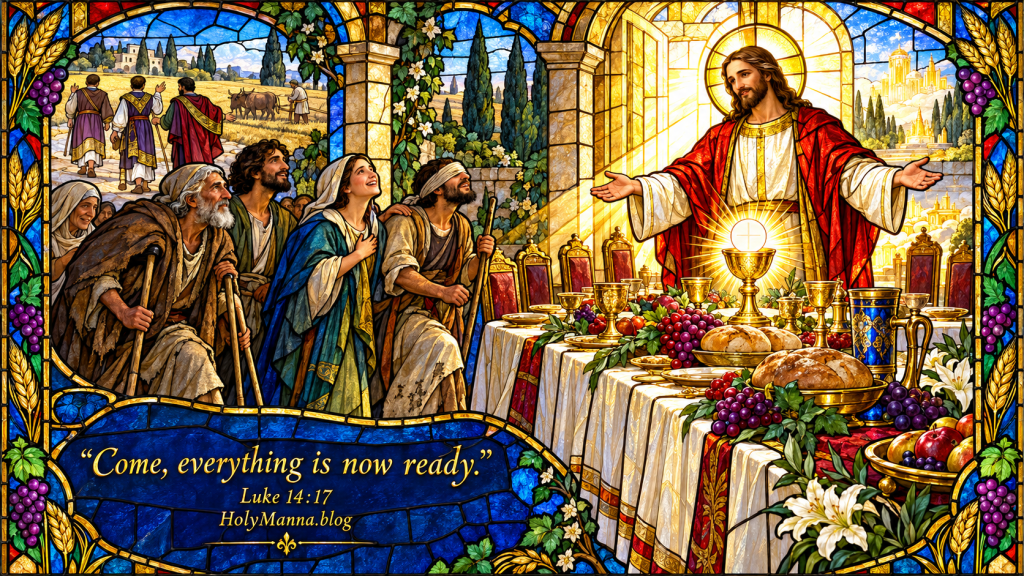
‘Come, everything is now ready.’
But one by one, they all began to excuse themselves.
The first said to him,
‘I have purchased a field and must go to examine it;
I ask you, consider me excused.’
And another said, ‘I have purchased five yoke of oxen
and am on my way to evaluate them;
I ask you, consider me excused.’
And another said, ‘I have just married a woman,
and therefore I cannot come.’
The servant went and reported this to his master.
Then the master of the house in a rage commanded his servant,
‘Go out quickly into the streets and alleys of the town
and bring in here the poor and the crippled, the blind and the lame.’
The servant reported, ‘Sir, your orders have been carried out
and still there is room.’
The master then ordered the servant,
‘Go out to the highways and hedgerows
and make people come in that my home may be filled.
For, I tell you, none of those men who were invited will taste my dinner.’”
Detailed Exegesis
Verse 15: “Blessed is the one who will dine in the Kingdom of God.”
The remark sounds pious, and it is true. But it quietly assumes the speaker already holds a reserved seat and the feast sits safely in the future. Jesus dismantles both assumptions, because the Kingdom is an invitation arriving now.
Verses 16 and 17: “A man gave a great dinner to which he invited many. When the time for the dinner came, he dispatched his servant to say to those invited, ‘Come, everything is now ready.’”
The Fathers saw in the host God the Father, and in the summons the voice of Christ. The words “everything is now ready” carry the whole urgency of the Gospel. After centuries of prophets and promises, heaven has finished waiting.
Verses 18 and 19: “But one by one, they all began to excuse themselves. The first said to him, ‘I have purchased a field and must go to examine it; I ask you, consider me excused.’ And another said, ‘I have purchased five yoke of oxen and am on my way to evaluate them; I ask you, consider me excused.’”
Nobody here is committing a crime. A field and ten oxen represent property and honest work, and the excuses even echo the exemptions Deuteronomy 20:5-7 granted to men headed for war. That is exactly the danger: the feast is rarely lost to scandalous sins; it is lost to good things loved out of order. Both men claim an urgency that does not exist, since nobody buys land or livestock sight unseen. The polite wording cannot hide the verdict: something else matters more than the host.
Verse 20: “And another said, ‘I have just married a woman, and therefore I cannot come.’”
The third guest does not even ask to be excused. Marriage is a gift from God, and Deuteronomy 24:5 exempted a newly married man from military service, but a wedding at home is a strange reason to refuse the feast of heaven. The words “I cannot come” really mean “I will not come.”
Verse 21: “Then the master of the house in a rage commanded his servant, ‘Go out quickly into the streets and alleys of the town and bring in here the poor and the crippled, the blind and the lame.’”
The master’s anger is the anger of wounded love, and his response is not to cancel the feast but to widen the doors. The guest list is word for word the one Jesus gave his host in Luke 14:13, the people who could never repay the invitation. These are the outcasts of Israel already seated around Jesus, the lowly eating their fill exactly as the psalm promised.
Verses 22 and 23: “The servant reported, ‘Sir, your orders have been carried out and still there is room.’ The master then ordered the servant, ‘Go out to the highways and hedgerows and make people come in that my home may be filled.’”
Still there is room. Those words contain the Church’s entire missionary history. The highways and hedgerows lie outside the town, and the Fathers read this second wave as the calling of the Gentiles, the nations of Psalm 22 streaming toward the table. The command to make people come in describes not force but holy insistence, a love that will not take a shy no from those who cannot believe the invitation is meant for them.
Verse 24: “For, I tell you, none of those men who were invited will taste my dinner.”
This closing sentence should end all complacency. The feast will be full with or without any particular guest, yet it remains possible to be invited, to say yes in theory, and to miss the meal entirely. Hell is not crashed gates. It is declined invitations.
Teachings
St. Augustine, in his Sermon 112, mapped the three excuses onto the triple concupiscence of 1 John 2:16: “The lust of the flesh, I have married a wife. The lust of the eyes, I have bought five pairs of oxen. The ambition of life, I have bought a farm.” The farm stands for pride, the oxen for the restless curiosity of the senses, the wife for pleasure of the flesh. St. Gregory the Great, in his Homily 36 on the Gospels, explained the refusals: “Fleshly delights when not possessed provoke a longing desire for them, but when possessed and devoured, the eater soon turns from satiety to loathing; spiritual delights, on the other hand, when not possessed are loathed, when possessed the more desired.” St. Cyril of Alexandria, in his Sermon 104 on Luke, wrote, “He therefore, the Creator of the universe, and the Father of glory, made a great supper, that is, a festival for the whole world, in honor of Christ.” The Catechism teaches in CCC 546, “Jesus’ invitation to enter his kingdom comes in the form of parables, a characteristic feature of his teaching. Through his parables he invites people to the feast of the kingdom, but he also asks for a radical choice: to gain the kingdom, one must give everything. Words are not enough; deeds are required.” And CCC 1402 recalls the Church’s ancient Eucharistic acclamation: “O sacred banquet in which Christ is consumed, the memory of his Passion is recalled, the soul is filled with grace and a pledge of the future glory is given to us.” At every Mass, the priest lifts the Host and announces, “Blessed are those called to the supper of the Lamb,” answering the sigh of verse 15.
Reflection
The excuses in this parable have modern translations: the deadline, the renovation, the game, the inbox. None of them is evil, yet every one of them can quietly outrank God. Write down the last three reasons given for skipping Mass or prayer, and ask whether a boss would have accepted the same excuse. Then become the servant. Somebody in your life is standing in the hedgerows, convinced the invitation could never be for them, and one text inviting them to Mass or dinner might change that. Finally, come to the feast hungry, arriving at Mass early enough to desire the Eucharist rather than merely attend it. Which good thing in your life is currently sitting in God’s chair? Who is one person you could personally bring to the banquet this month?
Still There Is Room
Step back and watch the whole story the Church tells on this ordinary Tuesday. It begins in the heights of heaven, where the Son of God looks at equality with the Father and refuses to clutch it like a prize. He empties himself, puts on the apron of a slave, and walks obediently down every step of the staircase, past the manger, past the workbench, all the way to a cross on a garbage hill outside Jerusalem. Then the Father raises him, hands him the Name above every name, and the whole universe begins to bend its knees.
And what does this exalted King do with his triumph? He throws a dinner party. Psalm 22 saw it coming centuries early: the lowly eating their fill, the nations remembering and turning, the dead bowing low, generations yet unborn hearing the story. Luke 14 shows the invitations going out and, scandalously, the respectable guests choosing fields, oxen, and comfortable evenings at home over the table of God. So the master sends his servant to the streets, the alleys, the highways, and the hedgerows, and the hall begins to fill with everyone the world forgot.
Here is the good news hiding in that hard parable: the summons has not expired. The same words still echo from every tabernacle on earth, “Come, everything is now ready.” The feast is the Eucharist now and the wedding supper of the Lamb forever, and the only ticket required is the humility to admit hunger. Say yes to the invitation this week. Go to Mass with an undivided heart, drag along somebody from the hedgerows, and take a seat at the table set by a kneeling God. Still there is room.
Engage With Us!
These readings were made for conversation, so please share your reflections in the comments below. Which image stayed with you: the Son emptying himself, the lowly eating their fill, or the empty chairs at the great dinner? Your story might be exactly what another reader in the hedgerows needs to hear today. Here are a few questions to pray with:
- In Philippians 2:5-11, Christ refuses to grasp at his rightful glory and instead empties himself for others. What is one area of your life, at work, at home, or online, where God might be inviting you to stop grasping and start serving?
- In Psalm 22:26-32, the rescued sufferer fulfills his vows publicly so that the lowly can eat and future generations can believe. When God answered a prayer or carried you through suffering, did your gratitude stay private, and who could you tell this week?
- In Luke 14:15-24, every declined invitation involves something good, a field, oxen, a marriage, loved more than the host. Which legitimately good thing most often becomes your excuse for declining God’s invitation, and what would it cost to reorder that love?
- Taken together, these readings reveal a God who humbles himself to fill the humble. Where is the Lord saying to you, personally, “Come, everything is now ready,” and what would a wholehearted yes look like before this week ends?
Faith was never meant to be lived alone or halfway. The King who knelt first is holding a seat at his table, and every small yes, every Mass attended, every person invited, every hidden act of humble service, fills the hall a little more. Go live this day with courage and joy, and do everything with the love and mercy Jesus taught us.
Sacred Heart of Jesus, we trust in You!
Immaculate Heart of Mary, pray for us!
Saint Michael the Archangel, defend us in battle!
Follow us on YouTube, TikTok, Instagram and Facebook for more insights and reflections on living a faith-filled life.


Leave a Reply