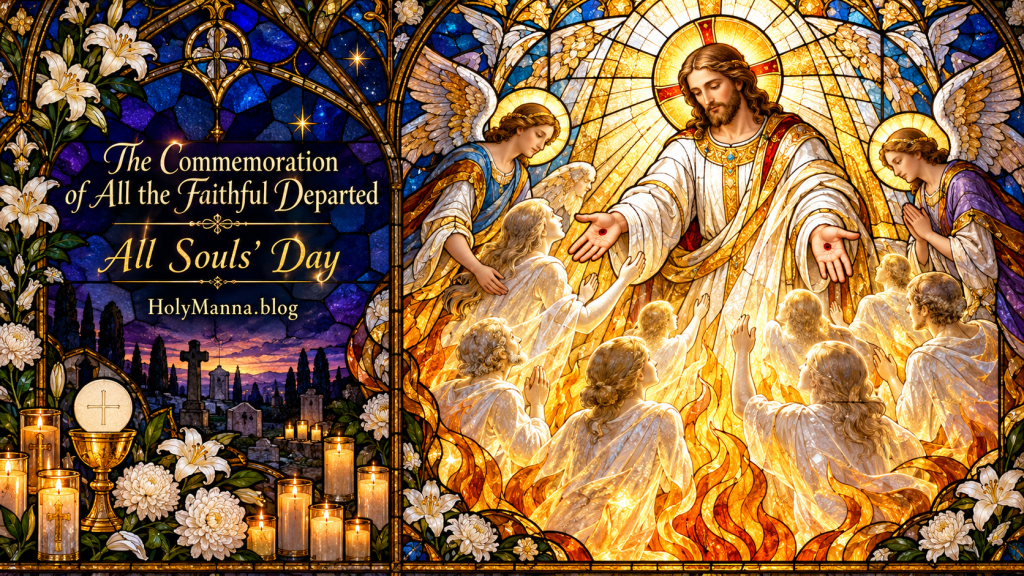
A Day the Whole Church Kneels Beside the Grave
Every year on November 2nd, the Catholic Church does something the modern world finds almost unthinkable. She looks death straight in the eye, and she refuses to let go of her dead. The Commemoration of All the Faithful Departed, known everywhere simply as All Souls’ Day, is the day the universal Church gathers her prayers, her Masses, her candles, and her tears for every soul who has died in God’s friendship but still awaits the full joy of heaven. It is deliberately placed the day after the Solemnity of All Saints, and the pairing is no accident. November 1st celebrates the Church triumphant, the saints already beholding the face of God. November 2nd turns to the Church being purified, the holy souls who need, and receive, the love of their brothers and sisters still on pilgrimage.
The Catechism of the Catholic Church teaches that these 3 states form one single family. Quoting the Credo of the People of God of St. Paul VI, it professes belief in “the communion of all the faithful of Christ, those who are pilgrims on earth, the dead who are being purified, and the blessed in heaven, all together forming one Church” (CCC 962). Death, in other words, does not dissolve the bonds forged in Baptism. It stretches them across eternity.
That is why All Souls’ Day matters so much to the life of the Church and to the devotion of the faithful today. A culture that hides death behind euphemisms and hurries grief along has no answer for the ache of loss. The Church does. She answers with the words of St. Paul proclaimed at the altar on this very day: “Hope does not disappoint” (Romans 5:5). On All Souls’ Day, grief and hope stand side by side, and hope wins. Anyone who has buried a parent, a grandparent, a friend, or a child knows that love does not simply end at a graveside. The Church says that love should not end there, because it still has work to do. Prayer for the dead is love’s unfinished business, and November 2nd is the day the whole Church takes up that work together.
From the Catacombs to Cluny
Christians prayed for their dead long before any calendar date existed for it. The walls of the Roman catacombs carry inscriptions begging prayers for the departed. Around the year 211, Tertullian described the already established custom of offering the Eucharist for the dead on the anniversaries of their deaths in his work De Corona. The ancient liturgies read the names of the departed aloud from folding tablets called diptychs, so that the dead were remembered by name at the altar. In the 4th century, St. Cyril of Jerusalem explained to the newly baptized in his Catechetical Lectures that the Church intercedes at the Eucharist for all who have fallen asleep, believing this to be of the greatest benefit to their souls.
The most moving early witness comes from a mother. As St. Monica lay dying at Ostia in 387, she released her sons from every funeral arrangement except one, telling them, as her son recorded in The Confessions, “One thing only I ask you, that you remember me at the altar of the Lord wherever you may be” (Confessions, Book 9). St. Augustine honored that request for the rest of his life, and the Catechism still holds up Monica’s words as the model of Christian remembrance (CCC 1371).
Monastic communities gradually gave this instinct fixed days. In 7th-century Spain, the rule of St. Isidore of Seville appointed the Monday after Pentecost for the deceased. The decisive step came from Cluny, the great Benedictine motherhouse in Burgundy. St. Odilo, its 5th abbot, decreed that every Cluniac monastery keep November 2nd, the day after All Saints, as a commemoration of all the faithful departed, with the Office of the Dead and Masses offered for them. The decree is traditionally dated to the year 998, though some historians place it later in Odilo’s long abbacy, and honesty requires noting that the exact year remains discussed. What is certain is the result. From Cluny’s vast network of monasteries the observance spread through dioceses across Europe, and by the 14th century Rome herself had adopted it, fixing November 2nd on the calendar of the universal Church.
Two popes later enlarged the day’s liturgical generosity. In 1748, Benedict XIV approved the custom of priests offering multiple Masses on this day in Spain, Portugal, and their territories. Then, on August 10th, 1915, with the First World War filling Europe with graves, Benedict XV issued the apostolic constitution Incruentum Altaris, extending to every priest of the Latin Church the privilege of celebrating 3 Masses on All Souls’ Day: one for an intention of his choosing, one for all the faithful departed, and one for the intentions of the Holy Father. That privilege remains in force today, which is why many parishes still schedule 3 Masses on November 2nd.
The Christian East keeps the same faith on different days. Byzantine churches, including the Eastern Catholic Churches, do not observe November 2nd but instead keep several “Soul Saturdays” through the year, especially before Great Lent, during Great Lent, and before Pentecost, since Saturday recalls the day Christ himself rested in the tomb. East and West differ in date, never in doctrine.
Why Catholics Pray for the Dead
Praying for the dead is not a medieval invention. It is biblical, and the Church has always read the Scriptures this way. The clearest Old Testament witness comes from 2 Maccabees 12:43-46, where Judas Maccabeus takes up a collection and sends it to Jerusalem to provide a sacrifice for soldiers who had died in sin. The sacred author praises him for acting “in view of the resurrection” and concludes, “Thus he made atonement for the dead, that they might be freed from this sin” (2 Maccabees 12:46, cited at CCC 1032). The inspired text assumes exactly what the Church teaches: the dead can be helped, and the living have the privilege of helping them.
The New Testament deepens the picture. Jesus speaks of a sin that “will not be forgiven, either in this age or in the age to come” (Matthew 12:32), words the Catechism reads as implying that certain offenses can be forgiven in the age to come (CCC 1031). St. Paul describes the judgment of each person’s works with the striking image of fire, writing that if someone’s work is burned up, “the person will be saved, but only as through fire” (1 Corinthians 3:15). Salvation, yes; purification, also yes.
The Fathers received this teaching and preached it boldly. St. John Chrysostom, a Doctor of the Church, urged his congregation in his Homilies on 1 Corinthians: “Let us not hesitate to help those who have died and to offer our prayers for them” (quoted at CCC 1032). St. Augustine wrote an entire treatise, On the Care of the Dead, defending prayer and the Holy Sacrifice offered for the departed.
When later centuries pressed the question, the Church’s councils answered with precision. The Second Council of Lyons in 1274, the Council of Florence in 1439, and above all the Council of Trent in its Decree on Purgatory of 1563 defined that a purgatory exists and that the souls detained there are helped by the suffrages of the faithful, especially by the acceptable Sacrifice of the altar (CCC 1032). This is the solid ground All Souls’ Day stands on: Scripture, the Fathers, and the solemn teaching of the Magisterium, all speaking with one voice across 2,000 years. The doctrine was never a concession to sentiment. It was, from the beginning, a conclusion drawn from the Resurrection itself, since the God who raises the dead does not abandon those he is making ready for glory.
The Theology Behind the Candles
Purgatory may be the most misunderstood word in the Catholic vocabulary, so the Catechism’s definition deserves to be read slowly. “All who die in God’s grace and friendship, but still imperfectly purified, are indeed assured of their eternal salvation; but after death they undergo purification, so as to achieve the holiness necessary to enter the joy of heaven” (CCC 1030). Notice what that sentence says. The souls in purgatory are saved. They are assured of heaven. Purgatory is not a second chance, not a waiting room of uncertainty, and certainly not a lesser hell. The Catechism states plainly that this final purification of the elect “is entirely different from the punishment of the damned” (CCC 1031). Purgatory is mercy. It is the love of God completing in a soul what remains unfinished, because, as Scripture teaches, nothing unclean shall enter the heavenly Jerusalem (Revelation 21:27).
Pope Benedict XVI gave this doctrine one of its most beautiful modern expressions in his encyclical Spe Salvi, where he presents purification as an encounter with the gaze of the risen Lord and writes, “The fire which both burns and saves is Christ himself, the Judge and Saviour” (Spe Salvi 47). In the same encyclical he teaches that the souls of the departed can receive solace and refreshment through the Eucharist, prayer, and almsgiving, because love reaches across death (Spe Salvi 48).
This is where the communion of saints becomes intensely practical. The Catechism teaches that the Church has honored the memory of the dead from the very beginning and has offered prayers and suffrages for them, and then adds a line worth memorizing: “Our prayer for them is capable not only of helping them, but also of making their intercession for us effective” (CCC 958). The holy souls, in turn, pray for those on earth. The exchange of charity runs in both directions.
The Church also opens her treasury on this day through indulgences, which the Catechism defines as the remission before God of the temporal punishment due to sins whose guilt has already been forgiven (CCC 1471). Because the faithful are united in one Body, the Church teaches that indulgences may be applied to the dead by way of prayer (CCC 1479), a doctrine St. Paul VI reaffirmed and reordered in the apostolic constitution Indulgentiarum Doctrina of 1967. The Second Vatican Council summarized the whole vision in Lumen Gentium 49-51, teaching that the union of the pilgrim Church with those who sleep in the peace of Christ is in no way interrupted, but strengthened by the exchange of spiritual goods. All Souls’ Day is that paragraph of the Council lived out loud.
Candles, Cemeteries, and the Treasury Thrown Open
November is dedicated to the holy souls, and the Church begins the month by making her treasury unusually easy to reach. According to the Manual of Indulgences (4th edition, 1999, concession 29), a plenary indulgence, applicable only to the souls in purgatory, is granted to the faithful who devoutly visit a cemetery and pray for the departed, even if only mentally, on each day from November 1st to November 8th. On All Souls’ Day itself, a plenary indulgence for the holy souls is granted to those who devoutly visit a church or oratory and recite the Our Father and the Creed there. The usual conditions apply in each case: sacramental Confession, Holy Communion, prayer for the intentions of the Holy Father, and complete detachment from sin, even venial sin. Taken seriously, these 8 days become a work of mercy of staggering scope, a chance to beg heaven’s doors open for souls who may have no one else to pray for them.
The liturgy of the day carries the same urgency. Thanks to Incruentum Altaris, every priest may offer 3 Masses, and the Roman Missal provides 3 distinct sets of prayers for them. Violet or black vestments may be worn, colors of penance and mourning shot through with hope (General Instruction of the Roman Missal 346). The Liturgy of the Hours provides the Office for the Dead, among the most ancient prayer forms in the Church. Parishes gather the names of the departed into books of remembrance and All Souls envelopes, so that the beloved dead are carried to the altar throughout November, in the spirit of the Catechism’s teaching that the Eucharistic sacrifice is offered for the faithful departed who have died in Christ but are not yet wholly purified (CCC 1371).
Simple devotions keep the day close at hand. The Eternal Rest prayer, drawn from the Church’s ancient liturgy for the dead, asks, “Eternal rest grant unto them, O Lord, and let perpetual light shine upon them”. Across the centuries, purgatorial societies and confraternities arose whose entire purpose was to have Masses offered for deceased members and for the forgotten dead. Pilgrims in Rome sometimes visit the Church of the Sacred Heart of Jesus in Prati, which houses a small collection popularly called the Museum of the Holy Souls in Purgatory; the objects there are associated with the holy souls by tradition and pious account, and the Church has issued no formal judgment on them, so they are best received as devotional heritage rather than proven fact. The Church’s Book of Blessings likewise provides for the blessing of graves and cemeteries, holy ground where the bodies of the baptized await the resurrection.
Pan de Muerto, Zaduszki, and the Music of the Requiem
Few days on the calendar have sunk deeper roots into human culture. In Mexico and across Latin America, the days of November 1st and 2nd blossom into Día de los Muertos, which grew up where the Spanish missionaries’ celebration of All Saints and All Souls met the memory customs of the native peoples. Families build ofrendas with photographs of their dead, bake sweet pan de muerto, and spend the night in candlelit cemeteries. The Church’s constant pastoral counsel is to keep the heart of these days Christian: Mass offered for the dead, prayer for their souls, and hope in the resurrection, so that remembrance never drifts loose from the Communion of Saints that gives it meaning.
In Poland, Zaduszki transforms cemeteries into seas of flame, and the great Powązki cemetery in Warsaw glows for days as millions place vigil candles on graves, including the graves of strangers. In the Philippines, Undas sees entire families keep vigil at the tombs of their loved ones, praying, eating, and remembering together. Italians bake sweets called ossa dei morti, bones of the dead, and in Sicily children traditionally wake to small gifts said to come from the departed, a custom lovingly handed down as tradition. In Austria, Germany, and Hungary, graves are blessed and lit with lanterns. In France, chrysanthemums blanket the cemeteries. In medieval England, the poor went souling door to door, promising prayers for the dead in exchange for small soul cakes; a widely repeated account connects this custom to later door-to-door traditions, though that connection is handed down as popular tradition rather than settled history.
The day also gave the world some of its greatest music. The sequence Dies Irae, traditionally attributed to Thomas of Celano, though the attribution remains uncertain, became the heartbeat of the Requiem Mass, and composers from Mozart to Fauré to Duruflé carried the Church’s prayers for the dead into every concert hall on earth. Dante built the entire second canticle of his Divine Comedy, the Purgatorio, on souls who beg the living for prayers. Among Eastern Catholics, the Soul Saturdays feature kolyva, boiled wheat sweetened with honey, recalling the Lord’s words that unless a grain of wheat falls to the ground and dies, it remains alone, but if it dies it bears much fruit (John 12:24).
The liturgy itself proclaims the mystery with breathtaking tenderness. For November 2nd, 2026, the readings announced for the day begin with Wisdom 3:1-9: “The souls of the just are in the hand of God, and no torment shall touch them”. The responsorial psalm is the beloved Psalm 23, the Lord the shepherd who walks through the dark valley with his own. The 2nd reading is Romans 5:5-11, with Romans 6:3-9 as an alternative, grounding hope in the death and resurrection of Christ into which every Christian is baptized. The Alleluia verse rings out from Matthew 25:34: “Come, you who are blessed by my Father; inherit the Kingdom prepared for you from the foundation of the world”. The Gospel is John 6:37-40, where Jesus promises, “this is the will of the one who sent me, that I should not lose anything of what he gave me, but that I should raise it on the last day” (John 6:39). The Lectionary (no. 668) permits any readings from the Masses for the Dead, but this selection says everything: the dead belong to God, and Jesus does not lose what the Father has given him.
Remembering Well
All Souls’ Day is not meant to end at sundown on November 2nd. It is meant to change how you love. Begin with the simplest practice of all: pray for your dead by name. Keep a list, on paper or on your phone, of the family members, friends, teachers, and coworkers who have gone before you, and bring it to prayer. Who taught you the faith and has already crossed to the other side? That person prayed for you once; now it is your turn.
Make the Eternal Rest prayer a reflex. Pray it when you drive past a cemetery, when a funeral procession passes, when a name surfaces in memory. Have Masses offered for your beloved dead, because the Catechism teaches that the Eucharistic sacrifice is offered for them precisely so that they may attain the light and peace of Christ (CCC 1371). During the first 8 days of November, visit a cemetery and seek the plenary indulgence for a soul in purgatory, fulfilling the usual conditions. It may be the most consequential errand you run all year.
Let the day also heal what death left unfinished. Many people carry unresolved wounds with the dead, words never said, forgiveness never exchanged. Prayer for the departed is the place where reconciliation remains possible, because in the communion of saints no relationship is beyond the reach of grace. Is there someone who has died whom you still need to forgive, or whose forgiveness you still long for? Bring that soul to the altar.
Finally, let All Souls’ Day teach you to grieve as a Christian. St. Paul told the Thessalonians not to grieve like the rest, “who have no hope” (1 Thessalonians 4:13). Christians grieve, and grieve deeply, but always with the Resurrection in view, for the Catechism calls death the end of earthly pilgrimage and the moment God calls each person to himself (CCC 1012). Compassion for the dead, resilience in loss, and unshakable faith in the promises of Christ: that is the spirituality of November 2nd, and it is available every single day.
Engage With Us!
The conversation does not end here, so share your thoughts and reflections in the comments below. This community grows stronger every time someone opens their heart about the faith, and stories about praying for the beloved dead have a way of consoling readers who are grieving right now. Consider these questions drawn from today’s commemoration:
- Who are the departed souls you most want to pray for this November, and what is one concrete way you will remember them?
- How does the Church’s teaching that purgatory is mercy, not punishment without hope, change the way you think about death?
- Which witness moved you most: St. Monica’s dying request, St. Odilo’s decree at Cluny, or Benedict XV’s 3 Masses amid the Great War, and why?
- Will you seek the plenary indulgence for the holy souls between November 1st and 8th, and what might stand in your way?
- How can your family make praying for the dead a living tradition, the way Catholic cultures around the world have done for centuries?
Keep walking this road of faith with courage and joy. Pray for the dead, hope in the Resurrection, and do everything, in grief and in gladness alike, with the love and mercy Jesus taught us.
Eternal rest grant unto them, O Lord, and let perpetual light shine upon them. May their souls and the souls of all the faithful departed, through the mercy of God, rest in peace. Amen.
Follow us on YouTube, TikTok, Instagram and Facebook for more insights and reflections on living a faith-filled life.


Leave a Reply