A Hidden Manna in the Church’s Memory
On November 2nd, while the universal Church bends her knees in prayer for the Holy Souls on the Commemoration of All the Faithful Departed, the Roman Martyrology quietly inscribes another name on that same date: Saint Victorinus of Pettau, bishop and martyr. He is not a household name, and that is a genuine loss, because this third century shepherd holds a distinction that touches every Catholic who has ever opened a Bible commentary written in a Western language. Saint Jerome, the greatest Scripture scholar the Latin Church has produced, identifies Victorinus as the first Christian to write biblical exegesis in Latin. Before Ambrose preached in Milan, before Augustine wrote in Hippo, before Jerome himself translated in Bethlehem, there was a bishop on the banks of the Drava River explaining the sacred page, verse by verse, in the language of Rome. His Commentary on the Apocalypse is the oldest surviving Latin commentary on any book of the Bible, and at the end of his life he sealed that written witness with his blood during the persecution of Diocletian, around the year 303 or 304.
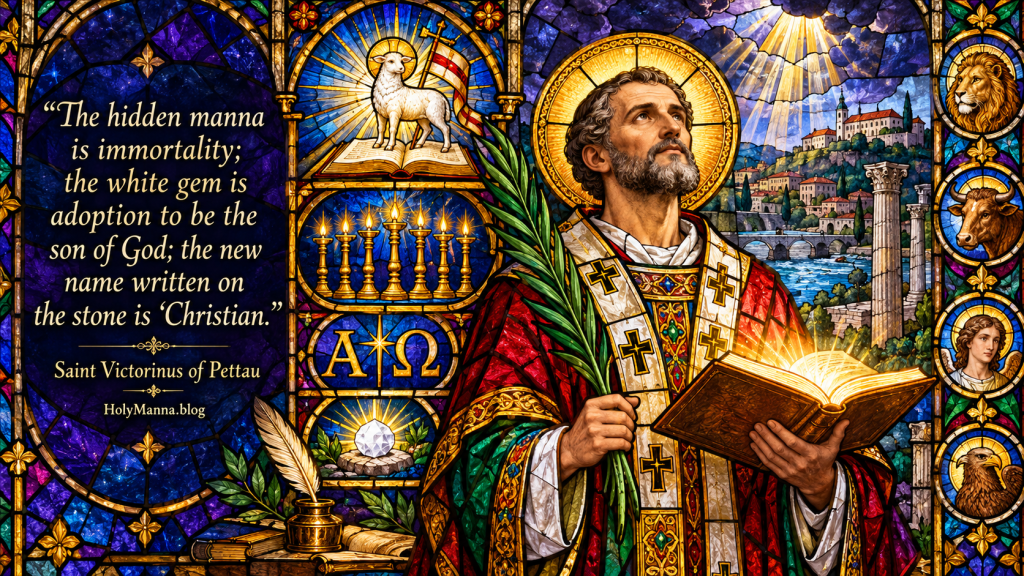
The Church teaches that “Martyrdom is the supreme witness given to the truth of the faith: it means bearing witness even unto death” (CCC 2473). Victorinus gave that witness twice over, once with his pen and once with his life. Fittingly for a saint remembered on a blog named for the bread from heaven, his most beautiful surviving line is about manna. Commenting on the promise of the Lord in The Book of Revelation 2:17, “To him that overcometh I will give the hidden manna, and I will give him a white stone,” Victorinus wrote: “The hidden manna is immortality; the white gem is adoption to be the son of God; the new name written on the stone is ‘Christian.’” That single sentence carries the whole Gospel. He is venerated by both the Catholic Church and the Eastern Orthodox Church, and sacred art shows him in pontifical vestments holding the palm of martyrdom.
From the Greek East to the Banks of the Drava
Nearly everything known about the life of Victorinus comes from one short paragraph written about 90 years after his death. Saint Jerome, compiling his catalogue of Christian authors in De Viris Illustribus (On Illustrious Men), chapter 74, gave the bishop of Pettau an honored entry and closed it with the line that defines him forever: “At the last he received the crown of martyrdom.” Everything else must be read carefully out of that entry, out of Jerome’s letters, and out of the saint’s own surviving pages.
Jerome records one telling detail about his origins: Victorinus knew Greek better than Latin. For that reason most Catholic sources, including the old Catholic Encyclopedia and Butler’s Lives of the Saints, conclude that he was born in the Greek-speaking East, probably in Greece itself, sometime in the first half of the 3rd century. Some modern scholars suggest instead that he may have been born in Poetovio itself, since the city was a frontier garrison town with a thoroughly mixed population of easterners and westerners. The honest conclusion is that his exact birthplace cannot be settled; what is certain is that he was a man of two worlds, carrying the theological riches of the Greek Christian East into the Latin West. Nothing at all survives about his family, his upbringing, his formation, his conversion, or the path that led him to the episcopate. By around the year 270 he was flourishing as bishop of Poetovio.
His city deserves a moment of attention, because it shaped his mission. Poetovio, called Pettau in later German usage and known today as Ptuj, is the oldest recorded town in Slovenia. In the Roman era it was a colony and legionary station in the province of Pannonia, set at a strategic crossing of the Drava River along the ancient Amber Road. Soldiers, merchants, and officials from every corner of the empire passed through it. A bishop there could not teach only in Greek, the common language of the early Church’s theology; his flock needed the Scriptures opened in Latin. Victorinus answered that need, and in doing so he became a pioneer. Jerome, with the blunt honesty of a master stylist, admitted that the bishop’s adopted Latin was rough, writing in a letter to his friend Paulinus: “Victorinus, although he has the glory of a martyr’s crown, yet cannot express what he knows.” In the same catalogue Jerome judged that his works, “though noble in thought, are inferior in style.” The style was imperfect; the substance was gold.
One caution belongs here. For centuries, until scholars in the 17th century untangled the records, Victorinus of Pettau was confused with Marius Victorinus, the celebrated Roman rhetorician whose dramatic conversion Saint Augustine recounts in the Confessions. They are two different men, and any detail about a brilliant career in rhetoric belongs to the other Victorinus, not to the humble bishop of the Drava.
Opening the Scriptures in the Language of Rome
Why should a Catholic in the 21st century remember a bishop whose books were mostly lost? Because Victorinus did something no one in the Western Church had done before him: he made the systematic, written study of the Bible possible in Latin. Jerome lists his commentaries on Genesis, Exodus, Leviticus, Isaiah, Ezekiel, Habakkuk, Ecclesiastes, the Song of Songs, and the Apocalypse, along with a treatise titled Against All Heresies. Elsewhere Jerome also mentions a commentary by Victorinus on The Gospel of Matthew. It was, for its age and place, an astonishing library of sacred scholarship, produced not in the great schools of Alexandria or Antioch but in a frontier river town, by a pastor with imperfect Latin and a heart on fire for the Word of God. Of all those works, only two survive: the Commentary on the Apocalypse and a short, vivid tract called De fabrica mundi, On the Creation of the World. He read widely and humbly, drawing on Origen, Papias, Irenaeus, and Hippolytus, which is to say that he did not invent a private interpretation but handed on what he had received, filtered through prayer and pastoral care.
His surviving commentary shows a genuinely penetrating mind. Victorinus was apparently the first of the Church Fathers to articulate the principle now called recapitulation, the insight that the visions of Revelation are not one continuous timeline but repeated, overlapping presentations of the same divine realities. In his own words: “We must not look for order in the Apocalypse; but we must follow the meaning of those things which are prophesied.” Serious Catholic study of the Apocalypse still works from that insight today. His reading of the four living creatures around the throne of God became part of the Church’s common inheritance: “The four living creatures are the four Gospels,” the lion for Mark, the man for Matthew, the calf for Luke, and the eagle for John. His comment on the creatures’ six wings is one of the loveliest early statements of how the two Testaments belong together; he taught that “the announcement of the New Testament gains no faith unless it have the fore-announced testimonies of the Old Testament, by which it is lifted from the earth, and flies.” That is precisely how the Church still instructs her children to read, attending “to the content and unity of the whole Scripture” (CCC 112), since “Christians therefore read the Old Testament in the light of Christ crucified and risen” (CCC 129).
When he reached the new song of The Book of Revelation 5, his prose caught fire: “It is a new thing that the Son of God should become man. It is a new thing to ascend into the heavens with a body. It is a new thing to give remission of sins to men.” And he was no mere theorist of the spiritual life. Commenting on the Lord’s warning to the lukewarm church, he wrote: “For it is not enough for a tree to live and to have no fruit, even as it is not enough to be called a Christian and to confess Christ,” without doing the Lord’s precepts. That is a 3rd century bishop saying exactly what The Letter of James 1:22 says: “Be doers of the word, and not hearers only.”
One more jewel from his lost works deserves remembrance. In his commentary on Matthew, Victorinus taught that the “brothers of the Lord” mentioned in the Gospels were brothers “by nearness, not by nature,” that is, kinsmen rather than children of Mary. Jerome later wielded that very testimony in his famous defense of the perpetual virginity of the Blessed Mother, and the Church teaches the same today, explaining that these men were “close relations of Jesus, according to an Old Testament expression” (CCC 500). A century before the great Marian controversies, a bishop on the Drava was already guarding the honor of the Virgin.
Here honesty requires a plain statement. The historical record preserves no miracles worked by Victorinus during his lifetime, no healings, no prophecies, no wonders. If such things occurred, no account of them survived the centuries. What survived instead is arguably the greater sign: a mind and a life wholly given over to the Scriptures, offered to ordinary believers in their own tongue. The reader should remember him and imitate him for exactly that reason. Sanctity does not require spectacle; it requires fidelity.
The Crown at the End of the Commentary
Victorinus lived through decades of relative peace for the Church, but that peace ended violently. Beginning in 303, the emperor Diocletian unleashed what history calls the Great Persecution, the most systematic assault on Christianity the Roman Empire ever mounted. Imperial edicts ordered churches demolished, Christian assemblies banned, clergy imprisoned, and, with a cruelty that must have pierced Victorinus to the heart, the sacred Scriptures surrendered and burned. Consider the terrible poetry of that moment: a bishop who had spent his whole adult life copying, studying, and explaining the holy books now faced an empire determined to turn those books to ash. Poetovio, a legionary town full of soldiers and imperial officials, was no place to hide. A bishop there was a marked man.
Jerome records the outcome in one sober clause: “At the last he received the crown of martyrdom.” According to the tradition handed down through Jerome, Victorinus was put to death in the persecution of Diocletian, in 303 according to some sources, in 304 according to others; the two dates appear side by side in Catholic reference works, and the conflict cannot now be resolved. No authentic account of his trial or death survives. History does not record whether he died by the sword, how long he was held, what he said before his judges, or whether he was offered the apostasy that would have saved his life. There are no stories of miraculous escapes or visible displays of divine protection attached to his name. What remains is the bare, blazing fact: when the moment came to choose between Caesar and Christ, the old exegete chose Christ, and the man who had written so often about the Lamb that was slain followed the Lamb all the way.
A caution is owed to the reader here, because older collections of saints’ lives sometimes blur this story. Certain accounts, including material found in Butler’s Lives of the Saints and repeated on devotional websites, narrate under this feast the sufferings of a Victorinus of Corinth, who confessed the faith with six companions before the proconsul Tertius around the year 249 and was later martyred under the emperor Numerian. That dramatic story belongs to a different martyr, or group of martyrs, who happened to share the same name, and careful Catholic hagiographers distinguish them from the bishop of Pettau. It is told here only so that the reader may recognize it and set it aside; it cannot be verified as belonging to this saint and almost certainly does not.
The Church has always understood that such deaths are not defeats. She still quotes Tertullian’s ancient observation that “the blood of martyrs is the seed of Christians” (CCC 852), and the subsequent flowering of the faith in the lands around Poetovio proved it once more. Victorinus had written, commenting on the Lord’s words to the suffering church of Smyrna, that the faithful “should continue to be faithful even unto death.” He practiced the exegesis he preached.
A Voice Edited, Questioned, and Vindicated
Honesty must govern this section as well: the Catholic record preserves no posthumous miracles attributed to Saint Victorinus, no healings at a tomb, no apparitions, and no translations of relics. No shrine of his relics is known to exist, and whatever remained of his body was lost in the upheavals that swept Pannonia in the centuries after his death. His afterlife in the Church took a different and remarkable form. It is the story of a book that refused to die, and of a Church that knew how to honor a father even while correcting him.
Victorinus held an opinion common among several early Christian writers: millenarianism, also called chiliasm, the expectation of a literal thousand-year earthly reign of Christ with his saints before the end of the world. Jerome says so plainly, noting that the bishop followed the opinions of the millenarians he had read, such as Papias. The Church, reflecting over centuries on the full witness of Scripture and Tradition, ultimately judged otherwise, and her mature teaching stands in the Catechism: “The Church has rejected even modified forms of this falsification of the kingdom to come under the name of millenarianism” (CCC 676). Because of that association, the 6th century document known as the Decretum Gelasianum listed the works of Victorinus among writings to be treated with caution. Yet the same Jerome who criticized his opinions and his Latin gave him an honorable place among the Church’s illustrious men and defended his substance. Around the year 398, at the request of a correspondent named Anatolius, Jerome personally produced a revised edition of the Commentary on the Apocalypse, keeping the great bulk of Victorinus’s work while replacing the millenarian conclusion with his own. For over a thousand years, readers who quoted “Victorinus” were usually reading Jerome’s edition; only in the modern era did scholars recover and publish the bishop’s original text, now available in critical editions. There is something profoundly Catholic in that whole story: the Church does not discard her imperfect fathers, she purifies their legacy and keeps what is true.
His influence quietly endured. The 8th century Spanish monk Beatus of Liébana drew on his commentary when compiling the most famous medieval work on the Apocalypse, which means generations of monks meditated on insights first written beside the Drava. In the Roman Martyrology Victorinus is inscribed on November 2nd, though an old misspelling of his title, Pictaviensis instead of Petavionensis, caused him for centuries to be wrongly claimed for the diocese of Poitiers in France; scholars corrected the error in the 17th century. Some devotional calendars also note an additional memorial on November 12th, though this usage is not universal.
The deepest devotion to him lives today in Slovenia. The people of Ptuj honor Victorinus as their city’s first known bishop and as a father of Christianity in the Slovenian lands. His veneration there was vigorously revived in the 18th century under the Ptuj archpriest Franz Ignaz, Count of Inzaghi, and it continues: a statue of the saint stands in Ptuj, and a fresco of him adorns the parish church of Nova Cerkev. The ancient see of Poetovio itself was never forgotten; it lives on as the titular see of Ptuj, held since 2008 by Bishop Pavel Posád of the Czech Republic, so that even now a successor bears the title Victorinus once bore. The Eastern Orthodox Church venerates him on the same day as a hieromartyr, a priest-martyr, making this frontier bishop a quiet bridge between East and West, just as he was in life. All of this is what the communion of saints looks like in practice, for “It is not merely by the title of example that we cherish the memory of those in heaven; we seek, rather, that by this devotion to the exercise of fraternal charity the union of the whole Church in the Spirit may be strengthened” (CCC 957).
Letting the Word of God Read You
The life of Saint Victorinus asks a blunt question of every modern Catholic: a 3rd century bishop on the edge of the empire gave his days to the Scriptures and his death to the Lord of the Scriptures, so what place does the Word of God actually hold in your daily schedule? His example suggests several concrete resolutions.
First, read the whole Bible as one book. Victorinus taught that the New Testament only flies on the wings of the Old, and the Church still reads this way, interpreting Scripture within “the living Tradition of the whole Church” (CCC 113). A practical start is simple: when the Sunday Gospel is proclaimed, go find the Old Testament reading paired with it and ask why the Church set them side by side. Ten minutes with a Bible after Mass is a genuinely Victorinian habit. When you hear the Old Testament at Mass, do you listen for Christ hidden inside it?
Second, let the reading become doing. Victorinus warned that it is not enough to be called a Christian and to confess Christ without keeping his precepts, echoing The Letter of James. Pick one verse from each day’s reading and translate it into a single act before sunset: an apology, a phone call, an alms, a held tongue. Which verse from this week is still waiting for you to obey it?
Third, offer God imperfect gifts. Jerome said the martyr could not express what he knew, and God used him to found Latin exegesis anyway. Many people stay silent about their faith because they fear sounding clumsy. Victorinus proves that clumsy fidelity outlasts polished indifference. What is the thing you have been refusing to do for God because you cannot do it perfectly?
Fourth, practice humble orthodoxy. Victorinus erred on a question the Church had not yet settled, and the Church corrected the error while honoring the man. His story teaches both courage in teaching and docility in being taught. The safest posture for any believer is to think with the Church, holding opinions loosely and the Creed tightly. Is there any area where you have quietly decided you know better than the Church?
Finally, persevere to the end. Everything Victorinus wrote would matter less if he had apostatized in 303. He finished well, and finishing well is the whole point, for the hidden manna is promised “to him that overcometh.” If the cost of your faith rose sharply tomorrow, what would you need to strengthen today?
Engage With Us!
Share your thoughts and reflections in the comments below; this community grows stronger every time someone speaks honestly about walking with the saints. To spark the conversation, consider these questions:
- Saint Victorinus opened the Scriptures for ordinary Latin speakers; who first opened the Scriptures for you, and have you ever thanked God for that person?
- Victorinus studied the Bible with imperfect language skills and still changed the Church forever; what imperfect gift is God asking you to put at his service anyway?
- The Church corrected his millenarian opinions while still honoring him as a father and martyr; how do you personally balance bold thinking with docility to the Church’s teaching?
- He taught that the New Testament flies on the wings of the Old; what is one Old Testament book you have never really read, and will you commit to starting it this month?
- Victorinus confessed Christ when confession meant death; where in your ordinary week does confessing Christ cost you something, and how do you respond?
The story of Saint Victorinus of Pettau is proof that God builds his Church out of faithful, hidden labor: a man with rough Latin and a deep love for the Word became the first exegete of the Latin Church and a martyr with a crown. The same God is ready to do surprising things with whatever is offered to him today. Open the Scriptures, do what they say, stay close to the Church, and hold nothing back. Live this day, and every day, with the love and mercy that Jesus taught, and the hidden manna he promises will be yours.
Saint Victorinus of Pettau, pray for us!
Follow us on YouTube, TikTok, Instagram and Facebook for more insights and reflections on living a faith-filled life.


Leave a Reply