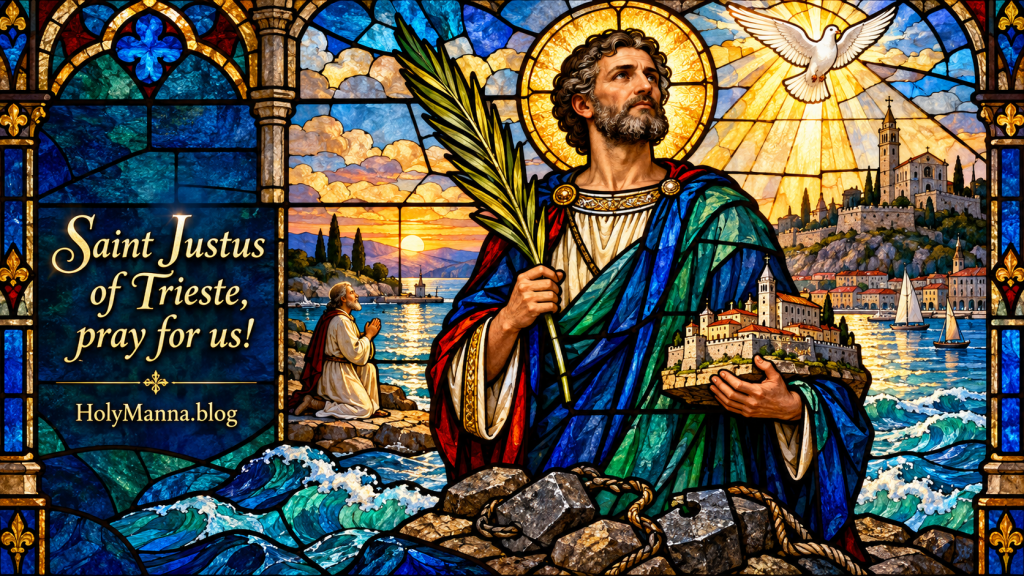
The Martyr the Sea Gave Back
On November 2nd, while the whole Church pauses to pray for the faithful departed, The Roman Martyrology adds one quiet line to the day: “At Trieste, Saint Justus, martyr.” Behind those few words stands a man who has watched over a great Adriatic seaport for seventeen centuries. Saint Justus, known in Italian as San Giusto, was a layman of Roman Tergeste, the city known today as Trieste in northeastern Italy. He held no office in the Church, founded no order, and wrote no books. He simply lived his faith with such integrity that when the persecution of the Emperor Diocletian reached his city, everyone knew exactly where he stood, and he paid for that clarity with his life. He was drowned in the gulf that now bears his city’s name, with lead weights bound to his hands and feet, and the earliest account of his death insists that the sea itself refused to keep him, returning his body to the shore so that the Christians of Trieste could bury their martyr with honor.
Saint Justus is the principal patron of the city and the Diocese of Trieste, a patronage attested since at least the 10th century, and his feast remains a public holiday there. He is also the patron of Labin in Croatia, of San Giusto Canavese in the Piedmont region of Italy, and of Misilmeri in Sicily. Local tradition further regards him as a protector of soldiers and of those who work in the port. Because November 2nd belongs to the Commemoration of All the Faithful Departed, the Diocese of Trieste celebrates his patronal Solemnity on November 3rd. There is something fitting in that overlap. The Church teaches that her pilgrim members on earth, the souls being purified, and the blessed in heaven form one communion in Christ, and that the saints do not cease to intercede for those still on the way (CCC 946, CCC 956). On the day the Church remembers all her dead, Trieste remembers the one whose death became the city’s enduring claim to glory.
Just in Name and in Every Work
Almost everything known about Saint Justus comes from a single ancient document, the Passio sancti Iusti martyris, a Latin account of his trial and death composed in Trieste itself, probably between the 6th and 8th centuries, and later edited by the Bollandist scholars in the Acta Sanctorum. The Passio records no birth date, no parents, and no details of his upbringing, and honesty requires saying so plainly. What it does record is a reputation. It presents Justus as a citizen of the Tergestina civitas, the city of Trieste in the Roman province of Istria, near the great regional capital of Aquileia, and it describes him with a phrase that became his epitaph: he was “just not only in name but in every work.” The name Justus means “the just one” in Latin, and the writer of the Passio wants the reader to understand that this was no accident of baptism records; the man grew into his own name.
The sources consistently remember him for three things: prayer, penance, and almsgiving. He was known throughout the city for his good works and his charity toward the poor. In a bustling pagan port, where commerce and the imperial cult shaped daily life, Justus was the neighbor whose generosity could not be explained by ambition, because it earned him nothing. This is precisely the pattern of life Jesus commends in The Gospel of Matthew, where almsgiving is to be done quietly, for “your Father who sees in secret will repay you” (Mt 6:4). The Church has never stopped teaching that the works of mercy, and almsgiving above all, are among the chief witnesses of fraternal charity and works of justice pleasing to God (CCC 2447).
How Justus came to the faith is not recorded. Some later retellings describe him as a convert to Christianity, which would make sense in a third-century Roman city where the Church was a minority community, often meeting in homes and burying her dead in cemeteries outside the walls. Whether he was raised Christian or embraced the faith as an adult, the record agrees on the result. The Passio calls him a vir Dei, a man of God, and that Latin phrase carries weight, because it suggests a mature man of settled holiness rather than an impulsive youth. Remarkably, the Diocese of Trieste has reported that examination of the relics preserved in the cathedral shows an adult male of rather advanced age, which matches the Passio and quietly corrects the later paintings and statues that imagine Justus as a beardless young man. The real Justus seems to have been formed by decades of ordinary fidelity before his extraordinary hour arrived.
Holiness Without Headlines
Here the honest storyteller must say something unusual for a saint of the ancient world: no miracles are recorded during the lifetime of Saint Justus. The Passio attributes to him no healings, no visions, and no prodigies before his arrest. Scholars who study the text have noticed its restraint, a simple narrative without complicated torments or sensational wonders, and many consider that very sobriety a mark of its rootedness in a real local memory rather than pious invention. For a modern reader, this is not a weakness in the story. It is the point of the story.
Saint Justus matters because he shows what the Church means when she teaches that all the faithful, whatever their state in life, are called to the fullness of Christian life and to the perfection of charity (CCC 2013). He was not a bishop, a monk, or a theologian. He was a layman in a commercial city, doing what faithful laypeople do: praying, doing penance, giving to the poor, and refusing to let the surrounding culture tell him who God is. His sanctity had no headlines until the day of his arrest. When the Church canonizes saints by solemnly proclaiming that they practiced heroic virtue and lived in fidelity to God’s grace, she recognizes the power of the Spirit of holiness within her and sustains the hope of believers by giving them models and intercessors (CCC 828). Justus was never processed through a modern canonization, because he belongs to the age before such procedures existed; the acclamation of the Church of Trieste, confirmed by his place in The Roman Martyrology, is his ancient equivalent.
Why should anyone remember and emulate a man with so thin a biography? Because the thinness is the lesson. Centuries of Christians have found in Justus the proof that God does not need a famous life to make a holy one, and that the daily accumulation of hidden faithfulness is exactly what produces a soul capable of martyrdom. The courage he showed before the governor was not conjured in the moment. It was the harvest of years. The Catechism teaches that the moral virtues are acquired by human effort and grow through education, deliberate acts, and perseverance, and that fortitude in particular strengthens the resolve to resist temptations and even enables one to renounce and sacrifice his life in defense of a just cause (CCC 1804, CCC 1808). Justus had been practicing fortitude in small coins long before he was asked to pay in gold.
The Trial Before Manatius and the Waters of the Gulf
The storm broke over the Church at the beginning of the 4th century. In February of 303, the Emperor Diocletian issued the first of a series of edicts launching what history calls the Great Persecution, the most systematic attempt the Roman Empire ever made to destroy Christianity. Churches were demolished, the Scriptures were seized and burned, and Christians were ordered to offer sacrifice to the Roman gods or face death. It is in this context that most scholars, and the Diocese of Trieste itself, place the martyrdom of Saint Justus, on November 2nd, 303. One manuscript of the Passio preserved in Verona gives instead the year 293, a date widely repeated online, and since the earlier persecutions under Diocletian’s reign were sporadic, that dating cannot be ruled out. The conflict between 293 and 303 should be stated honestly; the year is uncertain, while the day, November 2nd, is constant in the tradition.
According to the Passio, Justus was denounced as a Christian by his fellow citizens. The magistrates of Trieste sent a decurion of the city to summon him before Manatius, the official who governed the city, whose name appears in some retellings as Manazio or Mannacio. The charge was clear and the remedy was simple. Justus needed only to offer sacrifice to the gods of Rome, a pinch of incense, a gesture of civic loyalty, and he could go home to his prayers and his poor. He refused. For that refusal he was convicted of sacrilegium, the Roman crime of offending the gods, and the irony has not been lost on seventeen centuries of Christians: the man was condemned for sacrilege precisely because he would not commit it. The Church teaches that idolatry remains a constant temptation to faith, that it consists in divinizing what is not God, and that human life finds its unity in the adoration of the one God (CCC 2113, CCC 2114). Justus understood, with the clarity of the early martyrs, that a small act of idolatry is not a small thing.
The Passio narrates that he was stretched on the rack and beaten, and some accounts add that he was imprisoned overnight to reconsider. He spent that night in prayer, thanking Christ and declaring himself ready to die for Jesus. In the morning, Manatius summoned him again, found him unmoved, and pronounced the sentence: death by drowning. Lead weights were bound to his hands and feet, he was rowed out into the gulf, and he was thrown into the sea. A local tradition places the spot off the promontory known today as Sant’Andrea; that precise location cannot be verified. What the Church affirms about such a death is stated without flinching in The Catechism: “Martyrdom is the supreme witness given to the truth of the faith” (CCC 2473). The martyr bears witness to Christ even unto death, and endures it by fortitude, in a word spoken by the Lord himself in The Book of Revelation: “Be faithful until death, and I will give you the crown of life” (Rev 2:10). Justus went into the water a condemned criminal of Rome and came out of it a citizen of heaven.
The Sea Refused to Keep Him
The first wonder attached to Saint Justus is told in the Passio itself. The weights were meant to erase him, to deny the Christians of Trieste even a body to bury, which the Romans understood would deny them a shrine. Instead, the account says, the bonds broke, and before sunset of that same day the sea carried his body back and laid it on the shore of the city that had condemned him. That night, a priest named Sebastian saw the martyr in a vision. Justus spoke to him with the urgency of a command, telling him, “Rise at this hour,” find the body on the seashore, and bury it in a hidden place. Sebastian gathered his fellow believers, searched the waterline, and found the body near the stretch of shore known today as the Riva Grumula. They wrapped it in linen and buried it quietly near the sea. These events, the breaking of the weights, the returning of the body, and the vision given to Sebastian, come from a document written centuries after the fact; they are the Church of Trieste’s cherished account of her martyr, and as history they cannot be verified. As testimony to what that Church believed God had done for his faithful one, they could hardly be clearer, and a psalmist’s words seem written for the scene: “If I make my bed in the depths, you are there” (Ps 139:8).
The memory of the apparition to Sebastian ran so deep that until the early 20th century Trieste kept a second feast of its patron, the Apparitio Sancti Justi, on June 27th. The burial site itself left traces that archaeology can still read. The area near today’s Piazza Hortis was a cemetery in late antiquity, and scholars consider it a real possibility that an early basilica of the Holy Martyrs once stood over the tomb of Justus. By tradition his remains were later carried up the hill that now bears his name, where an early Christian basilica complex grew through the centuries. The church on that hill was dedicated to Mary, Mother of God, yet the people of Trieste so loved their martyr that the building itself surrendered its name to him; when its structures were finally united into one great church, the result was the Basilica Cattedrale di San Giusto Martire, the Cathedral of Saint Justus the Martyr, where his relics are venerated to this day. The Church has always commended such veneration; The Catechism lists the veneration of relics among the expressions of popular piety that extend the liturgical life of the Church (CCC 1674).
The cathedral hill became the heart of the city’s identity. A 12th-century mosaic in the cathedral shows Justus beside his fellow Triestine martyr Saint Servulus, a precious Byzantine silk veil bearing his image is kept in the cathedral treasury, and since the 14th century a statue of Justus has stood in a niche of the bell tower, holding the palm of martyrdom in one hand and a model of the walled city in the other. The symbolism is the whole theology of patronage in stone: the man the city killed now holds the city. Every November 3rd the Archbishop celebrates the Solemnity of San Giusto in the cathedral, the day is a public holiday, and the civic celebrations fill the streets below the hill. One diocesan tradition even tells of columns of fire associated with the saint’s protection of the city against danger, which is given as the reason soldiers and port workers look to him; that story does not appear in the Passio and cannot be verified. What can be verified is seventeen centuries of unbroken devotion, and a bishop of Trieste, preaching on the patronal feast, summed it up by turning to the words of Christ in The Gospel of John about the grain of wheat that must fall into the earth, for “if it dies, it bears much fruit” (Jn 12:24). Justus fell into the sea instead of the earth, and the fruit is a Church and a city that still carry his name.
What a Quiet Martyr Asks of a Noisy Age
Saint Justus leaves no writings, no famous sayings, and no dramatic conversion story, and that is exactly why he speaks so directly to the present moment. He is the patron saint of ordinary faithfulness under pressure. Most Christians today will never face a governor demanding incense, but nearly all will face the softer modern equivalents: the meeting where staying silent about the faith is easier, the workplace culture that treats belief as an embarrassment, the thousand small invitations to offer a pinch of incense to whatever the age has divinized, whether comfort, approval, money, or self. The Catechism warns that idolatry is not limited to false pagan worship but consists in honoring and revering a creature in place of God, whether gods, demons, power, pleasure, race, ancestors, the state, or money (CCC 2113). Where in daily life is there an altar quietly asking for just a pinch of incense?
Justus also teaches that heroism is prepared in hiddenness. His fortitude before Manatius was built through years of prayer, penance, and almsgiving that no one thought remarkable. The same is true in reverse: small compromises rehearse large ones. A practical way to walk with Saint Justus is to choose one hidden fidelity and guard it daily, perhaps ten minutes of silent prayer before the day begins, a weekly act of almsgiving that pinches the budget, or a fast kept without telling anyone. Another is to practice visible integrity in small matters, letting the yes be yes and the no be no at work, in friendships, and online, so that if a greater test ever comes, the soul already knows the way. If being a Christian were a crime in the city where you live, would your neighbors have enough evidence to convict you? The citizens of Trieste had no trouble convicting Justus, because his life had been one long confession of faith before the trial ever started.
Finally, Justus invites trust in God’s power over what seems final. The weights were supposed to make him disappear; instead, the sea gave him back, and his tomb became a cathedral. The Church draws from such stories her confidence that nothing offered to God is lost, that union with Christ is stronger than death, and that the communion between the living and the dead is real, which is why she prays for the departed and asks the saints to pray for her (CCC 958, CCC 962). What loss, failure, or buried hope needs to be entrusted to the God who raised a martyr’s body from the depths of the Adriatic?
Engage With Us!
Saint Justus of Trieste shows that a quiet life of prayer, generosity, and integrity can carry a soul all the way to heaven, and carry a city’s faith for seventeen centuries. Share thoughts and reflections in the comments below; stories of hidden faithfulness, of standing firm under pressure, or of devotion to the martyrs are all welcome, and they encourage every reader who finds them. Consider these questions as a starting point:
- Saint Justus was “just not only in name but in every work.” What would it look like for a Christian’s reputation at work or in the neighborhood to match the name Christian that completely?
- The governor asked for only a small gesture of sacrifice. What “small” compromises of faith or conscience does modern life present, and how can they be refused with both courage and charity?
- Justus prepared for his final test through years of prayer, penance, and almsgiving. Which of those three practices most needs strengthening right now, and what is one concrete step to take this week?
- The sea returned the martyr’s body, and his hidden grave became a cathedral. Where has God brought unexpected fruit out of something that looked like pure loss?
- On All Souls’ Day, the Church remembers her dead while Trieste remembers its martyr. How can praying for the dead and asking the saints’ intercession become a more regular part of family life?
May the witness of Saint Justus stir up a faith that does not flinch when the culture demands its pinch of incense, a generosity that gives in secret, and a hope that trusts God even in the depths. Live this day, and every day, with the love and mercy that Jesus taught, holding fast to him who is faithful, and who promises the crown of life to all who are faithful in return.
Saint Justus of Trieste, pray for us!
Follow us on YouTube, TikTok, Instagram and Facebook for more insights and reflections on living a faith-filled life.


Leave a Reply