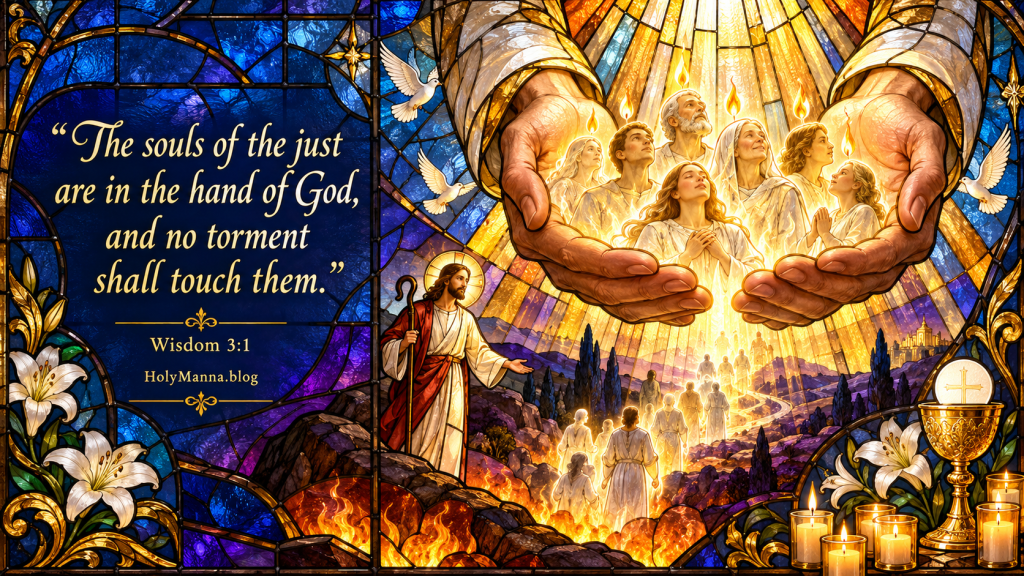
The Commemoration of All the Faithful Departed (All Souls) – Lectionary: 668
When the Church Refuses to Let Go of Her Dead
Every year on November 2nd, the Catholic Church does something the modern world finds almost unthinkable: she gathers at the altar and refuses to let go of her dead. The Commemoration of All the Faithful Departed, known simply as All Souls Day, follows directly after the Solemnity of All Saints, and the order matters. On November 1st the Church celebrates those already beholding the face of God. On November 2nd she turns in love toward those still being made ready, the souls undergoing their final purification, and she prays them home.
The observance took its fixed date from Saint Odilo, the great Abbot of Cluny, who decreed that every monastery of his congregation keep an annual commemoration of all the departed on the day after All Saints. Tradition places that decree in the year 998, though some historians date it a few decades later, and from Cluny the practice spread through all of Europe until the whole Church embraced it. Centuries later, in 1915, with the First World War filling graves faster than anyone could count, Pope Benedict XV granted every priest the privilege of offering three Masses on this day for the dead.
The readings of Lectionary 668 all sing one theme: hope full of immortality. The Book of Wisdom declares that the souls of the just rest in the hand of God. Psalm 23 walks through the dark valley without fear. Saint Paul grounds that confidence in a love proven at the Cross and sealed in baptism. And in The Gospel of John, Jesus Himself promises that the Father’s will is that He lose nothing, and raise it up on the last day. Death, for the Christian, is not the end of the story.
First Reading — Wisdom 3:1-9
A Book Written for People Watching the Good Die Young
The Book of Wisdom was composed in Greek, in the great city of Alexandria, roughly a century before Christ. Its first audience was a community of Jews surrounded by a glittering pagan culture that mocked their faith and whispered that death was simply the end. Chapter 2 of the book puts that whisper into words, as the wicked plot against the just man and reason that life is short, so they might as well oppress him. The Church Fathers read that chapter as a startling prophecy of the Passion of Christ. Chapter 3 is heaven’s answer. It is the clearest declaration of blessed immortality in the Old Testament, which is why the Church proclaims it at nearly every Catholic funeral and places it first on All Souls Day. Its image of gold refined in a furnace also quietly undergirds the Church’s understanding of purification after death, making it the perfect doorway into this day of prayer for the holy souls.
Wisdom 3:1-9
The souls of the just are in the hand of God,
and no torment shall touch them.
They seemed, in the view of the foolish, to be dead;
and their passing away was thought an affliction
and their going forth from us, utter destruction.
But they are in peace.
For if before men, indeed, they be punished,
yet is their hope full of immortality;
chastised a little, they shall be greatly blessed,
because God tried them
and found them worthy of himself.
As gold in the furnace, he proved them,
and as sacrificial offerings he took them to himself.
In the time of their visitation they shall shine,
and shall dart about as sparks through stubble;
they shall judge nations and rule over peoples,
and the Lord shall be their King forever.
Those who trust in him shall understand truth,
and the faithful shall abide with him in love:
because grace and mercy are with his holy ones,
and his care is with his elect.
Detailed Exegesis
Verse 1: “The souls of the just are in the hand of God, and no torment shall touch them.”
The verse opens with the single most consoling image in the reading. The hand of God in Scripture is the place of power, protection, and tenderness all at once. The just are not floating in some shadowy underworld; they are held. Notice also that the sacred author speaks of souls that survive bodily death, a truth the Church would later define with precision, teaching that the soul is immortal and does not perish at death (CCC 366).
Verse 2: “They seemed, in the view of the foolish, to be dead; and their passing away was thought an affliction”
The key word is seemed. The foolish, those who judge only by what the eye can see, look at a casket and conclude the story is over. Scripture calls that conclusion foolishness, not because grief is wrong, but because the appearance of death is not its reality for those who belong to God.
Verse 3: “and their going forth from us, utter destruction. But they are in peace.”
Three short words overturn every funeral the world has ever despaired over: they are in peace. This is why the Church has prayed for seventeen centuries that the departed rest in peace, the ancient requiescat in pace carved into catacomb walls and gravestones alike. The phrase is not a sentimental wish; it is a statement of faith drawn straight from this verse.
Verse 4: “For if before men, indeed, they be punished, yet is their hope full of immortality;”
Here is the phrase that names the whole day. The just may have suffered in the eyes of the world, yet their hope was never in this life alone. Hope full of immortality is the treasure the martyrs carried into the arena and the dying carry into their final hour.
Verse 5: “chastised a little, they shall be greatly blessed, because God tried them and found them worthy of himself.”
The proportions matter: chastised a little, blessed greatly. Suffering, in God’s economy, is never the last word, and it is never pointless. It is a trial in the old sense of the word, a testing that proves what is genuine. God does not test souls to break them but to find them worthy of Himself.
Verse 6: “As gold in the furnace, he proved them, and as sacrificial offerings he took them to himself.”
Gold goes into the furnace not to be destroyed but to be freed of everything that is not gold. This image became one of the Church’s favorite ways of speaking about the final purification of the elect, the purification named purgatory. The second image is just as rich: the just are received like sacrificial offerings, lives poured out and accepted on God’s altar.
Verse 7: “In the time of their visitation they shall shine, and shall dart about as sparks through stubble;”
The time of visitation points forward to the day when God sets all things right. On that day the just will not merely survive; they will shine, radiant and swift as sparks racing through dry straw. Jesus echoes this promise when He says in Matthew 13:43 that the righteous will shine like the sun in the kingdom of their Father.
Verse 8: “they shall judge nations and rule over peoples, and the Lord shall be their King forever.”
The destiny of the just is not passive rest but royal participation in the reign of God. Saint Paul picks up this very thread in 1 Corinthians 6:2 when he reminds the Church that the holy ones will judge the world. Glory, in the biblical imagination, is always a sharing in the life and authority of the King.
Verse 9: “Those who trust in him shall understand truth, and the faithful shall abide with him in love: because grace and mercy are with his holy ones, and his care is with his elect.”
The reading closes where All Souls Day lives: grace and mercy. Understanding, abiding, love, care; every noun in this verse describes relationship, not reward. Heaven is not a prize handed over at a distance. It is abiding with God in love, forever.
Teachings
This reading is the Old Testament soil from which the Church’s teaching on purgatory grows. The Catechism states it plainly: “All who die in God’s grace and friendship, but still imperfectly purified, are indeed assured of their eternal salvation; but after death they undergo purification, so as to achieve the holiness necessary to enter the joy of heaven” (CCC 1030). The next paragraph gives that purification its name: “The Church gives the name Purgatory to this final purification of the elect, which is entirely different from the punishment of the damned” (CCC 1031). The gold in the furnace of verse 6 is not an image of destruction but of mercy completing its work.
And because the souls being purified belong to the one Body of Christ, the living can help them. The Catechism grounds this in Scripture and quotes Saint John Chrysostom, the golden-mouthed Doctor of the Church, from his Homilies on 1 Corinthians: “Let us help and commemorate them. If Job’s sons were purified by their father’s sacrifice, why would we doubt that our offerings for the dead bring them some consolation? Let us not hesitate to help those who have died and to offer our prayers for them” (CCC 1032). The Council of Trent confirmed the same in 1563, teaching that there is a purgatory and that the souls detained there are helped by the suffrages of the faithful, and most of all by the sacrifice of the altar.
Reflection
Grief tempts everyone to think like the foolish of verse 2, to look at loss and see only ending. This reading invites a different gaze. Write down the names of the people you have loved and lost, and place that list where you pray. During November, the month of the holy souls, bring those names to Mass, offer a Rosary for them, or visit a cemetery and pray at a grave, an act to which the Church attaches a special indulgence for the dead during the first days of the month. Whose name belongs on your list this November? When sorrow comes, do you look at death the way the foolish do, or the way Wisdom does? Let the furnace image console you as well: the trials you are enduring right now may be God refining His gold.
Responsorial Psalm — Psalm 23:1-6
The Shepherd Who Walks Into the Valley First
No psalm has accompanied more Catholics to the grave than Psalm 23. Composed in the tradition of David, the shepherd boy who became Israel’s king, it draws on the hard realities of shepherding in the Judean wilderness, where flocks had to be led through narrow, shadowed ravines to reach water and pasture. The earliest Christians made this psalm their own in a striking way: the image of the Good Shepherd carrying a lamb on His shoulders is among the most common paintings in the Roman catacombs, placed lovingly over the graves of the dead. On All Souls Day the Church sings it as the prayer of every soul on its final journey, trusting that the Shepherd who walked through death Himself now leads His sheep through the dark valley and all the way to the Father’s house. It is the day’s quiet answer to the First Reading: the souls of the just are in the hand of God because the Shepherd never lets go of His flock.
Psalm 23:1-6
R. (1) The Lord is my shepherd; there is nothing I shall want.
or:
R. Though I walk in the valley of darkness, I fear no evil, for you are with me.
The LORD is my shepherd; I shall not want.
In verdant pastures he gives me repose;
beside restful waters he leads me;
he refreshes my soul.
R. The Lord is my shepherd; there is nothing I shall want.
or:
R. Though I walk in the valley of darkness, I fear no evil, for you are with me.
He guides me in right paths
for his name’s sake.
Even though I walk in the dark valley
I fear no evil; for you are at my side
with your rod and your staff
that give me courage.
R. The Lord is my shepherd; there is nothing I shall want.
or:
R. Though I walk in the valley of darkness, I fear no evil, for you are with me.
You spread the table before me
in the sight of my foes;
You anoint my head with oil;
my cup overflows.
R. The Lord is my shepherd; there is nothing I shall want.
or:
R. Though I walk in the valley of darkness, I fear no evil, for you are with me.
Only goodness and kindness follow me
all the days of my life;
and I shall dwell in the house of the LORD
for years to come.
R. The Lord is my shepherd; there is nothing I shall want.
or:
R. Though I walk in the valley of darkness, I fear no evil, for you are with me.
Detailed Exegesis
Verse 1: “The LORD is my shepherd; I shall not want.”
Everything else in the psalm flows from this first confession. In the ancient Near East, kings called themselves shepherds of their people, so David is making a political statement as much as a spiritual one: the LORD, not any earthly power, is the true King and caretaker. To say I shall not want is not to claim a life without loss; it is to claim that nothing necessary for salvation will ever be withheld.
Verse 2: “In verdant pastures he gives me repose; beside restful waters he leads me;”
Sheep will not lie down when they are afraid, and they will not drink from rushing water. The shepherd must find still water and safe grass, and the psalm says God does exactly that for the soul. Repose is the key word for All Souls Day; it is the very rest the Church begs for the departed in the ancient prayer for eternal rest.
Verse 3: “he refreshes my soul. He guides me in right paths for his name’s sake.”
The Hebrew behind refreshes carries the sense of restoring or bringing back, the shepherd retrieving the sheep that wandered. God guides the soul in right paths not because the soul has earned it but for His name’s sake, because His own honor is bound up with His mercy. That is a profound comfort when praying for the departed, whose hope rests on who God is.
Verse 4: “Even though I walk in the dark valley I fear no evil; for you are at my side with your rod and your staff that give me courage.”
Something beautiful happens in this verse: the psalm stops talking about God and starts talking to Him. In green pastures, God is he; in the dark valley, God becomes you. Intimacy deepens precisely where fear should reign. The dark valley, rendered in older translations as the valley of the shadow of death, is every deathbed and every graveside, and the rod and staff are the shepherd’s tools for defending and rescuing the flock.
Verse 5: “You spread the table before me in the sight of my foes; You anoint my head with oil; my cup overflows.”
The imagery shifts from the field to the banquet hall, and the Church Fathers could not help but see the sacraments here. Saint Cyril of Jerusalem, in his Mystagogical Catecheses, taught the newly baptized that the table of this psalm points to the altar of the Eucharist, the oil to their sacred anointing, and the overflowing cup to the chalice of the Lord. For a soul that received those sacraments in life, this verse reads like a memory and a promise at once.
Verse 6: “Only goodness and kindness follow me all the days of my life; and I shall dwell in the house of the LORD for years to come.”
The Hebrew word behind kindness is hesed, God’s covenant love, and the verb follow is strong enough to mean pursue. Goodness and mercy do not trail behind the soul politely; they chase it. The psalm ends with the destination of every soul the Church prays for on this day, dwelling in the house of the LORD, which the Christian reads in its fullest sense as the Father’s house of John 14:2.
Teachings
The Church sees in the shepherd of this psalm the face of Jesus Christ, who declared in John 10:11, “I am the good shepherd. A good shepherd lays down his life for the sheep.” The Catechism teaches that “The Church is, accordingly, a sheepfold, the sole and necessary gateway to which is Christ. It is also the flock of which God himself foretold that he would be the shepherd, and whose sheep, even though governed by human shepherds, are unfailingly nourished and led by Christ himself, the Good Shepherd and Prince of Shepherds, who gave his life for his sheep” (CCC 754).
The psalm is also a school of hope, the virtue All Souls Day exercises most. The Catechism defines it this way: “Hope is the theological virtue by which we desire the kingdom of heaven and eternal life as our happiness, placing our trust in Christ’s promises and relying not on our own strength, but on the help of the grace of the Holy Spirit” (CCC 1817). The dark valley is real, and the Church does not pretend otherwise. What she refuses to do is walk it alone, and what she refuses to believe is that her departed walk it alone. The Shepherd who descended into death on Holy Saturday knows the valley from the inside, and no sheep of His is beyond the reach of His staff.
Reflection
This psalm is worth praying slowly, verse by verse, with a specific departed loved one in mind, placing their name into every line: the Lord is her shepherd, He leads him beside restful waters. Praying Scripture this way turns grief into intercession. Consider also attending Mass on All Souls Day even though it is not a holy day of obligation, precisely because the table spread before the soul in verse 5 finds its fulfillment on the altar. When you walk through your own dark valleys, do you speak about God or to Him? Which verse of this psalm would you want prayed over you at the end of your life, and why? Let the answer shape how you pray for those who have gone before you.
Second Reading, Option 1 — Romans 5:5-11
Hope That Holds When Everything Else Breaks
The Letter to the Romans is Saint Paul’s longest and most carefully reasoned letter, written around the year 57 or 58, most likely from Corinth, to a Church in the capital of the empire that he had not yet visited. In chapter 5 Paul pauses his great argument about justification to marvel at what God has actually done, and he builds his case the way a rabbi would, from the lesser to the greater: if God did the hard thing, He will certainly do the easier one. The Church offers this passage on All Souls Day because it answers the question every grieving heart secretly asks: on what, exactly, does hope for the dead rest? Paul’s answer is unflinching. Hope rests not on how good the departed were, but on how good God is, proven once and for all at Calvary. That makes this reading the theological backbone of the entire commemoration.
Romans 5:5-11
Brothers and sisters:
Hope does not disappoint,
because the love of God has been poured out into our hearts
through the Holy Spirit who has been given to us.
For Christ, while we were still helpless,
died at the appointed time for the ungodly.
Indeed, only with difficulty does one die for a just person,
though perhaps for a good person
one might even find courage to die.
But God proves his love for us
in that while we were still sinners Christ died for us.
How much more then, since we are now justified by his Blood,
will we be saved through him from the wrath.
Indeed, if, while we were enemies,
we were reconciled to God through the death of his Son,
how much more, once reconciled,
will we be saved by his life.
Not only that,
but we also boast of God through our Lord Jesus Christ,
through whom we have now received reconciliation.
Detailed Exegesis
Verse 5: “Hope does not disappoint, because the love of God has been poured out into our hearts through the Holy Spirit who has been given to us.”
Paul does not say hope probably will not disappoint; he states it as fact. The reason is the verb poured out, a verb of abundance, the same extravagance seen in the overflowing cup of Psalm 23. Christian hope is not optimism or wishful thinking. It is the felt and real presence of the Holy Spirit already dwelling in the baptized, a down payment on glory.
Verse 6: “For Christ, while we were still helpless, died at the appointed time for the ungodly.”
Two words deserve attention: helpless and ungodly. Christ did not die for humanity at its best. He died for it at its weakest and worst, and He did so at the appointed time, meaning the Cross was never an accident of history but the center of the Father’s plan.
Verse 7: “Indeed, only with difficulty does one die for a just person, though perhaps for a good person one might even find courage to die.”
Paul appeals to common human experience. People occasionally die for someone admirable, a hero, a beloved friend, a child. That is the ceiling of natural love. Paul sets that ceiling up only to shatter it in the next verse.
Verse 8: “But God proves his love for us in that while we were still sinners Christ died for us.”
This is one of the most quoted verses in all of Scripture, and for good reason. God’s love is not a feeling asserted but a fact demonstrated, and the proof is a Body on a Cross offered for enemies. For the souls of the departed, this verse is everything: their standing before God was never built on their flawlessness but on His initiative.
Verse 9: “How much more then, since we are now justified by his Blood, will we be saved through him from the wrath.”
Here begins the how much more logic. If Christ shed His Blood for sinners, He will certainly finish the work in those He has already justified. The wrath here is not divine temper but the final judgment against sin, from which the justified are delivered by the very Blood made present at every Mass.
Verse 10: “Indeed, if, while we were enemies, we were reconciled to God through the death of his Son, how much more, once reconciled, will we be saved by his life.”
The argument reaches its peak. Reconciling enemies was the hard part, and it is finished. Saving the reconciled through Christ’s risen life is, in Paul’s logic, the sure continuation. The risen life of Jesus is not a past event but a present power, carrying the faithful departed toward their completion.
Verse 11: “Not only that, but we also boast of God through our Lord Jesus Christ, through whom we have now received reconciliation.”
Paul ends in boasting, which is remarkable for a man who elsewhere forbids all boasting. The one legitimate boast of a Christian is God Himself. On All Souls Day, the Church boasts in exactly this way: not in the merits of her dead, but in the mercy of the One who reconciled them.
Teachings
The Catechism echoes Paul’s logic when it teaches: “By giving up his own Son for our sins, God manifests that his plan for us is one of benevolent love, prior to any merit on our part: ‘In this is love, not that we loved God but that he loved us and sent his Son to be the expiation for our sins’” (CCC 604). And it draws out the implication for hope: “We can therefore hope in the glory of heaven promised by God to those who love him and do his will. In every circumstance, each one of us should hope, with the grace of God, to persevere ‘to the end’ and to obtain the joy of heaven, as God’s eternal reward for the good works accomplished with the grace of Christ. In hope, the Church prays for ‘all men to be saved’” (CCC 1821).
Pope Benedict XVI gave this reading its most beautiful modern commentary in his encyclical on hope, Spe Salvi, where he wrote of prayer for the departed: “It is never too late to touch the heart of another, nor is it ever in vain” (Spe Salvi 48). In the same paragraph he reminded the Church: “No one lives alone. No one sins alone. No one is saved alone” (Spe Salvi 48). Hope, in other words, is communal. The hope that does not disappoint binds the living and the dead into one Body, still able to reach one another in Christ.
Reflection
The temptation after a loved one dies is to tally their life like an accountant, weighing their faults against their virtues and wondering anxiously where they stand. Paul forbids that math. Hope rests on the Blood of Christ, not on a ledger. Make an act of hope for your departed loved ones this week, entrusting them by name to the love proven in verse 8. Then go further: have a Mass offered for someone, especially someone you suspect no one else is praying for, because no prayer for the dead is ever wasted. Do you believe, really believe, that God loved your departed loved ones while they were still sinners? Whose soul might be waiting on a prayer that only you will think to offer? Hope is a muscle, and All Souls Day is its training ground.
Second Reading, Option 2 — Romans 6:3-9
The Death That Already Happened to Every Christian
Just one chapter after the great hymn to hope, Saint Paul turns to baptism, and he assumes his Roman readers know exactly what he is talking about from experience. In the early Church, baptism was typically celebrated by immersion: the catechumen stepped down into the water as into a tomb, was buried beneath it, and rose up the other side into new life. Paul reads that ritual as a real participation in the death and Resurrection of Jesus. The Church proclaims this passage at the Easter Vigil, and she proclaims it again on All Souls Day, because the two moments belong together. For the Christian, the decisive death already happened at the font. Physical death, when it comes, is not a new catastrophe but the completion of a baptism begun long ago. That is why the funeral liturgy sprinkles the casket with holy water and clothes it in a white pall, deliberately echoing the garments of baptism, and why this reading fits a day devoted to souls finishing their journey into the Resurrection.
Romans 6:3-9
Brothers and sisters:
Are you unaware that we who were baptized into Christ Jesus
were baptized into his death?
We were indeed buried with him through baptism into death,
so that, just as Christ was raised from the dead
by the glory of the Father,
we too might live in newness of life.For if we have grown into union with him through a death like his,
we shall also be united with him in the resurrection.
We know that our old self was crucified with him,
so that our sinful body might be done away with,
that we might no longer be in slavery to sin.
For a dead person has been absolved from sin.
If, then, we have died with Christ,
we believe that we shall also live with him.
We know that Christ, raised from the dead, dies no more;
death no longer has power over him.
Detailed Exegesis
Verse 3: “Are you unaware that we who were baptized into Christ Jesus were baptized into his death?”
Paul opens with a question that expects the answer no. Baptism, he insists, is not a symbol of membership or a naming ceremony. It is baptism into Christ, and therefore into the whole of Christ, including His death. From the first moment of Christian life, the believer’s story is grafted onto the story of Good Friday.
Verse 4: “We were indeed buried with him through baptism into death, so that, just as Christ was raised from the dead by the glory of the Father, we too might live in newness of life.”
Buried with him is astonishingly strong language. The waters of the font are a tomb, and what rises from them is something genuinely new. Notice the pattern Paul sets: burial first, then resurrection by the glory of the Father. The pattern established at baptism is the same pattern the faithful departed are passing through now.
Verse 5: “For if we have grown into union with him through a death like his, we shall also be united with him in the resurrection.”
The image behind grown into union is organic, like a branch grafted into a tree until the two share one life. Union with Christ in death guarantees union with Him in resurrection; the two cannot be separated. This verse is the quiet logic beneath every Catholic funeral.
Verse 6: “We know that our old self was crucified with him, so that our sinful body might be done away with, that we might no longer be in slavery to sin.”
Paul names the enemy: not the body itself, which God created good, but the sinful self, the old self enslaved to sin. That old self was nailed to the Cross with Christ. Freedom, in Paul’s vocabulary, is not doing whatever one wants; it is finally being released from the master that was destroying the soul.
Verse 7: “For a dead person has been absolved from sin.”
A short verse with legal weight. Death ends sin’s claim, the way a sentence ends when it has been served. Applied to baptism, the one who has died with Christ stands absolved; applied to the faithful departed, those who died in His grace are beyond sin’s reach forever, needing only the purification that makes them ready for glory.
Verse 8: “If, then, we have died with Christ, we believe that we shall also live with him.”
Paul states the Christian creed about death in a single sentence. The words we believe matter: this is faith, not sight, held in the dark valley of Psalm 23 as firmly as in the Easter sunrise. Living with Christ is the destiny the Church begs for every soul commemorated on this day.
Verse 9: “We know that Christ, raised from the dead, dies no more; death no longer has power over him.”
The reading ends with the foundation underneath everything: the Resurrection was not a resuscitation. Lazarus came back and died again; Christ rose and dies no more. Death has lost its power over Him permanently, and therefore it has lost its final power over everyone united to Him.
Teachings
The Catechism gathers this entire reading into one luminous paragraph: “Because of Christ, Christian death has a positive meaning: ‘For to me to live is Christ, and to die is gain.’ ‘The saying is sure: if we have died with him, we will also live with him.’ What is essentially new about Christian death is this: through Baptism, the Christian has already ‘died with Christ’ sacramentally, in order to live a new life; and if we die in Christ’s grace, physical death completes this ‘dying with Christ’ and so completes our incorporation into him in his redeeming act” (CCC 1010). The same paragraph quotes the martyr Saint Ignatius of Antioch, writing on his way to the lions around the year 107: “It is better for me to die in Christ Jesus than to reign over the ends of the earth. Him it is I seek, who died for us. Him it is I desire, who rose for us” (CCC 1010).
The Church places on the lips of this day a passage from Saint Ambrose, Doctor of the Church, who buried his own brother Satyrus and preached through his tears. In his work On the Death of His Brother Satyrus, read in the Office of Readings for All Souls, he urges: “Let us then die with Christ, to live with Christ.” Ambrose understood Paul perfectly: grief is real, but for the baptized, death has been turned inside out, transformed from an ending into a passage.
Reflection
Most Catholics cannot remember their own baptism, which makes it easy to forget that the most important death of their life is already behind them. Find your baptismal date if you do not know it, and begin celebrating it like the spiritual birthday it is. When you enter a church and reach for the holy water, make the Sign of the Cross slowly, remembering that you are touching your own burial and resurrection. And when you pray for the dead this November, pray for them as what they are: the baptized, marked by Christ, finishing what the font began. Do you live as someone whose old self has truly been crucified, or does the old self still give orders? What would change in your daily choices if you treated your baptism as the defining event of your life?
Holy Gospel — John 6:37-40
The Will of the Father Is That Nothing Be Lost
These four verses come from the Bread of Life discourse, delivered by Jesus in the synagogue at Capernaum the day after He multiplied the loaves for the five thousand. The crowd has chased Him across the Sea of Galilee looking for more bread, and Jesus responds by revealing what the bread was pointing to all along: Himself, given for the life of the world. Within that discourse, these verses form a kind of still center, where Jesus pulls back the curtain on the Father’s will itself. Four times in John 6 Jesus repeats the same promise, that He will raise up His own on the last day, and twice in this short passage alone. The Church chose this Gospel for All Souls Day because it anchors every prayer for the departed not in human sentiment but in the explicit, stated will of God. The dead who belong to Christ are not lost property. They are the Father’s gift to the Son, and the Son does not lose what the Father gives.
John 6:37-40
Jesus said to the crowds:
“Everything that the Father gives me will come to me,
and I will not reject anyone who comes to me,
because I came down from heaven not to do my own will
but the will of the one who sent me.
And this is the will of the one who sent me,
that I should not lose anything of what he gave me,
but that I should raise it on the last day.
For this is the will of my Father,
that everyone who sees the Son and believes in him
may have eternal life,
and I shall raise him on the last day.”
Detailed Exegesis
Verse 37: “Everything that the Father gives me will come to me, and I will not reject anyone who comes to me,”
The verse holds two promises in perfect balance. The first is about the Father’s initiative: the faithful are a gift from the Father to the Son, which means no one belongs to Christ by accident. The second is about the Son’s welcome: I will not reject anyone. The Greek is emphatic, closer to I will never, ever cast out. Every soul the Church prays for on this day once came to Christ in baptism, and this verse is His standing guarantee that the door never slammed behind them.
Verse 38: “because I came down from heaven not to do my own will but the will of the one who sent me.”
Jesus grounds His welcome in His obedience. He came down from heaven, language that points to His divine origin, on a mission defined entirely by the Father’s will. This matters enormously for the grieving heart, because it means the mercy of Jesus is not a mood that might change. It is the eternal will of the Father, executed perfectly by the Son.
Verse 39: “And this is the will of the one who sent me, that I should not lose anything of what he gave me, but that I should raise it on the last day.”
Here is the heartbeat of All Souls Day. The Father’s will is stated in the negative and the positive: lose nothing, raise everything. The Good Shepherd of Psalm 23 reappears in a new key, a shepherd whose explicit mission is a flock with no missing sheep. The last day refers to the general resurrection at the end of time, when the souls now with God will be reunited with their glorified bodies.
Verse 40: “For this is the will of my Father, that everyone who sees the Son and believes in him may have eternal life, and I shall raise him on the last day.”
Jesus repeats the promise, now in personal terms: everyone who sees and believes. Eternal life in The Gospel of John is not merely endless duration but a share in God’s own life, begun already in faith and the sacraments. The verse ends the Mass readings for this day exactly where hope ends: with Jesus personally pledging, in the first person, to raise up each believer. Not humanity in the abstract. Him. Her. Each one.
Teachings
The Catechism takes up this Gospel almost word for word in its teaching on the resurrection: “We firmly believe, and hence we hope that, just as Christ is truly risen from the dead and lives for ever, so after death the righteous will live for ever with the risen Christ and that he will raise them up on the last day” (CCC 989). It also roots the obedience of verse 38 in the eternal plan of salvation, quoting this very discourse: “The Son of God, who came down ‘from heaven, not to do (his) own will, but the will of him who sent (him),’ said on coming into the world, ‘Lo, I have come to do your will, O God’” (CCC 606).
And because Jesus goes on in John 6:54 to attach this promise to the Eucharist, pledging to raise up those who feed on His Flesh, the Church has always understood the Mass as the greatest gift the living can offer the dead. The Roman Canon has carried a remembrance of the departed since antiquity, and the Catechism teaches that in the communion of saints “our prayer for them is capable not only of helping them, but also of making their intercession for us effective” (CCC 958). No one lived this more movingly than Saint Monica. As she lay dying far from home, she told her son, the future Saint Augustine, as he records in The Confessions: “Bury my body wherever you will; let not care of it cause you any concern. One thing only I ask you, that you remember me at the altar of the Lord wherever you may be” (Confessions, Book IX). A dying mother asked for one thing: the Mass.
Reflection
Read verse 39 again and let it get personal, because it is personal. The Father’s will, stated by Jesus Himself, is that nothing He has been given be lost. That includes the grandmother whose Rosary sits in a drawer, the friend taken too soon, the family member whose faith seemed to flicker. Make Saint Monica’s request your family’s custom: have Masses offered for your departed by name, and when the priest reaches the commemoration of the dead in the Eucharistic Prayer, silently speak the names you carry. Consider keeping a small book of the dead in your home each November, adding names as they come to mind, and praying the eternal rest prayer over it daily. Whom have you quietly feared might be lost, and can you hand that fear over to the will of the Father described in John 6:39? When was the last time you asked for a Mass to be offered for someone you love?
Love That Reaches Across the Grave
Picture a candle burning in a November cemetery, one small flame against the gray. That is All Souls Day: the Church’s stubborn, luminous insistence that love does not end at the grave because God does not end at the grave. The Book of Wisdom promised that the souls of the just are in the hand of God, tried like gold and found worthy. Psalm 23 gave those souls a Shepherd who walks the dark valley beside them and spreads a table at the journey’s end. Saint Paul explained why such confidence is reasonable: hope does not disappoint, because Christ died for sinners and raised the baptized into His own death and life. And in The Gospel of John, Jesus sealed it all with the Father’s own will, promising to lose nothing and to raise up His own on the last day.
From Saint Odilo’s monks at Cluny to Saint Monica’s deathbed request, the Church has always understood what to do with that hope: pray. Offer the Mass. Visit the graves. Speak the names. The souls being purified cannot help themselves, but they are not beyond help, because the Body of Christ is one, and prayer passes freely across the border of death.
So let this November 2nd be more than a date on the calendar. Go to Mass for the faithful departed. Have a Mass offered for someone by name. Walk through a cemetery this week and pray for the souls no one else remembers. One day, please God, the prayers of others will rise in the same way for every soul alive today, and the whole flock will stand together in the house of the LORD, where goodness and mercy have pursued every last sheep home.
Engage With Us!
The conversation does not end here, and your voice matters in it. Share your reflections in the comments below: the names you are praying for this November, the traditions your family keeps for the faithful departed, or the line from today’s readings that stayed with you. Someone else’s hope may be strengthened by what you share.
Here are some questions to pray with and respond to:
- The Book of Wisdom, chapter 3, verses 1 through 9, says the just are tried like gold in the furnace. Where in your life right now might God be refining you, and how does that change the way you see your trials?
- Psalm 23, verses 1 through 6, shifts from speaking about God to speaking to God in the dark valley. When you face loss or fear, do you talk about God or to Him, and what would it take to close that gap?
- The Letter to the Romans, chapter 5, verses 5 through 11, teaches that Christ died for us while we were still sinners. How does that truth change the way you pray for your departed loved ones?
- The Letter to the Romans, chapter 6, verses 3 through 9, calls baptism a burial with Christ. What would change in your daily life if you treated your baptism as the most important death you will ever undergo?
- The Gospel of John, chapter 6, verses 37 through 40, records Jesus promising to lose nothing the Father has given Him. Whose name do you most need to entrust to that promise today?
- Taken together, these readings proclaim a hope full of immortality. What is one concrete act of love for the dead, a Mass, a cemetery visit, a daily prayer, that you will commit to this November?
Keep praying, keep hoping, and keep loving beyond the grave, because that is exactly what Jesus does. Live this month, and every month, with the love and mercy He taught us, and let no soul you have loved go unremembered at the altar of the Lord.
Sacred Heart of Jesus, we trust in You!
Immaculate Heart of Mary, pray for us!
Saint Michael the Archangel, defend us in battle!
Follow us on YouTube, TikTok, Instagram and Facebook for more insights and reflections on living a faith-filled life.


Leave a Reply