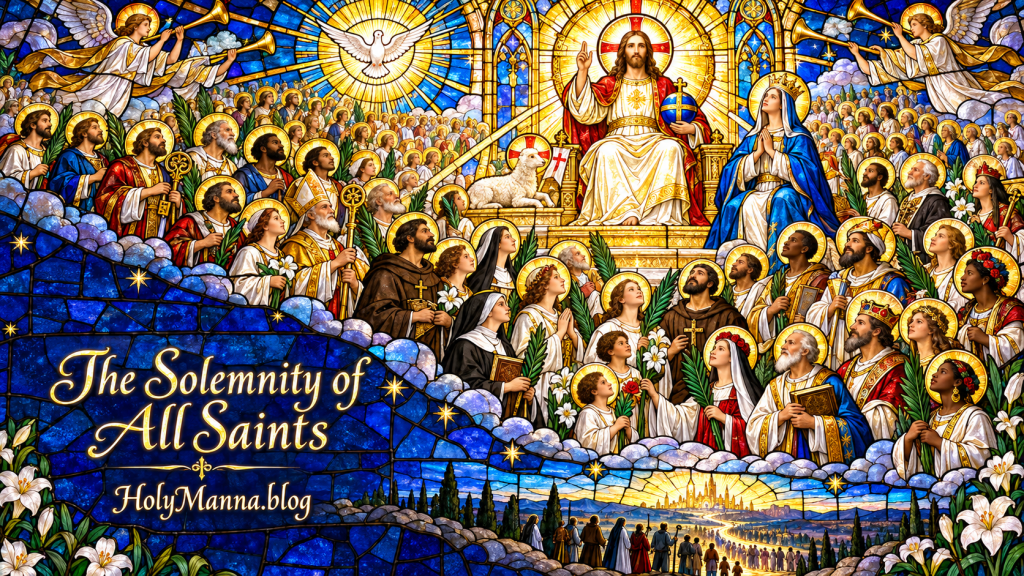
A Multitude No One Could Count
Every year on November 1st, the Catholic Church throws open a window onto heaven and invites the whole world to look inside. The Solemnity of All Saints honors every man, woman, and child who now sees God face to face: the canonized saints whose names fill the calendar, and the countless hidden ones whose names are known to God alone. Grandmothers who prayed the Rosary through war and famine, missionaries buried in unmarked graves, martyrs whose stories never reached a historian, ordinary workers who loved Christ quietly for decades; all of them belong to this day.
In 2026 the celebration carries particular weight, because November 1st falls on a Sunday. The Solemnity of All Saints outranks and replaces the 31st Sunday in Ordinary Time, so Catholics everywhere will keep this glorious day at Sunday Mass, and even Saturday evening anticipated Masses take the texts of the solemnity.
Why does the Church gather every saint into a single celebration? The Catechism of the Catholic Church answers with a question borrowed from an ancient catechist: “What is the Church if not the assembly of all the saints?” (CCC 946). All Saints is the Church’s family portrait. The Book of Revelation describes the scene that the liturgy places before the faithful: “a great multitude, which no one could count, from every nation, race, people, and tongue” (Revelation 7:9). That multitude is not a crowd of strangers. It is family, cheering for the pilgrims still on the road, and this solemnity exists so that no one forgets where the road leads.
From a Pagan Temple to the Whole Catholic World
The story begins at the tombs of the martyrs. From the earliest generations, Christians gathered at the graves of those who had died for Christ and celebrated the anniversaries of their deaths as heavenly birthdays. The 2nd century account of the martyrdom of Saint Polycarp of Smyrna already shows a community treasuring the remains of its bishop and keeping the memory of his witness year after year. When the persecution under the Emperor Diocletian in the early 4th century produced more martyrs than the calendar had days, local churches began keeping common commemorations of all the martyrs together.
The East moved first. The church of Antioch kept a feast of all the martyrs on the first Sunday after Pentecost, and a homily of Saint John Chrysostom for that very day survives. Saint Ephrem the Syrian, who died in 373, attests a commemoration of the martyrs in May, and a Chaldean calendar from 411 records a commemoration of confessors on the Friday after Easter, as the old Catholic Encyclopedia documents.
In the West, the road ran through Rome. On May 13th in the year 609 or 610 (the sources genuinely differ on the exact year, and that discrepancy deserves honest mention) Pope Boniface IV consecrated the Pantheon, the magnificent Roman temple once dedicated to all the pagan gods, as the church of Saint Mary and the Martyrs, Santa Maria ad Martyres. Tradition holds that 28 wagonloads of martyrs’ relics were carried from the catacombs for the dedication; the number cannot be verified, so it is best received as the tradition it is. From that day forward, Rome kept an annual commemoration of all the martyrs on May 13th.
The move to November came a century later. Pope Gregory III, who reigned from 731 to 741, dedicated an oratory in Saint Peter’s Basilica in honor of all the saints, no longer the martyrs alone, and fixed its anniversary on November 1st. Then Pope Gregory IV, who reigned from 827 to 844, extended the November 1st celebration to the entire Church with the support of the Emperor Louis the Pious. Popular summaries give the year as 835 or 837; the exact year is uncertain, though the pontificate is not. Some modern retellings tie the November date to pre-Christian harvest festivals, but the documented history runs through these Roman dedications, and claims beyond that remain disputed among historians rather than settled fact.
Later centuries added solemnity upon solemnity. Pope Sixtus IV, who reigned from 1471 to 1484, gave the feast an octave, 8 days of extended celebration. The calendar reform of 1955 under Pope Pius XII later removed both the vigil and the octave, yet the old vigil left a permanent mark on the English language: All Hallows’ Eve, the evening before All Hallows’ Day, is the origin of the word Halloween.
White Robes, Washed Clean
The Solemnity of All Saints is not built on one event in the Gospels but on the whole sweep of Scripture, which the liturgy of the day gathers into a single vision. The Book of Revelation gives that vision its center. Saint John sees an angel seal the servants of God, 144,000 from every tribe of Israel, a number signifying fullness rather than a headcount, and then the scene explodes beyond all counting: the great multitude from every nation stands before the throne and before the Lamb, wearing white robes and holding palm branches. When John asks who they are, an elder answers that these have survived the time of great distress and have “washed their robes and made them white in the Blood of the Lamb” (Revelation 7:14). The detail matters enormously. The saints did not bleach their own robes by willpower. Holiness is Christ’s victory applied to a human life, which is why the Church can honor the saints without ever taking glory away from God.
The roots run deep into the Old Testament. The prophet Daniel foresaw that the holy ones of the Most High would receive and possess the kingdom forever (Daniel 7:18). The Second Book of Maccabees recounts how Judas Maccabeus, before battle, beheld in a vision the deceased high priest Onias and the prophet Jeremiah interceding in prayer for the whole people (2 Maccabees 15:12-16), an early biblical witness that the holy dead remain lovingly involved with the living. Psalm 24, sung on this solemnity, describes the generation that seeks the face of the God of Jacob, and the Letter to the Hebrews pictures the Christian life as a race run before “so great a cloud of witnesses” (Hebrews 12:1). Saint Paul, for his part, addressed his letters to the “holy ones” in Rome, Corinth, and Ephesus, because baptism itself makes a people set apart for God.
Tradition carried this scriptural inheritance forward. The walls of the Roman catacombs preserve inscriptions in which the living ask the departed to pray for them. The Apostles’ Creed professes faith in “the communion of saints,” which the Catechism explains as communion in holy things and communion among holy persons (CCC 948). And Saint Bernard of Clairvaux, Doctor of the Church, preached for this very feast the sermon the Church still reads in the Office of Readings on November 1st. Honoring the saints, he insisted, changes nothing for them and everything for the one who honors them: “The saints have no need of honor from us” (Sermon 2 for All Saints). What their memory stirs in the heart, Bernard said, is above all “a longing to enjoy their company”, and that longing is itself a grace that pulls a soul toward heaven.
One Family in Three Places
Behind this solemnity stands one of the most consoling doctrines in the entire Catholic faith. The Catechism teaches that the Church exists at every moment in three states: the pilgrims still journeying on earth, the dead who are being purified, and the blessed who already behold God in glory (CCC 954). Death does not dissolve the bonds of the Body of Christ. The three states remain one family, exchanging spiritual goods in a constant circulation of charity (CCC 947, 955).
The saints’ share in that exchange is intercession. “They do not cease to intercede with the Father for us” (CCC 956), and the Catechism adds that “their intercession is their most exalted service to God’s plan” (CCC 2683). Asking a saint to pray is therefore no detour around Jesus Christ; it travels entirely through Him, the one Mediator, just as asking a friend on earth to pray does. Veneration honors the saints; adoration belongs to God alone, and devotion to the saints serves the charity that binds the whole Church together (CCC 957).
This day also proclaims something about the Church herself. Despite the sins of her members, the Church is held, as a matter of faith, to be “unfailingly holy” (CCC 823), because Christ her Head is holy and sanctifies her. Canonizations are the visible proof. By solemnly proclaiming certain faithful as saints, the Church “recognizes the power of the Spirit of holiness within her” and sustains the hope of believers by giving them models and intercessors (CCC 828). Yet the solemnity reaches far past the canonized. The Second Vatican Council devoted an entire chapter of Lumen Gentium to the universal call to holiness, and the Catechism echoes it: all of Christ’s faithful, whatever their rank or state, are “called to the fullness of Christian life and to the perfection of charity” (CCC 2013).
The popes have preached this truth on November 1st with striking warmth. In his homily for the solemnity in 2006, Pope Benedict XVI taught that “being a Saint means living close to God, to live in his family” (Homily for the Solemnity of All Saints, November 1st, 2006), and he stressed that holiness requires no extraordinary deeds or exceptional charisms, because it is first of all God’s gift before it is any human achievement. Pope Francis carried the same message into his apostolic exhortation Gaudete et Exsultate, pointing to “a holiness found in our next-door neighbours” and affectionately calling them “the middle class of holiness” (Gaudete et Exsultate, 7).
The Gospel of the day shows what that holiness looks like. The Catechism teaches that “the Beatitudes are at the heart of Jesus’ preaching” (CCC 1716) and that they “depict the countenance of Jesus Christ and portray his charity” (CCC 1717). The saints are simply the people in whom that countenance became visible. Their destination is the heaven the Catechism describes as the state of supreme, definitive happiness, where those who die in God’s grace and are perfectly purified live forever with Christ and see God as He is (CCC 1023, 1024). All Saints is the annual reminder that this destiny is offered to everyone.
Litanies, Candles, and the Quiet Walk Through Cemetery Gates
The devotional life surrounding this solemnity is as rich as the doctrine beneath it. First among its treasures is the Litany of the Saints, one of the most ancient litanies of the Roman liturgy. The Church sings it at the Easter Vigil, at baptisms, at ordinations, and at religious professions, calling the whole heavenly court by name and answering each invocation with a plea for prayer. On All Saints, many parishes sing it in procession, and families can pray it at home around a few lit candles, letting children hear name after name of people who made it home to God.
The veneration of relics flows from the same instinct. The Catechism lists the veneration of relics among the expressions of popular piety that extend the liturgical life of the Church (CCC 1674), and nearly every Catholic altar contains a relic, which quietly turns every parish into a shrine of this solemnity. Pilgrims who want to stand where the feast was born can still do so: the Pantheon in Rome remains a consecrated church, Saint Mary and the Martyrs, and the Roman catacombs along the ancient roads still hold the graves that first taught Christians to celebrate their dead in Christ.
The solemnity also opens the Church’s great month of prayer for the dead. November 2nd follows immediately with the Commemoration of All the Faithful Departed, and the two days together display the full communion of saints: the blessed in glory on the 1st, the souls being purified on the 2nd, and the pilgrims on earth praying for them both. The Catechism teaches that those who die in God’s grace but still imperfectly purified undergo a final purification, and that the Church commends them by prayer, above all the Eucharistic sacrifice (CCC 1030-1032). To encourage that charity, the Church grants, in the Enchiridion Indulgentiarum, a plenary indulgence applicable only to the souls in purgatory for the faithful who devoutly visit a cemetery and pray for the departed, even only mentally, on each day from November 1st to November 8th, under the usual conditions of sacramental confession, Eucharistic Communion, prayer for the intentions of the Holy Father, and complete detachment from sin. A further plenary indulgence for the departed is attached to visiting a church on All Souls’ Day and praying the Our Father and the Creed. An indulgence, the Catechism explains, is a remission of the temporal punishment due to sins already forgiven, drawn from the treasury of the merits of Christ and the saints (CCC 1471, 1476-1479).
The Church’s own prayer gathers all of this into a single breath. The Collect of the day blesses God, “by whose gift we venerate in one celebration the merits of all the Saints” (Roman Missal, Collect for All Saints), and begs an abundance of reconciliation through the prayers of so many intercessors. One celebration, countless intercessors, one abundant mercy; the liturgy itself teaches the theology.
How the Whole World Keeps the First of November
The liturgy of the solemnity uses the same readings every year, found at Lectionary number 667, and they proclaim the mystery with breathtaking unity. The first reading, Revelation 7:2-4, 9-14, unveils the sealed servants of God and the white-robed multitude. The responsorial psalm, Psalm 24, answers with the refrain “Lord, this is the people that longs to see your face.” The second reading, 1 John 3:1-3, grounds everything in divine adoption: “See what love the Father has bestowed on us that we may be called the children of God”, with the staggering promise that “we shall be like him, for we shall see him as he is” (1 John 3:2). Then the Gospel, Matthew 5:1-12a, sets the Beatitudes before the assembly, beginning “Blessed are the poor in spirit, for theirs is the Kingdom of heaven” (Matthew 5:3) and ending with the very invitation of the solemnity: “Rejoice and be glad, for your reward will be great in heaven” (Matthew 5:12a). In 2026 these readings replace those of the 31st Sunday in Ordinary Time, and Evening Prayer on both Saturday and Sunday belongs to the solemnity.
Around that liturgy, the nations have woven a glorious variety of customs. In Mexico, November 1st and 2nd coincide with the beloved observances of the Day of the Dead, when families build home altars with photographs, flowers, and candles, clean and decorate graves, and keep the Church’s two liturgical days alongside treasured cultural traditions. In the Philippines, the days around November 1st are known as Undas, and millions travel home so that entire families can spend the day, and often the night, at the cemeteries beside their beloved dead. In Poland, All Saints is a national holiday, and after dark the cemeteries glow with a sea of votive candles stretching to the horizon. In France, La Toussaint brings chrysanthemums to nearly every grave in the country, while Italians keep Ognissanti and Spaniards mark Todos los Santos with visits to the cemetery and traditional sweets. In New Orleans, families have long whitewashed and decorated the tombs of their dead for the day. Across the English-speaking world, congregations raise the much-loved 19th century hymn For All the Saints, and the Litany of the Saints resounds in processions from Rome to the smallest mission parish.
The East keeps the same mystery in its own season. Byzantine-rite Catholics, together with the Orthodox, celebrate the Sunday of All Saints on the first Sunday after Pentecost, a usage attested in the era of Saint John Chrysostom, whose homily honoring all the martyrs on that Sunday still survives. The placement preaches its own sermon: the saints are the harvest of Pentecost, the proof of what the Holy Spirit can do with human clay. Tradition relates that the Emperor Leo VI the Wise, who reigned from 886 to 912, built a splendid Church of All Saints in Constantinople after the Church declined to canonize his wife Theophano, reasoning that if she were indeed holy, she would be honored whenever all the saints were honored; the account comes from the synaxarion as a tradition, and it is offered here as exactly that. East and West, on different days, bow before the same multitude.
The Saint Only You Can Become
Here is the part of the solemnity that is easy to miss while admiring the stained glass: it is about you. The Church does not parade the saints past you like celebrities behind velvet ropes. She holds them up the way a coach holds up film of champions, saying, this is what the game looks like when it is played all the way. Pope Benedict XVI taught that the whole meaning of the day is to look at the shining example of the saints and let it reawaken the longing to become like them, happy to live near God in the great family of His friends. That longing is not nostalgia. It is a compass.
So let the solemnity get practical in your life this week. Choose a patron, perhaps a saint who shared your work, your struggles, or your temperament, and read a short account of his or her life before the month ends. Return to the Sacrament of Reconciliation if it has been a while; every saint was a forgiven sinner before anything else. Go to Mass on November 1st with your whole heart, since in the earthly liturgy the Church already shares in “a foretaste of that heavenly liturgy” (CCC 1090), which means the nearest you will come to the great multitude this side of death is standing in the Communion line. Between November 1st and November 8th, visit a cemetery and pray for the dead, gaining for some soul the indulgence the Church so generously offers. Pray the Litany of the Saints out loud once, slowly, and notice how many of those names belonged to people with ordinary jobs and difficult families.
Then take the Beatitudes personally. Pick one each week, poverty of spirit, meekness, mercy, purity of heart, peacemaking, and practice it deliberately at home and at work, with the patience of someone training rather than the discouragement of someone failing. Which Beatitude is Christ setting before you this November? Holiness, the saints insist with one voice, is built from exactly such small, repeated, grace-soaked choices: compassion when irritation would be easier, resilience when quitting would be quieter, faith when the fog refuses to lift. Heaven is full of people who did precisely that, and heaven is waiting to be fuller.
Engage With Us!
Share your thoughts and reflections in the comments below; stories of grace strengthen everyone who reads them, and this community grows every time a reader opens up about the saints, known or hidden, who have marked a life.
- Which saint has shaped your walk with Christ the most, and what first drew you to him or her?
- Who has been a saint next door in your own life, someone whose quiet holiness reflected God’s presence to you?
- Which of the Beatitudes challenges you most right now, and what would it look like to live it this week?
- How could visiting a cemetery to pray for the departed between November 1st and 8th deepen your sense of the communion of saints?
- What is one concrete step you can take this month to answer the universal call to holiness in your state of life?
May this Solemnity of All Saints lift your eyes to the great multitude that no one could count, and may their prayers carry you through November and far beyond. Live this week as someone already written into that family portrait, do everything with the love and mercy Jesus taught, and keep walking the road to the Kingdom of heaven, one faithful, hopeful, grace-filled day at a time.
All the Holy Saints, pray for us!
Follow us on YouTube, TikTok, Instagram and Facebook for more insights and reflections on living a faith-filled life.


Leave a Reply