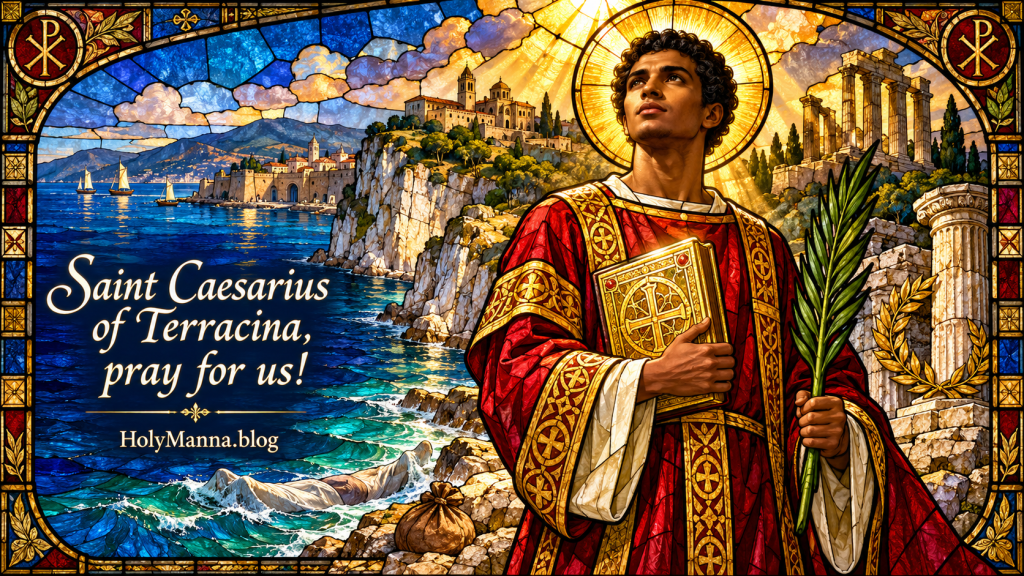
The Deacon Who Took Back the Name of Caesar
On November 1st, the whole Church celebrates the Solemnity of All Saints, that great family portrait of heaven drawn from The Book of Revelation: “These are the ones who have survived the time of great distress; they have washed their robes and made them white in the blood of the Lamb” (Rev 7:14). Tucked quietly inside that same day, the Roman Martyrology remembers one martyr by name, a deacon whose witness is so old that his feast was already being recorded by Saint Bede in the 8th century. The 2004 Martyrologium Romanum gives him a single, unadorned line, which reads in English translation, “At Terracina on the coast of Lazio, Saint Caesarius, martyr.”
Saint Caesarius of Terracina was a deacon from North Africa who stood up, alone, against a pagan rite of human sacrifice in a Roman harbor town, and paid for it with his life. He was sewn into a sack with a priest named Julian and thrown into the sea from a cliff. Yet God, who loves to write surprise endings, took this obscure foreign deacon and made him one of the most politically significant saints of the early Church. Because his name, Caesarius, literally means “devoted to Caesar,” the Church raised him up as the “Christian Caesar.” Emperors venerated him. The first regularly established Christian place of worship on the Palatine Hill, the very hill of the imperial palaces, bore his name. The cult of the deified Caesars, which had demanded worship for centuries, was quietly replaced by devotion to a humble deacon who called himself a slave of Jesus Christ.
He is honored as the co-patron of the city of Terracina together with Saint Peter, as the traditional patron of the Roman emperors, and he is invoked against drowning and flooding. He is a pre-congregation saint, venerated from antiquity by the constant devotion of the faithful, and the Church proposes such saints to believers precisely as the Catechism teaches, as “models and intercessors” (CCC 828).
From Africa’s Shores to a City in the Grip of an Idol
Honesty first, because the standing rule of this blog is that history and tradition are never blended without labels. Almost nothing about the early life of Saint Caesarius is documented. No birth date survives, no record of his parents, no account of his formation. What the Church possesses is his ancient Passio, the written account of his martyrdom, which survives in two main Latin versions catalogued by the Bollandist scholars as BHL 1511 and BHL 1515. The shorter version was written in Rome in late antiquity as a sequel to the Passio of Saints Nereus and Achilleus, which ends with a deacon named Caesarius burying the virgin martyr Domitilla at Terracina. The longer version was written in Terracina itself and is full of the local geography of that town, its forum, its temple, and its famous cliff.
From these sources and the traditions that grew around them, a portrait emerges. Caesarius came from Africa, the Roman province whose great city was Carthage, the same soil that would later give the Church giants like Saint Cyprian and Saint Augustine. Later tradition adds that his family descended from the noble gens Iulia, the ancient Julian clan of Rome, which would make his name a family inheritance. One version of the story holds that he arrived at Terracina after a shipwreck and stayed to preach the Gospel to the poor. These details about his origins come from tradition rather than documented history, and they cannot be verified.
The dating of his life is genuinely tangled, and the sources disagree. The Passio and Saint Bede’s Martyrology place the events “in the time of Claudius,” in the 1st century, though scholars note that the Passio opens by saying Claudius killed his own mother, a crime history attributes to Nero, so even the ancient author may have confused his emperors. The local tradition of Terracina dates the martyrdom precisely to November 1st in the year 107, under the Emperor Trajan. The pre-2001 editions of the Roman Martyrology placed it instead under Diocletian, around the turn of the 4th century. The current 2004 Martyrologium Romanum wisely names no emperor and no year at all. What stands firm beneath the shifting dates is the constant, ancient memory of the Church: a deacon named Caesarius was martyred at Terracina, and the faithful have honored him there since the earliest centuries.
What is certain about his identity is his office. Caesarius was a deacon, a man configured to Christ the servant through the Sacrament of Holy Orders. The Catechism teaches that “Deacons share in Christ’s mission and grace in a special way” (CCC 1570), and that is exactly what his story shows. Like the first deacons chosen in The Acts of the Apostles, men “filled with the Spirit and wisdom” (Acts 6:3), Caesarius served at the edge of the Church’s mission, far from home, among people who had never heard the name of Jesus. Terracina, where he landed, was a prosperous harbor town on the Appian Way between Rome and Naples, a place of commerce, travelers, and one horrifying local custom.
The Day the Temple Fell
Here begins the story that the ancient Passio tells, and it should be received as the Church has received it, as a venerable tradition handed down from the early centuries.
According to the Passio, Terracina practiced a yearly rite in honor of the god Apollo. A young man was selected and then pampered for months, fed richly, indulged in every desire, and treated like a little king. When the appointed day came, he was placed on a richly harnessed horse, led to the summit of the city’s great cliff, the rock called Pisco Montano, and compelled to ride off the edge, horse and all, crashing onto the rocks and into the waves below. His death was offered to Apollo as a propitiatory sacrifice for the salus, the health and prosperity, of the state and of the emperors. One account names the final victim Lucianus and adds that his body was burned and his ashes given a place of honor in the temple of Apollo. The whole city cheered this as patriotism and piety.
Caesarius did not cheer. The Passio records the deacon crying out in public against the spectacle: “Alas for a state and emperors who persuade by tortures and are fattened on the outpouring of blood.” Read that line slowly. In one sentence, this foreign deacon declared that no empire is made prosperous by the blood of its children, and that a state fattened on death is a state to be wept over. The Church still proclaims the truth he died defending: “Human life is sacred because from its beginning it involves the creative action of God and it remains for ever in a special relationship with the Creator, who is its sole end” (CCC 2258). Caesarius also saw clearly what the crowd could not, that the rite was idolatry dressed in civic clothing, and the Catechism names that sin precisely: “Idolatry consists in divinizing what is not God” (CCC 2113). Terracina had divinized the state, the emperors, and its own prosperity, and a young man died for it every year.
The Passio continues. Firminus, the priest of Apollo, had Caesarius arrested. The deacon was held for days, and then interrogated by Leontius, the Roman consularis of Campania, who had come up from the nearby city of Fundi. Leontius asked him his name and whether he was a free man or a slave, the standard opening of a Roman interrogation. The answer Caesarius gave has echoed for centuries. He told the consul his name and declared that he was “a slave of Jesus Christ.” Not a citizen pleading his rights, not a free man protesting his treatment, but a man who had already handed over his whole life to a Master worth dying for.
Leontius ordered Caesarius dragged in chains to the temple of Apollo to offer incense and renounce his faith. As they drew near, the deacon prayed that God would not abandon him. At that moment, the Passio says, the temple collapsed to the ground, killing the priest Firminus. The crowd saw it, and so did Leontius. The hardened Roman official was pierced to the heart, and he begged Caesarius to baptize him on the spot. Caesarius did. The local priest Julian then gave the new Christian the Holy Mysteries, the Eucharist. Leontius, overwhelmed, gave thanks to God, asked the two clergy to pray that he might be taken home, and immediately delivered his soul to God in peace. In a single afternoon, the man sent to break Caesarius was baptized, communicated, and carried into eternity. The Catechism teaches why the dying consul’s request mattered so urgently: “The Lord himself affirms that Baptism is necessary for salvation” (CCC 1257). These episodes, the sacrifice of the youth, the collapse of the temple, and the conversion and holy death of Leontius, come from the ancient Passio, and they cannot be verified.
The Sack, the Cliff, and the Sea
The death of Leontius did not end the persecution; it enraged it. According to the Passio, a magistrate named Luxurius took charge, accused Caesarius of practicing magic, and condemned him together with the priest Julian. The sentence chosen was the poena cullei, the ancient and infamous Roman punishment reserved for parricides, those who murdered their own fathers. The condemned man was sewn alive into a leather sack and thrown into the water. Some later tellings of the story add the full gruesome ritual of that penalty, the wolf-skin hood over the head and live animals sealed into the sack. On November 1st, by the local tradition in the year 107, Caesarius and Julian were bound together in a sack and hurled into the sea from the cliff of Pisco Montano, the same rock from which the young victims of Apollo had been made to leap.
Sit with the bitter irony of that sentence. Rome executed Caesarius as a parricide, a father-killer, because in Roman eyes he had attacked the sacred “fathers” of the state, the gods and the deified Caesars whose worship held the empire together. Yet the deacon had killed no father. He had defended the Father’s children. He had insisted that the true salus of any nation is found not in blood poured out to idols but in the Blood of the Lamb poured out for sinners. Scholars of the Passio have noted that the entire account revolves around this question of salus, of what truly saves a state, and the answer the martyr gave with his body is the answer of the Gospel.
The Passio adds a final grace note. That very same day, the sea refused to keep them. The bodies of Caesarius and Julian were cast back onto the shore, and a servant of God named Eusebius took them and buried them at night near the city of Terracina. Many who witnessed these things were converted and were baptized by a priest named Felix. The persecution then reached for them too. Leontius the younger, the son of the converted consul, full of rage over his father’s death, arrested Felix and Eusebius, and when they refused to sacrifice, they followed Caesarius into martyrdom. Saint Bede’s Martyrology preserves their memory alongside the deacon’s. The washing ashore of the bodies and the martyrdoms of Eusebius and Felix come from the Passio and early martyrologies, and they cannot be verified.
The older Roman Martyrology summed up the constant memory of the Church in one line: “At Terracina, in Campania, the holy Deacon Caesarius, who suffered many days in prison, and was afterwards put into a sack, along with the holy Priest Julian, and cast into the sea.” While the dramatic details belong to tradition, the fact of his martyrdom at Terracina is the ancient and unbroken testimony of the Church, attested in her earliest liturgical books. And the Church is clear about what such a death means: “Martyrdom is the supreme witness given to the truth of the faith: it means bearing witness even unto death” (CCC 2473). Caesarius had nothing the world counts as power, no citizenship worth invoking, no army, no title but deacon. He had only the fearlessness Jesus commanded in The Gospel of Matthew: “And do not be afraid of those who kill the body but cannot kill the soul” (Mt 10:28). The sack and the sea took his body. They could not touch the rest.
The Christian Caesar on the Palatine
What God did with this martyr after his death is one of the great quiet victories in Church history.
A 6th or 7th century account, the Sanatio Gallae et translatio S. Caesarii Romam, tells the story of how his relics came to Rome. According to this account, the daughter of the Emperor Valentinian, named Galla, was miraculously cured at the shrine of Caesarius in Terracina. In gratitude, the emperor had the relics of the martyr translated to Rome itself. This healing story comes from a late account and cannot be verified. What is historically visible, however, is where his cult landed: inside the imperial palace.
An oratory dedicated to Saint Caesarius, known as San Cesareo in Palatio, stood within the imperial residence on the Palatine Hill, and it holds the remarkable distinction of being the first regularly and officially established Christian place of worship on that hill, the very hill from which the pagan Caesars had ruled and been worshiped. Some sources attribute the naming of the imperial chapel to the Emperor Valentinian III in the 5th century. Think about what that means. The hill that gave the world the word “palace,” the hill where incense had been burned to deified emperors, now housed a chapel honoring a deacon who had denounced sacrifices offered for those same emperors. In the Byzantine centuries that followed, when a new emperor was proclaimed in Constantinople, his official images were received and honored in Rome in the chapel of Saint Caesarius. The saint whose very name means “devoted to Caesar” had become the heavenly protector of the Caesars, and in doing so he Christianized and effectively replaced the old imperial cult of Julius Caesar and Augustus. The deacon conquered the palace without ever raising a hand. A note of scholarly honesty belongs here: some modern researchers have proposed that the Palatine chapel’s name might originally derive from the Latin word Caesarium, meaning simply “belonging to Caesar.” The constant tradition of the Church, however, has always tied the dedication to the martyr of Terracina, and the spread of his relics and churches across Italy testifies to a real and vigorous ancient cult.
That cult left footprints everywhere. In Rome, the beautiful titular church of San Cesareo de Appia still stands near the Baths of Caracalla at the start of the Via di Porta San Sebastiano, its interior frescoed with scenes from the saint’s story, painted in part by the Cavalier d’Arpino, beneath a gold and blue coffered ceiling that bears the image of Caesarius himself. His principal relics have rested since the 13th century in the basalt urn beneath the high altar of the Basilica of Santa Croce in Gerusalemme in Rome, one of the Seven Pilgrim Churches of the city, where pilgrims venerating the relics of the True Cross pass over the bones of the deacon of Terracina. Other relics are preserved in the Basilica of San Frediano in Lucca and in Terracina itself, whose cathedral is dedicated jointly to Saint Peter and Saint Caesarius and remains the heart of his veneration. Records tell that Pope Alexander II gave portions of the saint’s arm to a chapel in Cologne in Germany, for relics of Caesarius were treasured gifts by which the popes honored churches and rulers across Europe. An illuminated English manuscript, a Passionale made in 1110 for the monastery of Saint Augustine in Canterbury, preserves a miniature of his martyrdom, proof that his story was being read and loved far beyond Italy. Several Italian towns, among them San Cesareo in Lazio, carry his name to this day, and in recent years a new icon of the saint was placed in the Sancta Sanctorum, the ancient papal chapel at the Scala Santa in Rome. The Eastern Churches venerate him as well, commemorating the deacon Caesarius and the priest Julian on October 7th.
This is the communion of saints in action, exactly as the Catechism describes it. The saints in glory “do not cease to intercede with the Father for us” (CCC 956), and the Church has always cherished the veneration of relics and pilgrimages to the shrines of the martyrs among the beloved expressions of popular piety (CCC 1674). For more than a thousand years, emperors, popes, monks, and fishermen have asked the prayers of Caesarius, the deacon thrown into the sea, and The Book of Psalms explains why heaven treasures him: “Precious in the eyes of the LORD is the death of his faithful ones” (Ps 116:15).
Courage When the Whole Crowd Is Cheering
Here is where the story of Saint Caesarius stops being ancient history and starts reading like a mirror.
Caesarius did not confront a culture that was ashamed of its sin. He confronted a culture that was proud of it. Terracina did not hide the sacrifice of its young men; it celebrated it, dressed it in patriotism, and called it devotion. The hardest kind of witness is not speaking against what everyone already condemns. It is speaking against what everyone applauds. The modern world has its own rites that consume the young and call it progress, its own idols of prosperity, pleasure, and national success that demand their quiet sacrifices. The Catechism does not treat witness as optional heroism for the few: “Service of and witness to the faith are necessary for salvation” (CCC 1816). Caesarius simply believed that, and acted on it.
Notice also how he witnessed. He did not organize an army or seize the temple. He spoke the truth out loud, once, in public, and then he endured everything that followed with patience. His only recorded self-description was “a slave of Jesus Christ,” which is almost word for word how Saint Paul introduces himself in The Letter to the Romans, the same letter that declares, “For I am not ashamed of the gospel. It is the power of God for the salvation of everyone who believes” (Rom 1:16). The power was God’s; the availability was his. That is a division of labor any believer can live with.
And look at the fruit. One honest sentence from a foreign deacon toppled a temple, converted the very official sent to condemn him, and ultimately dethroned the cult of the Caesars on the Palatine Hill. No one watching the sack sink beneath the waves at Pisco Montano would have predicted any of it. God specializes in that kind of math. The question is never whether a single faithful voice can matter. The question is whether the voice will be offered.
So consider a few honest questions. Where in daily life does the crowd cheer for something that quietly destroys people, and what would it cost to say so with charity and courage? When asked, in effect, who you belong to, by a boss, a friend group, or a culture, does the honest answer sound anything like “a slave of Jesus Christ”? Is there one young person within reach, at home, at work, or in the parish, whose dignity needs someone to defend it this week?
Practical ways to walk with Saint Caesarius are close at hand. Defend the sacredness of human life concretely, by supporting a crisis pregnancy center, praying for the vulnerable, or simply refusing to laugh along when human dignity is the punchline. Practice one act of public, unashamed faith this week, grace before a meal in a restaurant, ashes worn without explanation, a calm word of truth in a hard conversation. Honor the diaconate by thanking a deacon, and by imitating the servant heart that the order embodies. And when life throws its own sack over your head, when the situation feels sewn shut and sinking, remember the shore of Terracina, where the sea itself gave back what God refused to abandon.
Engage With Us!
Saint Caesarius of Terracina has a way of finding people who feel small, outnumbered, and out of place, and reminding them that one surrendered life is enough for God to work with. Share your thoughts and reflections in the comments below; this community grows stronger every time someone tells the truth about their own walk with Christ. To help the conversation begin, here are a few questions to pray with.
- What “temple of Apollo” in the surrounding culture most needs a Christian voice today, and what holds that voice back?
- Caesarius answered a Roman consul by calling himself “a slave of Jesus Christ.” What would change in daily decisions if that identity came first?
- Leontius went from persecutor to baptized believer in a single day. Who seems farthest from God right now, and what would it look like to pray for that person by name this week?
- The deacon was executed on the same cliff used for the sacrifices he denounced. Where has suffering for doing the right thing shown up in your own story, and what fruit has God drawn from it?
- His relics rest beneath the altar of Santa Croce in Gerusalemme. How could a pilgrimage, even a local one to a nearby shrine or adoration chapel, renew your sense of the communion of saints?
Live this day the way Caesarius lived his last one, unafraid, unashamed, and utterly convinced that no empire, no crowd, and no cliff is stronger than the love of God. Speak the truth, serve the least, defend the little ones, and do everything with the love and mercy that Jesus taught us.
Saint Caesarius of Terracina, pray for us!
Follow us on YouTube, TikTok, Instagram and Facebook for more insights and reflections on living a faith-filled life.


Leave a Reply