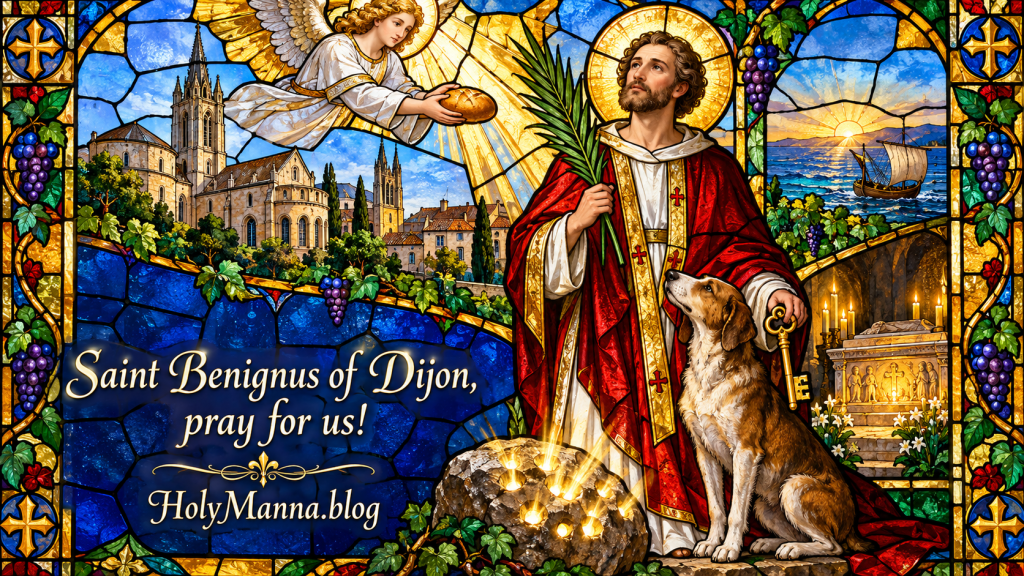
A Hidden Treasure in the Heart of Burgundy
Every November 1st, while the universal Church celebrates the Solemnity of All Saints, the ancient city of Dijon in Burgundy, France, quietly remembers the man it honors as its first evangelist: Saint Benignus, known in French as Saint Bénigne, a missionary priest and martyr of the early Church. His name stands under this date in the Martyrologium Hieronymianum, one of the oldest martyrologies of the Western Church, and he remains inscribed for November 1st in the current Roman Martyrology. Because the Solemnity of All Saints takes liturgical precedence, his feast is not celebrated on the universal calendar; the medieval abbey of Dijon even transferred his principal celebration locally to November 2nd. Yet in Burgundy his memory has never faded. Saint Benignus is the patron saint of the city of Dijon and of the Archdiocese of Dijon, whose cathedral, the Cathédrale Saint-Bénigne, bears his name to this day and still guards the ancient sarcophagus venerated as his tomb.
What makes Benignus so compelling is not a long and detailed biography; it is almost the opposite. History preserves very little that is certain about him except the one thing that matters most: he gave his life for Jesus Christ. The Catholic Encyclopedia puts it plainly: “It is an historical fact that Benignus suffered martyrdom in a persecution of the third century and was publicly honoured as a martyr.” The Church teaches that “Martyrdom is the supreme witness given to the truth of the faith: it means bearing witness even unto death” (CCC 2473). Benignus bore that witness so completely that even after the details of his story were lost, God made sure his tomb, and his intercession, were not. His story is a story about memory; about what the world forgets, and what Heaven refuses to forget.
From Smyrna to the Heart of Gaul
Honesty has to come first here, because honesty honors a saint far more than embroidery ever could. Documented history records nothing certain about where Benignus was born, who his family was, or how he came to faith. Early in the 6th century, even the Christians of Dijon who prayed at his tomb knew no particulars about his life. Later scholarship has suggested that he may have been a missionary priest connected with the church of Lyon, the great mother church of Roman Gaul, and that he may have died at Epagny near Dijon; proposed dates for his martyrdom range from around the year 179 to the years 270 through 275, and those dates cannot be reconciled with one another. Serious Catholic sources flag this conflict openly rather than papering over it, and this post does the same.
The tradition, however, is beautiful, and it deserves to be told as exactly what it is. It took written shape in a document called the Passio Sancti Benigni, an account of the saint’s mission and martyrdom that appeared suddenly at Dijon in the early 6th century and was said to have been brought there by a pilgrim traveling from Italy. According to this tradition, Benignus was born in Smyrna in Asia Minor, in present-day Turkey, and became a disciple of Saint Polycarp, the holy bishop of Smyrna who had himself sat at the feet of the Apostle John. The tradition tells that Polycarp sent Benignus into Gaul as a missionary, together with the priest Andochius and the deacon Thyrsus, to carry the Gospel into a land still wrapped in paganism. The older editions of the Roman Martyrology preserved this account for centuries: “At Dijon, the holy Priest Benignus, who was sent into Gaul to preach the Gospel by blessed Polycarp, under the Emperor Marcus Aurelius.”
Catholic scholarship itself, led by Monsignor Louis Duchesne and echoed by the Catholic Encyclopedia and Butler’s Lives of the Saints, concluded that the Passio was composed centuries after the events it describes, as part of a family of origin stories written by a single hand for the churches of Besançon, Autun, Langres, and Valence. Its chronology does not hold together; Polycarp died around the year 155, while other versions of the story place the martyrdom under the Emperor Aurelian, who reigned from 270 to 275. For this reason the current Martyrologium Romanum, issued in 2004, states soberly that at Dijon Saint Benignus is venerated as a priest and martyr, and it says nothing more. The story of the mission from Smyrna is a cherished tradition, but it cannot be verified.
Yet even as tradition rather than established history, the account captures something profoundly true about how the faith actually reached that corner of the world. The Gospel did come to Gaul from the East, through the living line of the apostles; the early church of Lyon really was led by men like Saint Pothinus and Saint Irenaeus, who came from Asia Minor and from the circle of Polycarp. The Catechism teaches: “In order that the full and living Gospel might always be preserved in the Church the apostles left bishops as their successors” (CCC 77). Whatever the exact details of his journey, Benignus stood within that apostolic river, and he carried its waters to Dijon.
Sowing the Gospel in Roman Burgundy
Why should a believer in the 21st century remember a priest about whom so little is known? Because Benignus represents something the Church can never do without: the anonymous missionary. The tradition preserved in the Passio describes him laboring as a priest across the towns of Roman Burgundy, preaching in Autun, in Langres, and finally in Dijon, then a fortified town called Divio in the territory of the Gallic tribe of the Lingones. The same tradition credits his preaching with remarkable fruit. It tells that at Autun he instructed and encouraged the young nobleman Symphorian, who would himself die for Christ and be venerated as Saint Symphorian of Autun, and it connects Benignus with the Holy Twins of Langres, the brothers Speusippus, Eleusippus, and Meleusippus, who according to their own tradition were converted together with their grandmother and also gave their lives for the faith. These connections come from the same unverifiable 6th-century tradition and cannot be confirmed; what they witness to is how deeply later generations believed that one man’s hidden apostolate had seeded an entire region with saints.
No miracle stories from Benignus’ lifetime survive in any document historians can verify; the wonders attached to his name cluster around his passion and, above all, around his tomb. That fact is itself worth pausing over, because his greatest documented miracle is simply this: a church existed at Dijon, and a martyr’s blood had watered it. Tertullian’s famous observation, quoted by the Catechism in its teaching on the Church’s missionary nature, applies to him perfectly: “the blood of martyrs is the seed of Christians” (CCC 852). Jesus Himself said: “Amen, amen, I say to you, unless a grain of wheat falls to the ground and dies, it remains just a grain of wheat; but if it dies, it produces much fruit” (The Gospel of John 12:24). Benignus was that grain of wheat for Burgundy. He is worth remembering precisely because the world did not remember him; he preached without applause, converted without headlines, and died without a biographer, and God built a cathedral on top of him.
He matters, and he deserves to be emulated, because most Christian lives look far more like his than like the lives of famous saints. Most believers will share the faith with people whose names history will never record, in places no pilgrim will ever visit. Benignus is living proof that none of it is wasted.
The Count, the Dogs, and the Iron Bar
The tradition of the Passio narrates the martyrdom of Benignus in vivid, almost cinematic detail, and the Church’s medieval martyrologies, including the Martyrology of Saint Bede in the 8th century, handed the account down through the generations. According to this tradition, the imperial authorities learned of Benignus’ preaching at Dijon during a persecution; the Passio places the events under the Emperor Aurelian, while the older Roman Martyrology names Marcus Aurelius, and the two claims cannot both be true, a conflict Catholic scholarship has long acknowledged. The saint was arrested, beaten with rough cords, and interrogated, and when he refused to renounce Christ he was handed over to a count named Terentius to be broken.
The tradition tells that Terentius had Benignus stretched on pulleys and scourged, then thrown into prison. There the priest prayed, and the idols he had been ordered to worship crumbled to pieces. Enraged, his tormentors drove ten red-hot awls under his fingernails and set his feet into a hollowed stone, fixing them in place with molten lead. Then they shut him in his cell for six days with twelve savage dogs and no food, expecting the animals to finish what the torturers had begun. The dogs never touched him. Instead, an angel of God came to him in the darkness, fed him with heavenly bread, drew the awls from his hands, and freed his feet from the lead. When the sixth day came and Benignus was found alive, serene, and still praising Christ, the order was given to end it: his neck was crushed with an iron bar and his body was pierced with a lance. This is why later Christian art gave him a dog as his emblem, together with a key, on the seal of the great abbey that rose over his grave. This entire account comes from the 6th-century Passio, and it cannot be verified.
What can be held with confidence is the core beneath the drama: a real priest named Benignus truly was put to death for Jesus Christ in the region of Dijon during a Roman persecution of the 3rd century, and the Christians there honored him as a martyr from the earliest times. The Church has always treasured such witnesses, and she explains why: “The Church has painstakingly collected the records of those who persevered to the end in witnessing to their faith. These are the acts of the Martyrs. They form the archives of truth written in letters of blood” (CCC 2474). That reverence for truth is exactly why Catholic scholars examined the Passio of Benignus so rigorously and labeled its embellishments honestly; the Church does not need exaggeration, because the plain fact of a man dying rather than denying Christ is already the most powerful argument on earth. Scripture says of such a death: “Precious in the sight of the LORD is the death of his saints” (Psalm 116:15).
The Tomb That Refused to Stay Silent
The best documented chapter of Benignus’ story begins nearly three centuries after his death, and it comes from the pen of one of the great historians of the early medieval Church, Saint Gregory of Tours, in his work Glory of the Martyrs. At Dijon there stood an enormous ancient sarcophagus where the common people loved to pray, and where they received favors. The bishop of the region, Saint Gregory of Langres, who governed from about 507 to 539 and was the great-grandfather of Gregory of Tours, believed the tomb belonged to a pagan and tried to put a stop to the devotion. Then came the vision. By night, the martyr Benignus revealed to the bishop that the tomb was his own, and that he was grieved to see his memory neglected. Gregory of Langres reversed course completely: he restored the tomb, built a crypt for it around the year 511, and raised a basilica over it, completed around the year 535. Gregory of Tours writes that Benignus, “another witness to the name of the Lord, was perfected by martyrdom in the town of Dijon,” and that after the shrine was restored “the holy martyr revealed himself to the people with many miracles.”
Gregory of Tours records three of those miracles. First, he tells that while the basilica was being built, a holy woman of Dijon named Paschasia, already at rest in her own burial church, appeared in order to encourage the workmen in their labor. Second, he describes how the faithful would pour wine and cider over the stone pierced with the holes where, tradition held, the martyr’s feet had been fixed with molten lead; the liquid was collected in vessels and given to the sick, and it healed them. Gregory testifies that he himself was among those cured. Third, he recounts that his own mother, Armentaria, was warned that plague had marked her household; a man reminded her that the passion of Benignus the martyr would be celebrated on November 1st and urged her to keep the saint’s vigils. She kept them faithfully, and her home was spared. These accounts rest on the testimony of a 6th-century Catholic bishop reporting what he witnessed and what his own family experienced; they are venerable testimony handed down by the Church rather than miracles verified by any modern process, and the reader should receive them as such.
From that restored tomb grew one of the great holy places of France. A Benedictine abbey was founded at the site in 871, and in 990 Saint Majolus of Cluny sent the monk William of Volpiano to reform it. Saint William built a magnificent Romanesque church between 1001 and 1018, crowned by a famous three-story rotunda 17 meters across, raised directly over the martyr’s resting place; it was counted among the architectural wonders of its age. That church collapsed in the 13th century, and the soaring Gothic church that replaced it, built between 1280 and 1325 and consecrated in 1393, still stands today. After the French Revolution it became the Cathédrale Saint-Bénigne, the cathedral of what is now the Archdiocese of Dijon, whose patron remains the martyr himself. Pilgrims and visitors can still descend into the ancient crypt, the surviving lower level of William’s rotunda, excavated in the 19th century, and venerate the sarcophagus associated with the saint. The former abbey buildings now house the Archaeological Museum of Dijon, which preserves a Romanesque sculpted head of the saint, and a medieval textile honored as the shroud of Benignus is kept at the Cluny Museum in Paris. Perhaps most striking of all, a statue of Saint Benignus, carved around 1667, stands among the 140 saints atop Bernini’s great colonnade embracing Saint Peter’s Square in Rome, dressed in Eastern robes that nod to the Smyrna tradition. The Church cherishes exactly this kind of devotion, commending “the veneration of relics, visits to sanctuaries, pilgrimages, processions” among the expressions of piety that surround her sacramental life (CCC 1674). A city’s cathedral, a statue in Rome, and 17 centuries of prayer all grew from one unmarked grave.
When Heaven Remembers What the World Forgets
The life of Saint Benignus speaks directly to anyone who has ever wondered whether hidden faithfulness counts, because no one seems to see it. Here was a priest who preached, suffered, and died, and within a few generations even the Christians of his own city could not tell his story. By every worldly measure his memory had failed. And yet God saw. Jesus promised: “And your Father who sees in secret will repay you” (The Gospel of Matthew 6:4). The tomb that a bishop mistook for a pagan grave became a cathedral; the forgotten martyr became the patron of an archdiocese. Benignus teaches that the measure of a Christian life is fidelity, not fame.
He also teaches something about the communion of saints that the modern world badly needs. The Catechism explains that the saints in heaven “do not cease to intercede with the Father for us” (CCC 956), and that “It is not merely by the title of example that we cherish the memory of those in heaven; we seek, rather, that by this devotion to the exercise of fraternal charity the union of the whole Church in the Spirit may be strengthened” (CCC 957). The Letter to the Hebrews describes the Christian life as a race run while “surrounded by so great a cloud of witnesses” (Hebrews 12:1). Benignus belongs to that cloud, and it is beautifully fitting that a saint whose biography was lost shares November 1st with the feast of all the saints whose names were never written down, that “great multitude, which no one could count, from every nation, race, people, and tongue” standing before the throne of God (The Book of Revelation 7:9).
How can you weave his lessons into your daily life? Begin with hidden fidelity: pray when no one is watching, keep your word when no one would notice if you broke it, and do small acts of compassion that will never be posted or praised. Practice resilience in the style of Benignus: when faith costs you something at work, in your family, or among friends, endure it with serenity rather than bitterness, trusting that God keeps perfect records. Reclaim memory as a spiritual discipline: learn the story of your own parish, pray for the missionaries who first brought the Gospel to your region, and visit a shrine, a crypt, or a cemetery to pray with and for those who went before you. And ask Saint Benignus to intercede for perseverance, especially if you are tempted to believe that your quiet faith is wasted. Is there a hidden faithfulness in your life that you have been tempted to abandon because no one notices it? If your name were forgotten tomorrow, would your witness to Christ still bear fruit in the people you have touched? Who first planted the faith in you, and when did you last thank God for that person?
Engage With Us!
Saint Benignus waited centuries for the world to remember him, and his story is still bearing fruit today; now it is your turn to carry it forward. Share your thoughts and reflections in the comments below, because every comment helps build up this little corner of the communion of saints and encourages other readers walking the same road. Here are some questions to spark reflection and discussion:
- What part of Saint Benignus’ story moved you the most: the mission, the martyrdom, or the rediscovery of his tomb, and why?
- Have you ever lived through a season when your faithfulness felt invisible? What helped you persevere?
- Saint Gregory of Langres changed his mind when God corrected him in prayer. How do you respond when God redirects your plans or your judgments?
- The faithful of Dijon brought their sick to the martyr’s stone with simple confidence. What would it look like for you to bring your needs to the saints with that same childlike trust?
- Who in your life needs you to be a grain of wheat right now, quietly laying down your comfort so that faith can grow in them?
Go into this week unafraid of being unseen, because God sees, God remembers, and God rewards. Live your faith boldly when you can and hiddenly when you must, trust that no act of love is ever lost, and do everything with the love and mercy that Jesus taught us.
Saint Benignus of Dijon, pray for us!
Follow us on YouTube, TikTok, Instagram and Facebook for more insights and reflections on living a faith-filled life.


Leave a Reply