Solemnity of All Saints – Lectionary: 667
A Crowd Too Big to Count
Every family keeps a photo album, and on November 1st the Church opens hers. The Solemnity of All Saints, which falls on a Sunday this year, celebrates every soul who now stands before the throne of God, the canonized giants with feast days of their own and the countless hidden grandmothers, farmers, nurses, and martyrs whose names history forgot but heaven did not. The feast has deep roots. Christians in the East were already honoring all the martyrs together by the 4th century. Around the year 609, Pope Boniface IV consecrated the Roman Pantheon, once a temple to every god of the empire, as a church in honor of the Blessed Virgin Mary and all the martyrs; some records place the dedication in 610, and the sources honestly disagree on the exact year. Pope Gregory III later dedicated an oratory in Saint Peter’s Basilica to all the saints and attached the observance to November 1st in Rome, and around the year 835 Pope Gregory IV extended the feast to the universal Church.
The central theme uniting today’s readings is this: the saints are not a different species of human being; they are what grace does to ordinary people who keep longing to see the face of God. The 4 readings trace a single arc. Revelation 7 shows the destination, a multitude no one could count already standing in glory. Psalm 24 gives the pilgrim’s song for everyone still climbing. 1 John 3 reveals the identity underneath every halo, children of God destined to see Him as He is. And Matthew 5 hands over the road map, the Beatitudes. The refrain of the day says it best: “Lord, this is the people that longs to see your face.”
First Reading — Revelation 7:2-4, 9-14
A Vision of Victory for a Church That Felt Like It Was Losing
Saint John received this vision in exile on the island of Patmos near the end of the 1st century, during the reign of the Emperor Domitian according to the early tradition reported by Saint Irenaeus. The Christians who first heard The Book of Revelation read aloud were a small, pressured minority. Refusing to burn incense to the emperor could cost a person their trade, their friendships, and sometimes their life. Into that fear, John delivers an unveiling, which is what the Greek word apocalypsis actually means. He pulls back the curtain on reality. This passage sits deliberately between the sixth and seventh seals of judgment: before anything else happens, God pauses history to mark His own people as His. On All Saints Day the Church proclaims this reading because it answers the question the whole feast asks. Where does holiness finally lead? It leads home, into a crowd too large to count, standing in white before the throne.
Revelation 7:2-4, 9-14
I, John, saw another angel come up from the East,
holding the seal of the living God.
He cried out in a loud voice to the four angels
who were given power to damage the land and the sea,
“Do not damage the land or the sea or the trees
until we put the seal on the foreheads of the servants of our God.”
I heard the number of those who had been marked with the seal,
one hundred and forty-four thousand marked
from every tribe of the children of Israel.After this I had a vision of a great multitude,
which no one could count,
from every nation, race, people, and tongue.
They stood before the throne and before the Lamb,
wearing white robes and holding palm branches in their hands.
They cried out in a loud voice:“Salvation comes from our God, who is seated on the throne,
and from the Lamb.”All the angels stood around the throne
and around the elders and the four living creatures.
They prostrated themselves before the throne,
worshiped God, and exclaimed:“Amen. Blessing and glory, wisdom and thanksgiving,
honor, power, and might
be to our God forever and ever. Amen.”Then one of the elders spoke up and said to me,
“Who are these wearing white robes, and where did they come from?”
I said to him, “My lord, you are the one who knows.”
He said to me,
“These are the ones who have survived the time of great distress;
they have washed their robes
and made them white in the Blood of the Lamb.”
Detailed Exegesis
Verse 2. “I, John, saw another angel come up from the East, holding the seal of the living God. He cried out in a loud voice to the four angels who were given power to damage the land and the sea,”
The East is the direction of the sunrise, and in Scripture it is the direction of hope; the prophet Ezekiel saw the glory of the Lord return to the temple from the East in Ezekiel 43:2. A seal in the ancient world was a signet pressed into wax, marking a document or a possession as belonging to its owner and protected by his authority. This angel carries the seal of the living God, a pointed contrast with the dead idols of the empire. Before judgment touches the earth, heaven moves to claim its own.
Verse 3. “Do not damage the land or the sea or the trees until we put the seal on the foreheads of the servants of our God.”
This verse echoes Ezekiel 9:4, where a man with a writing case marks the foreheads of those who grieve over the sins of Jerusalem before judgment falls on the city. The pattern reveals the heart of God: mercy always goes first. The Church Fathers saw in this sealing an image of Baptism and Confirmation, the sacraments that mark a Christian on the forehead with the sign of the cross. The forehead matters; it is the most public part of the body. Belonging to God is not meant to be hidden.
Verse 4. “I heard the number of those who had been marked with the seal, one hundred and forty-four thousand marked from every tribe of the children of Israel.”
The number is symbolic, not a seating capacity for heaven. It is 12 times 12 times 1,000: the 12 tribes of Israel, the 12 apostles of the Lamb, multiplied by 1,000, a biblical number for vastness. The figure signifies the complete fullness of God’s people, with no one missing whom God intends to save. Notice that John hears the number but, in the next verse, sees something far beyond numbering.
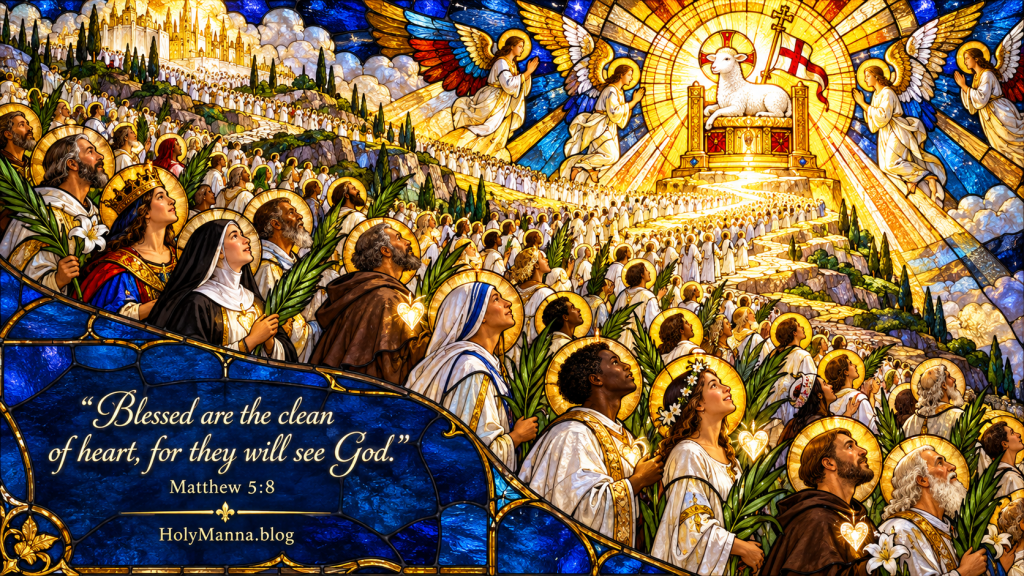
Verse 9. “After this I had a vision of a great multitude, which no one could count, from every nation, race, people, and tongue. They stood before the throne and before the Lamb, wearing white robes and holding palm branches in their hands.”
Here is the fulfillment of the promise made to Abraham in Genesis 15:5, descendants as countless as the stars. The multitude is radically universal, drawn from every nation, race, people, and tongue, which means no culture, language, or background disqualifies anyone from sanctity. The white robes signify baptismal purity and victory, and the palm branches recall both the Jewish Feast of Tabernacles and the triumphant welcome given to Jesus in John 12:13. These are people celebrating a victory already won.
Verse 10. “They cried out in a loud voice: ‘Salvation comes from our God, who is seated on the throne, and from the Lamb.’”
Heaven has one song, and it is not a song of self-congratulation. The saints do not sing about what they achieved; they sing about what they received. Salvation comes from God and from the Lamb, and the fact that the Lamb shares the worship given to the One on the throne is one of the clearest declarations of the divinity of Christ in all of Scripture.
Verse 11. “All the angels stood around the throne and around the elders and the four living creatures. They prostrated themselves before the throne, worshiped God,”
The scene unfolds in concentric circles of worship: the throne at the center, then the four living creatures representing all creation, then the 24 elders, understood by many commentators as the 12 patriarchs and 12 apostles together representing the whole People of God, then the angels, then the multitude. This is a liturgy. Heaven is not a vague cloudscape; it is ordered, communal worship.
Verse 12. “and exclaimed: ‘Amen. Blessing and glory, wisdom and thanksgiving, honor, power, and might be to our God forever and ever. Amen.’”
The doxology lists exactly 7 attributes, the biblical number of perfection, and it is framed on both sides by Amen. The Mass borrows this grammar directly; the Gloria and the Great Amen are rehearsals for this moment. Anyone who has ever sung at Mass has already practiced the song of the saints.
Verse 13. “Then one of the elders spoke up and said to me, ‘Who are these wearing white robes, and where did they come from?’”
The elder asks a question he already knows the answer to, a classic teaching device in apocalyptic literature. It is also the question of All Saints Day itself. Who are these people, and how did they get there? The answer is meant for the reader as much as for John.
Verse 14. “I said to him, ‘My lord, you are the one who knows.’ He said to me, ‘These are the ones who have survived the time of great distress; they have washed their robes and made them white in the Blood of the Lamb.’”
John’s humble deference gives way to the great paradox of the Christian life: robes washed white in blood. Human effort does not bleach a soul; the Blood of Christ does. The saints are not people who avoided the time of great distress; they are people who passed through it clinging to the Lamb. Every generation of the Church has known its own great distress, and every generation has produced saints in the middle of it.
Teachings
The Catechism reads this very scene as the cast of the heavenly liturgy, naming the powers of heaven, all creation, the servants of the Old and New Covenants, the new People of God, and the great multitude as those who take part in the worship of God and the fulfillment of His plan (CCC 1138). Every Mass on earth is a participation in that liturgy, which means the parish pew on Sunday is closer to this vision than it feels. The Church also teaches why the saints matter to the living. The Catechism, quoting the Second Vatican Council’s Lumen Gentium, declares: “It is not merely by the title of example that we cherish the memory of those in heaven; we seek, rather, that by this devotion to the exercise of fraternal charity the union of the whole Church in the Spirit may be strengthened” (CCC 957). The saints are not trophies in a case; they are family members actively strengthening the Church. On the seal itself, the Catechism teaches that Confirmation marks the Christian with the seal of the Holy Spirit, a sign of total belonging to Christ, of enrollment in His service forever, and of divine protection in the great eschatological trial (CCC 1296). The multitude in white and the baptized reader share the same mark.
Reflection
This reading is a family photo, and your relatives are in it. Somewhere in that uncountable crowd stand the holy souls who prayed you toward the faith, whether a grandmother with a worn rosary or a friend who showed you quiet heroism. Living this reading can be concrete. Pray the Litany of the Saints slowly this week and add the names of holy people you have personally known. At Mass this Sunday, when the congregation sings the Holy, Holy, Holy, picture the multitude singing it with you, because the Church teaches that they truly are. And when distress comes, resist the lie that suffering disqualifies you from holiness; the elder says the exact opposite. Where in your life does it feel like the time of great distress right now, and what would it mean to hand that struggle to Christ to be washed white? Which holy men and women, canonized or hidden, have shown you what a washed robe looks like in real life?
Responsorial Psalm — Psalm 24:1-6
The Song of the People Still Climbing
If the First Reading showed the saints who have arrived, Psalm 24 is the song of everyone still on the way up. Attributed to David, this psalm was an entrance liturgy, sung by pilgrims as they ascended the Temple Mount in Jerusalem, and many scholars connect it to the procession that brought the Ark of the Covenant into the city, described in 2 Samuel 6. The psalm works like a dialogue at the gates: the pilgrims ask who is worthy to go up, and the answer comes back describing the kind of person God welcomes. On All Saints Day the Church places this psalm on the lips of the pilgrim Church on earth, and the refrain gives the entire solemnity its heartbeat: “Lord, this is the people that longs to see your face.” The saints in glory were once exactly this, a people mid-climb, still longing.
Psalm 24:1-6
R. (see 6) Lord, this is the people that longs to see your face.
The LORD’s are the earth and its fullness;
the world and those who dwell in it.
For he founded it upon the seas
and established it upon the rivers.
R. Lord, this is the people that longs to see your face.
Who can ascend the mountain of the LORD?
or who may stand in his holy place?
One whose hands are sinless, whose heart is clean,
who desires not what is vain.
R. Lord, this is the people that longs to see your face.
He shall receive a blessing from the LORD,
a reward from God his savior.
Such is the race that seeks him,
that seeks the face of the God of Jacob.
R. Lord, this is the people that longs to see your face.
Detailed Exegesis
Verse 1. “The LORD’s are the earth and its fullness; the world and those who dwell in it.”
The psalm opens with a sweeping claim of ownership: everything and everyone belongs to God. Nothing is truly secular in the sense of standing outside His claim. This grounds the universal call to holiness before the psalm ever mentions it, because if every person already belongs to the Lord, then every person is already invited up the mountain.
Verse 2. “For he founded it upon the seas and established it upon the rivers.”
In the imagery of the ancient Near East, the seas represented chaos, the untamable forces that threatened life. The psalmist declares that God founded the world on top of them, meaning His order stands firmly over everything that feels unstable. The One who steadied the world can steady a soul, which is quiet good news for anyone whose interior life feels like open water.
Verse 3. “Who can ascend the mountain of the LORD? or who may stand in his holy place?”
Here is the pilgrim’s question, asked at the base of Mount Zion, and underneath it sits the question of salvation itself. Who gets to stand in the presence of God? It is worth noticing that in today’s Gospel, Jesus answers this question from another mountain, and He answers it with blessings rather than barriers.
Verse 4. “One whose hands are sinless, whose heart is clean, who desires not what is vain.”
The answer covers the whole person: hands, meaning deeds; heart, meaning the interior life; and desires, meaning the loves that steer everything else. God is not asking for ritual correctness but for integrity all the way down. The clean heart named here anticipates the sixth beatitude almost word for word, and the warning about vain desires names the real competition for every human heart.
Verse 5. “He shall receive a blessing from the LORD, a reward from God his savior.”
The verb matters: the one who ascends receives. Even after describing clean hands and a pure heart, the psalm insists that what waits at the top is a gift from God the savior, not a wage earned from an employer. The saints would recognize this instantly; holiness itself is grace received, which is exactly what the multitude sings in Revelation 7:10.
Verse 6. “Such is the race that seeks him, that seeks the face of the God of Jacob.”
The psalm ends by defining God’s people not by their achievements but by their seeking. The face of God means His personal presence, the most intimate encounter possible. The saints, in the end, are simply the generation that never stopped seeking that face, through dry seasons, failures, and ordinary Tuesdays, all the way to the summit.
Teachings
The climb described in this psalm is not reserved for a spiritual elite. The Catechism, quoting Lumen Gentium, teaches: “All Christians in any state or walk of life are called to the fullness of Christian life and to the perfection of charity” (CCC 2013). The same paragraph adds the Lord’s own standard: “Be perfect, as your heavenly Father is perfect.” That word all is the doctrinal engine of this solemnity; accountants, parents, students, and plumbers are called up the same mountain as popes and mystics. Saint Gregory of Nyssa, a Doctor of the Church who loved the image of ascent and built his classic work The Life of Moses around it, pressed the point further in a line the Catechism itself preserves: “Christian perfection has but one limit, that of having none” (CCC 2028). For Gregory, the climb never flattens out this side of heaven; every summit reached opens onto another, because the God being sought is infinite. The Catechism also connects the psalm’s clean heart to its destination, teaching that purity of heart lets the baptized see according to God and is the precondition for the vision of God promised in the Beatitudes (CCC 2518–2519).
Reflection
You are mid-climb, and this psalm hands you a trail map for the examination of conscience. At the end of each day this week, walk through verse 4 as a checklist in prayer: what did your hands do, what did your heart love, and what vain thing did you chase that could never satisfy? Bring what you find to the Sacrament of Reconciliation, which functions like a washing station on the mountain, restoring clean hands and a clean heart for the next stretch of trail. Then practice the seeking the psalm describes: one deliberate moment each day of looking for God’s face, in the Blessed Sacrament, in Scripture, or in the face of someone who needs you. What vain desire keeps pulling your attention off the climb, and what would it cost to set it down? How would this week change if you treated it as an ascent toward a face rather than a list of tasks?
Second Reading — 1 John 3:1-3
Children Now, With Something Greater Still Hidden
The First Letter of John was written near the end of the 1st century, and ancient tradition places its author, the Apostle John, in Ephesus. The communities receiving it had been shaken by teachers who denied that the Son of God had truly come in the flesh, treating the faith as an abstract idea rather than an embodied reality. Against that fog, John writes with almost blunt concreteness: God’s love is not a theory, and neither is what it produces. It makes children. In only 3 verses, this reading delivers the identity hidden underneath every halo on today’s feast. Before any saint was a wonder-worker or a martyr, each one was first a child of God who took that title seriously. The reading also stretches forward to the destination the whole day points toward, the moment of seeing God as He is, which the Church calls the beatific vision.
1 John 3:1-3
Beloved:
See what love the Father has bestowed on us
that we may be called the children of God.
Yet so we are.
The reason the world does not know us
is that it did not know him.
Beloved, we are God’s children now;
what we shall be has not yet been revealed.
We do know that when it is revealed we shall be like him,
for we shall see him as he is.
Everyone who has this hope based on him makes himself pure,
as he is pure.
Detailed Exegesis
Verse 1. “See what love the Father has bestowed on us that we may be called the children of God. Yet so we are. The reason the world does not know us is that it did not know him.”
John opens with a command to look, the way a person grabs a friend’s arm to point at something astonishing. The love in question is bestowed, pure gift, and the result is not a polite nickname. The phrase yet so we are slams the door on any watered-down reading; through Baptism, divine adoption is an ontological reality, a change in what a person actually is. The world’s failure to recognize Christians follows logically, because the world failed to recognize Christ Himself. This explains something every reader has noticed: most saints went completely unrecognized in their own lifetimes.
Verse 2. “Beloved, we are God’s children now; what we shall be has not yet been revealed. We do know that when it is revealed we shall be like him, for we shall see him as he is.”
This single verse holds the entire tension of the Christian life, the already and the not yet. The adoption is present tense, real now, and yet something greater waits under wraps. John then gives one of the most staggering promises in Scripture: seeing God as He is will complete the transformation into His likeness. Vision and likeness arrive together, the way a face is shaped by what it spends a lifetime beholding. The saints in glory are not admirers of God from a distance; they are children who finally resemble their Father.
Verse 3. “Everyone who has this hope based on him makes himself pure, as he is pure.”
Hope, for John, is not wishful thinking; it is moral energy. People prepare for what they genuinely expect. A person who truly expects to see God face to face starts cleaning house now, not out of fear but out of anticipation. This verse quietly ties the whole day together, reaching back to the clean heart of Psalm 24:4 and forward to the sixth beatitude in Matthew 5:8, where the clean of heart are promised the sight of God.
Teachings
No one has preached this passage more memorably than Saint Augustine, whose Tractate 4 on the First Letter of John is read in the Liturgy of the Hours. Augustine teaches: “The entire life of a good Christian is in fact an exercise of holy desire.” He explains the idea with a homely image: a person about to receive a large quantity stretches the sack or wineskin meant to hold it. In the same way, God sometimes delays giving Himself precisely to enlarge desire, and enlarged desire expands the soul’s capacity to receive Him. Augustine concludes: “We must extend ourselves toward the measure of Christ so that when he comes he may fill us with his presence.” Longing, in other words, is not a flaw in the spiritual life; it is the training program. The Church defines the destination with precision. The Catechism, drawing on Pope Benedict XII’s constitution Benedictus Deus from the year 1336, teaches that the souls of the just in heaven “see the divine essence with an intuitive vision”, face to face, with no creature standing in between (CCC 1023). That is what the word heaven actually means, and it is what every name on today’s feast has already received.
Reflection
Start where John starts, with identity. Tomorrow morning, before checking a single notification, say the first 2 words of the Lord’s Prayer slowly and let them land: you are addressing your Father, because you are His child now, not after you get your act together. Then let hope do its work the way verse 3 describes. Choose one concrete purification this week, not as self-improvement but as preparation for a meeting: reconcile with one person, cut one habit that dulls your desire for God, or return to Confession if it has been a while. Augustine would call every bit of it stretching the wineskin. Does your daily life look like the life of someone who is already a child of God? What one attachment would you trade away this week if it meant seeing His face more clearly?
Holy Gospel — Matthew 5:1-12a
The Family Resemblance, Written in 8 Blessings
These verses open the Sermon on the Mount, the great discourse that runs through chapters 5 to 7 of The Gospel of Matthew. Matthew, writing for an audience steeped in the Old Testament, deliberately frames the scene to recall Mount Sinai: a mountain, a gathered people, and the giving of a law. The difference is everything. Moses climbed Sinai to receive the law from God; Jesus climbs this hill in Galilee and gives the law in His own name, speaking with an authority no prophet ever claimed. The crowds following Him, described at the end of chapter 4, came from Galilee, the Decapolis, Jerusalem, Judea, and beyond the Jordan, an early hint of the every-nation multitude of Revelation 7. The Church proclaims the Beatitudes on All Saints Day because they are not abstract ideals; they are the collective biography of the saints. Every canonized life is one of these blessings lived out loud.
Matthew 5:1-12a
When Jesus saw the crowds, he went up the mountain,
and after he had sat down, his disciples came to him.
He began to teach them, saying:“Blessed are the poor in spirit,
for theirs is the Kingdom of heaven.
Blessed are they who mourn,
for they will be comforted.
Blessed are the meek,
for they will inherit the land.
Blessed are they who hunger and thirst for righteousness,
for they will be satisfied.
Blessed are the merciful,
for they will be shown mercy.
Blessed are the clean of heart,
for they will see God.
Blessed are the peacemakers,
for they will be called children of God.
Blessed are they who are persecuted for the sake of righteousness,
for theirs is the Kingdom of heaven.
Blessed are you when they insult you and persecute you
and utter every kind of evil against you falsely because of me.
Rejoice and be glad,
for your reward will be great in heaven.”
Detailed Exegesis
Verse 1. “When Jesus saw the crowds, he went up the mountain, and after he had sat down, his disciples came to him.”
Every detail carries weight. The mountain evokes Sinai, the place where God forms His people. Sitting was the posture of the authoritative teacher in the ancient world, which is why the Church still speaks of a bishop’s cathedra, his teaching chair. And the disciples draw near, because the Beatitudes are meant to be heard up close, by people who intend to follow.
Verse 2. “He began to teach them, saying:”
The Greek behind this verse says literally that Jesus opened His mouth, a solemn biblical formula signaling that a weighty declaration is coming. Matthew wants the reader leaning in before a single blessing is spoken.
Verse 3. “Blessed are the poor in spirit, for theirs is the Kingdom of heaven.”
The poor in spirit are the anawim of the Old Testament, the lowly ones who expect everything from God because they have stopped pretending they can save themselves, the very people the prophet describes in Zephaniah 2:3. Notice the tense: theirs is the Kingdom, present and already underway. The first beatitude is the doorway to all the rest, because no one climbs toward God while clutching self-sufficiency.
Verse 4. “Blessed are they who mourn, for they will be comforted.”
This mourning is grief over sin, over personal failure, and over a wounded world, the sorrow of people whose hearts are soft enough to break. The promised comfort echoes Isaiah 61:2, the mission text Jesus claimed for Himself. God does not bless numbness; He blesses the tears of those who love.
Verse 5. “Blessed are the meek, for they will inherit the land.”
The verse quotes Psalm 37:11 almost exactly. Meekness is not weakness; it is strength under the governance of love, power that refuses to dominate. Scripture calls Moses meek, and Jesus applies the word to Himself in Matthew 11:29. The meek inherit rather than seize, receiving from God what the ruthless try to grab.
Verse 6. “Blessed are they who hunger and thirst for righteousness, for they will be satisfied.”
Righteousness here means right relationship with God and genuine justice among people, and Jesus describes the desire for it in the language of appetite, the most insistent drive a human being knows. The blessing belongs to those who want holiness the way a starving person wants bread, and the promise is satisfaction that only God can supply.
Verse 7. “Blessed are the merciful, for they will be shown mercy.”
Mercy is love meeting misery, and this beatitude runs on a measure-for-measure logic that Jesus repeats throughout the Gospel: what is given is what will be received. The corporal and spiritual works of mercy, which the Church has always drawn from texts like Matthew 25, are simply this beatitude organized into a to-do list, and they form the signature of saint after saint.
Verse 8. “Blessed are the clean of heart, for they will see God.”
Here is the hinge of the whole solemnity. The clean heart of Psalm 24:4, the promised vision of 1 John 3:2, and this beatitude all converge on one point: an undivided heart is the organ that sees God. Purity here is bigger than one virtue; it is singleness of love, a heart that wants one thing.
Verse 9. “Blessed are the peacemakers, for they will be called children of God.”
Peace in Scripture is shalom, the full flourishing of right relationships, and it must be actively made, not merely wished for. The reward lands with precision on today’s Second Reading: peacemakers are called children of God because they bear the family resemblance of the Son, who reconciled the world to the Father.
Verse 10. “Blessed are they who are persecuted for the sake of righteousness, for theirs is the Kingdom of heaven.”
The eighth beatitude repeats the reward of the first, bracketing the whole list with the Kingdom and completing the portrait. Persecution is not an accident that befalls a few unlucky disciples; it is the predictable cost of righteousness in a world that resists it. These are the robes being washed in Revelation 7:14.
Verse 11. “Blessed are you when they insult you and persecute you and utter every kind of evil against you falsely because of me.”
The grammar suddenly turns personal, shifting from blessed are they to blessed are you. Jesus looks His disciples in the eye. The decisive phrase is because of me; the suffering that is blessed is suffering borne in loyalty to Christ Himself, a claim no mere teacher could make.
Verse 12a. “Rejoice and be glad, for your reward will be great in heaven.”
Jesus commands joy, of all things, in the face of persecution, because the reward is not a consolation prize but God Himself. The multitude in the First Reading is already obeying this verse, and every celebration of All Saints is a rehearsal for joining the song.
Teachings
The Catechism gives the Beatitudes a place of extraordinary honor: “The Beatitudes are at the heart of Jesus’ preaching” (CCC 1716). It then makes the claim that turns this Gospel into an icon: “The Beatitudes depict the countenance of Jesus Christ and portray his charity” (CCC 1717). Reading the Beatitudes is looking at a portrait of the Lord, who is poor in spirit, meek, merciful, pure of heart, and persecuted. The same paragraph then connects the portrait directly to today’s feast, teaching that these blessings “have begun in the lives of the Virgin Mary and all the saints” (CCC 1717). Saint John Chrysostom, Doctor of the Church, opened his great commentary on this passage in his Homily 15 on Matthew by asking and answering the obvious question: “What is meant by the poor in spirit? The humble and contrite in mind.” Chrysostom stresses that Jesus blesses chosen humility, the lowliness a person freely embraces rather than the kind circumstances force. History keeps proving the Catechism right. Saint Francis of Assisi lived poverty of spirit, Saint Monica mourned for decades over her son, and the martyrs of every century have claimed the eighth beatitude, which is why the Church can honestly call this list the family resemblance of the saints.
Reflection
Treat the Beatitudes this month as a mirror rather than a poster. Read the list slowly and notice which blessing stings, because the one that feels least believable is usually the one Jesus is currently offering you. Then shrink it to practical size: pick that single beatitude and live it deliberately in one relationship this week, mercy toward the coworker who irritates you, peacemaking in the family group chat, mourning honestly instead of numbing out. Let a saint coach you by reading a short life of someone who embodied your chosen beatitude, since the saints are the proof that this portrait can be painted on ordinary material. Which beatitude feels least believable to you right now, and what might Jesus be offering you through it? If the Beatitudes are the family portrait of heaven, where does your face already fit, and where is it still missing?
Saving You a Seat in the Multitude
Picture the day again as one story. A multitude no one could count stands in white before the throne, singing that salvation belongs to God and to the Lamb. Down the mountain, a pilgrim people is still climbing, asking who can ascend and answering with clean hands, a clean heart, and an undivided desire. An old apostle leans in and reveals the secret of the whole crowd: they are children of God, and when they finally see Him as He is, they will be like Him. And on a hillside in Galilee, Jesus hands the climbers their map, 8 blessings that turn out to be His own portrait, the family resemblance of everyone who makes it home. That is the Solemnity of All Saints: not a memorial for spiritual superstars, but a family reunion with an empty seat that has a name on it.
Saint Bernard of Clairvaux preached for this very feast, and his words still carry: “Calling the saints to mind inspires, or rather arouses in us, above all else, a longing to enjoy their company, so desirable in itself.” Then he added the line that stings a little: “The saints want us to be with them, and we are indifferent.” Let this be the year indifference loses. Go to Mass on November 1st and sing the Gloria like a rehearsal. Ask the saints for their prayers by name, the famous ones and the hidden ones who loved you into faith. Pick one beatitude and wear it all month. The multitude is not a closed club; it is a family photo still being taken, and the Father who bestowed such love is holding a place in the frame.
Engage With Us!
This feast belongs to the whole family of God, so share your reflections in the comments below. Which reading spoke to you most, and which saint, canonized or quietly hidden in your own story, has shown you what holiness looks like up close? Here are some questions to pray with this week:
- In Revelation 7:2-4, 9-14, the elder reveals that the saints washed their robes white in the Blood of the Lamb after surviving great distress. What trial in your own life might God be inviting you to hand over to Christ so it can be washed white?
- Psalm 24:1-6 describes the one who ascends the mountain of the Lord as having sinless hands, a clean heart, and no desire for what is vain. Which of those 3 areas, your actions, your heart, or your desires, needs the most attention on your climb right now?
- 1 John 3:1-3 declares that you are a child of God now, with something greater still to be revealed. How would this week change if you woke up each morning fully believing that identity?
- In Matthew 5:1-12a, Jesus pronounces 8 blessings that form the portrait of every saint. Which beatitude is Jesus asking you to live more fully, and what is one concrete step you can take this week?
- Taken together, today’s readings proclaim that the saints are ordinary people transformed by grace, longing to see the face of God. Who is one holy person who made you want heaven, and how will you imitate them before next Sunday?
Holiness is not reserved for stained glass. It is built from small, daily choices to love God and neighbor, made by people exactly like you. Keep climbing, keep longing for His face, and do everything this week with the love and mercy Jesus taught us.
Sacred Heart of Jesus, we trust in You!
Immaculate Heart of Mary, pray for us!
Saint Michael the Archangel, defend us in battle!
Follow us on YouTube, TikTok, Instagram and Facebook for more insights and reflections on living a faith-filled life.


Leave a Reply