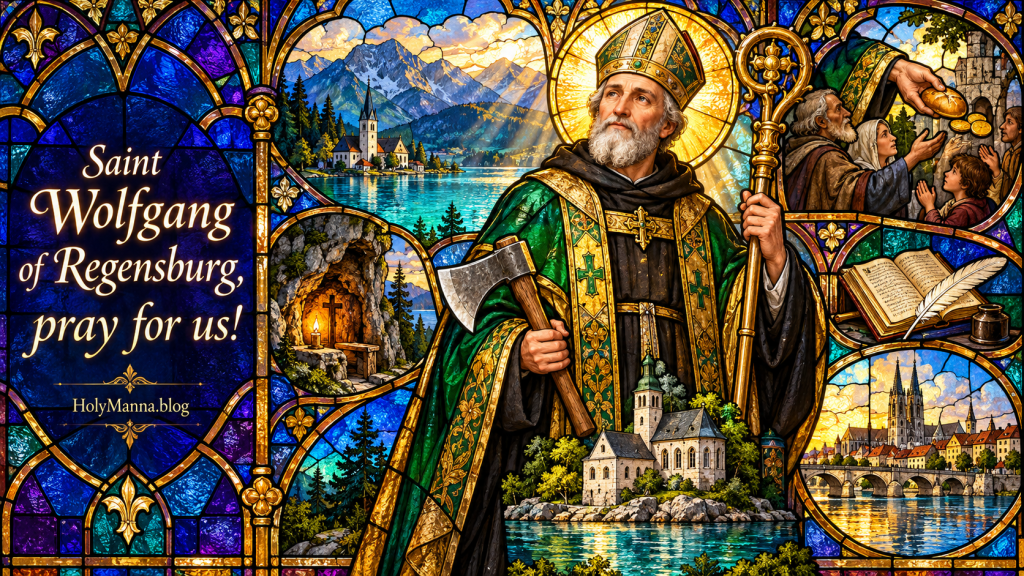
The Bishop Who Threw an Axe
Every October 31st, while the world busies itself with costumes and candy, the Church quietly celebrates a man whose name means wolf’s path, and whose life became a straight path to the Lamb of God. Saint Wolfgang of Regensburg was a schoolmaster, a Benedictine monk, a missionary to the Magyars of Hungary, and finally the reforming Bishop of Regensburg in Bavaria, serving from Christmas of 972 until his death in 994. The Catholic Encyclopedia ranks him among the “three brilliant stars of the tenth century,” shining alongside Saint Ulrich of Augsburg and Saint Conrad of Constance, three bishops who renewed the Church in the German lands during one of history’s most turbulent eras.
Wolfgang is remembered as a teacher who formed a future emperor and saint, a reformer who rebuilt monastic life from the inside out, and a giver so generous that his own generation nicknamed him the Grand Almoner. He is also remembered for something wonderfully strange: a thrown axe, a hermit’s cave above an Alpine lake, and a lakeside church that still draws pilgrims more than a thousand years later. The Church teaches that God gives such shepherds to His people on purpose, since each bishop stands as the visible source and foundation of unity in the particular Church entrusted to him (CCC 886), and Wolfgang lived that calling with both a crozier and calloused hands.
Saint Wolfgang is the patron of carpenters and wood carvers, a fitting honor for the bishop who swung an axe and built his own hermit’s cell. He is invoked against strokes and apoplexy, against paralysis, and against stomach ailments, and he is a patron of the city of Regensburg itself. Over the centuries the farmers and woodcutters of Bavaria, Austria, and Switzerland also claimed him as their own. For a generation that loves a saint with a good story, Wolfgang delivers; for a generation that needs a saint with real substance, he delivers even more.
A Swabian Boy in the School of the Saints
Wolfgang was born in Swabia, in what is now southwestern Germany, very probably at Pfullingen, to a family the Catholic Encyclopedia identifies with the Swabian counts of Pfullingen. His birth year is genuinely uncertain, and honesty demands saying so. The Catholic Encyclopedia places his birth around 934, modern German scholarship favors roughly 925 or 930, and Austria celebrated the 1,100th anniversary of his birth in 2024, which presumes a birth in 924. The safest statement is that he was born in the 920s or early 930s, into a Europe still bruised by invasion and instability, where the monasteries kept learning and holiness alive.
As a boy he was sent to the famous island abbey of Reichenau on Lake Constance, one of the great Benedictine schools of the age. There he met a young nobleman named Henry, and that friendship quietly changed the course of his life. The two studied together at Würzburg, and when Henry was made Archbishop of Trier in 956, he brought Wolfgang along to teach in the cathedral school there. In Trier, Wolfgang poured himself into the archbishop’s efforts to reform the clergy, and he came into contact with the reform minded monks of the Abbey of Saint Maximin, where he met Ramwold, who would later teach Saint Adalbert of Prague. Friendship, formation, and reform wove through his whole story, and good company was, humanly speaking, the soil of his sanctity. That is no accident of biography; the Church teaches that the human person needs life in society in order to develop according to his God given nature (CCC 1879), and holy friendships are one of grace’s favorite delivery systems.
When Archbishop Henry died in 964, Wolfgang stood at a crossroads. Worldly logic pointed upward toward promotion; grace pointed downward toward hiddenness. He chose the monastery. He entered the Benedictine abbey of Einsiedeln, in present day Switzerland, embraced the vows of a monk, and was soon placed in charge of the monastery school, which flourished under his direction. Catholic sources record that he was ordained a priest by the great bishop Saint Ulrich of Augsburg, though they disagree on the year, with some giving 968 and others 971. Either way, the pattern of his life was now set. Wolfgang did not chase greatness; obedience kept handing it to him. That is conversion in the deepest Catholic sense, not a single lightning bolt moment but the steady reorientation of an entire life toward God, the ongoing conversion that The Catechism calls an uninterrupted task for the whole Church (CCC 1428).
The Grand Almoner of Regensburg
Fresh from the cloister, Wolfgang set out in 971 with companions to preach the Gospel to the Magyars of Hungary, a people whose raids had terrorized Europe within living memory. The visible results did not match his zeal, and other missionaries sent by Bishop Piligrim of Passau soon followed into that territory. Yet the Church has never measured mission work by immediate headcounts. Within a generation Hungary would have a Christian king, Saint Stephen, and Wolfgang’s willingness to go first helped till that soil. Missionary endeavor is not a side project for the Church; it flows from her very nature, since she is sent by Christ to all nations (CCC 849 to 850). Seeds sown in apparent failure have a long history of becoming harvests.
His hiddenness did not last. After the death of Bishop Michael of Regensburg on September 23rd, 972, Bishop Piligrim obtained from the imperial court Wolfgang’s appointment to the vacant see, and the monk was invested as Bishop of Regensburg at Christmas of 972. Many popular retellings credit Emperor Otto II with the appointment, though at Christmas of 972 Otto the Great still reigned with his son as crowned co-emperor, so the sources are best read as pointing to the imperial court as a whole. Wolfgang begged to remain a simple monk. He lost that argument, and Bavaria gained a saint.
What followed were 22 years of remarkable reform. Wolfgang kept wearing his plain monastic habit and never abandoned the austerity of the cloister, even while governing one of the most important dioceses in the empire. He reformed his clergy, restored monasteries, promoted education, and preached with a vigor that people remembered. In 975 he gave the great abbey of Saint Emmeram its own capable abbot by calling the monk Ramwold from Trier, voluntarily ending the comfortable custom by which the bishops of Regensburg had held the abbacy, and its revenues, for themselves. He reformed the convents of Obermünster and Niedermünster, and in 983 he founded the monastery of Saint Paul, called Mittelmünster. Under his episcopate Regensburg also experienced a renaissance in the production of liturgical manuscripts and sacred music, a reminder that reform and beauty are allies, not rivals.
Two acts reveal his heart most clearly. The first was his charity. Wolfgang’s care for the poor was so extravagant that his generation called him the Grand Almoner, in Latin Eleemosynarius Major. He did not treat almsgiving as an optional extra of the Christian life, and neither does the Church, which teaches that giving alms to the poor is among the chief witnesses to fraternal charity and a work of justice pleasing to God (CCC 2462). In Wolfgang’s open hands, the words of Jesus took flesh: “Amen I say to you, as long as you did it to one of these my least brethren, you did it to me” (Matthew 25:40).
The second was his generosity with power. When the emperor wished to carve a new Diocese of Prague out of Regensburg’s vast territory, so that the Bohemian people could have a shepherd of their own, many bishops would have fought to keep every acre and every coin of revenue. Wolfgang consented freely and generously, and Prague became a diocese, with Saint Adalbert soon serving as its bishop. Sources differ on the date, with the Catholic Encyclopedia giving 975 and German scholarship favoring 973, but they agree completely on the spirit of the act. The Catholic Encyclopedia judges that “Wolfgang’s services in this new position were of the highest importance, not only for the diocese, but also for the cause of civilization.”
He remained a teacher to the end. As bishop he tutored the children of the Duke of Bavaria, including the boy who would become Emperor Saint Henry II, a canonized saint in his own right, who learned from Wolfgang the principles that governed his life. Poppo, later Archbishop of Trier, and Tagino, later Archbishop of Magdeburg, also sat at his feet. The earliest accounts present his lifetime less as a catalog of spectacular wonders and more as one long, unbroken act of charity. His contemporaries saw the miracle of a transformed diocese, a generation of holy leaders formed by his hand, and the poor of Bavaria fed from his table. In the Church’s eyes that is no small sign, for charity is the very soul of the holiness to which everyone is called (CCC 826).
The Axe, the Hermit’s Cave, and a Holy Death
Wolfgang was never martyred; he was a confessor, a saint who bore witness through a long obedience rather than through a single hour of blood. His hardships were real all the same. He inherited a diocese of enormous geographical extent, entangled with imperial politics, with monasteries in decline and clergy in need of reform, and reformers are rarely thanked in their own lifetime. The heaviest trial arrived in 976, when open conflict broke out between Duke Henry II of Bavaria, called the Quarrelsome, and Emperor Otto II. Caught between men he served and families he had taught, Wolfgang withdrew from the storm. He spent a year at the abbey of Mondsee, and from there he retreated deeper still, to a cave on the Falkenstein above the Abersee, the Alpine lake in the Salzkammergut region that now bears his name.
Here the most famous tradition of his life takes shape. The story runs that Wolfgang, seeking the exact place where God wanted him, prayed and then hurled his axe down into the wilderness, vowing to build a church wherever it landed. The Catholic Encyclopedia preserves the tradition this way: “the spot on which the axe fell he regarded as the place where God intended he should build his cell.” After searching, he found the axe and raised a chapel on the rocky height beside the lake, on the spot where the great pilgrimage church of Saint Wolfgang stands today. An axe said to be his is still shown in the little market town of Saint Wolfgang. The hermit years themselves are well documented; the detail of the thrown axe comes from later tradition and cannot be verified.
A second, stranger story grew up around the building of that lakeside church. The tradition tells that the devil offered to help Wolfgang raise the church in exchange for the first living soul to cross its threshold, and that the saint agreed, then outwitted the enemy when the first creature to run through the door was not a man but a wolf. The devil, cheated of his prize, fled howling into the mountains. It is a vivid piece of Catholic folk storytelling about a serious truth, that the devil is always outmatched wherever God’s servants build, but it is devotional tradition, not history, and it cannot be verified.
Wolfgang’s solitude did not last long. He was discovered by a hunter and brought back to Regensburg, and he obeyed the summons. The pull between the cave and the cathedral never left him, and he resolved it the Catholic way, by letting duty outrank preference. The Catechism names the price of that road without flinching: “There is no holiness without renunciation and spiritual battle” (CCC 2015). Wolfgang fought that battle for decades, not against emperors or devils so much as against his own longing for a quieter life.
The end came on the road, which is fitting for a missionary. In the autumn of 994, traveling down the Danube into Austria, Wolfgang fell ill as he reached the Eferding basin. Feeling death near, he asked to be carried into the little chapel of Saint Othmar at Pupping. His biographer records that he insisted the doors be left open, so that anyone who wished could come in and watch a Christian die, since death, for a soul in grace, is nothing to hide. There, before the altar, on October 31st, 994, he gave his soul back to God. Scripture had supplied the caption centuries in advance: “Precious in the sight of the Lord is the death of his saints” (Psalm 116:15). The Church still urges the faithful to prepare for the hour of death with exactly that kind of serene readiness (CCC 1014).
The Lake That Learned His Name
Count Aribo of Andechs and Archbishop Hartwich of Salzburg escorted the bishop’s body back to Regensburg, where he was solemnly buried in the crypt of the abbey church of Saint Emmeram. Almost immediately the faithful began to pray there, and the early sources report that many miracles were worked at his grave. Pilgrims suffering from stomach ailments in particular reported relief through his intercession, which is why he remains invoked against those troubles to this day. Cures of the sick multiplied at the tomb until, in 1052, less than 60 years after his death, Pope Saint Leo IX came to Regensburg, solemnly elevated his relics, and canonized him. The individual healing stories recorded at the tomb by medieval hands cannot be verified one by one today, and it is honest to say so plainly, but the Church weighed them in that era and judged the verdict of sanctity to be sound. That judgment is precisely what canonization means; by canonizing certain members of the faithful, the Church solemnly declares that they practiced heroic virtue, acknowledges the power of the Holy Spirit at work within her, and holds the saints up to believers as models and intercessors (CCC 828).
Within living memory of those cures, a Benedictine monk of Saint Emmeram named Otloh wrote the life of Saint Wolfgang around the middle of the 11th century, building on earlier notices by the monk Arnold. That Life of Saint Wolfgang is a treasure of early medieval history for Bavaria and Austria, and every later account of the saint, including this one, ultimately rests on it.
Devotion then spread like spring runoff. Soon after his death many churches took Wolfgang as their patron and whole towns were named for him. The lake where he had hidden, the Abersee, gradually took his name and is now the Wolfgangsee. The lakeside church connected with his hermitage was a pilgrimage destination by the 13th century at the latest, and in the late Middle Ages Saint Wolfgang im Salzkammergut ranked among the most significant pilgrimage sites in Central Europe, a status the church still enjoys, with a marked pilgrimage route running from Regensburg to the lake that is walked to this day. Pilgrims came seeking healing of body, especially from strokes, paralysis, and ailments of the stomach, and healing of soul. In 1481 the pilgrimage received an artistic crown when Michael Pacher’s monumental carved and painted altarpiece was installed in the church in the artist’s own presence. It remains his only fully preserved altar and is counted among the supreme masterpieces of late Gothic art, with Saint Wolfgang standing in sculpted glory beside Saint Benedict at the Coronation of the Virgin.
The oldest surviving portrait of the saint is a miniature painted around the year 1100 in the celebrated Evangeliary of Saint Emmeram, and panel paintings of his life now hang in the Alte Pinakothek in Munich. In sacred art he appears in episcopal vestments with a crozier in one hand and an axe in the other, or as a hermit in the wilderness being discovered by a hunter. His cult spread across southern Germany, Austria, and Switzerland, where he was honored among the regional holy helpers and claimed as a patron by farmers and woodcutters, and in 2024 Austria celebrated a jubilee year for the 1,100th anniversary of his birth, complete with a commemorative stamp bearing his Gothic statue.
One tender tradition even reaches beyond his grave into the life of his most famous pupil. It is told that Saint Henry II once saw his old teacher in a dream, pointing to the words “after six,” and that Henry braced himself to die within six days, only to be elected king six years later, in 1002. The story comes from accounts of Henry’s life and cannot be verified. What can be affirmed with certainty is the deeper pattern it illustrates, that the saints in glory do not forget those they loved on earth, for they continually bring the needs of the faithful before the Father through Christ (CCC 956).
Lessons from a Bishop in a Monk’s Habit
Wolfgang’s life asks uncomfortable and liberating questions of anyone trying to follow Christ in a loud century. He threw an axe and let God pick the ground. Most people today grip their 5 year plans with white knuckles, and the anxiety shows. Where in your life are you still refusing to let God choose the ground you build on? Obedience kept redirecting Wolfgang, from classroom to cloister to mission field to cathedral, and holiness met him at every unwanted assignment. That same invitation stands open to every baptized person, because the call to holiness is not reserved for a spiritual elite; all the faithful, whatever their state in life, are called to the fullness of Christian life and the perfection of charity (CCC 2013).
His charity offers a second lesson. The Grand Almoner did not give leftovers, and the Church still teaches that mercy must be proven in concrete action, in works that meet a neighbor’s bodily and spiritual needs (CCC 2447). A practical suggestion drawn from his example: automate generosity the way Wolfgang institutionalized his. Pick one standing commitment, a monthly gift to a crisis pregnancy center, a weekly hour serving at a food pantry, a tithe scheduled before the paycheck clears, and let it run whether the feelings show up or not. Who are the poor whom God has placed within your actual reach this week?
Then there is the cave. Wolfgang governed one of the great dioceses of Europe, and still he fled to silence when his soul required it. Jesus commanded nothing less: “But thou when thou shalt pray, enter into thy chamber, and having shut the door, pray to thy Father in secret” (Matthew 6:6). A phone left in another room for a single hour, a weekday Mass before work, a holy hour on Saturday morning, an annual silent retreat; these are a modern Falkenstein, available to anyone willing to climb. Prayer, The Catechism insists, is a vital necessity for the Christian life, and nothing can replace it (CCC 2744). What would a hermitage realistically look like inside your schedule?
Finally, Wolfgang teaches how to die: doors open, unafraid, in front of the altar. On the eve of All Saints, he hands every believer the same reminder; live so that death finds nothing worth hiding. Frequent confession, honest relationships, and daily surrender build exactly that kind of soul (CCC 1014). If your death were witnessed by everyone you know, what would it preach?
Engage With Us!
What a life, and what a friend to have in heaven. Share your thoughts and reflections in the comments below; this little corner of the internet exists so that believers and seekers can sharpen one another the way Wolfgang and his friend Henry once did. To get the conversation started, here are a few questions worth praying over before answering.
- Wolfgang begged to stay a monk and was made a bishop instead. When has God asked you to accept a role you did not want, and what fruit came from it?
- The Grand Almoner gave until his whole generation talked about it. What is one concrete, scheduled act of generosity you could commit to this month?
- Wolfgang freely surrendered a huge portion of his diocese so that Prague could have a shepherd. Where is God inviting you to give away power, credit, or territory for the good of someone else?
- The hermit of the Falkenstein guarded his silence fiercely. What would it cost you to build 30 minutes of daily silence with God, and what might it gain you?
- He died with the chapel doors open. What practical step could you take this week to prepare your soul to meet Christ without fear?
May Saint Wolfgang, schoolmaster, monk, missionary, and bishop, intercede for everyone reading these words. Go into this week determined to live a life of visible, generous faith; throw the axe of your own plans trustingly into God’s hands, build wherever He points, and do everything, every small task and every great sacrifice, with the love and mercy that Jesus taught us.
Saint Wolfgang of Regensburg, pray for us!
Follow us on YouTube, TikTok, Instagram and Facebook for more insights and reflections on living a faith-filled life.


Leave a Reply