The Saint Who Answered the Door for God
Every October 31st, the Church remembers a saint who never preached a sermon, never wrote a book for publication, never founded an order, and never left the small island where obedience planted him. Saint Alphonsus Rodríguez, known in his native Spain as Alonso, spent the last 46 years of his life at the Jesuit college of Montesión in Palma de Mallorca, and for a long stretch of those years his entire job was to answer the door. He received visitors, ran errands, delivered messages, handed out alms to the poor, and consoled the brokenhearted people who wandered up to the porter’s lodge because they had nowhere else to go. That was it. That was the whole résumé. And yet when Pope Leo XIII canonized him on January 15th, 1888, the Church held him up beside missionaries and martyrs as proof that holiness does not require a dramatic stage. It requires a heart that treats every knock at the door as if Christ himself were knocking. His story speaks directly to anyone who has ever felt that their life turned out smaller, harder, or more ordinary than they planned, which is to say, it speaks to almost everyone. Alphonsus is honored as the patron of the city and island of Majorca, a title the island’s own Council General gave him in 1633, long before Rome had even beatified him, and he is also venerated as the patron of Jesuit lay brothers. Before his story begins, one point of honest clarification matters. He is often confused with another Jesuit of the very same era and almost the same name, Father Alonso Rodríguez, the author of The Practice of Christian Perfection. The author, though a holy man, was never canonized. The saint is the doorkeeper, and quotations from that famous book that circulate online under the saint’s name are misattributed.
The Merchant Who Lost Everything
Alphonsus was born in Segovia, Spain, on July 25th, 1532, into the family of a prosperous wool merchant. Some Jesuit sources give the year as 1533, but 1532 is the more widely attested date. Jesuit accounts record that he was the second of 11 children, and his childhood carries one of the loveliest footnotes in early Jesuit history. Blessed Peter Favre, one of the first companions of Saint Ignatius of Loyola and today a canonized saint himself, stayed in the Rodríguez family home while preaching in the region, and it was Favre who prepared young Alonso for his First Holy Communion. The boy who would one day open doors for the Society of Jesus first opened his own front door to one of its founders.
The comfortable path did not last. Alphonsus was sent to study at the new Jesuit college at Alcalá, but when he was about 12 years old his father died suddenly, and he was called home to help run the family business. The studies ended; the ledgers began. At about age 26 he married María Suárez, a woman of his own station, and together they had three children. Then came the years that would have broken most people. The business, squeezed by heavy taxes and expenses, slid toward ruin. His wife died. His mother died. Two of his children died. By age 31 Alphonsus was a widower clinging to one surviving child, and in time that child died too. Biographers describe a man who felt, by every worldly measure, like a failure. He had lost his family, his livelihood, and his plans, one piece at a time.
Here is where his story turns, and it is worth slowing down to watch it happen, because this is the hinge on which his sainthood swings. Alphonsus did not grow bitter. He stepped back, sold what remained of the business, moved in with his two sisters, and under their patient guidance learned the discipline of daily prayer and meditation. The widower began living like a monk in the middle of ordinary life, embracing prayer and penance. The Catechism teaches that “The way of perfection passes by way of the Cross. There is no holiness without renunciation and spiritual battle” (CCC 2015), and Alphonsus lived that paragraph three centuries before it was written. Grief did not get the last word. After the death of his last child, his thoughts turned fully toward religious life, and he set his heart on the Society of Jesus, the order of the man who had given him his First Communion.
The Jesuits said no. He was too old, around 35, his health was wrecked by his penances, and his education had ended in boyhood. Most men would have taken the hint. Alphonsus instead went to Valencia and sat down to study Latin, a middle-aged widower sharing lessons with schoolboys, enduring the humiliation for the sake of the call he could not shake. He applied again and was refused again. Then, in a decision that changed the history of the Church, the provincial overruled the objections and admitted him, not as a priest, which his lack of education made impossible, but as a lay brother. Jesuit tradition holds that the provincial remarked that if Alonso was not qualified to become a brother or a priest, he could enter to become a saint. That remark is a cherished tradition reported in Jesuit sources rather than a documented verbatim quotation, but events proved it prophetic. Alphonsus entered the Society of Jesus on January 31st, 1571, at about 40 years old. Within six months he was sent to the recently founded college of Montesión on the island of Majorca. He never left.
Forty-Six Years at the Door
Why should a 21st century reader remember a 16th century doorkeeper? Because Alphonsus Rodríguez is the Church’s great witness that no task is too small to become a path to God. The Catechism teaches that “Work can be a means of sanctification and a way of animating earthly realities with the Spirit of Christ” (CCC 2427), and few lives illustrate it so purely. At Montesión, Alphonsus was formally appointed porter in 1579, and careful Jesuit accounts note that he held that post for about 15 years before failing health forced him to lighter duties, though popular memory, with some justice, remembers his whole 46 years on the island through the frame of that door. His duties read like a job posting nobody would fight over. He received visitors who came to the college. He tracked down the fathers or students who were wanted in the parlor. He delivered messages and ran errands. He gave alms to the needy who came begging. He consoled the sick at heart and counseled the troubled who, having no one else to turn to, came to the porter’s lodge.
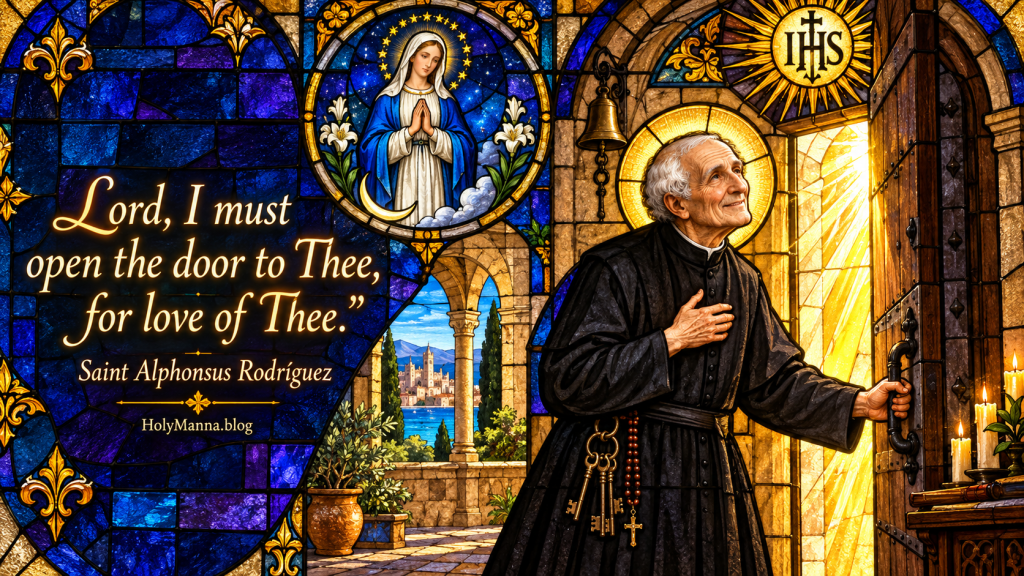
What transformed the job was the interior act he attached to it. Alphonsus trained himself to hear every ring of the bell as the voice of God. His biographer, Father Francis Goldie, records in Life of St. Alphonsus Rodriguez that when he heard the doorbell, he would make acts of joy in his heart as if he were going to open the door to his God, as if God himself had rung the bell, saying as he went, “I am coming, my Lord.” Goldie also preserves his prayer at the door: “Lord, I must open the door to Thee, for love of Thee.” In the spiritual memoirs Alphonsus later wrote under obedience, he described the same grace in his own words, recalling that God was seeking admission and that he replied, “I am coming, Lord.” The practice was not sentimentality. It was the Gospel taken literally. Our Lord says in The Gospel of Matthew, “Amen, I say to you, whatever you did for one of these least brothers of mine, you did for me” (Matthew 25:40), and in The Book of Revelation he says, “Behold, I stand at the door and knock. If anyone hears my voice and opens the door, then I will enter his house and dine with him, and he with me” (Revelation 3:20). Alphonsus simply believed both verses at the same time, every single day, for decades. The psalmist sings, “Better one day in your courts than a thousand elsewhere” (Psalm 84:11), preferring the threshold of God’s house to the tents of the wicked, and Alphonsus made that threshold his monastery.
The influence that flowed from that lodge was astonishing. Students, professors, and townspeople sought him out for counsel, and his reputation for holiness spread across the island. His superiors, recognizing graces at work in him, commanded him to write down his spiritual experiences, and he obeyed, producing memoirs and notes that were never intended for publication and that were later gathered and published in Barcelona in 1885 as Obras Espirituales del B. Alonso Rodríguez. In those pages, and in the testimonies gathered after his death, it is recorded that Alphonsus was favored with mystical graces, ecstasies, and visions of our Lord, our Lady, and the saints. Interior graces of this kind, attested by the saint under obedience and weighed by the Church in his cause, are by their very nature not externally verifiable in the way a date or a document is, and the reader should receive them as the Church does, as the testimony of a proven saint rather than as public record. What is beyond dispute is his tender devotion to the Blessed Virgin Mary, especially under the title of her Immaculate Conception, decades before the dogma was defined, and to the Sacred Heart. He would patiently copy out by hand the complete text of the Little Office of the Blessed Virgin Mary for anyone who asked, so that ordinary laypeople could pray it privately. A later claim that he composed the Little Office of the Immaculate Conception himself was examined and set aside by early Jesuit scholars, one of whom established that the office he used came from an old printed copy from outside Spain and existed before the saint’s time; honesty about a saint requires saying so.
The most famous fruit of his hidden apostolate walked up to him in 1605, when Alphonsus was 72 years old. A 25-year-old Jesuit seminarian named Peter Claver arrived at Montesión and attached himself to the old porter as to a spiritual father. Alphonsus saw what the young man was made for and urged him toward the missions of the New World. Claver followed that advice, sailed for South America, and spent his life at the port of Cartagena serving enslaved Africans as they were carried off the ships, baptizing and catechizing hundreds of thousands and calling himself the slave of the slaves forever. When the Church canonized Peter Claver, she canonized Alphonsus Rodríguez on the very same day, January 15th, 1888, as if to declare that the doorkeeper and the missionary were one work of grace. The man who never left his island evangelized a continent through the vocation he helped to form. The Catechism observes that “Humility is the foundation of prayer” (CCC 2559), and from the humility of that porter’s lodge God built something intercontinental.
The Battles Behind the Smile
Alphonsus was not a martyr, but anyone tempted to think his path was gentle has not read his life. His hardships came in three long waves, and he endured every one of them with a fortitude The Catechism defines as “the moral virtue that ensures firmness in difficulties and constancy in the pursuit of the good” (CCC 1808).
The first wave was grief. Before he ever wore a cassock, Alphonsus buried his father, his wife, his mother, and all three of his children, while watching the family business collapse around him. He knew the particular loneliness of the person whose life has emptied out room by room. The second wave was humiliation. He was a grown man refused twice by the order he loved, sent back to grammar lessons beside children, and finally admitted only to the lowest rung of the house. Even inside the Society, sources note that he was overlooked by some of the Jesuits he lived with, an old brother at the door whom it was easy to walk past. He answered that bell for decades with perfect patience while visitors, as Goldie recounts, sometimes grew angry with him for making them wait a few extra minutes; nothing fazed him, and his calm so disarmed the angry that their mood turned in the opposite direction. Goldie even tells of the day Alphonsus inadvertently locked a workman inside the church, one small mortification among the daily trials of a doorkeeper’s life, and notes that he was tested like this almost constantly.
The third wave was interior, and it was the fiercest. The Catholic Encyclopedia records that the bodily mortifications he imposed on himself were extreme, that he was subject to frequent scruples and mental agitation, that his obedience was absolute, and that his absorption in God was continual even in the most distracting employments. In plain language, this gentle old man fought crushing anxiety of conscience, interior darkness, and spiritual temptations for years on end, and he fought them with prayer, obedience to his directors, and stubborn trust. His serenity at the door was not a sunny temperament. It was a victory, won daily. In his final years his broken health confined him; by 1615 he was bedridden, rising only to attend Holy Mass, the one appointment he would not surrender. He died after a long illness on October 31st, 1617, at about 85 years of age, and the island he had served answered his lifetime of door-opening in kind. Civil and Church leaders of Majorca attended the funeral of the porter, and the crowds came to venerate the man who had always come when they knocked.
The Island That Claimed Its Doorkeeper
The devotion of Majorca did not wait for Rome. In 1633, only 16 years after his death, the Council General of Majorca chose Alphonsus as one of the special patrons of the city and island, an extraordinary civic act of veneration toward a man not yet beatified, and a measure of how completely the island was convinced of his sanctity. His remains were enshrined at Majorca, where they rest in the church of Montesión in Palma, the very college where he served, and the faithful have venerated them there for four centuries. Pilgrims to Palma can still pray at the shrine of the saint beside the doorway he kept.
The formal causes followed the Church’s careful path. Alphonsus was beatified in 1825 by Pope Leo XII; sources differ on the exact day, with some recording May 20th and others June 5th, so the year is stated here with confidence and the day is left to the archives. He was canonized by Pope Leo XIII on January 15th, 1888, together with his spiritual son Saint Peter Claver. As the process of beatification and canonization requires, miracles attributed to his intercession were examined and approved along the way; the commonly available Catholic sources, however, do not preserve detailed narratives of specific posthumous healings, and rather than embroider stories that cannot be sourced, this post states that limitation plainly. What the record does preserve abundantly is the quieter miracle of his expanding legacy. The Catechism teaches of the saints in glory that “They do not cease to intercede with the Father for us” (CCC 956), and generations have confidently asked the heavenly doorkeeper to open doors for them.
That legacy crossed oceans. A town in Québec, Canada, bears the name Saint-Alphonse-Rodriguez, and a parish in Woodstock, Maryland, is dedicated to him, so that the porter of a Spanish island is now a patron of communities in the New World his protégé evangelized. His hidden life even conquered the world of letters. The Jesuit poet Gerard Manley Hopkins, moved by the canonization of 1888, wrote the sonnet In Honour of St. Alphonsus Rodriguez, marveling at “those years and years by of world without event that in Majorca Alfonso watched the door.” Hopkins saw the point exactly. The world records the exploits that gash flesh and galled shield, but God was waging and winning a war inside an uneventful life, and heaven was watching the door with him. In canonizing such a man, the Church did precisely what The Catechism describes: “By canonizing some of the faithful, i.e., by solemnly proclaiming that they practiced heroic virtue and lived in fidelity to God’s grace, the Church recognizes the power of the Spirit of holiness within her and sustains the hope of believers by proposing the saints to them as models and intercessors” (CCC 828). Alphonsus sustains a very particular hope, the hope of everyone whose life looks unremarkable from the outside.
Opening Your Own Door
The genius of Saint Alphonsus Rodríguez is that his sanctity is immediately imitable. Nobody can schedule a martyrdom, and few will found an order, but everyone has a door. For one person it is a literal front desk, a classroom, a hospital station, or a customer service queue. For another it is an inbox, a group chat, a crying toddler at 3 in the morning, or the coworker who interrupts for the fifth time before lunch. Alphonsus teaches one revolutionary habit: receive the interruption as the arrival of Christ. Saint Paul gives the same instruction in The Letter to the Colossians: “Whatever you do, do from the heart, as for the Lord and not for others” (Colossians 3:23). Imagine answering the next phone call, the next knock, the next text, with the porter’s whispered words, “I am coming, my Lord.” Who is the person who rings your bell most often, and what would change if you honestly believed Christ stood behind them?
His life also speaks to the grieving and the disappointed. Alphonsus lost his spouse, his children, his parents, and his career before his real vocation ever began, and he was rejected twice by the community he felt called to join. His 40s, the decade when the world told him his story was over, turned out to be the decade his story actually started. God wastes nothing, not even ruins. What loss or failure in your own life might God be quietly preparing to transform into the doorway of your mission? The practical takeaways from his witness fit into any state of life. A commuter can consecrate the workday each morning by offering every task to God before it begins. A parent can imitate his patience by pausing for one silent breath of prayer before responding to the next demand. A professional can keep a small holy image near the spot where interruptions arrive, as a reminder of who is really arriving. Anyone can adopt his Marian devotion in miniature by praying a daily decade of the Rosary, honoring the Lady whose Immaculate Conception he loved and whose Little Office he copied by hand for strangers. And everyone can imitate his perseverance in prayer through dryness and anxiety, trusting, as he did, that fidelity in darkness is worth more than feelings in the light. If your hidden faithfulness were the only sermon you ever preached, what would it be saying this week?
Engage With Us!
Readers are warmly invited to share their thoughts and reflections in the comments below. The doorkeeper of Majorca has a way of showing up in very ordinary lives, and hearing how his story lands in yours encourages the whole HolyManna community. Consider these questions as a starting point for prayer and discussion.
- Where is the “porter’s lodge” in your life, the humble post where God has stationed you, and how might you serve there with new intention this week?
- Alphonsus endured staggering grief without turning bitter. What loss are you carrying right now, and have you invited Christ to stand inside it with you?
- He was rejected twice before his vocation opened. Is there a closed door in your life that you have interpreted as God’s absence rather than God’s timing?
- When the bell rang, he said, “I am coming, my Lord.” What daily interruption could you begin receiving as the knock of Christ?
- Alphonsus quietly formed Saint Peter Claver, who changed a continent. Who is the younger or struggling soul in your orbit whom your encouragement might send on mission?
Go live this day like the saint of the door. Answer the small summonses of love promptly, bear the hidden battles patiently, and trust that a life the world calls uneventful can be, in God’s eyes, heroic. Do everything, from the grandest sacrifice to the simple turning of a doorknob, with the love and mercy that Jesus taught us, and when heaven finally knocks for you, may you rise with joy and say, “I am coming, my Lord.”
Saint Alphonsus Rodríguez, pray for us!
Follow us on YouTube, TikTok, Instagram and Facebook for more insights and reflections on living a faith-filled life.


Leave a Reply