Saturday of the Thirtieth Week in Ordinary Time – Lectionary: 484
The Thirst That Finds the Lowest Seat
There is a question hiding inside this Saturday’s readings, and it is an uncomfortable one: what does the heart actually want? On October 31st, the Saturday of the Thirtieth Week in Ordinary Time and the eve of All Saints, the Church places three very different scenes side by side. A prisoner in chains writes a letter and cannot decide whether he would rather live or die, because both options give him Christ. An exiled Levite, far from the Temple, compares his soul to a deer searching a dry streambed for water. And Jesus, watching dinner guests elbow their way toward the best couches at a Pharisee’s banquet, quietly recommends the worst seat in the house.
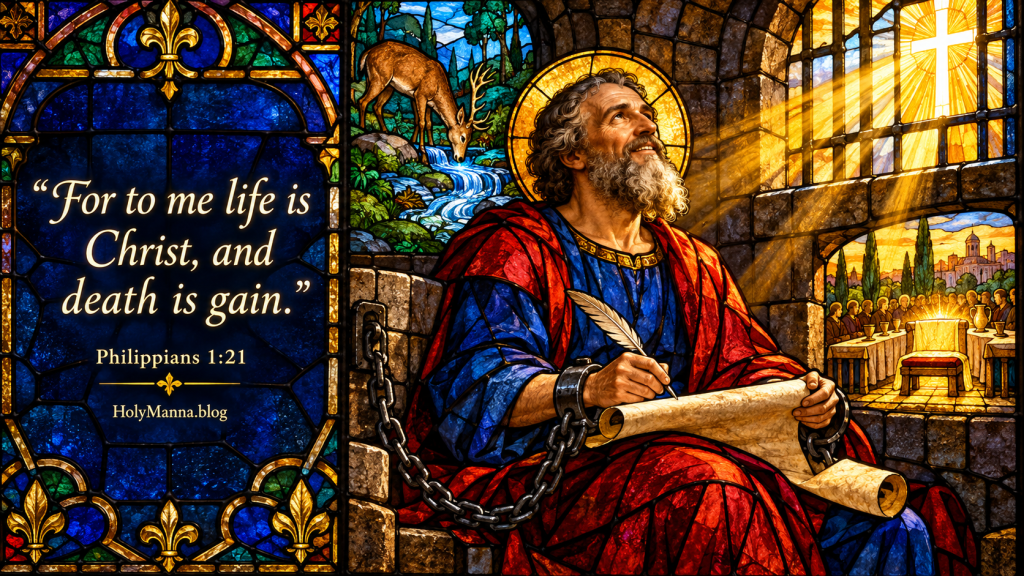
One thread ties them together: holy longing and the lowest place. The soul that truly thirsts for God stops grasping at everything else, and the soul that stops grasping is the one God Himself lifts up. Saint Paul wrote from Roman custody to Philippi, a proud Roman colony where status was everything, yet he measured his life by a Person rather than a position: “For to me life is Christ, and death is gain” (Philippians 1:21). The sons of Korah, temple singers in exile, turned homesickness for the liturgy into one of the most beautiful prayers ever written. And at a table where every seat announced a reputation, Jesus revealed the seating chart of the Kingdom of God.
Tomorrow the Church celebrates every man and woman who ever got this right. The saints are simply the people who wanted God more than the good seat. Today’s readings explain how they did it.
First Reading — Philippians 1:18b-26
A Prisoner Who Cannot Lose
Picture a man in chains, awaiting a verdict that could end his life, writing the most joyful letter of his career. That is the setting of The Letter to the Philippians. Saint Paul writes from custody, traditionally the Roman imprisonment of around AD 61 to 63, since he mentions the praetorium guard (Philippians 1:13), though some scholars propose an earlier confinement at Ephesus or Caesarea. His readers lived in Philippi, a proud Roman colony in Macedonia and the first Church founded on European soil, where Lydia and the town jailer came to faith (Acts 16). In a city obsessed with Roman citizenship and rank, Paul models the day’s central theme perfectly: a heart so filled with longing for Christ that even the choice between life and death becomes a choice between two good things.
Philippians 1:18b-26
Brothers and sisters:
As long as in every way, whether in pretense or in truth,
Christ is being proclaimed, and in that I rejoice.Indeed I shall continue to rejoice,
for I know that this will result in deliverance for me
through your prayers and support from the Spirit of Jesus Christ.
My eager expectation and hope
is that I shall not be put to shame in any way,
but that with all boldness, now as always,
Christ will be magnified in my body,
whether by life or by death.
For to me life is Christ, and death is gain.
If I go on living in the flesh, that means fruitful labor for me.
And I do not know which I shall choose.
I am caught between the two.
I long to depart this life and be with Christ,
for that is far better.
Yet that I remain in the flesh is more necessary for your benefit.
And this I know with confidence,
that I shall remain and continue in the service of all of you
for your progress and joy in the faith,
so that your boasting in Christ Jesus may abound on account of me
when I come to you again.
Detailed Exegesis
Verse 18b: “As long as in every way, whether in pretense or in truth, Christ is being proclaimed, and in that I rejoice. Indeed I shall continue to rejoice.”
Some preachers in Rome were proclaiming Christ out of envy and rivalry, hoping to add to Paul’s distress (Philippians 1:15-17). His response is astonishing. He does not defend his reputation or demand credit. As long as the name of Jesus goes forward, the apostle rejoices, because his ego left the throne of his heart long ago.
Verse 19: “for I know that this will result in deliverance for me through your prayers and support from the Spirit of Jesus Christ.”
The word translated “deliverance” is the Greek sōtēria, which also means salvation, and Paul leaves it deliberately open. Whether the verdict brings acquittal or execution, he will be delivered. Notice also the means of that deliverance: the intercessory prayers of ordinary believers and the help of the Holy Spirit, working together.
Verse 20: “My eager expectation and hope is that I shall not be put to shame in any way, but that with all boldness, now as always, Christ will be magnified in my body, whether by life or by death.”
Paul treats his own body as an instrument for glorifying God, echoing his teaching that believers should glorify God in their bodies (1 Corinthians 6:20). Ministry magnifies Christ, and so does martyrdom. The outcome of the trial changes the method but never the mission.
Verse 21: “For to me life is Christ, and death is gain.”
Here is the hinge of the whole passage, and one of the most quoted sentences Paul ever wrote. He does not say life is ministry, success, or even survival. Life is a Person. And only the one who can honestly finish that sentence with Christ can call death a gain, because death then means more of the very thing life was already about.
Verse 22: “If I go on living in the flesh, that means fruitful labor for me. And I do not know which I shall choose.”
Remaining alive means more souls won, more churches strengthened, more letters written. The remarkable thing is Paul’s freedom. Most people cling to life with white knuckles, yet he weighs living and dying like a man comparing two gifts.
Verse 23: “I am caught between the two. I long to depart this life and be with Christ, for that is far better.”
The Greek word for “depart,” analysai, described soldiers breaking camp or a ship loosing its moorings. For Paul, death is not annihilation but a setting sail, and the destination is not a place first of all but a Person. Being with Christ immediately after death is, in his words, far better.
Verse 24: “Yet that I remain in the flesh is more necessary for your benefit.”
Love settles the dilemma. Paul measures the question not by his own preference, which is heaven, but by the need of his spiritual children. This is longing purified by humility, desire that serves rather than grasps.
Verse 25: “And this I know with confidence, that I shall remain and continue in the service of all of you for your progress and joy in the faith.”
Paul expects release, and tradition holds that he was in fact freed before his final imprisonment and martyrdom under Nero around AD 67. Notice what he wants for the Philippians: progress and joy together. Growth in faith was never meant to be grim.
Verse 26: “so that your boasting in Christ Jesus may abound on account of me when I come to you again.”
The passage ends where it began, with all boasting redirected to Christ. Paul’s survival, his ministry, and his eventual reunion with this beloved community exist for one purpose, so that Jesus receives the glory.
Teachings
The Church has placed this passage at the heart of her teaching on death. The Catechism declares: “Because of Christ, Christian death has a positive meaning: ‘For to me to live is Christ, and to die is gain.’” (CCC 1010). It continues: “In death, God calls man to himself. Therefore the Christian can experience a desire for death like St. Paul’s: ‘My desire is to depart and be with Christ.’” (CCC 1011). In that same paragraph the Catechism gathers the saints who inherited Paul’s longing. Saint Ignatius of Antioch, dragged to Rome for martyrdom around AD 107, wrote: “there is living water in me, water that murmurs and says within me: ‘Come to the Father.’” Saint Teresa of Ávila prayed: “I want to see God and, in order to see him, I must die.” And Saint Thérèse of Lisieux, on her deathbed, said: “I am not dying; I am entering life.” Saint John Chrysostom, preaching on this very passage in his Homilies on Philippians, marveled that for Paul, with Christ beside him, “even though death overtake me, still I live.” Chrysostom also noted that although Paul could have departed to the Christ he loved, he “still remained in the contest on behalf of man.” Heaven pulled him upward, and charity held him here.
Reflection
Try a simple and honest exercise today. Take Paul’s sentence and leave it unfinished: for to me, life is what, exactly? Whatever fills that blank truthfully, whether career, comfort, approval, or Christ, is the real master of the heart. If the answer needs work, start small. Offer the first minutes of each morning to Jesus before touching a phone. Memorize Philippians 1:21 and repeat it during the commute. Spend ten minutes before the Blessed Sacrament this week and simply tell the Lord about every fear of death and loss. Pray by name for someone who is dying, asking that they meet death with Paul’s confidence. If life were honestly reduced to one sentence, what would fill the blank in “For to me, life is…”? Does the thought of heaven stir genuine longing, mild interest, or quiet fear, and what does that answer reveal about the state of the soul right now?
Responsorial Psalm — Psalm 42:2-3, 5cdef
The Deer, the Exile, and the Memory of Joy
Psalm 42 opens the second book of the Psalter and carries the superscription of the sons of Korah, a family of Levitical singers who served in the Temple liturgy. The voice behind the psalm belongs to a man cut off from that liturgy. Later verses place him far to the north, near Mount Hermon and the headwaters of the Jordan (Psalm 42:7), exiled from Jerusalem while hostile voices taunt him with the question of where his God has gone. In a land where streambeds run dry for months at a time, he reaches for the most desperate image his landscape offers: a deer searching for water that is not there. The psalm gives a melody to the day’s central theme, because it names the thirst that drove Paul’s longing and that makes the Gospel’s humility possible. Only a soul that knows what it truly wants can stop chasing lesser seats.
Psalm 42:2-3, 5cdef
R. My soul is thirsting for the living God.
As the hind longs for the running waters,
so my soul longs for you, O God.
R. My soul is thirsting for the living God.
Athirst is my soul for God, the living God.
When shall I go and behold the face of God?
R. My soul is thirsting for the living God.
I went with the throng
and led them in procession to the house of God.
Amid loud cries of joy and thanksgiving,
with the multitude keeping festival.
R. My soul is thirsting for the living God.
Detailed Exegesis
Verse 2: “As the hind longs for the running waters, so my soul longs for you, O God.”
A hind is a female deer, and in drought her entire body becomes a single act of searching. The psalmist chooses “running waters,” flowing and alive, over the stagnant water of a cistern, because God is not a resource to be stored but a living spring to be sought. The verse quietly insists that the soul’s need for God is not a hobby or a weekend interest. It is survival.
Verse 3: “Athirst is my soul for God, the living God. When shall I go and behold the face of God?”
Twice the psalmist calls the Lord “the living God,” a deliberate contrast with the lifeless idols of the surrounding nations. To “behold the face of God” was pilgrimage language for appearing before the Lord in the Temple, yet the Church hears in it something greater, the hope of seeing God as He is. The Catechism teaches that this contemplation of God in His heavenly glory is called “the beatific vision” (CCC 1028). Every restless human desire is, at bottom, this question asked badly.
Verse 5cdef: “I went with the throng and led them in procession to the house of God. Amid loud cries of joy and thanksgiving, with the multitude keeping festival.”
Memory becomes fuel. The exile recalls the days when he led pilgrim crowds up to the house of God amid shouts of joy, and he uses that memory not to wallow but to hope. Notice that his happiest memory is communal worship, the ancient ancestor of the Mass. When God feels distant, the psalmist does not invent a private spirituality. He remembers the liturgy and aches to return to it.
Teachings
No one has preached this psalm like Saint Augustine. In his Exposition on Psalm 42, he urges the soul to imitate the deer: “Run to the fountain; long for the fountain.” And he names the destination: “With God is the fountain of Life; a fountain that shall never be dried up.” Augustine also records a beautiful piece of history, noting that this psalm was customarily sung for catechumens as they approached baptism, longing for the fountain of the remission of sins. The Church has never forgotten that instinct, and the psalm still appears among the chants of the Easter Vigil as the elect draw near the font. The Catechism grounds the whole experience in human nature itself: “The desire for God is written in the human heart, because man is created by God and for God; and God never ceases to draw man to himself.” (CCC 27). It then reveals the astonishing other half of the story: “prayer is the encounter of God’s thirst with ours. God thirsts that we may thirst for him.” (CCC 2560). The thirst of Psalm 42 is answered thirst. And Augustine, quoted in CCC 30, gave the experience its most famous sentence, confessing to God: “you have made us for yourself, and our heart is restless until it rests in you.”
Reflection
Everyone passes through dry seasons when prayer feels like walking a cracked streambed. The psalmist offers a path through them. First, keep showing up, because the deer does not stop searching when the first streambed is empty. Second, remember on purpose. Write down three moments when God felt unmistakably close, and revisit that list whenever the taunting voice asks where He has gone. Third, bring the thirst to its true fountain by returning to Sunday Mass with fresh intention, or by adding one daily Mass this week, since the Eucharist is the running water this psalm was always pointing toward. Finally, be honest about substitutes. Endless scrolling, overwork, and comfort purchases are all attempts to pour something into a thirst shaped like God. What gets poured into the soul’s thirst before God does, and what would it cost to stop? When prayer runs dry, is the instinct to run harder toward the fountain or to quietly abandon the search?
Holy Gospel — Luke 14:1, 7-11
Where You Sit Reveals What You Seek
Meals matter enormously in The Gospel of Luke, and this one crackles with tension from the first line. Jesus accepts a Sabbath dinner invitation from a leading Pharisee, in a world governed by honor and shame, where a banquet was a public scoreboard. Guests reclined on couches arranged by rank, and the seat nearest the host announced a man’s standing to the entire room. Everyone present understood the rules, which is exactly why everyone scrambled for the best positions. Into that scramble Jesus speaks counsel that echoes the wisdom of Israel, where Proverbs 25:6-7 warns against claiming honor in the king’s presence and Sirach 3:18 teaches that the great should humble themselves all the more. Yet Luke calls this teaching a parable, which signals that far more than table manners is at stake. The banquet is the Kingdom, the host is God, and the question of where a soul sits is the question of what that soul is truly thirsting for.
Luke 14:1, 7-11
On a sabbath Jesus went to dine
at the home of one of the leading Pharisees,
and the people there were observing him carefully.He told a parable to those who had been invited,
noticing how they were choosing the places of honor at the table.
“When you are invited by someone to a wedding banquet,
do not recline at table in the place of honor.
A more distinguished guest than you may have been invited by him,
and the host who invited both of you may approach you and say,
‘Give your place to this man,’
and then you would proceed with embarrassment
to take the lowest place.
Rather, when you are invited,
go and take the lowest place
so that when the host comes to you he may say,
‘My friend, move up to a higher position.’
Then you will enjoy the esteem of your companions at the table.
For everyone who exalts himself will be humbled,
but the one who humbles himself will be exalted.”
Detailed Exegesis
Verse 1: “On a sabbath Jesus went to dine at the home of one of the leading Pharisees, and the people there were observing him carefully.”
The watching is not friendly. Luke has already shown the Pharisees plotting against Jesus, and this dinner doubles as surveillance. Jesus knows it and comes anyway, because He never writes anyone off, and because He is observing them right back. The table becomes His classroom.
Verse 7: “He told a parable to those who had been invited, noticing how they were choosing the places of honor at the table.”
Jesus notices the quiet jostling, the calculated drift toward the good couches. The behavior has not aged a day. The modern versions are the curated profile, the title in the email signature, the mental ranking of who matters in the room. Luke’s word “parable” warns that Jesus is about to describe the Kingdom of God, not recommend etiquette.
Verse 8: “When you are invited by someone to a wedding banquet, do not recline at table in the place of honor. A more distinguished guest than you may have been invited by him.”
Jesus sets the scene at a wedding banquet, the Bible’s favorite image for the feast of the Kingdom, from the rich banquet promised in Isaiah 25:6 to the wedding feast of the Lamb in Revelation 19:9. Self-exaltation is exposed as a gamble, a bet placed on a ranking the guest does not control. Someone more distinguished always exists.
Verse 9: “and the host who invited both of you may approach you and say, ‘Give your place to this man,’ and then you would proceed with embarrassment to take the lowest place.”
In an honor culture, a public demotion in front of the whole room was a social catastrophe, and by then the lowest seat is the only one left. The detail is almost comic, and deliberately so. Pride always overplays its hand, and the shame it fears is the shame it manufactures.
Verse 10: “Rather, when you are invited, go and take the lowest place so that when the host comes to you he may say, ‘My friend, move up to a higher position.’ Then you will enjoy the esteem of your companions at the table.”
Listen to the tenderness in the address, “My friend.” The one who takes the lowest place loses nothing real and gains the voice of the host calling him upward. Honor received as a gift is joy, while honor seized is a trap waiting to spring. Behind the host’s face stands God Himself, who delights in raising the lowly.
Verse 11: “For everyone who exalts himself will be humbled, but the one who humbles himself will be exalted.”
The verbs are what scholars call divine passives. God is the One who humbles, and God is the One who exalts. Mary sang this law of the Kingdom before her Son preached it: “He has thrown down the rulers from their thrones but lifted up the lowly” (Luke 1:52). And Jesus did not merely teach it. He lived it to the end, for “he humbled himself, becoming obedient to death, even death on a cross,” and therefore “God greatly exalted him” (Philippians 2:8-9), the very letter from today’s First Reading.
Teachings
Western monasticism built its entire school of holiness on this single verse. Saint Benedict opens chapter 7 of his Rule, the longest chapter he wrote, by quoting Luke 14:11, then describes the spiritual life as a ladder of twelve steps of humility, like the ladder Jacob saw in his dream. Benedict teaches that the ladder is this earthly life itself, and that “if we humble our hearts the Lord will raise it to heaven.” Saint Augustine said the same thing to an ambitious young scholar named Dioscorus around AD 410. Asked about the way to truth, the great Doctor answered that “the first part is humility; the second, humility; the third, humility” (Letter 118), adding that without humility, pride snatches every good work right out of the hand. The Catechism carries the teaching into the heart of prayer: “He who humbles himself will be exalted; humility is the foundation of prayer.” And it concludes with Augustine’s unforgettable summary: “Man is a beggar before God.” (CCC 2559). Humility, in Catholic teaching, is never self-hatred. It is simply the truth about who God is and who the creature is, and the truth sets the soul free to be lifted.
Reflection
Humility grows by practice, not by accident. Try taking the literal lowest place this week: the back pew, the end of the line, the chore nobody wants, the conversation where someone else gets the credit. Do one hidden act of service that no one will ever discover, and let God be the only witness. Before posting anything online, pause and ask what the post is really seeking. Consider praying the Litany of Humility, composed by Cardinal Rafael Merry del Val, which asks for deliverance from the desire to be esteemed and the fear of being forgotten. These small descents matter because every one of them tells God that His opinion is the only scoreboard that counts. Which seats get chased in daily life, at work, online, or even at church, and what would change if the host’s voice were the only approval that mattered? What is one concrete lowest place to choose this week, and what makes it so hard to take?
The Host Keeps the Best Seat for the Humble
Three scenes, one secret. A prisoner in chains discovered that when Christ is everything, nothing can be taken away, and so he could write with a free heart, “For to me life is Christ, and death is gain” (Philippians 1:21). An exiled singer, miles from the Temple and surrounded by mockers, discovered that the thirst itself was a kind of prayer, a homing signal planted in the soul by the God it was seeking. And dinner guests at a Pharisee’s table heard the Teacher reveal that the way up in the Kingdom runs through the lowest seat, because the Host Himself does the seating.
The saints the Church celebrates tomorrow are the living proof. Not one of them clawed a way into glory. Every single one thirsted like the deer, surrendered like Paul, and descended like the honored guest who chose the far end of the table, and God spoke over each of them the words every soul aches to hear: my friend, move up higher. Their feast is not a museum exhibit. It is an invitation with a name on it.
So here is the challenge for this last day of October. Bring the thirst to the fountain by getting to Mass, and bring the pride to the Cross by getting to Confession. Choose one lowest seat on purpose this week, quietly, without an audience, and let God be the only one who sees. The world will keep scrambling for the good couches. Let the children of God practice a different posture, kneeling, which turns out to be the position from which the Father most loves to raise His own.
Engage With Us!
These readings have a way of finding the tender spots: the thing life is really built on, the thirst underneath the busyness, the seats quietly being chased. Share a reflection in the comments below, because someone else walking this same road needs to read it, and this little corner of the internet grows holier every time a reader speaks up. Here are some questions to pray with before commenting:
- In Philippians 1:18b-26, Saint Paul declares that “For to me life is Christ, and death is gain.” What honestly fills that sentence today, and what is one concrete step toward letting Christ fill it completely?
- In Psalm 42:2-3, 5, the psalmist thirsts for the living God like a deer searching for running waters. When did a dry season of prayer actually deepen faith, and what kept the search alive?
- In Luke 14:1, 7-11, Jesus counsels taking the lowest place at the banquet. Where is one real opportunity this week to choose the lowest seat, and what makes that choice difficult?
- Taken together, these readings teach that the soul thirsting for God alone is the soul God Himself exalts. Where do holy longing and humility most need to meet in life right now?
However the answers turn out, take heart. The God who watched Paul in his chains, heard the psalmist in his exile, and noticed every guest at that Sabbath table is watching, hearing, and noticing still. Keep thirsting, keep descending, and keep doing everything with the love and mercy Jesus taught, trusting that the Host already knows exactly which seat He is saving. He calls it higher. He calls the one who takes it friend.
Sacred Heart of Jesus, we trust in You!
Immaculate Heart of Mary, pray for us!
Saint Michael the Archangel, defend us in battle!
Follow us on YouTube, TikTok, Instagram and Facebook for more insights and reflections on living a faith-filled life.


Leave a Reply