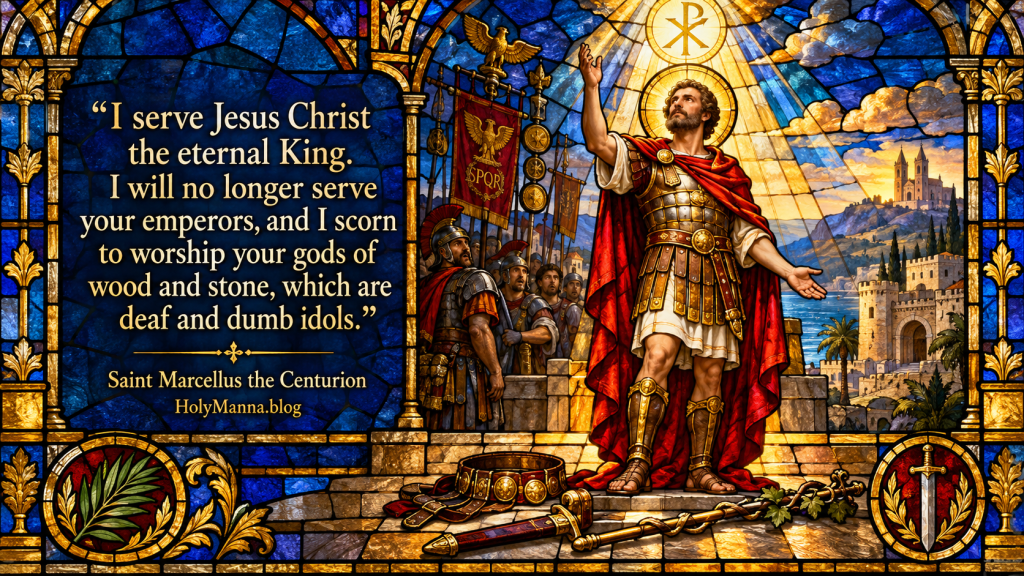
A Soldier of a Greater King
Every army in history has understood the power of a symbol. For a Roman soldier at the end of the 3rd century, no symbol mattered more than the cingulum, the military belt that marked a man as a soldier of the empire. To wear it was to belong to Rome. To take it off in public was to renounce everything: rank, pay, pension, honor, and very possibly life itself. On July 21st, in the year 298, in the middle of a raucous imperial festival filled with pagan sacrifices, a centurion named Marcellus stepped out in front of the standards of his legion, unbuckled that belt, and threw it on the ground. He threw down his weapons. He threw down the vine staff that marked his rank as a centurion. And according to the ancient record of his trial, he declared for all to hear, “I serve Jesus Christ the eternal King. I will no longer serve your emperors, and I scorn to worship your gods of wood and stone, which are deaf and dumb idols.”
A little more than 3 months later, on October 30th, 298, Marcellus was beheaded at Tingis, the city known today as Tangier in Morocco. The Church has honored him ever since as Saint Marcellus the Centurion, martyr, with his feast kept on October 30th, the very anniversary of his death. What makes Marcellus extraordinary among the early martyrs is not a dramatic later biography but something far rarer: the official transcript of his Roman military trial survives. The document is known as the Acta Marcelli, and scholars, including the great Bollandist tradition of critical hagiography and the collection of authentic acts published by Ruinart, regard it as one of the most reliable accounts of any martyrdom in the ancient Church. When the Church tells the story of Marcellus, she is not repeating pious rumor. She is reading a court record.
Marcellus is the patron saint of the city of León in Spain, where his relics rest to this day in the high altar of the church that bears his name, and where the city government and the cathedral chapter still honor him with an annual procession. He is also honored as a patron of León’s local police, and in modern times many Catholic sources have come to regard him as a patron of conscientious objectors, those who refuse to act against the moral law no matter the cost. The Catechism teaches that “martyrdom is the supreme witness given to the truth of the faith: it means bearing witness even unto death” (CCC 2473). Saint Marcellus gave that witness with a soldier’s bluntness, and his words still ring across 17 centuries.
A Life Hidden Until One Loud Moment
Here is the honest truth about the early life of Saint Marcellus: history records almost nothing. The Acta Marcelli opens not with his birth but with his defiance. His childhood, his formation, his path into the Roman army, and the moment of his conversion to Christ are all hidden from the documented record. In that sense, Marcellus resembles the centurions of the Gospels, men like the officer at Capernaum whose faith amazed Our Lord in The Gospel of Matthew, who step into the story fully formed, speak a few unforgettable words, and change everything.
What the documents do establish is his rank and his situation. Marcellus was a centurion, a commander of roughly 80 to 100 men, a position earned through years of proven service, discipline, and courage. The centurion carried a vine staff, the vitis, as the badge of his authority; Roman officers were forbidden to strike a soldier with any instrument except that staff, which is why it became the universal emblem of the rank. A man did not become a centurion by accident. Marcellus had given the empire his best years, and the empire had rewarded him with honor and command. He was, by every worldly measure, a success.
Later Spanish tradition fills in the silence of the documents with a beautiful family portrait. According to the tradition cherished in León, and accepted into later breviaries and the older Roman Martyrology, Marcellus was a native of the region of León, a centurion of the Legio VII Gemina, the famous Seventh Legion whose permanent camp gave the city of León its very name. One account places his birth at Arzas in Galicia. The tradition holds that he married a holy woman named Nonna, venerated in León as Santa Nonia, that God blessed them with 12 sons, and that a holy bishop of León preached the Gospel that converted Marcellus and his entire household. Most remarkably of all, the tradition holds that all 12 of his sons followed their father into martyrdom, among them Claudius, Lupercus, and Victorius, who were put to death at León under the governor Diogenianus around the year 303, as well as Facundus and Primitivus, Servandus and Germanus, Faustus, Januarius, and Martial, martyrs honored across Spain. The older Roman Martyrology itself commemorates the first three on October 30th as “the holy martyrs Claudius, Lupercus, and Victorius, sons of the centurion St. Marcellus, who were condemned to decapitation, in the persecution of Diocletian and Maximian, under the governor Diogenian.” It must be said plainly that this family tradition, however beloved, cannot be verified; hagiographical scholars note that the relationship between Marcellus and these Spanish martyrs is probably a later devotional connection rather than established history. The martyrs themselves are real and venerated; their kinship to Marcellus is tradition, and it is told here as tradition.
What is beyond dispute is what Marcellus was most known for, both in his own day and in the present one: in a single public act, he declared that no oath, no rank, and no emperor could stand above Jesus Christ. Sacred Scripture gives the principle in Acts 5:29, where Saint Peter and the Apostles tell the Sanhedrin, “We must obey God rather than men.” Marcellus lived that verse with his whole body, in front of witnesses, with no path of retreat.
The Belt, the Staff, and the Standards of Rome
To understand what happened on July 21st, 298, it helps to picture the scene. The occasion was a great festival in honor of the Emperor Maximian, co-ruler of the Roman world alongside Diocletian. Butler’s account in Butler’s Lives of the Saints describes it as the celebration of the emperor’s birthday, while the trial record speaks of the anniversary festival of the emperor; sources differ on the precise occasion, and that difference is noted here honestly. What no source disputes is the religious character of the day. The festival was saturated with sacrifices to the Roman gods, and the army was expected to participate as one body. Feasting, incense, and the worship of idols were woven together with loyalty to the emperor, so that a soldier could not join the party without joining the cult.
For a Christian, that was precisely the problem. The Catechism teaches that “idolatry consists in divinizing what is not God. Man commits idolatry whenever he honors and reveres a creature in place of God, whether this be gods or demons (for example, satanism), power, pleasure, race, ancestors, the state, money, etc.” (CCC 2113). The imperial cult asked Marcellus to revere the state and its gods in place of the living God. Our Lord had already settled the question in The Gospel of Matthew: “No one can serve two masters” (Mt 6:24). Marcellus chose his Master in the most public way imaginable, at the head of his own company, before the sacred standards of the legion, where every eye could see him and every ear could hear him.
He cast away the belt. He cast away his arms. He cast away the vine staff of his centurion’s rank. Butler records that he declared aloud that he was a soldier of Jesus Christ, the eternal King. His fellow soldiers were stunned; some accounts say they thought he had lost his mind. They reported him at once to Anastasius Fortunatus, the prefect of the legion, who had Marcellus thrown into prison until the festival ended. When Fortunatus summoned him and demanded an explanation, Marcellus did not soften a syllable. As Butler relates from the acts, Marcellus answered, “I said aloud that I was a Christian, and could serve no other than Jesus Christ, the Son of God.” Fortunatus replied that such boldness was beyond his power to overlook and that the case would have to go up the chain of command.
It is worth pausing on a question readers often ask about saints like Marcellus: where are the miracles? The honest answer, and the one the sources require, is that the Acta Marcelli record no miracles worked by Marcellus during his life. No healings, no visions, no wonders are attached to his name in the authentic documents. And yet the Church holds him up as a giant, because the greatest work of God in his life was the grace that made a career soldier capable of such fearlessness. The Catechism teaches that “the virtue of fortitude enables one to conquer fear, even fear of death, and to face trials and persecutions” (CCC 1808). That supernatural fortitude, poured into a human heart, is itself a divine intervention. Marcellus matters, and deserves to be remembered and emulated, precisely because his sanctity did not depend on spectacle. It depended on a decision, made once and held unto death, that Jesus Christ is King and everything else is negotiable.
A Transcript That Still Preaches
Fortunatus did not dare judge the case himself. Marcellus was sent under strong guard across to Tingis, the modern Tangier on the coast of Morocco, to stand before Aurelius Agricolanus, deputy of the praetorian prefects, one of the most powerful judicial officials in that part of the empire. Here the sources diverge on one point, and the divergence should be flagged rather than smoothed over. Butler and the Leonese tradition hold that Marcellus’s legion was posted in Spain, so that the famous act of defiance happened at León and Marcellus was then transported across the strait to Africa for judgment. Other manuscripts of the Acta, and much modern scholarship, place the entire sequence of events at Tingis itself. Both versions agree completely on what matters most: the final trial and the martyrdom took place at Tingis on October 30th, 298.
The hearing before Agricolanus was brief, and because the transcript survives, his very words and the saint’s can be read today. The court first heard the letter of referral, and Marcellus confirmed his earlier declaration in words the record preserves: “I have already told you on 21 July, loudly and in public, before the standards of this legion, when you were celebrating the anniversary of your emperor, that I am a Christian and cannot observe this oath unless to Jesus Christ the Son of the Living God.” Agricolanus pressed him: “What madness possessed you to cast aside your oath and say such things?” And Marcellus gave an answer that belongs among the great one-line confessions of the martyrs: “No madness possesses him who fears God.”
The judge asked whether he had truly hurled down his weapons, and Marcellus answered, “I did. It is not proper for a Christian man, one who fears the Lord Christ, to engage in earthly military service.” For Marcellus, in that moment and in that army, soldiering had become inseparable from idolatry, and his conscience would not permit it. The Church, for her part, has always honored both her faithful soldiers and her martyrs of conscience; what she teaches without compromise is the principle Marcellus died for, that “the citizen is obliged in conscience not to follow the directives of civil authorities when they are contrary to the demands of the moral order, to the fundamental rights of persons or the teachings of the Gospel” (CCC 2242).
Agricolanus pronounced sentence: because Marcellus had publicly rejected his military oath and defiled the office of centurion, he was to be executed by the sword. Then came a moment of almost unbearable tenderness. As the guards led him away to die, Marcellus turned to the man who had just condemned him and spoke his final recorded words: “May God be good to you, Agricolanus.” No curse, no protest, no bitterness. A blessing for his executioner, in perfect imitation of Our Lord, who prayed for those who crucified Him. The sword fell on October 30th, 298, and Marcellus went to the King he had chosen over Caesar.
His death immediately bore fruit in another soul. Cassian, the notary of the court whose job was to record the proceedings, was so struck by the injustice of the sentence that he refused to write it down. He threw his pen to the ground in protest. Cassian was arrested on the spot and, about a month later, on December 3rd, he too was beheaded for Christ. The Church venerates him as Saint Cassian of Tangier, and his short acts were preserved and published alongside those of Marcellus. One martyr’s courage kindled another’s; grace is contagious. The Catechism teaches that the martyr “bears witness to Christ who died and rose, to whom he is united by charity” (CCC 2473), and Cassian is living proof of how powerfully that witness works on those who see it up close.
From Tangier to León
Because the documented record of Marcellus ends at the executioner’s sword, his story after death is a story of veneration rather than of recorded wonders, and honesty requires saying so plainly: no formally documented miracles are attributed to Saint Marcellus after his death in the standard Catholic sources. There are no catalogued healings at his tomb, no approved apparitions, no wonder stories attached to his relics. What there is instead is something quietly miraculous in its own way: 17 centuries of unbroken love from the faithful, and a devotion so strong that it moved kings.
The traditional Roman Martyrology enshrined his memory for the universal Church with the entry for October 30th: “At Tangier, in Morocco, St. Marcellus, a centurion, who endured martyrdom by being beheaded under the vice-prefect Agricolaus.” The 2004 Martyrologium Romanum keeps him in that same place of honor on October 30th. His body was buried at Tangier, where it remained for nearly 12 centuries while the city around it passed from Rome to the Vandals to Islam.
Then, in 1493, the year after Granada fell and Columbus sailed, King Ferdinand the Catholic arranged for the relics of Marcellus to come home to Spain, to the city that had claimed him as her own son. The translation was carried out at the initiative of the king together with the cathedral chapter and the city council of León, through the abbot Gómez Díaz de Isla. Leonese records state that the relics arrived in León on March 29th, 1493, which fell on Holy Saturday, though the account preserved at the Monastery of San Claudio describes the great reception, with trumpets, shawms, and drums accompanying the relics in procession, as concluding on Easter Monday; the small discrepancy in dates between arrival and solemn procession is noted here rather than hidden. The relics were laid to rest in the high altar of the Church of San Marcelo in the heart of León, a church whose origins reach back to the 9th or 10th century and which tradition associates with the saint himself. There they remain today.
León took Marcellus utterly to heart. He is the patron saint of the city, honored with a pontifical rescript establishing his festivity, and each year the city government and the cathedral chapter still go together in procession to venerate his relics at San Marcelo. The city keeps his civic festivity on October 29th, one day before the universal commemoration, a quirk of local custom that the Leonese themselves acknowledge. The great square beside his church, the Plaza de San Marcelo, bears his name at the very center of civic life. In 1466, King Enrique IV granted León the right to hold a fair tied to his feast, decreeing that it should run from 15 days before All Saints to 15 days after; the Fair of San Marcelo grew into the most important fair in the city by the middle of the 1700s. The church of San Marcelo also preserves images of the saint together with Santa Nonia and their 12 sons, keeping the beloved family tradition alive in art; as stated above, that tradition of kinship cannot be verified and is honored as tradition. Devotion to Marcellus even crossed the Atlantic: a relic of Saint Marcellus is embedded in the main altar of the Basilica of the Sacred Heart at the University of Notre Dame in Indiana, so that the sacrifice of the Mass is offered daily over the bones of a soldier who died rather than offer sacrifice to idols.
This is what The Catechism means when it teaches about the communion of saints, that “it is not merely by the title of example that we cherish the memory of those in heaven; we seek, rather, that by this devotion to the exercise of fraternal charity the union of the whole Church in the Spirit may be strengthened” (CCC 957). León does not merely remember Marcellus. León belongs to him, and he to León, in a friendship that death has never interrupted.
What Would You Throw Down for Christ?
It would be easy to file Saint Marcellus away as a hero from a distant, brutal age, admirable but irrelevant. That would be a mistake, because the question he answered is the same question every baptized person faces, usually in far smaller and quieter forms. Marcellus had spent a lifetime building his career, his reputation, and his security, and all of it was held together by one belt. The moment that belt required him to betray Christ, he dropped it in the dirt. Saint Paul wrote in 2 Timothy 2:3, “Share in suffering as a good soldier of Christ Jesus,” and Marcellus shows what that verse looks like when it walks around in boots.
Most people will never stand before a Roman tribunal, but nearly everyone eventually stands in a conference room, a group chat, a family dinner, or a classroom where fidelity to Christ carries a price. The pressure rarely announces itself as idolatry; it comes dressed as fitting in, staying quiet, laughing along, fudging the numbers, or keeping the peace. The Catechism teaches that “man has the right to act in conscience and in freedom so as personally to make moral decisions. He must not be forced to act contrary to his conscience. Nor must he be prevented from acting according to his conscience, especially in religious matters” (CCC 1782). A right that solemn implies a duty just as solemn: to form that conscience by the teaching of the Church and then to obey it, even when obedience costs something real. Where in your life right now is there a quiet pressure to serve two masters? What is your belt, the symbol of security or belonging that would be hardest to lay down if Christ asked for it?
There are practical ways to train for such moments, because courage like that of Marcellus is built in small daily drills long before the great test comes. Making the Sign of the Cross and praying grace openly before meals in public is a small act of allegiance to the eternal King. Keeping Sunday holy when work, sports, and travel push against it declares who truly commands the calendar. Speaking up with charity when Christ or His Church is mocked in conversation, refusing the dishonest shortcut at work, and choosing modesty, honesty, and purity when they are inconvenient are all ways of refusing the incense. Our Lord promised in The Gospel of Matthew, “Every one who acknowledges me before men, I also will acknowledge before my Father who is in heaven” (Mt 10:32). And the last words of Marcellus offer a second lesson that may be even harder than the first: he blessed the man who condemned him. When you are wronged for doing right, do you respond with the blessing of Marcellus or with bitterness? Praying sincerely, by name, for the people who make fidelity costly is perhaps the most Marcellus-like habit a Christian can build.
Engage With Us!
Saint Marcellus threw down everything the world had given him rather than deny the King who had given him everything, and his trial transcript still preaches louder than most sermons. Readers are warmly invited to share their thoughts and reflections in the comments below; stories of moments when faith carried a real cost, big or small, encourage the whole community.
- What “belt” in your life, a career, a reputation, a relationship, or a comfort, would be hardest to throw down if remaining faithful to Christ demanded it?
- Marcellus declared his faith loudly and in public, before the standards of his legion. Where is God inviting you to be more public and less private about your faith?
- His final words were a blessing for the judge who condemned him. Who in your life needs that same blessing from you, and can you pray for that person by name this week?
- The courage of Marcellus converted Cassian, the court notary who watched him die. Who might be quietly watching your witness right now?
- What small daily act of allegiance to Christ the eternal King can you commit to between now and his feast next year?
The world still hands out belts and vine staffs, symbols of rank, security, and belonging, and it still asks for incense in return. Saint Marcellus the Centurion stands at the head of the legion of heaven as proof that no earthly honor compares with hearing the voice of Jesus Christ, the Son of the Living God, call a soul His own. May every reader find the courage to serve one Master only, to bless rather than curse, and to do everything, in word and in deed, with the love and mercy that Jesus taught us.
Saint Marcellus the Centurion, pray for us!
Follow us on YouTube, TikTok, Instagram and Facebook for more insights and reflections on living a faith-filled life.


Leave a Reply