The Runaway Novice
Some saints seem born for the altar, serene from the cradle to the grave. Saint Angelo d’Acri was not one of them. Born Luca Antonio Falcone on October 19th, 1669, in the hill town of Acri in Calabria, he ran away from religious life not once but twice before God finally got him to stay, and then he failed spectacularly the first time he climbed into a pulpit. Yet this same man became one of the greatest missionary preachers Italy has ever known, the Capuchin friar whom the people of the south came to call the Apostle of Calabria. For 38 years of priestly life he walked the roads of the Kingdom of Naples preaching Christ crucified in the plain dialect of farmers and shepherds, spent countless hours absolving sinners in the confessional, and stood up to powerful nobles on behalf of the poor. He died on October 30th, 1739, the day the Church now keeps as his feast. Pope Leo XII beatified him on December 18th, 1825, and after nearly 2 more centuries of quiet miracles, Pope Francis canonized him on October 15th, 2017. Saint Angelo is the patron of his hometown of Acri, and several sources also honor him as a patron of missionaries. His story is a living illustration of what the Church means when she raises someone to the altars, for The Catechism teaches that by canonizing some of the faithful “the Church recognizes the power of the Spirit of holiness within her and sustains the hope of believers by proposing the saints to them as models and intercessors” (CCC 828). Saint Angelo is a model for anyone who has ever doubted, quit, failed, and wondered whether God could still use them.
The Baker’s Son Who Ran Away Twice
Luca Antonio Falcone came into the world in the old Casalicchio quarter of Acri, a small town sitting at the foot of the Sila plateau in Calabria, in the far south of Italy. He was baptized the very next day in the church of Saint Nicholas. His family had little money but deep faith. His father was named Francesco and his mother Diana, and years later, when the friar found himself in conversation with aristocrats, he liked to remind them that he was “the son of a baker and a goatherd.” He wore his humble origins like a badge of honor rather than a source of shame. His father died while Luca Antonio was still young, leaving Diana a widow, and the boy learned to read and write from a neighbor who had opened a sort of small elementary school. He absorbed his catechism at the parish of Saint Nicholas and at the Capuchin friary church of Saint Mary of the Angels, where the brown-robed sons of Saint Francis first caught his imagination. His maternal uncle, a priest named Fr. Domenico Errico, took charge of his education, hoping to make the boy a learned man who could one day support his widowed mother.
That hope collided with something stronger. Around the age of 20, after briefly experimenting with the life of a hermit, Luca Antonio heard the fiery preaching of the Capuchin missionary Antonio of Olivadi in 1689, and he resolved to give himself to God as a Capuchin. What followed was anything but smooth. He entered the novitiate and fled. He entered again and fled again. The sheer austerity of Capuchin life frightened him, and his heart ached for the mother he had left behind in tears. Anyone who has ever started something hard, quit, and carried the embarrassment of that quitting knows exactly what the young man felt. Yet grace kept calling. On November 12th, 1690, he began the novitiate a third time at the friary of Belvedere Marittimo, and he received a new name, Angelo of Acri. Even then the doubts and temptations did not vanish. The turning point came during the reading of the heroic life of Brother Bernard of Corleone, a Capuchin who had died in 1667 and whose cause for beatification was then underway. Hearing of that friar’s holiness, Brother Angelo poured out a desperate prayer for help, and it is recounted that the Lord encouraged him to follow in Brother Bernard’s footsteps. It was the sign he had been waiting for. He professed his vows on November 12th, 1691, exactly 1 year after his third beginning, and he was ordained a priest at Easter, on April 10th, 1700, in the cathedral of Cassano all’Ionio. His whole winding vocation story is a lived commentary on the promise of Jesus in The Gospel of Mark: “there is no one who has left house or brothers or sisters or mother or father or children or lands, for my sake and for the gospel, who will not receive a hundredfold” (Mk 10:29 to 30). Angelo left his mother and his uncle’s plans, and God gave him all of Calabria as a family.
A Fire That Spread Through the South
Obedience soon assigned the new priest to the work that would define his life, the preaching of popular missions. His debut was a disaster. Sent to preach at San Giorgio Albanese, near Corigliano Calabro, Father Angelo stood in the pulpit on 3 consecutive evenings, and on all 3 evenings his memory failed him completely. The elaborate sermon he had so carefully committed to memory, full of the ornate rhetoric fashionable in his day, simply evaporated. Unable to continue, he walked away in bitter disappointment. Back in his cell, in tears before the crucifix, he took stock of his failure and made what the Capuchin Minister General’s letter for his canonization calls an irrevocable decision. From then on he would preach “Christ crucified and naked, far from esoteric rhetoric”, and he would do it not in polished literary Tuscan but in the everyday Calabrian dialect of his own people, repeating step by step whatever the Holy Spirit placed in his heart. A tradition handed down by his biographers adds a mystical dimension to that night of tears. The story goes that a voice promised him the gift of preaching, and when the stunned friar asked who was speaking, the voice answered with the divine name revealed to Moses, “I am who am” (Ex 3:14), and counseled him to preach simply, as if he were having a conversation, so that everyone could understand him. It is a beautiful account, faithfully retold in Catholic sources for generations, but it comes from tradition and cannot be verified.
What can be verified is the fire that followed. From 1702 until his death in 1739, Father Angelo traveled tirelessly on foot through all of Calabria and much of southern and central Italy, preaching Lenten courses, retreats, and popular missions. His simple, direct style, centered entirely on the Passion of Christ, echoed the resolve of Saint Paul: “For I decided to know nothing among you except Jesus Christ and him crucified” (1 Cor 2:2). Crowds that had yawned through learned orations wept at the words of the baker’s son. He was convinced that a preacher who does not also hear confessions is like a sower who never thinks about the harvest, so he spent long hours in the confessional, never tiring of listening, and treating every sinner with mercy. He believed the hardest cases were won by charity, and he did not merely wait for sinners to come to him; love drove him out to seek them, just as it drove him to the bedsides of the sick. His ministry in the confessional was a living picture of what The Catechism teaches about that sacrament, that “the priest is the sign and the instrument of God’s merciful love for the sinner” (CCC 1465).
His simplicity was tested most famously in Naples. In 1711, Cardinal Pignatelli invited the Calabrian friar to preach the Lenten sermons in the great capital, and the sophisticated gentry of the city laughed openly at his plain, conversational style. The local clergy wanted him silenced, but the cardinal stood by him, and Father Angelo kept preaching. A tradition attached to that Lent recounts that at the end of one sermon he asked the packed church to pray for a person present who was about to meet a sudden death, and that the leading scoffer dropped dead while leaving the church, after which the Neapolitans listened to him as to a man sent by God. The invitation to Naples and the initial ridicule are documented history; the sudden death of the scoffer is a story from tradition and cannot be verified. His biographers and devotional sources also attribute to him abundant miracles during his lifetime, healings of the sick, prophecies fulfilled, bilocation, and the ability to read the souls of penitents in the confessional. These gifts are attributed to him by devotional literature rather than established by the Church’s official decrees, which rest on his heroic virtue and on specific miracles after death, so they are best received as the loving testimony of the people who knew him.
Two habits reveal the heart of his missions. Wherever he preached the mercy of God and reconciled sinners, he never left without planting concrete reminders behind him, an image of Calvary and a statue of Our Lady of Sorrows, tangible tokens of the Love that suffers and offers itself so that humanity might have life. He also composed a devotional work called the Gesù pijssimo, known as the Clock of the Passion, rhythmic stanzas that walk the soul hour by hour through the sufferings of Jesus. His preaching of mercy flowed naturally into a thirst for justice. Father Angelo strongly and courageously denounced the miserable conditions of the poor of his time. He condemned banking scandals, the arbitrary reduction of rates of return, the crushing duties imposed on the cultivation of silkworms, and the unjust and violent confiscation of private property by the powerful. More than once he summoned the courage to call the Sanseverino family, the noble lords of Acri for centuries, to listen to the justified claims of the people and to respect their basic rights. He visited the imprisoned, defended those unjustly condemned, and shared with the poor whatever Providence had given him. In this he anticipated what The Catechism teaches plainly, that “those who are oppressed by poverty are the object of a preferential love on the part of the Church” (CCC 2448). Within his own Order he was entrusted with authority, serving as Provincial Minister, and he governed with such gentleness that his brothers called him the Angel of Peace. He left the friars what the Capuchin letter describes as 5 precious gems: austerity, simplicity, exact observance of the Rule and the Constitutions, innocence of life, and boundless charity.
Mocked by the Learned, Assailed in the Night
Saint Angelo was not a martyr, but his road to holiness was paved with real suffering, and it is worth walking through it slowly, because his hardships look remarkably like ours. First came the long agony of his vocation, the 2 flights from the novitiate, the shame of returning, the tug of war between love for his widowed mother and the call of God. Then came the interior battles. The American Capuchins record that he confided to his confessor a constant struggle with temptation, including temptations against purity, which he overcame only through fervent prayer and hard personal penance. Then came the public humiliations, 3 nights of blank silence in his first pulpit, and years later the laughter of the Neapolitan elite, the self-styled enlightened minds who found a dialect-speaking friar beneath them. He endured the relentless physical toll of nearly 4 decades of travel on foot across mountainous country, in Capuchin austerity, often meditating moment by moment on the Passion of the Lord as he walked. Devotional biography adds a darker trial, comparing him to Saint Pio of Pietrelcina. The story is told that the devil assaulted him physically in the night, leaving his head battered, his body lashed, and his legs bleeding, while the enemy mocked him as a ragged beggar. That account comes from devotional tradition and cannot be verified. What needs no verification is the principle his whole life embodied, stated crisply in The Catechism: “The way of perfection passes by way of the Cross. There is no holiness without renunciation and spiritual battle” (CCC 2015). Saint Angelo never sought escape from his crosses; he contemplated the Crucified so long and so lovingly that one of the oldest paintings of him shows him simply gazing at the crucifix, the center of his preaching and his prayer. At the age of 70, just 11 days past his birthday, he died in the friary of his hometown on October 30th, 1739, offering his life to God so that Acri and all of Calabria might receive the greatest of gifts, peace and well-being for all. He died as he had lived, giving himself away.
A Cord, a Coma, and Two Centuries of Grace
Veneration of Father Angelo began almost immediately. A canonical process verifying that no premature public cult had arisen began just 5 years after his death, followed by informational processes at Bisignano from 1748 to 1759 and at Cosenza across several periods between 1764 and 1796. His cause was formally introduced on May 27th, 1778, and Pope Pius VII declared his heroic virtues on June 17th, 1821. On November 20th, 1825, Pope Leo XII approved the decree on the miracles attributed to his intercession. Three healings were examined for his beatification: the preservation of a person who fell from a precipice, the complete healing of a grave arthritis, and the sudden resolution of a dangerous purulent infection. Another remarkable healing supported the cause along the way. A notarial act dated December 26th, 1796, drawn up by the notary Angelo Antonio Abbruzzese of Sant’Andrea di Conza, with the physician and multiple witnesses present, recorded the unexplained healing the previous July of a young man named Pasquale Bozzone, who had been suffering from a tumor in his leg and was cured through the intercession of Father Angelo. With the miracles approved, Pope Leo XII beatified him on December 18th, 1825, in Saint Peter’s Basilica.
Then came a long, quiet stretch of nearly 2 centuries in which, as the Capuchin Minister General wrote, Blessed Angelo never ceased interceding for those who turned to him. The miracle that finally opened the door to canonization happened in his own hometown. In March of 2010, a young man of Acri named Salvatore Palumbo suffered a catastrophic accident while driving a quad bike. The medical documentation submitted to the Congregation for the Causes of Saints describes polytrauma, cranial trauma with lacerated and contused lesions, a fracture of the right fronto-temporal region, a thoraco-abdominal fracture with pulmonary contusion, and maxillofacial trauma. The doctors held out no hope, and his family, people of deep faith, turned to the Capuchin friars of Acri and asked for a relic. The friars gave them the cord of Blessed Angelo’s habit, the very rope that had girded the preacher’s rough tunic, and it was placed beside the machines keeping Salvatore alive. The next day the young man began to show signs of recovery, and in the end he needed only rehabilitation. The diocesan inquiry into the healing was held in 2014, its juridical validity was recognized on March 20th, 2015, the medical board gave its favorable judgment in December of 2016, and the cardinals and bishops of the Congregation judged it a true miracle on March 14th, 2017. Pope Francis authorized the decree on March 23rd, 2017, and on October 15th, 2017, in Saint Peter’s Square, he canonized Angelo d’Acri alongside 34 others, including the Martyrs of Natal in Brazil and the child Martyrs of Tlaxcala in Mexico.
Today the saint’s remains rest in Acri itself. In the 1890s they were transferred to the great church built in his honor, today the Basilica of Saint Angelo, and anyone who visits is struck by the steady stream of faithful who come day after day to pray with him, to ask his advice, and to entrust themselves to his intercession. Each October the town of Acri celebrates its saint with solemn festivities, and the devotion has traveled wherever Calabrians have emigrated; at least one parish in the United States venerates an exact replica of his statue, hand delivered by the friars of his shrine. Devotional literature has also long counted Saint Angelo among the saints whose bodies were found incorrupt. That claim appears in devotional sources rather than in the official decrees of his cause, and it cannot be verified here, so it is best received as a cherished tradition of his devotees. What the Church does affirm without hesitation is why any of this matters, for The Catechism teaches of the saints in heaven that “they do not cease to intercede with the Father for us” (CCC 956). Salvatore Palumbo’s family believed that, a notary in 1796 recorded it, and the pilgrims filling the basilica in Acri still live by it.
When God Writes Straight With Our Failures
It is easy to admire Saint Angelo from a distance; it is far more fruitful to notice how much of his story overlaps with ordinary life today. He quit twice. He disappointed people who had invested in him. He froze in front of an audience, not once but on 3 straight nights. He got laughed at by the cultured crowd. If any of that sounds familiar, then this saint belongs to you. The lesson of his life is not that holy people never fail, but that failure surrendered to God becomes raw material for mission. The Catechism describes the Christian life as a continual turning back, teaching that “Christ’s call to conversion continues to resound in the lives of Christians” and that this second conversion “is an uninterrupted task for the whole Church” (CCC 1428). Saint Angelo’s third entry into the novitiate was not an embarrassment to be hidden; it was the hinge on which his sanctity swung. Is there a place in your life where you have quit once or twice, and where God may be quietly inviting a third attempt?
His second lesson is simplicity. Angelo discovered that polished words about God often reach fewer hearts than plain words from a heart on fire, and he chose to speak of Jesus the way he would speak to a neighbor. That choice is available to every Christian in every conversation. Speaking about the faith does not require a theology degree; it requires sincerity, charity, and a real relationship with the Crucified. When you talk about your faith with friends or family, do you hide behind complicated language, or do you speak simply from the heart? His third lesson is the confessional. Saint Angelo poured out his life absolving sinners because he believed mercy was the shortest road back to God, and that same mercy waits in every parish confessional today. A practical way to honor him would be to return to the Sacrament of Reconciliation this month, especially for anyone who has been away for years; he spent his whole priesthood proving that no one is too far gone. Finally, there is his justice. He never separated love of God from the defense of the poor, and neither can any disciple, since the works of mercy belong to the heart of the Gospel (CCC 2447). Choosing 1 concrete act this week, a donation, a visit, a meal, an honest word spoken for someone with no voice, would be a thoroughly Angelo-like way to keep his feast. Who are the poor and overlooked people within your reach, and what would it cost you to stand with them the way Saint Angelo stood with the people of Acri?
Engage With Us!
Saint Angelo d’Acri proves that God does not call the polished; He polishes the called. Share your thoughts and reflections in the comments below, because this community grows every time someone has the courage to be honest about their own winding road. Here are some questions to pray with and respond to.
- Saint Angelo left religious life twice before persevering on his third attempt. Where in your own faith journey have you given up, and what would returning look like?
- After his failure in the pulpit, Saint Angelo resolved to preach only Christ crucified, simply and plainly. What complicated things in your spiritual life might God be asking you to simplify?
- Saint Angelo spent countless hours in the confessional treating sinners with mercy. How long has it been since you received the Sacrament of Reconciliation, and what is holding you back?
- He publicly defended the poor of Calabria against powerful nobles, at real personal risk. Where might God be asking you to speak up for someone who cannot speak for themselves?
- The family of Salvatore Palumbo asked for Saint Angelo’s intercession when the doctors had given up hope. Do you truly believe the saints intercede for you, and which saint will you turn to this week?
Keep walking, keep returning, and keep it simple. The same God who met a runaway novice weeping before a crucifix in Calabria is waiting to meet you in your own failures and begin something beautiful there. Live this week with the love and mercy that Jesus taught us.
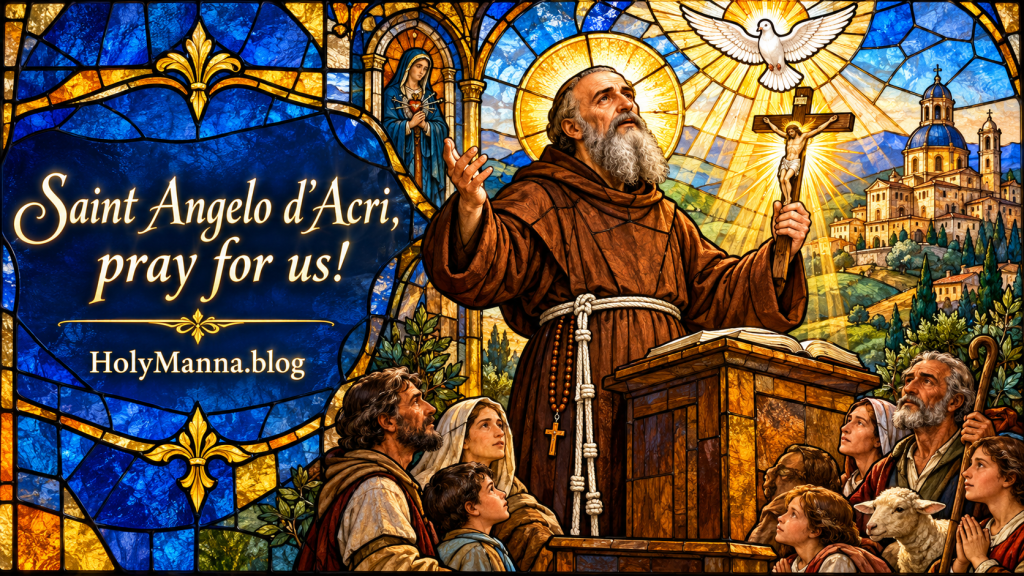
Saint Angelo d’Acri, pray for us!
Follow us on YouTube, TikTok, Instagram and Facebook for more insights and reflections on living a faith-filled life.


Leave a Reply